

Rebuild Confidence After GCSE Engineering Exam
Rebuild confidence after GCSE engineering exam with a calm results-day plan while protecting focus and momentum for your remaining GCSE maths papers.
You leave the exam hall and one question follows you home. Then another. By the evening, the entire paper can feel like evidence that everything went wrong.
If you need to rebuild confidence after GCSE engineering exam disappointment, the immediate answer is this: stop trying to calculate an unknowable grade, record only the useful lessons, and redirect your attention towards what you can still influence. That may be your remaining GCSE maths papers, your wellbeing, or a sensible results-day plan.
A difficult exam is an event. Confidence turns it into an identity only when you keep replaying it.
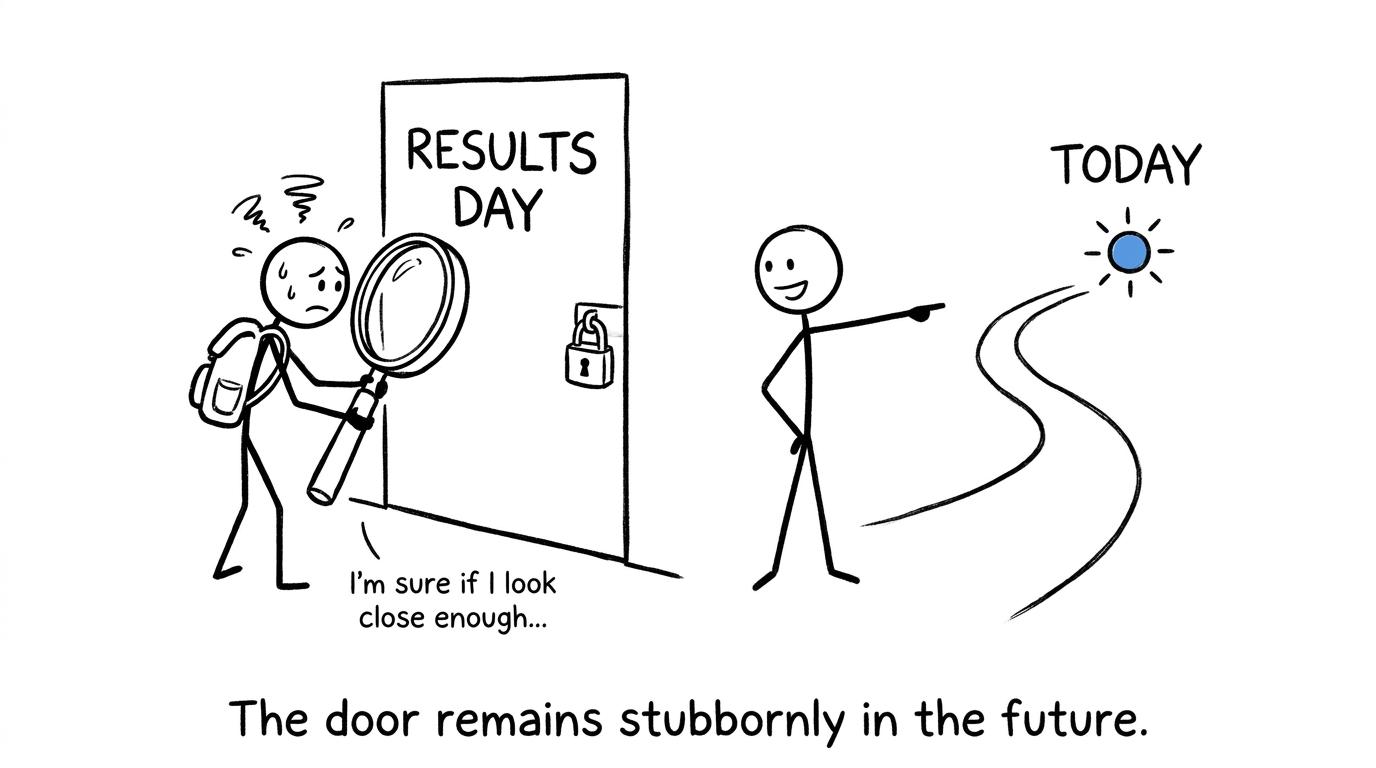 A student discovers that results day remains stubbornly in the future
Your post-exam recovery checklist
Use this as your plan for the hours and weeks after the paper:
- Give yourself one short, deliberate debrief.
- Separate what you know from what you are guessing.
- Confirm your exact qualification and results arrangements with school.
- Protect your preparation for any exams still to come.
- Rebuild momentum through small, measurable maths tasks.
- Keep sleep, movement and social contact in your routine.
- Prepare two or three results-day routes rather than one perfect outcome.
- Ask for help if anxiety begins affecting daily life.
This is not pretending the exam felt fine. It is choosing not to let one finished assessment control the next part of your summer.
Debrief the engineering exam once, not every day
A short debrief can be useful. Endless reconstruction is not.
Set aside about 101010 minutes and divide a page into three headings:
- Facts: what you clearly remember happening.
- Possibilities: what might have gone wrong, but cannot yet be confirmed.
- Actions: anything that can still be done.
A fact might be that you left one part unfinished. A possibility might be that this cost enough marks to change your grade. Those are not the same statement.
If illness, an unexpected event or an examination-room problem affected you, tell your teacher or exams officer promptly. They can explain whether any formal process is relevant. Otherwise, your main action is usually to protect the exams and decisions still ahead.
Avoid comparing reconstructed answers in group chats. Memories are incomplete, different methods can be valid, and nobody in the chat knows the final grade boundaries. Ofqual confirms that grade boundaries are set after students have taken the assessments and evidence about paper difficulty is available. They cannot be predicted reliably from how hard the paper felt.
Understand what one bad paper does and does not mean
First, check exactly which qualification you took. “GCSE Engineering” may refer to a GCSE specification, such as AQA GCSE Engineering, while some schools offer differently structured Level 1/Level 2 technical or vocational engineering qualifications. Assessment components and results arrangements are not identical.
For AQA GCSE Engineering, for example, the written paper contributes 60%60\%60% of the qualification and non-exam assessment contributes 40%40\%40%. That does not tell you what grade you received, but it does show why a disappointing written examination is not automatically the whole story.
More broadly, an exam can feel bad for reasons that are poor predictors of the final result:
- You remember unfinished questions more vividly than completed ones.
- A demanding paper may have felt demanding to many candidates.
- Correct working can earn marks even when a final answer is wrong.
- Your judgement immediately after a stressful event is not a mark scheme.
Do not invent a best-case grade. Do not invent a worst-case grade either. Until results arrive, both are guesses.
Protect the GCSE maths exams you can still influence
Engineering and maths overlap through formulae, ratio, units, scale, graphs, tolerances, area, volume, speed and density. The danger after a difficult engineering paper is not merely feeling disappointed. It is allowing that feeling to consume preparation time for maths.
Open the GCSE Maths revision hub and choose one manageable task matched to your exam board and tier. This might be a short lesson, a small question set or a mini test. The objective is not to prove that you are brilliant at maths. It is to collect evidence that you can still begin, concentrate and improve.
Useful engineering-linked areas include:
- speed and density revision, where formula selection and units matter;
- area and perimeter revision, which supports measurement and design contexts;
- conversions and units practice, where careful reading prevents avoidable errors;
- rearranging harder formulae for students preparing for Higher-tier algebra.
Choose resources for your own level rather than treating this list as a requirement. Foundation and Higher students should follow the content appropriate to their tier.
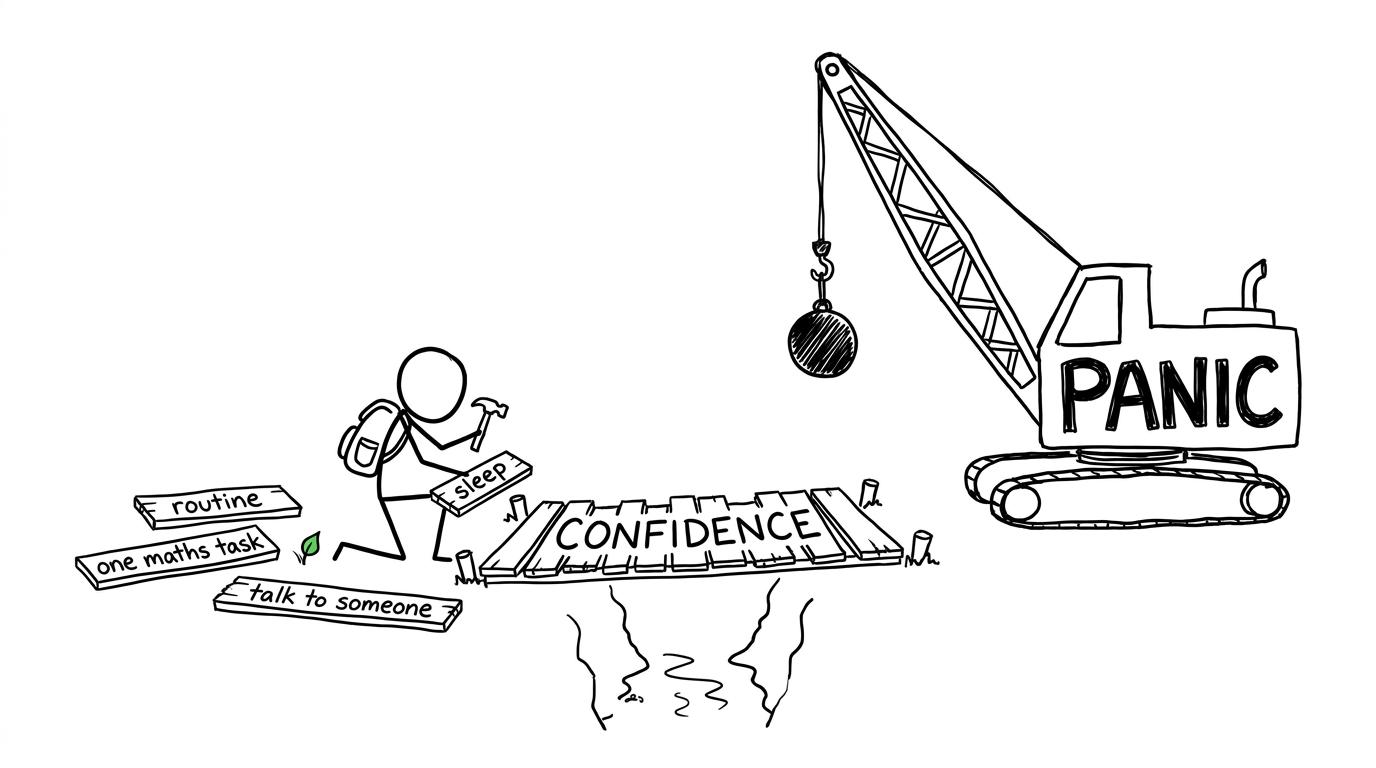 Confidence being repaired with small planks while the panic crane remains unused
Rebuild confidence through evidence
Confidence is often treated as a feeling that must arrive before you act. In revision, it usually works the other way round. Action creates evidence; evidence gradually changes the feeling.
Use a short recovery cycle:
- Choose one precise maths skill.
- Review the method using a revision lesson.
- Complete a small set of practice questions.
- Check the mark scheme or video solution.
- Record one correction.
- Return to the skill on another day.
Keep the first session deliberately modest. A focused 252525-minute block is more useful than planning a heroic afternoon and avoiding it. If you need wider structure, use the GCSE one-month maths revision plan or follow the best order for learning GCSE maths topics.
Measure what you control: sessions completed, errors corrected and questions attempted. Do not measure the day by whether you felt perfectly calm.
Use papers as information, not judgement
When you are ready for mixed practice, select a paper matching your board and tier. The guide to starting GCSE past papers explains how to move from topic work to timed practice without beginning with too much pressure.
After marking, classify each lost mark:
- missing knowledge;
- correct method but inaccurate execution;
- misreading or weak exam technique;
- time pressure.
This makes mistakes specific. “I need to check unit conversions” gives you a next action. “I am terrible at exams” does not.
What to do during the wait for results
The weeks before results day need shape, but they do not need to become an extended exam season.
In the first few days
Finish any remaining examinations and keep your routine stable. Eat regularly, sleep at consistent times, move your body and talk to people who make the situation feel proportionate.
Official health guidance recognises that waiting for results can involve worry, poor sleep and repeated thoughts about expected grades. If those reactions persist or interfere with ordinary life, speak to a parent, carer, teacher, school pastoral lead or GP. Seeking support is a practical response, not an admission of failure.
In the middle weeks
Once examinations are over, take a genuine break. You do not need to revise engineering answers that can no longer be changed.
If you want to keep maths active before sixth form, college or a possible resit, use light maintenance rather than full exam intensity. One or two short sessions each week might include a familiar topic, a mini test or selected questions. Students planning A Level Maths can also revisit algebra gradually, but should wait for confirmed course requirements before assuming a particular route.
In the final week before results
Replace vague worry with preparation. Write down:
- when and where your results will be available;
- who you can contact at school or college;
- your preferred next step;
- one acceptable alternative;
- the entry requirements you need to check.
For the summer 2026 series, GCSE results are released to candidates on Thursday 20 August 2026. Level 1 and Level 2 vocational or technical results used for progression are released on or before the corresponding results day, depending on the awarding organisation. Confirm the arrangements for your qualification with your school rather than assuming every engineering course follows the same timetable.
Plan for results day without predicting the result
A plan is useful because it works across several outcomes.
If your result meets your requirement, confirm the next step with your school, college or training provider. If it is lower than expected, speak to staff before deciding what it means. Entry decisions may consider the complete set of results and the requirements of the course.
If the mark looks surprising, ask whether accessing the script or considering a review of marking would be appropriate. For most students, requests are made through the school or college and require consent. A review checks whether marking was completed correctly; it is not a request for extra marks because a candidate was close to a boundary. Depending on the qualification and service, a mark can remain unchanged, rise or fall.
Do not wait until the final deadline to raise a concern. Schools need time to examine the evidence and follow the relevant awarding organisation's process.
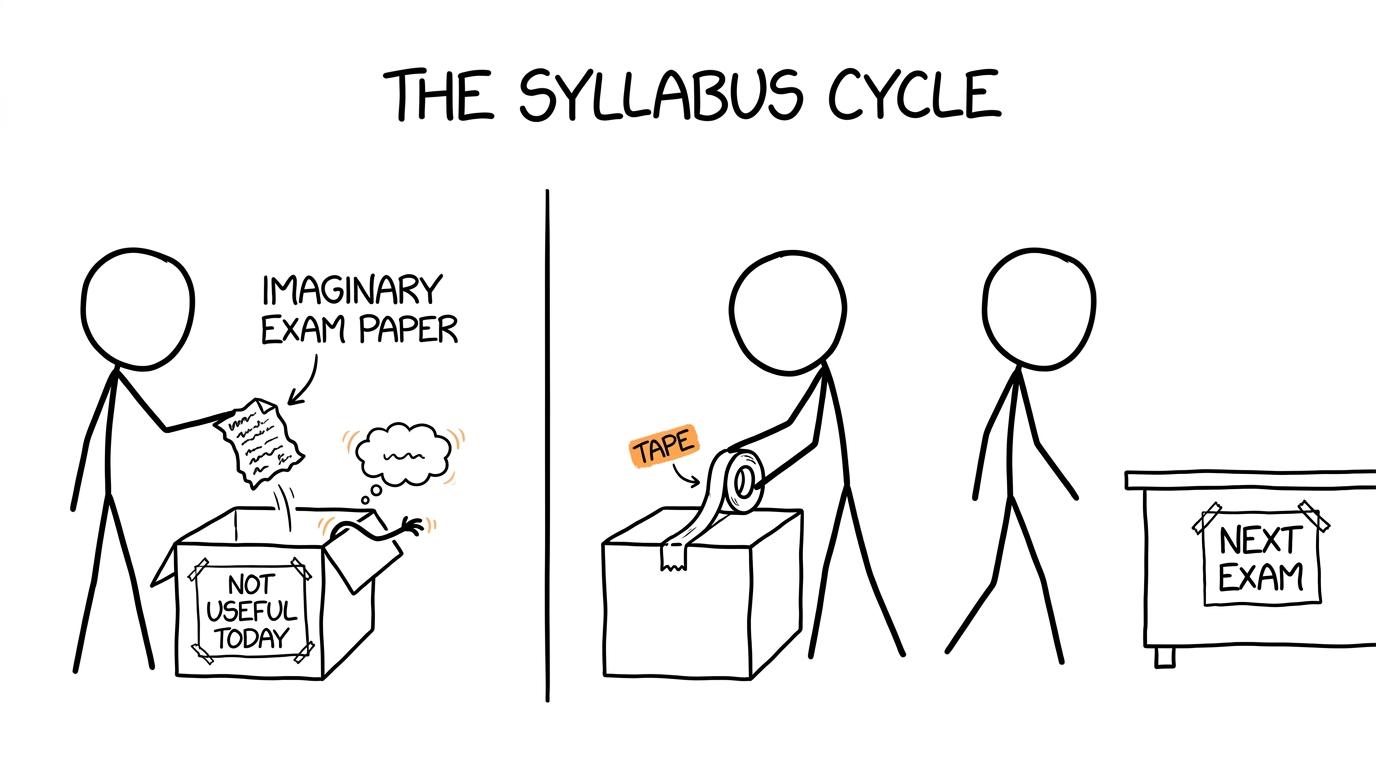 A student files away an imaginary exam paper and turns towards the next task
Common mistakes after a bad GCSE Engineering exam
Reconstructing every answer
This feels productive because it resembles analysis. Usually, it creates new uncertainty from incomplete memories. Debrief once, then stop.
Treating the feeling as the result
“How it felt” and “how it was marked” are different things. Wait for the actual evidence.
Searching for predicted grade boundaries
Grade boundaries are not fixed in advance. Online guesses cannot account reliably for completed marking, paper difficulty and the awarding process.
Abandoning remaining maths revision
One finished paper should not take marks from a future paper. Resume with a short task, not an exhausting catch-up session.
Comparing yourself with confident classmates
Post-exam confidence can reflect personality, memory or willingness to talk. It is not a verified score.
Having only one acceptable results-day outcome
A first choice matters, but alternatives reduce panic and improve decision-making. An alternative route is not the same as giving up.
Move forward with MathsGenie
You cannot reopen the engineering paper. You can decide what receives your attention next.
Start with one task in the MathsGenie GCSE revision hub. Use revision lessons to restore a method, practice questions to make it reliable, and mini tests to collect evidence of progress. Then move towards past papers, mark schemes and video solutions. If you study Edexcel, GCSE Maths predicted papers can provide additional timed practice once your topic knowledge is secure.
Confidence rarely returns through one dramatic breakthrough. It comes back quietly: one completed session, one corrected mistake and one sensible decision at a time.










