Real Life Maths GCSE: Money, Time and Best Buys
Real life maths GCSE made clearer. Learn to solve multi-step bills, timetable and best-buy questions with organised working and exam-ready checks for resits.
A bill lands on the desk. A timetable has three different times. Two packets claim to offer better value. None of the arithmetic looks especially frightening, yet it can be difficult to know where to begin.
That is the real challenge of real life maths GCSE questions. You must turn a practical situation into a sequence of calculations, keep track of units and decide what the final answer means. For resit students, the most reliable approach is simple: identify the goal, write one calculation per line, include units and check that the answer is realistic.
These questions matter because GCSE Maths includes the use of standard units of time, money and other measures. They can appear on foundation or higher tier papers, often as multi-step problems rather than isolated calculations.
A checklist for real-life maths questions
Before reaching for the calculator, use this short routine:
- Underline what the question wants you to find.
- Circle the figures and units you need.
- Cross out information that is irrelevant.
- Decide which calculation must happen first.
- Write one step on each line.
- Keep extra calculator digits until the end.
- Add the correct unit to the final answer.
- Read the answer back in the context of the question.
The last point is easily overlooked. A calculator can confirm that your arithmetic is correct, but it cannot tell you whether you calculated the cost per item when the question asked for the total bill.
If the opening calculations still feel uncertain, the free Edexcel GCSE Maths revision topics provide a useful route through the underlying skills by grade.
How to lay out multi-step working
Good working is not about making a page look formal. It reduces the amount your memory must hold at once.
A clear layout normally follows this pattern:
Step 1: find the first required amount\text{Step 1: find the first required amount}Step 1: find the first required amount Step 2: use that amount in the next calculation\text{Step 2: use that amount in the next calculation}Step 2: use that amount in the next calculation Step 3: round if required and state the unit\text{Step 3: round if required and state the unit}Step 3: round if required and state the unitAvoid compressing several unrelated operations into one long calculator entry. If one number is entered incorrectly, it becomes difficult to find the mistake. Separate lines also make your method visible to the examiner, which can help you earn method marks even when the final answer is wrong.
Money problems GCSE students should recognise
Money questions may involve wages, shopping, household bills, discounts, tariffs, tax or change. Their surface details vary, but the structure is often the same: calculate separate amounts, combine them and round sensibly.
Worked example: calculating a bill
A fictional energy bill covers 303030 days. The standing charge is 53p53\text{p}53p per day, energy use is 184 kWh184\text{ kWh}184 kWh at 24.6p24.6\text{p}24.6p per kWh\text{kWh}kWh, and the question tells you to add 5%5\%5% to the subtotal.
First calculate the standing charge:
30×£0.53=£15.9030 \times \pounds 0.53 = \pounds 15.9030×£0.53=£15.90Then calculate the usage charge:
184×£0.246=£45.264184 \times \pounds 0.246 = \pounds 45.264184×£0.246=£45.264Add the two parts before rounding:
£15.90+£45.264=£61.164\pounds 15.90 + \pounds 45.264 = \pounds 61.164£15.90+£45.264=£61.164Find the additional 5%5\%5%:
0.05×£61.164=£3.05820.05 \times \pounds 61.164 = \pounds 3.05820.05×£61.164=£3.0582Now find the total:
£61.164+£3.0582=£64.2222\pounds 61.164 + \pounds 3.0582 = \pounds 64.2222£61.164+£3.0582=£64.2222Money is given to the nearest penny, so the final answer is:
£64.22\boxed{\pounds 64.22}£64.22Notice the order. Each part of the bill was calculated separately, the percentage was applied to the correct subtotal, and rounding happened only at the end. Rounding every intermediate result can create a small but avoidable error.
Time questions maths papers often include
Time questions may ask for a duration, departure time, arrival time or waiting time. Timetables add another demand: you must select the correct row or column before calculating.
The awkward feature of time is that it does not behave like ordinary decimal notation. One hour contains 606060 minutes, so 111 hour 303030 minutes is 1.51.51.5 hours, not 1.301.301.30 hours.
The GCSE time revision lesson is a useful starting point if converting between hours and minutes is slowing down your problem solving.
Worked example: reading a timetable
A traveller leaves at 09:4709{:}4709:47 and arrives at a station at 11:1811{:}1811:18. Their connecting service leaves at 11:3611{:}3611:36 and takes 111 hour 242424 minutes.
Find the first journey time by splitting at a convenient hour:
09:47 to 10:00=13 minutes09{:}47 \text{ to } 10{:}00 = 13\text{ minutes}09:47 to 10:00=13 minutes 10:00 to 11:00=60 minutes10{:}00 \text{ to } 11{:}00 = 60\text{ minutes}10:00 to 11:00=60 minutes 11:00 to 11:18=18 minutes11{:}00 \text{ to } 11{:}18 = 18\text{ minutes}11:00 to 11:18=18 minutesTherefore:
13+60+18=91 minutes13 + 60 + 18 = 91\text{ minutes}13+60+18=91 minutesThis is 111 hour 313131 minutes.
The waiting time is:
11:36−11:18=18 minutes11{:}36 - 11{:}18 = 18\text{ minutes}11:36−11:18=18 minutesAdd 111 hour 242424 minutes to the second departure time:
11:36+1 hour=12:3611{:}36 + 1\text{ hour} = 12{:}3611:36+1 hour=12:36 12:36+24 minutes=13:0012{:}36 + 24\text{ minutes} = 13{:}0012:36+24 minutes=13:00The traveller arrives at 13:0013{:}0013:00. Their total elapsed time from 09:4709{:}4709:47 is:
3 hours 13 minutes3\text{ hours }13\text{ minutes}3 hours 13 minutesA timeline can make this much clearer. Mark departures, arrivals and waits separately rather than attempting everything mentally.
Best-buy questions and fair comparisons
A best buy is not necessarily the cheapest packet. It is the option offering the lowest cost for the same quantity. To compare fairly, convert each option to a common unit, such as cost per kilogram, cost per litre or cost per item.
The full best-buy questions revision page brings lessons and exam-style practice together. You can also revisit the method through the best-buy revision lesson.
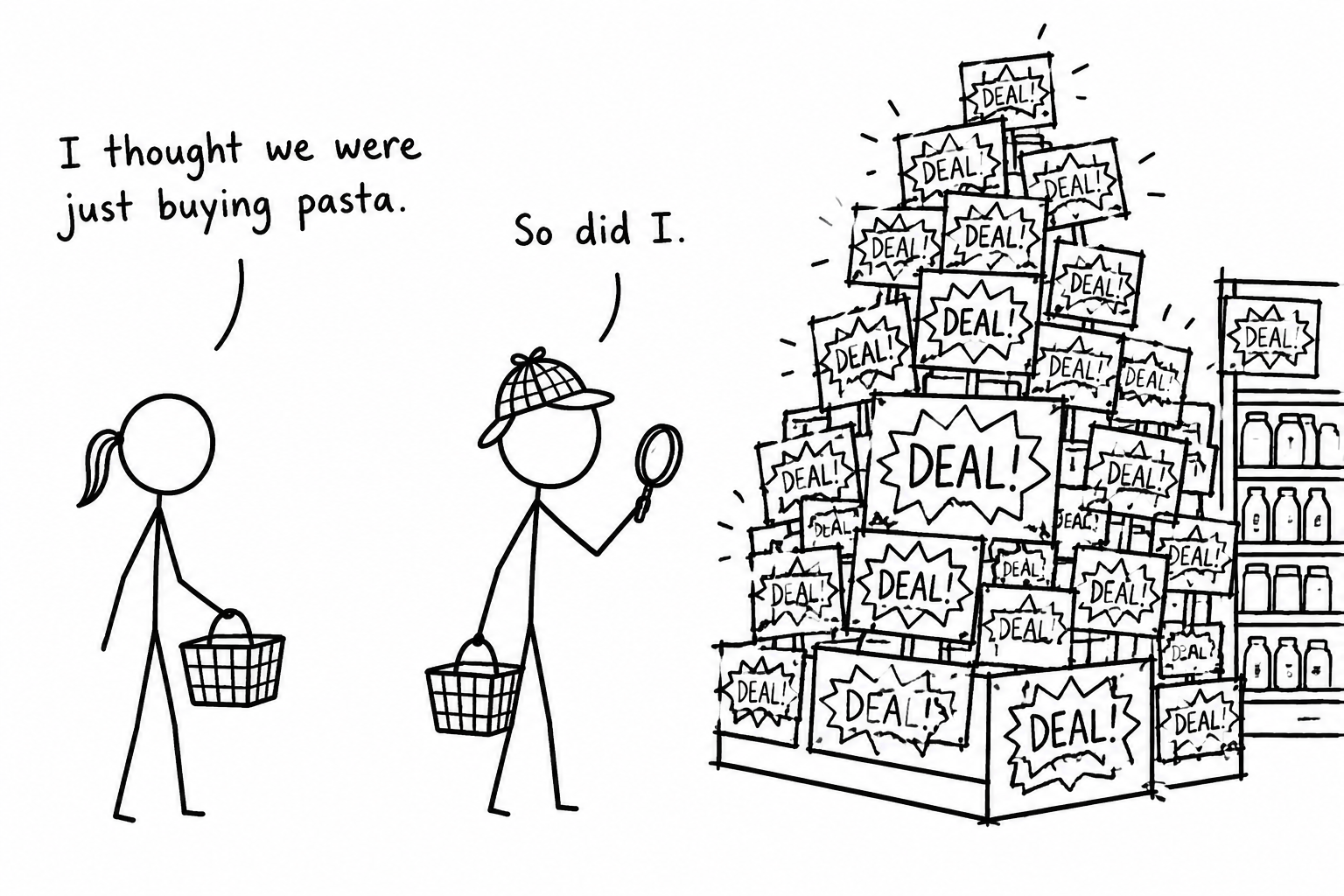 A student becomes a supermarket deal detective while shopping for pasta
Worked example: cost per kilogram
Packet A contains 750 g750\text{ g}750 g and costs £2.70\pounds 2.70£2.70. Packet B contains 1.2 kg1.2\text{ kg}1.2 kg and costs £4.08\pounds 4.08£4.08.
Convert Packet A to a cost per kilogram. Since 750 g=0.75 kg750\text{ g}=0.75\text{ kg}750 g=0.75 kg:
£2.70÷0.75=£3.60 per kg\pounds 2.70 \div 0.75 = \pounds 3.60\text{ per kg}£2.70÷0.75=£3.60 per kgFor Packet B:
£4.08÷1.2=£3.40 per kg\pounds 4.08 \div 1.2 = \pounds 3.40\text{ per kg}£4.08÷1.2=£3.40 per kgPacket B is the best buy because £3.40\pounds 3.40£3.40 per kilogram is less than £3.60\pounds 3.60£3.60 per kilogram.
An equally valid method would find the cost per gram, provided both packets are compared using the same unit. The conclusion should name the option and explain why it offers better value.
To practise laying out the comparison yourself, use the Edexcel best-buy question booklet. Students following other specifications can use the AQA best-buy exam-style questions or the OCR best-buy revision guide.
Common mistakes in real-life maths GCSE questions
Answering an intermediate question
You might correctly calculate a daily cost and forget that the question asks for the monthly total. After every calculation, ask: is this the requested answer, or just a value I still need to use?
Mixing units
Do not compare grams directly with kilograms or pence directly with pounds. Convert first:
1000 g=1 kg1000\text{ g}=1\text{ kg}1000 g=1 kg 100p=£1100\text{p}=\pounds 1100p=£1Treating time as a decimal
From 14:4514{:}4514:45 to 15:1515{:}1515:15 is 303030 minutes, not 0.700.700.70 hours. Count through the hour or convert both times into minutes.
Rounding too early
Keep the full calculator value during intermediate steps. Round money to the nearest penny only when the calculation is complete, unless the question gives different instructions.
Choosing the lowest displayed price
A smaller packet may cost less but offer worse value. Best-buy decisions require a common quantity, not a glance at the price label.
Giving a number without context
Write the unit and, where needed, a short conclusion such as “Packet B is the best buy.” This shows that you have interpreted the result.
Turn practical questions into reliable marks
Real-life problems become manageable when you stop treating them as one large puzzle. Bills are separate charges joined together. Timetables are intervals placed in order. Best buys are fair comparisons using a common unit.
For resit revision, learn one method and then practise it under gentle time pressure. Use MathsGenie's free revision lessons and practice questions first, check the mark schemes and video solutions, then return to the question without help. Short GCSE Maths mini tests can reveal whether the method still works when the wording changes.
As confidence grows, add past papers and predicted papers to your revision planner. The aim is not to memorise every possible bill or timetable. It is to build a process strong enough to handle an unfamiliar one. Start with the MathsGenie GCSE revision resources and turn each careful line of working into a better chance of earning the marks available.