

Ready for GCSE Astronomy Early Sitting? Checklist
Ready for GCSE Astronomy early sitting? Check your knowledge, observations, maths fluency, past-paper performance and exam stamina before entering.
Being fascinated by black holes is not the same as being ready for an examination about them. Curiosity can start the journey, but evidence must decide when you sit the paper.
If you are asking whether you are ready for GCSE Astronomy early sitting, the short answer is this: you should enter early only when you have covered the full Pearson Edexcel specification, completed the required observations, demonstrated secure performance on unseen papers and shown that the extra qualification will not weaken your main GCSE preparation.
The important word is not early. It is ready.
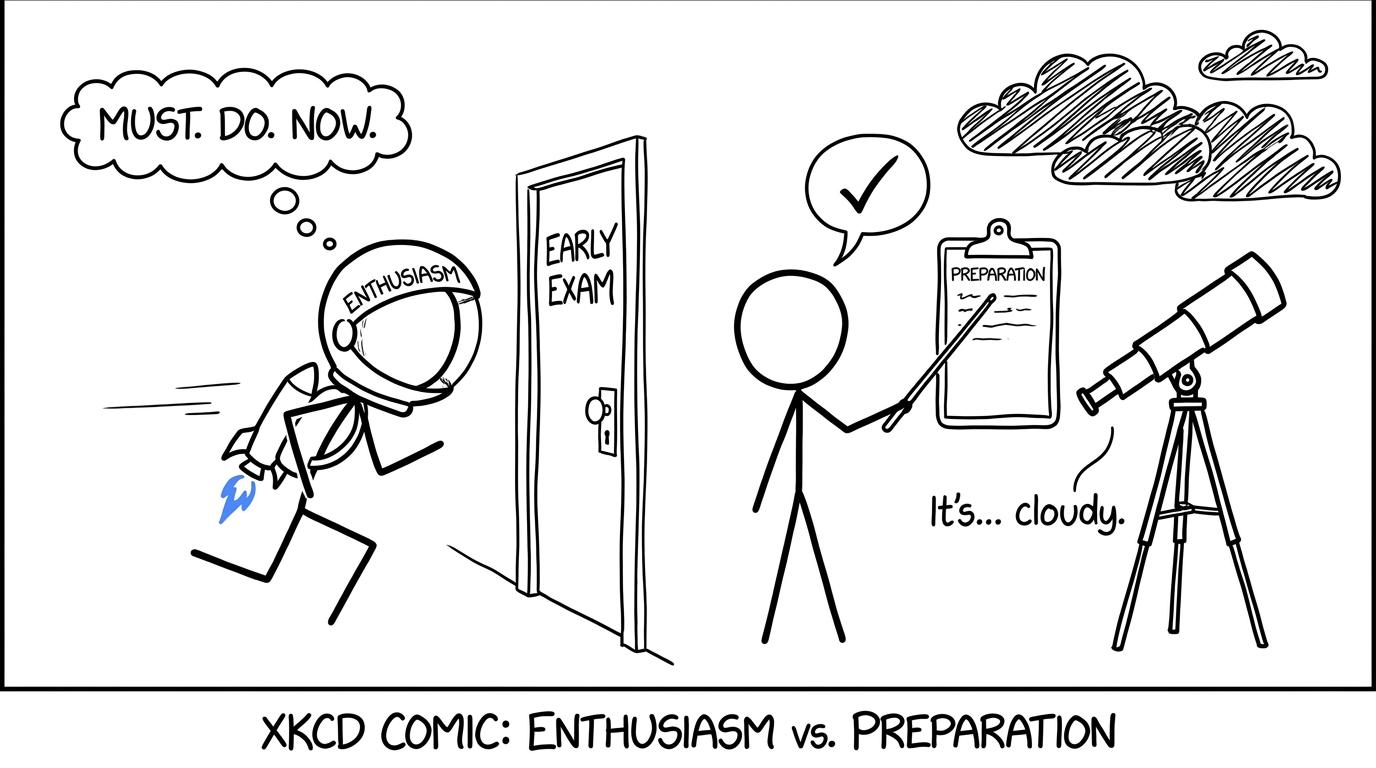 A keen student races towards an early exam while a teacher points to the preparation checklist
Your early-entry readiness checklist
Before agreeing to an early sitting, you should be able to answer yes to most of these questions:
- Have you covered every section of the current GCSE Astronomy specification?
- Can you recall and apply ideas rather than simply recognise your notes?
- Have you completed at least one unaided and one aided observation?
- Can your school or exam centre confirm that the observational requirement has been met?
- Have you completed both papers under the correct timed conditions?
- Are your results consistent across several unseen papers?
- Can you handle calculations, graphs, units and extended written explanations?
- Do you understand command words such as describe, explain, calculate and evaluate?
- Can you maintain your performance when the paper includes an unfamiliar context?
- Will preparing early leave enough time for GCSE maths, English, science and your other subjects?
One weak answer does not automatically mean you must wait. Several weak answers usually mean enthusiasm is running ahead of preparation.
Understand the qualification you are entering
The current GCSE Astronomy qualification is Pearson Edexcel GCSE Astronomy, specification 1AS01\mathrm{AS}01AS0. It is not offered by AQA, OCR or Eduqas, and it does not have foundation and higher tiers. That is different from GCSE maths, where your board and tier affect the questions and available grades.
The Astronomy GCSE has two externally examined papers:
| Paper | Main content | Time | Marks | Weighting |
|---|---|---|---|---|
| Paper 111 | Naked-eye Astronomy | 111 hour 454545 minutes | 100100100 | 50%50\%50% |
| Paper 222 | Telescopic Astronomy | 111 hour 454545 minutes | 100100100 | 50%50\%50% |
Both papers must be taken in the same May or June examination series. Questions can include multiple-choice items, short answers, calculations, graphs and extended responses. Calculators are permitted.
An early sitting therefore does not mean taking a smaller version of the qualification. You face the same specification, papers and assessment standard as every other candidate.
You have finished the specification, not merely your favourite topics
A keen student may know a great deal about galaxies, stellar evolution or planetary exploration. The examination, however, can move from the Earth-Moon-Sun system to coordinate systems, telescopes, astronomical observation and cosmology without asking which areas you prefer.
Genuine readiness means you can explain and apply material across all 161616 specification topics. Use the official Pearson specification as your master checklist and label each statement:
- Secure: you can answer an unfamiliar question without help.
- Developing: you understand the idea but still need prompts.
- Uncovered: you have not learnt it properly yet.
Do not count a topic as secure because you have watched a video or highlighted a page. Recognition feels comfortable, but an examination requires retrieval. Close the notes, explain the idea, answer questions and check the result.
The same principle strengthens ordinary GCSE preparation. MathsGenie's guide to GCSE maths topics by exam board and tier can help you audit the mathematical skills surrounding your Astronomy revision without confusing the two specifications.
Your observational work is complete and properly arranged
Every candidate must complete at least one unaided observation and one aided observation during the course. These are mandatory requirements, not optional enrichment activities to complete if the weather behaves.
An observation involves more than looking through a telescope. You need to understand how to plan, carry out, record, analyse and evaluate astronomical observations. Limitations matter too: cloud, light pollution, equipment, timing and the observer's method can all affect the quality of evidence.
Your centre must confirm completion through Pearson's required process for the relevant examination series. Deadlines and administrative arrangements can change, so your teacher or exams officer should check the current Pearson instructions rather than relying on an old course guide.
If you are entering as a private candidate, contact an approved centre well in advance. Awarding organisations do not accept private entries directly, not every centre accepts private candidates, and a centre must be willing to handle the Astronomy observation requirement. Finding somewhere that will host the written papers is not enough.
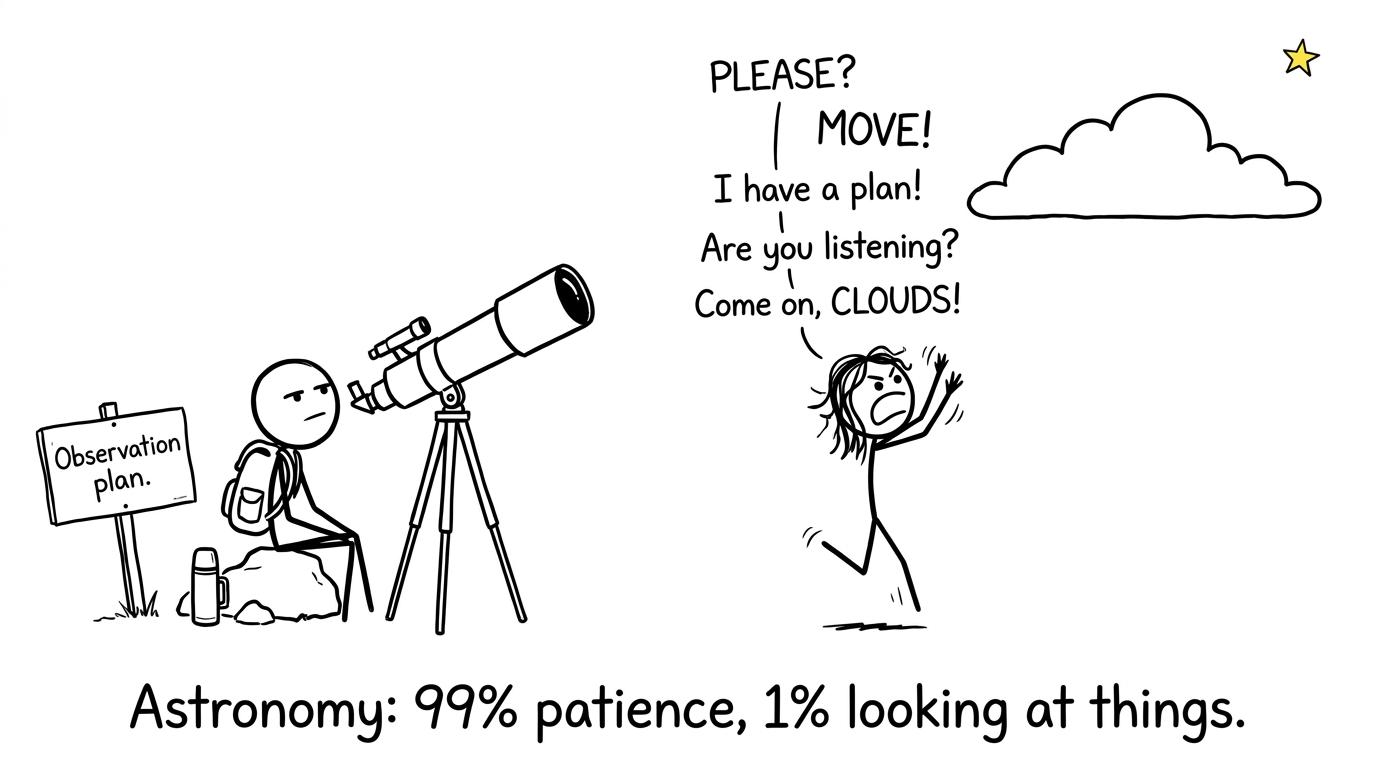 Two students discover that clouds do not follow the observation plan
Your maths works when it is hidden inside astronomy
GCSE Astronomy is not GCSE maths in a spacesuit. Yet weak mathematical foundations can quietly remove marks from otherwise sound astronomical understanding.
You should be comfortable with:
- substituting into equations;
- rearranging straightforward formulae;
- standard form and powers of 101010;
- ratios, scale and proportional reasoning;
- angles and geometrical interpretation;
- reading, plotting and interpreting graphs;
- unit conversions;
- significant figures and sensible rounding;
- using a calculator accurately;
- checking whether an answer is physically reasonable.
The best test is transfer. Can you select the correct mathematics when the question is written in an astronomical context, rather than when the worksheet tells you which method to use?
Use MathsGenie's SOHCAHTOA revision guide if angular problems expose uncertainty. For very large and small quantities, focused standard-form revision and practice can strengthen the underlying skill, although you should select resources matching your own maths board where possible.
This matters beyond Astronomy. If early preparation is consuming time needed to secure core GCSE maths skills, that is evidence to reconsider the timing.
Your past-paper results are consistent, timed and honest
One high mark on a familiar paper proves less than students often hope. You may remember questions, recognise mark-scheme wording or perform unusually well because the paper favours your strongest topics.
A stronger readiness test uses several unseen papers or secure mock papers. Complete them:
- in a quiet room;
- within 111 hour 454545 minutes;
- without notes or internet searches;
- with only permitted equipment;
- in one uninterrupted sitting;
- using the published mark scheme strictly afterwards.
Do not rely on a universal percentage to declare yourself ready. Grade boundaries vary between examination series, and the right target depends on the grade you need. Instead, compare your raw marks with the official boundaries for that exact paper and ask a teacher to review your extended responses.
Look for stability. If your performance collapses whenever a less familiar topic appears, you are not yet secure across the course. If mistakes are mainly isolated slips and you can explain how to correct them, early entry becomes more credible.
MathsGenie's advice on redoing past papers effectively explains why diagnosis should come before repetition. Although the examples focus on maths revision, the paper-mark-repair-retest cycle transfers well to Astronomy.
You can write explanations as well as remember facts
Astronomy rewards accurate scientific communication. Knowing that something happens is different from explaining why it happens.
Check whether you can:
- build a logical chain of reasoning;
- use precise astronomical vocabulary;
- distinguish observation from interpretation;
- relate evidence to a conclusion;
- evaluate a method using specific limitations;
- answer the command word actually given;
- show mathematical working and include appropriate units.
Ask a teacher to mark a sample of extended responses. Self-marking is useful for calculations, but written explanations are easier to over-credit. A response may sound knowledgeable while missing the particular causal link required by the mark scheme.
Early entry will not damage your wider GCSE preparation
Readiness is partly academic and partly practical. You may be capable of passing Astronomy while still making an unwise timetable decision.
Map the preparation against your other commitments. Include observation sessions, full papers, corrections and final revision. Then ask what gets displaced. If Astronomy repeatedly replaces maths practice, science consolidation or sleep, the cost may exceed the benefit of finishing early.
A realistic plan should survive an ordinary school week, not just an unusually motivated weekend. MathsGenie's one-month GCSE maths revision plan offers a useful model for balancing retrieval, topic work and timed papers. You can also use predicted-topic revision advice to avoid gambling your preparation on favourite areas.
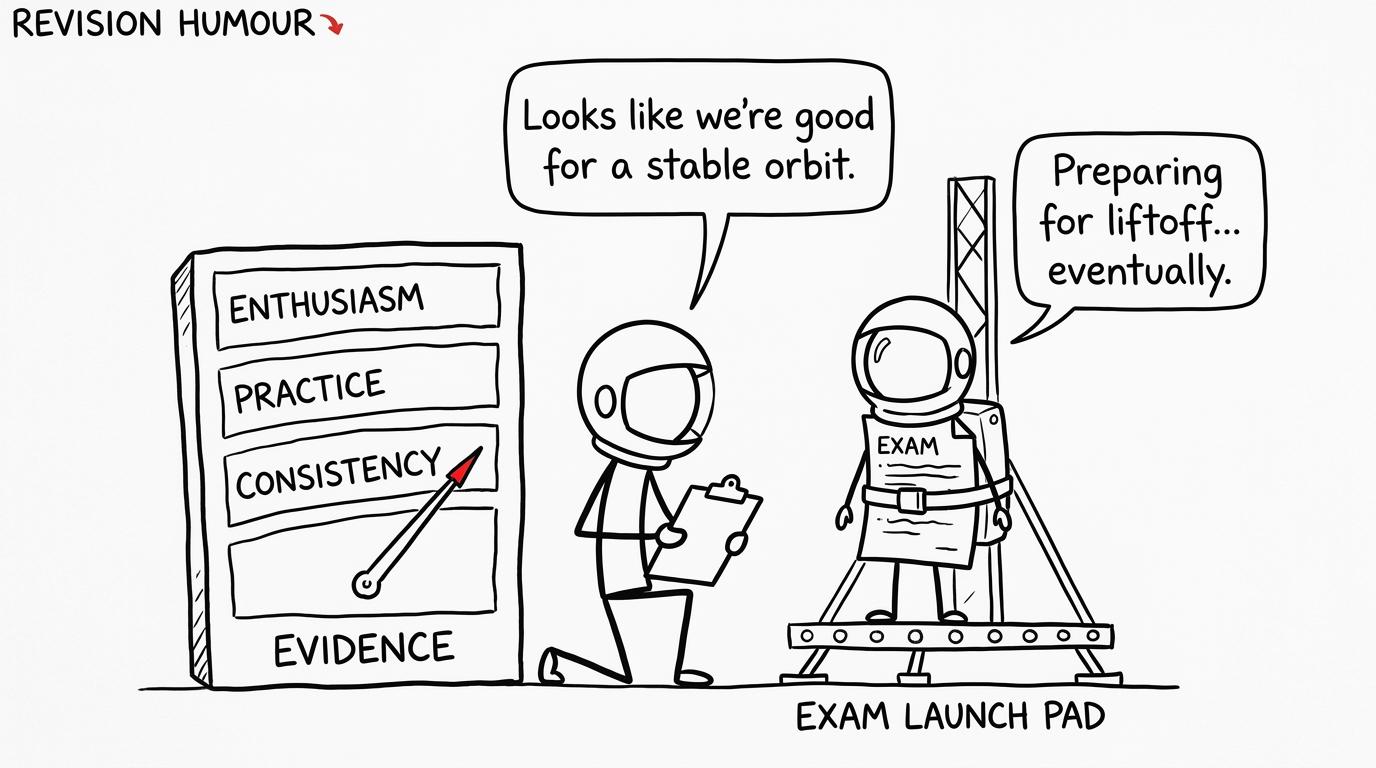 An exam paper waits on a launch pad while the evidence gauge approaches consistency
Signs that you are keen but not yet ready
Enthusiasm is valuable, but these warning signs suggest that waiting may produce a stronger result:
- You have read widely about space but cannot map your knowledge to the specification.
- You avoid Paper 111 or Paper 222 because one feels less interesting.
- Your observation tasks are incomplete or the centre arrangements are uncertain.
- You have never sat both full papers under timed conditions.
- Your marks depend heavily on familiar questions.
- You know facts but struggle with calculations or extended explanations.
- You are entering early mainly to prove that you can.
- Your teacher's evidence conflicts with your own impression of readiness.
- Astronomy revision is reducing performance in core GCSE subjects.
Waiting is not failure. Sometimes the most ambitious choice is giving knowledge enough time to become reliable.
Common mistakes when deciding on an early sitting
Treating interest as examination evidence
Enjoying documentaries, telescope sessions or astronomy books creates useful background knowledge. It does not demonstrate complete specification coverage or exam technique.
Using only topic questions
Topic practice tells you what method is needed. Mixed papers test whether you can identify it independently. You need both.
Memorising mark schemes
Repeated wording can create inflated scores. Use fresh material and explain answers in your own precise language.
Ignoring observations until the end
Weather and equipment access are not fully controllable. Plan mandatory observations early and keep your centre informed.
Chasing predicted questions
Predictions can provide extra practice, but they cannot replace full-course revision. The same is true in maths: Edexcel GCSE maths predicted papers are most useful after topic learning and official past-paper practice.
Making the decision alone
Discuss the entry with your Astronomy teacher, exams officer and parent or carer. They can challenge blind spots and confirm whether the administrative arrangements are actually possible.
Make the decision from evidence
The strongest sign that you are ready for an early GCSE Astronomy sitting is not excitement or speed. It is repeatability: complete knowledge, finished observations, secure maths, consistent timed-paper performance and enough capacity to protect your other subjects.
Ask your teacher to review the evidence, confirm the current Pearson requirements and set a final mock using unseen material. If the evidence says wait, use the extra time well. If it says proceed, enter with confidence grounded in preparation.
For the mathematical skills supporting Astronomy and your wider GCSEs, make MathsGenie your free revision base. Use revision lessons to repair gaps, practice questions and mini tests to build fluency, then past papers, predicted papers, mark schemes and video solutions to test whether your methods still work under pressure.










