Read the GCSE Chemistry Specification: Is It Worth It?
Read GCSE Chemistry specification documents strategically to find exact content, practical requirements and maths skills without wasting revision time.
A revision guide is designed to feel helpful. The official specification is designed to be exact. That difference matters.
If you plan to read GCSE Chemistry specification documents from beginning to end, the short answer is: it is worth looking at the correct specification, but rarely worth treating it like a textbook. Its greatest value is not explanation. It is certainty.
The specification tells you what can be assessed, which mathematical skills are expected, how practical work connects to written questions and where the boundaries of the course lie. A revision guide explains those ideas more clearly, while lessons and exam questions teach you how to use them.
The best approach is therefore to use the specification as a map, not as your entire journey.
The short checklist
Before opening a specification, make sure you:
- identify your exam board: Edexcel, AQA, OCR or Eduqas;
- check whether you take separate Chemistry or Combined Science;
- select the correct tier where your qualification has tiered papers;
- use the latest version published by your exam board;
- turn content statements into a revision checklist;
- mark mathematical skills and practical requirements separately;
- use revision lessons and exam questions to learn each listed topic;
- confirm temporary arrangements, such as equation support, using current exam-board guidance.
That final point matters because specifications are relatively stable, while exam arrangements can change. The document itself normally shows a version number or issue date. Always check that you have the current document for the examination series you will sit.
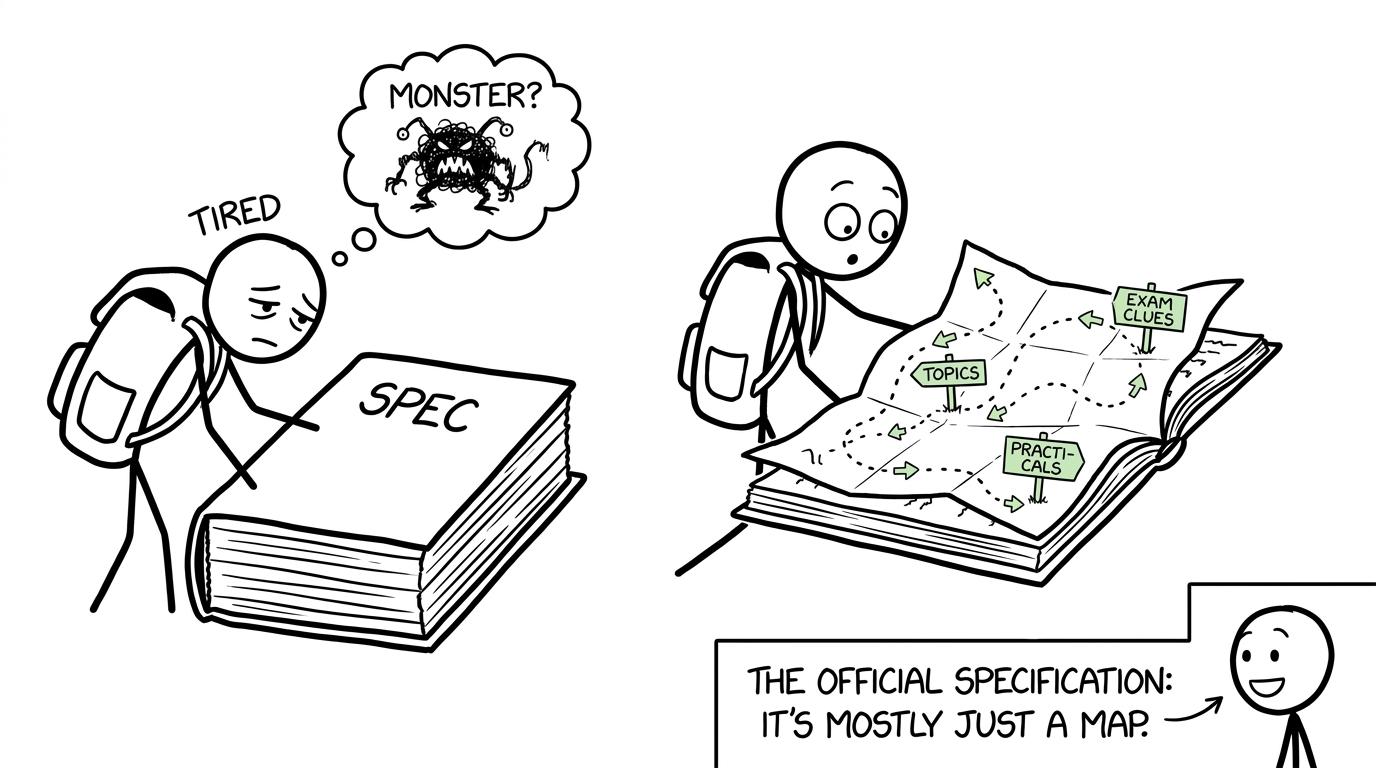 A student discovers that the specification is a treasure map rather than a monster
What you gain from reading the official document
You see the boundary of the course
Revision guides have to make editorial choices. They may add background explanation, rearrange topics or include extension material to make an idea understandable. Usually, that is useful. But it can leave you wondering whether every paragraph must be memorised.
The specification answers a narrower question: what knowledge, understanding and skills belong to this qualification?
Its content statements help you distinguish between three things:
- material you are required to know;
- supporting explanation added by a teacher or guide;
- ideas that sit beyond the assessed course.
This does not mean that every exam question repeats a specification sentence. Questions can combine topics, place familiar science in an unfamiliar context and test whether you can apply what you know. The specification defines the ingredients, not every possible recipe.
You can find small topics that guides make easy to overlook
Large topics attract attention because they fill chapters. Small requirements are easier to miss: interpreting a particular graph, explaining a practical decision, using significant figures appropriately or recalling the meaning of a technical term.
A careful scan can expose these quiet gaps. They may represent only one line in the document, but one line can still support several styles of exam question.
This is where the specification becomes especially valuable near the end of revision. When you already understand most of the course, improvement often comes from finding omissions rather than rereading your strongest chapters.
You understand the role of practical work
Required or specified practical activities are not simply classroom memories to file away. Written papers can assess your understanding of practical methods, variables, measurements, hazards, data, accuracy and evaluation.
The wording and organisation differ between exam boards, so use the practical requirements for your exact qualification. Ask yourself whether you can:
- identify independent, dependent and control variables;
- describe suitable apparatus and measurements;
- recognise sources of uncertainty or error;
- interpret results and spot anomalies;
- suggest realistic improvements;
- connect observations to chemical ideas.
A guide may teach these skills more accessibly. The specification helps you check that none has disappeared from your revision plan.
You notice how much maths chemistry contains
GCSE Chemistry is not a maths paper wearing a lab coat, but mathematical fluency matters. Official subject requirements include quantitative skills, and exam-board specifications show where those skills enter the chemistry course. The exact assessment arrangements depend on the qualification, so consult your own board rather than assuming that another student's document is interchangeable.
Common demands include:
- ratios and proportional reasoning;
- percentages and percentage change;
- rearranging relationships;
- substituting values accurately;
- converting units;
- interpreting tables and graphs;
- using standard form;
- selecting appropriate significant figures;
- calculating means and rates.
For many students, the chemistry idea is not the only obstacle. The method may be understood, yet a unit conversion or ratio causes the mark to slip away.
MathsGenie's free GCSE maths revision programme lets you revisit these underlying skills by grade. In particular, the lessons on ratio, percentages, standard form and conversion graphs can strengthen techniques that appear across both subjects.
 A beaker and calculator debate who worked harder in the exam
What the specification does not give you
Precision is useful, but it is not the same as teaching.
A specification may state that you need to calculate or explain something without showing the reasoning that makes the skill understandable. It will not usually provide the sequence of carefully chosen questions needed to make a method automatic. Nor will it necessarily show how students commonly lose marks.
It cannot replace:
- clear explanations from lessons or a trusted guide;
- active recall of facts and definitions;
- practice questions organised by topic;
- full papers completed under timed conditions;
- mark-scheme analysis;
- feedback on misconceptions.
This is why reading the document alone can create false confidence. A highlighted statement feels familiar, but familiarity is not the same as being able to answer an unfamiliar question.
The same principle applies in maths. Reading that you must be able to use proportional reasoning does not prove that you can do it under pressure. That is why MathsGenie combines revision materials with GCSE past papers, answers and video solutions.
How to read the GCSE Chemistry specification efficiently
Begin with the identity of the qualification
Check the board, qualification title and code on information supplied by your school. Separate Chemistry and Combined Science are different qualifications, even where much of their content overlaps. Do not build a checklist from a document found through a vague search result.
Check the issue date as well. If your saved copy and the exam board's current page differ, use the current official version and ask your teacher about any changes that affect your class.
Scan the assessment structure before the content
Find out how the qualification is organised. Look for the number of papers, the content allocated to each paper, question types, tier information and any stated assessment objectives.
This helps you interpret the rest of the document. A topic list without the paper structure is like having destinations without knowing which train reaches them.
Do not assume that rules from one board apply to another. Edexcel, AQA, OCR and Eduqas cover nationally required subject content, but they can organise and assess it differently.
Convert statements into three categories
Use a simple system:
- Secure: you can explain the idea and answer exam questions without support.
- Developing: you recognise it but make errors or need prompts.
- Not revised: you have not yet tested it properly.
Base the category on evidence, not mood. A topic becomes secure through successful retrieval and question practice, not because its heading looks familiar.
Then prioritise the developing and not-revised areas. This turns a long official document into a practical plan rather than another object on your desk.
Create a separate maths-skills list
When a content statement involves calculation, graph interpretation, units or data, mark it with a consistent symbol. Gather those requirements into one list and connect each weakness to a maths revision topic.
For example, difficulty with rates may reveal a broader weakness in proportion or graph gradients. Weakness with concentration calculations may come partly from rearrangement or unit handling. The chemical context changes, but the underlying mathematical habits remain surprisingly stable.
If algebra is the sticking point, MathsGenie's solving equations resources can help you practise the structure separately before returning to chemistry questions.
Test the checklist against questions
Once you have identified a statement, move quickly to retrieval or exam practice. Ask whether you can define it, explain it, connect it to practical evidence and handle any associated calculation.
Later, complete full papers to see how topics are mixed together. MathsGenie's predicted maths papers serve this purpose for maths revision: they help students move beyond isolated topics and practise choosing methods across a complete paper. For Chemistry, use current materials that match your own board and qualification.
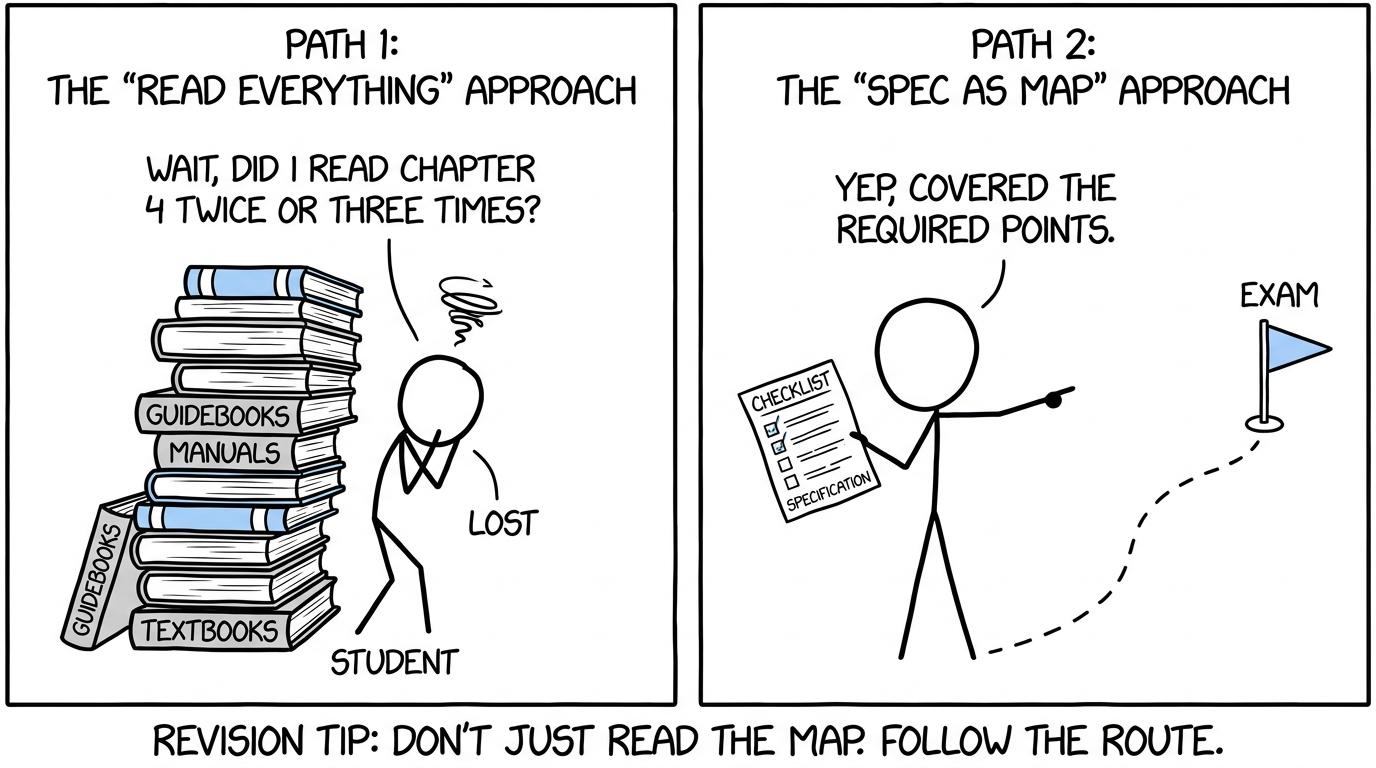 One student follows a checklist while another gets lost beneath revision books
Is reading every page worth your time?
Usually, no.
Front matter about administration, regulatory wording and centre responsibilities may be important to schools without being useful daily revision for a student. Read the sections that affect what you must know and do. Scan the rest so that you understand the document's structure, then return when you need a precise answer.
A sensible pattern is:
- one initial scan to understand the course;
- a careful pass through assessable content and practical skills;
- occasional checks while creating revision resources;
- a final audit before the examination period.
Repeatedly reading the entire document has a high opportunity cost. That time could be spent answering questions, correcting errors or completing a timed paper. The specification should direct active revision, not replace it.
Common mistakes when using a Chemistry specification
Downloading the wrong qualification
A Combined Science document is not a substitute for a separate Chemistry specification. Likewise, content from one exam board should not be assumed to match another board's structure or wording.
Treating every line as equally important to memorise
Some pages explain administration or assessment arrangements rather than student knowledge. Concentrate on assessable content, skills and practical requirements while keeping the wider context available for reference.
Using the specification as a revision guide
Dense wording can tell you the destination without teaching the route. Pair each weak statement with an explanation, retrieval activity and relevant questions.
Highlighting without testing
Colour creates an attractive record of reading, not evidence of recall. Close the document and write what you know, explain it aloud, or answer questions without notes.
Ignoring the maths because it is a science course
Calculations, graphs and data handling reward accuracy. Practise units, proportional reasoning and calculator use before they become an extra burden inside a chemistry question. MathsGenie's GCSE mini tests offer focused opportunities to identify gaps in the underlying maths.
Assuming the specification contains every current exam instruction
Temporary examination support and series-specific arrangements may be communicated separately. Check the latest official exam-board information and guidance from your school rather than relying on an old downloaded copy.
Make the specification work for you
The official GCSE Chemistry specification is worth reading once with care and revisiting with a purpose. It gives you something no guide can quite offer: the exam board's own boundary around the qualification. But it becomes valuable only when you convert its statements into action.
Use it to find gaps. Use lessons to understand them. Use questions to expose weak reasoning. Then use mark schemes and feedback to refine what you do next.
For the mathematical skills behind Chemistry, and for the maths exams you are preparing to sit, begin with MathsGenie's free GCSE revision resources. Work through revision lessons and practice questions, use mini tests to diagnose weaknesses, and progress to past papers, predicted papers, mark schemes and video solutions. The specification gives you the map. Deliberate practice is what moves you forward.