Read Answers Aloud GCSE Food and Nutrition
Read answers aloud GCSE Food and Nutrition: discover how your voice exposes weak structure, missing links and vague evaluation during revision.
A paragraph can look convincing when you have just written it. You know what you intended to say, so your brain quietly supplies the missing links. An examiner cannot do that. They can only assess the words on the page.
That is why the read answers aloud GCSE Food and Nutrition technique can help: hearing your response often reveals unclear reasoning, overloaded sentences and conclusions that do not answer the question. It will not replace accurate subject knowledge or mark-scheme practice, but it can make the knowledge you already have easier to follow and assess.
The same habit is valuable for GCSE maths. You may not read every calculation aloud, but explaining a method verbally can expose a missing step, an unexplained assumption or an answer that does not address the context.
The quick answer
Reading your answer aloud is worth trying when you want to check:
- whether your opening sentence answers the question directly;
- whether each paragraph develops one clear idea;
- whether explanations include a reason rather than an unsupported claim;
- whether evidence and technical vocabulary are connected to the question;
- whether analysis leads logically to a judgement;
- whether sentences are too long, repetitive or incomplete;
- whether your conclusion follows from what you have written.
Use it as an editing tool, not as your entire revision method. First build knowledge, then answer a question, compare your work with the mark scheme and finally read the revised response aloud.
Why silent reading can hide structure problems
The difficulty with checking your own writing is familiarity. You remember the plan in your head, the classroom discussion behind it and the sentence you almost wrote. Silent reading can therefore become a form of recognition: the answer feels right because it resembles what you meant.
Reading aloud slows the process. You have to encounter the words in their actual order. University writing centres commonly recommend the method because it can help writers notice missing words, awkward transitions, overlong sentences and organisational problems that fast silent reading overlooks.
That does not prove that reading aloud automatically raises GCSE marks. Its value is more precise: it creates a different way of inspecting an answer. Whether that improves a mark depends on the quality of the changes you make afterwards.
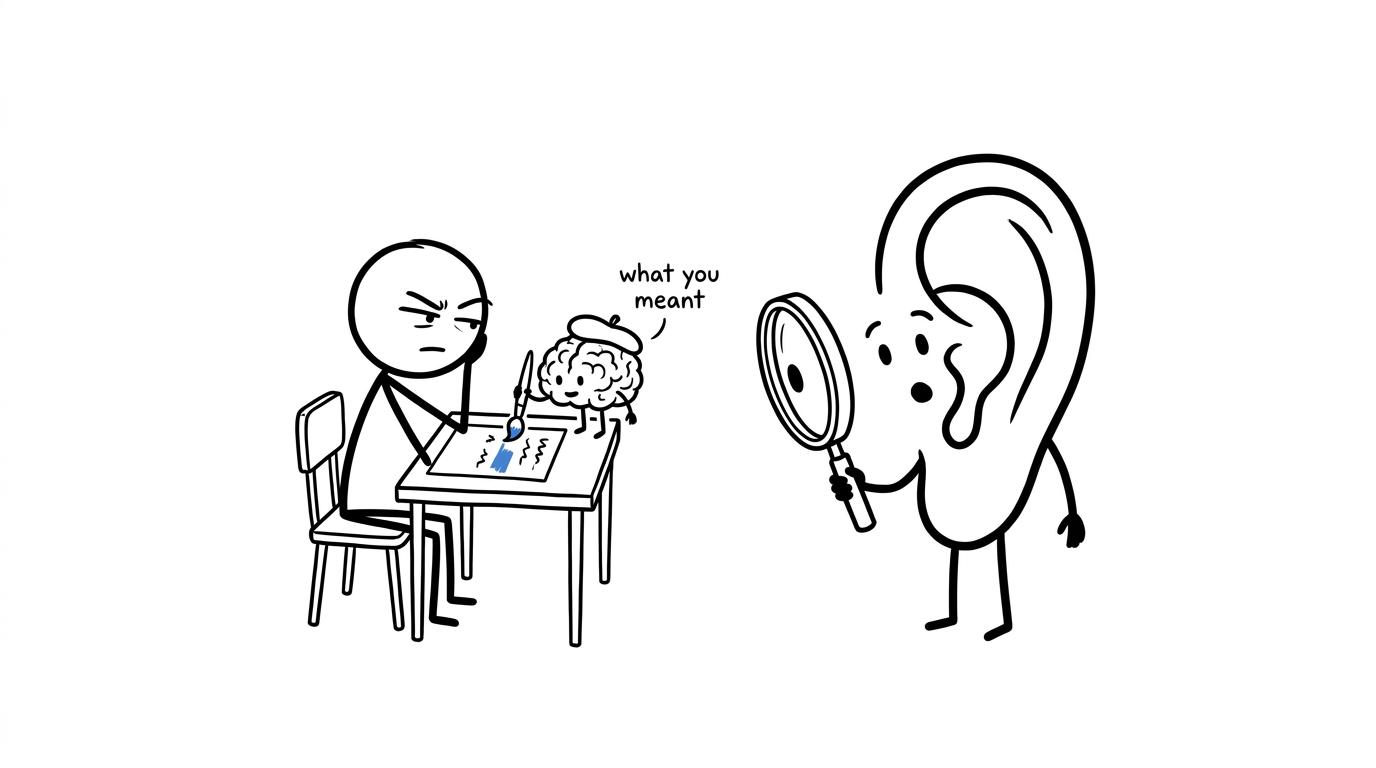 A student's intended meaning secretly repairs gaps until an ear catches them
What your voice reveals about an answer
A paragraph without a clear destination
A strong paragraph normally has a recognisable job. It might identify a nutritional issue, explain a food-science process, apply knowledge to a named person or evaluate a choice.
If you reach the end of a paragraph aloud and cannot summarise its purpose in a few words, it may contain too many ideas. Splitting it can make the reasoning clearer. Alternatively, you may discover that several sentences provide background information without addressing the command word.
Ask after each paragraph:
- What claim did I make?
- What knowledge supports it?
- How did I apply that knowledge to the question?
- Why does the point matter?
These questions are particularly useful for responses requiring analysis or evaluation. The current AQA specification, for example, distinguishes demonstrating knowledge, applying it, planning and practical work, and analysing or evaluating food-related issues. Simply listing facts is therefore not the same as building an analytical response.
Missing links between cause and effect
Food and Nutrition answers frequently depend on chains of reasoning. A student may know a correct fact but move too quickly from the fact to a recommendation. When spoken, that jump can sound abrupt.
Listen for places where a reader might reasonably ask:
- Why?
- What causes that?
- How does this affect the person or product in the question?
- What evidence supports the judgement?
Words such as because, therefore, however and as a result can make relationships visible, but inserting connectives mechanically is not enough. The ideas on either side must genuinely follow from one another.
Sentences carrying too much
Long sentences are not automatically weak. The problem begins when one sentence tries to define a term, describe a process, apply it to the scenario and evaluate the outcome without giving the reader a clear route through.
Your breathing provides a useful warning. If you repeatedly run out of breath or lose track of the sentence, inspect its structure. One full stop may do more for clarity than another technical term.
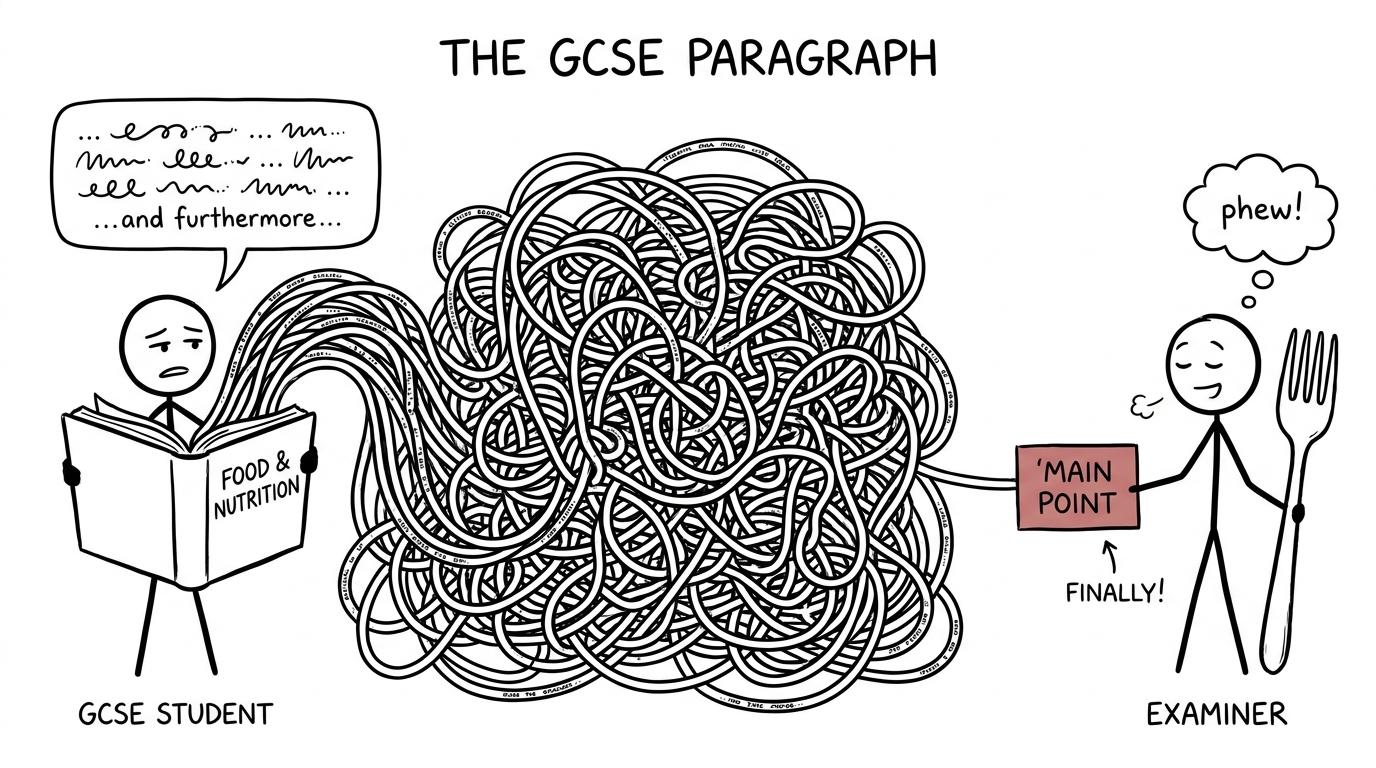 A tangled spaghetti sentence finally reveals its main point
A practical read-aloud revision routine
Reading aloud works best when it has a narrow purpose. Muttering through several pages without making changes can feel productive while leaving the answer untouched.
Prepare the right material
Choose one completed exam response or a permitted draft being reviewed under your teacher's instructions. Keep the question, mark scheme and any teacher feedback nearby. If the work forms part of a controlled non-exam assessment, follow your exam board's rules and your teacher's directions about drafting, feedback and independent work.
Do not try to repair knowledge, structure, spelling and presentation simultaneously. Make separate passes.
Read exactly what is written
Do not improve the wording while speaking. If a word is missing, allow the sentence to sound incomplete. If the same phrase appears three times, say it three times. The discomfort is useful evidence.
Read at a measured pace and follow each line with a finger or blank sheet of paper. Mark a small symbol wherever you:
- stumble;
- need to restart;
- lose the main idea;
- hear repetition;
- expect a link that is absent;
- reach a judgement unsupported by the paragraph.
Finish the paragraph before editing. Otherwise, polishing one sentence can distract you from a larger structural weakness.
Check the answer against the question
Now reread the command word and context. Describe, explain, analyse and evaluate require different kinds of response. An answer may sound fluent and remain poorly matched to the task.
Use a simple structure audit:
- Opening: Does it address the task rather than repeat it?
- Development: Does each paragraph add a distinct relevant point?
- Application: Is the knowledge connected to the food, process or person named?
- Evaluation: Are benefits, limitations or alternatives considered where required?
- Judgement: Is the conclusion justified by the preceding analysis?
Then consult the relevant mark scheme or level descriptor. The mark scheme remains the standard; your ear is a diagnostic tool.
Make one purposeful revision
After reading, identify the biggest weakness. It might be a missing explanation, two paragraphs in the wrong order or an unsupported final judgement. Correct that problem first, then read the changed section again.
This small cycle resembles effective maths revision: attempt, inspect, correct and retest. MathsGenie's guide to finding your weakest GCSE topics applies the same principle to lost maths marks, while the 20-minute maths revision routine turns diagnosis and correction into a manageable habit.
How this technique transfers to GCSE maths
Food and Nutrition uses extended written explanations more often than GCSE maths, but mathematical answers also have structure. Your reasoning needs a starting point, valid steps and a conclusion that answers the question.
Try describing your method aloud after completing a practice question. Can you state why you selected that operation, formula or representation? Does your written working contain the step you just described, or did it exist only in your head? Have you interpreted the result in context and included appropriate units?
Verbal explanation is especially useful for reasoning, proof, multi-step problems and questions asking you to show that a result is true. It is not a substitute for writing full mathematical working. The examiner marks the script, not the explanation you could have given.
Build this check into the broader GCSE maths revision hub, where you can move from revision lessons to topic questions, solutions and exam practice. When you begin complete papers, follow the cycle in how to use GCSE past papers properly: complete the paper, mark it carefully, diagnose errors, repair weak topics and retest.
When reading aloud is most useful
The method is particularly helpful:
- after you have left some time between writing and editing;
- when a response contains several linked paragraphs;
- when feedback says your ideas are unclear or insufficiently developed;
- when you know the content but struggle to communicate it precisely;
- after moving, deleting or combining sentences;
- when checking whether a conclusion follows from the analysis.
It is less useful when the main problem is missing subject knowledge. A polished explanation of an inaccurate idea remains inaccurate. Return to your specification, class materials and teacher feedback before editing the prose.
Reading aloud is also impractical during most timed examinations. Use it in revision so that clear answer structures become habitual. In the exam, a short silent check of the command word, paragraph purpose and conclusion is more realistic.
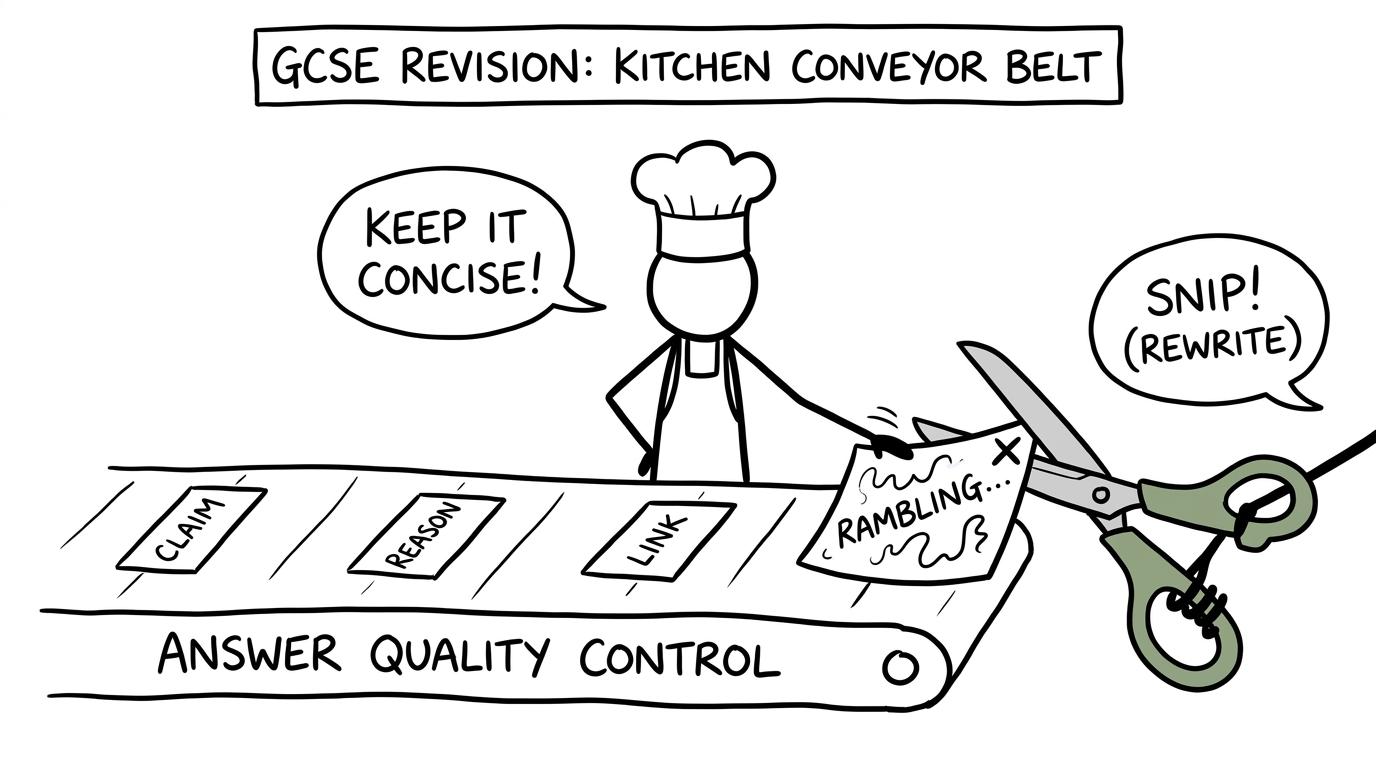 A quality-control kitchen checks claims, reasons and links
Common mistakes when reading answers aloud
Listening only for spelling
The greatest benefit may be structural. Listen for missing reasoning, weak sequencing and irrelevant material before concentrating on punctuation or individual words.
Changing words as you read
This recreates the original problem: your brain supplies a better answer than the page contains. Read faithfully, mark the difficulty and edit afterwards.
Assuming fluent writing is correct
A confident rhythm can disguise inaccurate science or a response that misses the command word. Check facts and assessment requirements separately.
Treating every stumble as an error
You may stumble because you are tired, nervous or unfamiliar with a technical term. Re-read the sentence once and decide whether a genuine reader would struggle.
Editing without retesting
Changing a paragraph can create repetition or break a transition elsewhere. Read the revised section again, just as you would redo a maths question after correcting its method. The discussion of when to redo GCSE past papers explains why correction should be followed by a fresh check rather than a quick glance.
Using the technique instead of exam practice
Reading aloud improves inspection, not recall under pressure. For maths, combine it with topic practice, mini tests and timed papers. A sustainable GCSE maths revision timetable can help you balance these activities, while Edexcel GCSE maths predicted papers provide final-stage practice for students taking that specification.
Make your answers easier to assess
Good answers do not merely contain knowledge. They guide the examiner through it. Reading your own GCSE Food and Nutrition responses aloud can expose the places where that guidance disappears: the sentence that tries to do four jobs, the paragraph without a central point or the conclusion that arrives before the reasoning.
Use the technique briefly and deliberately. Read exactly what you wrote, mark moments of friction, compare the answer with the question and mark scheme, then make one meaningful change. Carry the same discipline into maths by explaining methods, checking written steps and recording the precise reason for every lost mark.
Start with MathsGenie's free GCSE maths revision resources. Choose your exam board and tier, strengthen weak topics with revision lessons and practice questions, then test your progress using mini tests, past papers, predicted papers, mark schemes and video solutions. Clearer thinking becomes useful only when it reaches the page.