Read Answers Aloud GCSE Art and Design: Does It Help?
Read answers aloud GCSE Art and Design to catch weak structure, vague analysis and missing links, then transfer the checking habit to GCSE maths.
A paragraph can look finished simply because you have looked at it for too long. Your eyes recognise the sentences, your brain remembers what you intended to say, and the gaps quietly disappear.
That is why it can help to read answers aloud GCSE Art and Design students have written in sketchbooks, portfolios or preparatory work. Hearing the words often exposes unclear structure, repeated ideas, missing explanations and sentences that never quite reach a conclusion. Research on proofreading has found that reading aloud can improve the detection of spelling, grammar and word-choice errors compared with silent reading.
There is an important limit, though. Reading aloud will not decide whether your artistic interpretation is strong, prove that you have met an assessment objective or replace feedback from your teacher. It is a checking tool, not a marking system.
For students preparing for GCSE maths as well as Art and Design, the wider lesson matters: work can feel clear in your head without being clear on the page.
The quick answer and revision checklist
Yes, reading your own writing aloud can help you improve it, particularly when you use the technique to check one specific feature at a time.
Try this short process:
- Leave the writing briefly before reviewing it, if your deadline allows.
- Read exactly what is on the page rather than what you remember writing.
- Mark any place where you pause unexpectedly, run out of breath or lose the thread.
- Check whether each paragraph explains a decision, insight or connection.
- Remove repetition and vague filler.
- Confirm that specialist vocabulary is accurate.
- Ask whether the writing supports the visual evidence rather than replacing it.
- Use teacher feedback and your exam board's specification alongside your own review.
This should be a focused editing pass, not a dramatic performance. A quiet voice is enough. If speaking is uncomfortable or impractical, recording the passage and listening privately can create some of the same distance from the text.
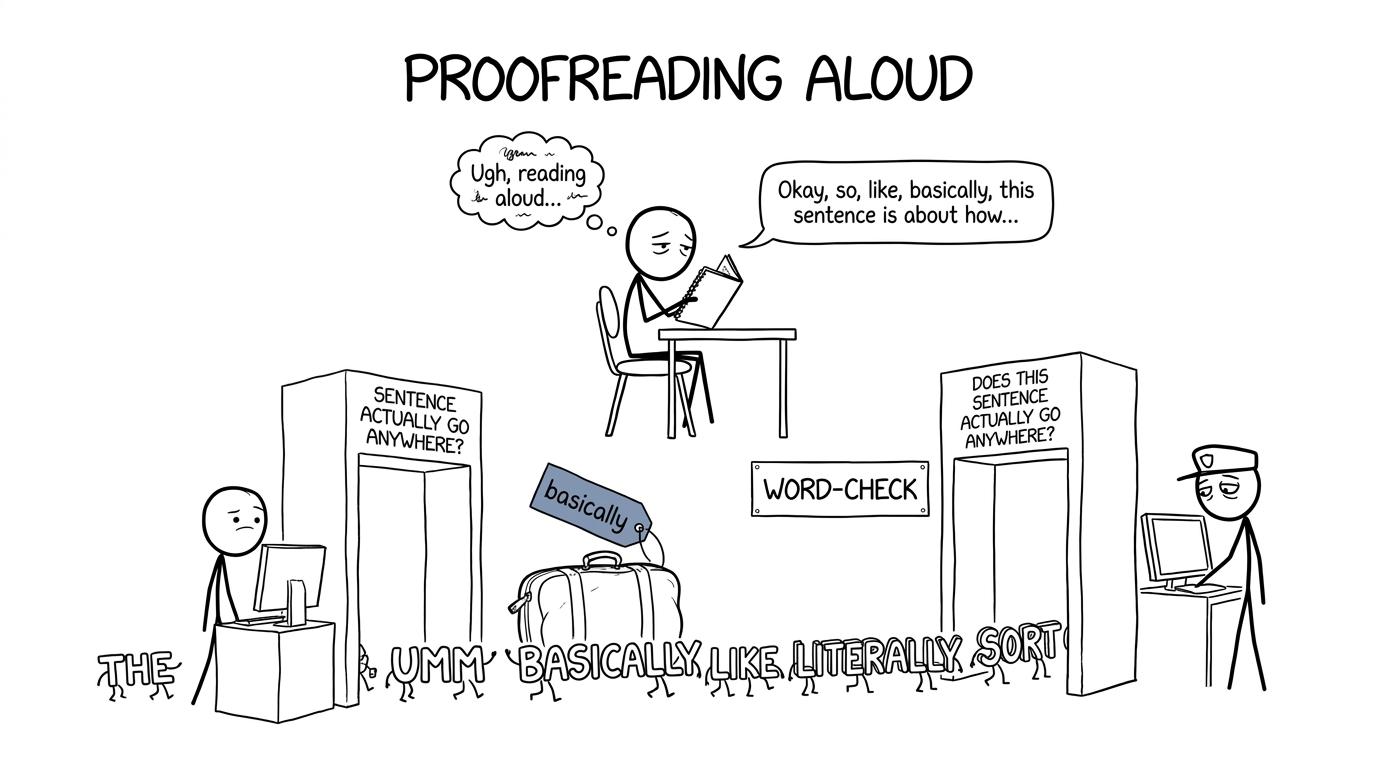 A student sends sketchbook words through an imaginary clarity scanner
Why silent reading misses structure problems
When you silently reread familiar work, you do not always process every word with equal care. You already know the intended meaning, so your brain can smooth over an omitted word, an abrupt transition or a claim that has not been explained.
Reading aloud changes the task. You must move through the sentence in order, giving each phrase some attention. That makes several problems easier to hear.
Sentences that are carrying too much
A sentence may contain an artist reference, a description of colour, an explanation of technique and an evaluation of your own outcome without showing how those ideas connect. On the page, it can resemble detailed analysis. Spoken aloud, it may sound like four thoughts competing for one space.
That is a structural warning. Divide the ideas or decide which one actually advances your explanation.
Paragraphs without a clear direction
Strong annotation does more than list what happened. It can explain why you selected a material, how a source influenced an idea, what an experiment revealed and what you intend to refine next.
If a paragraph sounds like a sequence of unrelated observations, ask what its central purpose is. The problem may not be grammar. It may be that the paragraph has no destination.
Missing links between evidence and judgement
You might write that a technique was successful but leave the success undefined. Successful in producing texture? Communicating atmosphere? Connecting with your chosen source? Supporting your intention?
Reading the statement aloud can make an unsupported judgement sound noticeably unfinished. Add the reasoning the reader needs, but do not add words merely to make the annotation longer.
What GCSE Art and Design annotation is meant to do
GCSE Art and Design is not normally built around conventional essay-style exam answers. The more accurate focus is written annotation integrated with practical and visual work.
Across exam boards, the four assessment objectives concern developing ideas through investigations, refining work through experimentation, recording ideas and insights, and presenting a personal response. AQA states that written annotation must be evidenced through AO3 and may also support evidence for AO1, AO2 and AO4. Pearson Edexcel similarly describes annotation as purposeful writing that can analyse, evaluate and reflect on your work and the work of others.
The practical implication is simple: useful annotation communicates thinking that the images alone may not make obvious. It should remain connected to the creative process.
Read for purpose, not impressive vocabulary
During the first reading, ignore minor punctuation and ask:
- Does this explain a choice or merely name it?
- Does it connect the source to the development of my own idea?
- Does it evaluate an experiment with a clear reason?
- Does it show what changed as my work progressed?
- Is the comment relevant to the visual evidence beside it?
Specialist terms can make an explanation precise, but only when they are used correctly. Words such as composition, contrast, scale, tone and texture should clarify what you observed or decided. They should not decorate an otherwise empty sentence.
Read for movement through the creative process
A portfolio should allow the reader to follow the development of your intentions. Listen for movement between research, experimentation, reflection, refinement and outcome.
If several annotations repeat that you “like” an artist's work, the writing has probably stopped moving. Your next question is not “How can I make this sound more sophisticated?” It is “What did this source cause me to notice, test or change?”
This distinction matters because purposeful annotation is not measured by sheer length. Pearson's guidance makes clear that extended writing is not required at GCSE and that annotation should support visual evidence rather than replace practical work.
A three-pass method for reading answers aloud
Trying to check everything at once usually creates a vague sense that something is wrong. Three shorter passes are more useful.
The meaning pass
Read at a natural pace. Mark any sentence you cannot explain immediately in simpler words. If you wrote it but cannot identify its main point, an examiner or moderator should not be expected to untangle it for you.
Check whether observations lead to insights. Description identifies what is visible; analysis considers how choices create an effect; reflection explains what you learnt and how that learning affects your next decision.
The structure pass
Pause at the end of every sentence and paragraph. Ask whether the order is logical. A reader should not encounter your conclusion before understanding the experiment or source that led to it.
Listen particularly for repeated openings, sudden topic changes and long stretches with no clear connection to your intention. These often indicate that separate notes have been combined without being organised.
The accuracy pass
Now slow down. Check missing words, repeated words, punctuation, artist names and technical terminology. Reading aloud has been shown to help with proofreading, including contextual errors involving grammar or word choice, but it is sensible to follow this with a visual check of spelling and formatting.
Then compare the revised annotation with your teacher's guidance and the requirements for your own board, whether that is AQA, Pearson Edexcel, OCR or Eduqas. Reading aloud can reveal expression problems. It cannot independently confirm assessment decisions.
How this helps students preparing for GCSE maths
The subject matter changes, but the checking principle transfers well. In maths, students often know what they meant by a line of working and therefore fail to notice what they actually wrote.
For a worded response, geometric justification or explanation of a method, reading the sentence quietly aloud can reveal an undefined quantity, a conclusion without evidence or reasoning written in the wrong order. For numerical and algebraic work, however, speaking is secondary to checking operations, notation, units and whether the result answers the question.
Use the right tool for the right error:
- Read explanatory sentences aloud to test clarity.
- Recalculate to test numerical accuracy.
- Substitute where appropriate to test an algebraic result.
- Compare your response with the mark scheme to understand how marks are awarded.
- Use a video solution when you need to see the complete method.
MathsGenie's GCSE maths revision resources combine lessons and practice questions so that understanding is followed by application. You can then diagnose smaller gaps with Edexcel GCSE Maths mini tests before moving to full Edexcel GCSE Maths past papers.
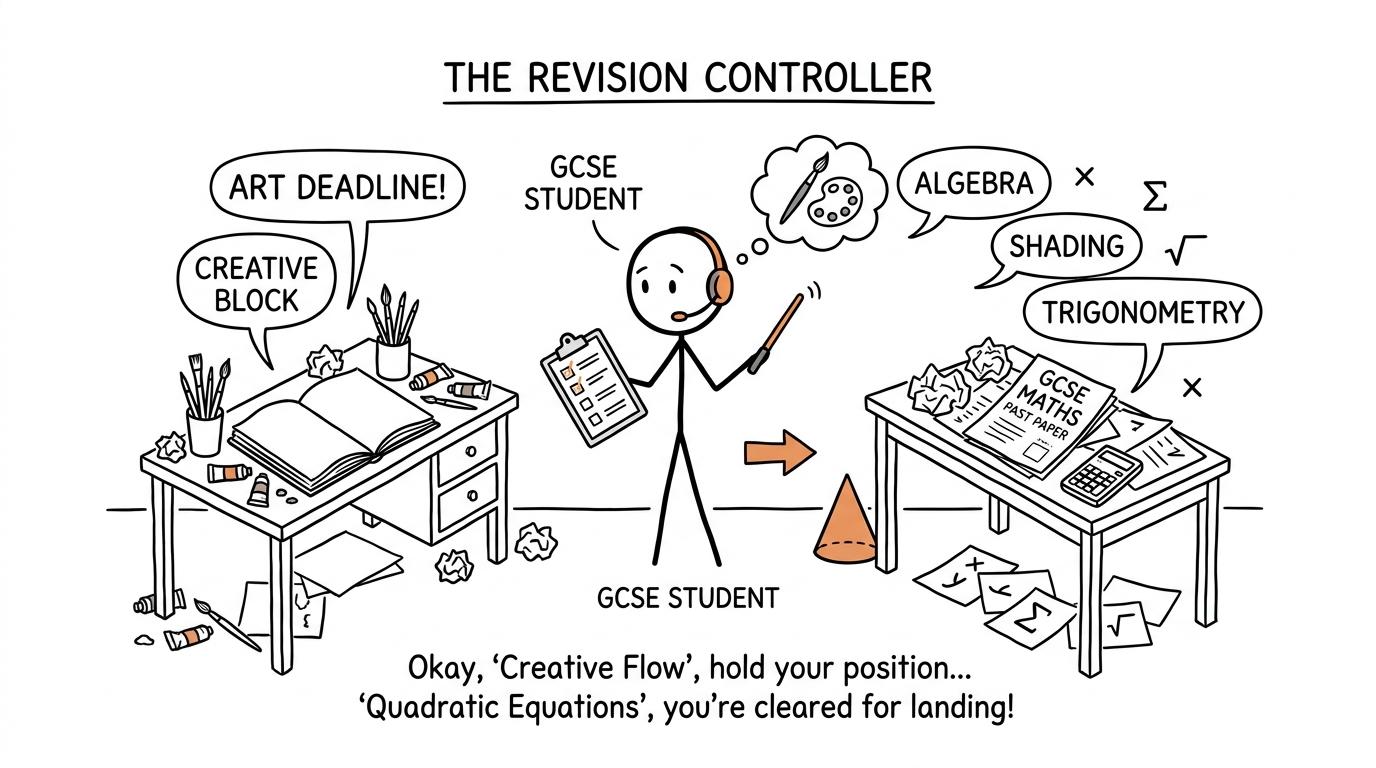 A student calmly switches between art proofreading and maths revision
Build the technique into a realistic revision routine
Reading aloud works best as a brief final check after you have already developed the content. It should not consume the time needed for practical development, teacher feedback or maths practice.
A balanced session might begin with one clearly defined Art and Design editing task. Once it is complete, switch subjects deliberately rather than drifting between tabs and sketchbook pages. For maths, the GCSE one-month revision plan offers a framework based on diagnosis, focused topic work and paper practice.
When you are unsure where marks are being lost, use the process in finding your weakest GCSE topics. If the problem is mainly organisation, build sessions around a realistic GCSE maths revision timetable.
Nearer the exams, use GCSE predicted papers as exam-style rehearsal rather than as a substitute for the specification. The same disciplined loop applies in both subjects: produce work, examine the evidence, identify one weakness, improve it and check again.
Common mistakes when reading work aloud
Correcting only spelling
A perfectly spelt paragraph can still be directionless. Check meaning and structure before polishing surface details.
Changing every sentence that sounds informal
Your annotation should be clear and purposeful, not artificially grand. A direct explanation of a creative decision is usually more useful than inflated vocabulary.
Treating annotation as a substitute for artwork
Written comments support the visual journey. They cannot compensate for missing investigation, experimentation, recording or refinement.
Reading from memory
Follow the words with a finger or cursor. Otherwise, you may unconsciously supply missing language and repeat the weakness of silent reading.
Assuming the technique guarantees better marks
Research supports reading aloud as a proofreading aid, not as an automatic route to higher assessment outcomes. Content, visual evidence, accurate judgement and teacher guidance still matter.
Applying it to every part of maths
Reading a calculation aloud does not prove it is correct. Use mark schemes, inverse operations, substitution and fresh practice. The guide to using Edexcel past papers properly explains how to turn mistakes into targeted revision rather than merely collecting paper scores.
Make your next revision pass more honest
The value of reading aloud is not that speaking makes writing cleverer. It makes the page harder to pretend with. A missing connection sounds missing. Repetition becomes tiring. A sentence with no destination runs out of road.
Use that honesty carefully. Review GCSE Art and Design annotations for purpose, structure and accuracy, then seek teacher feedback. When you return to maths, bring the same habit of checking what is present rather than what you intended.
Start your next MathsGenie session with a revision lesson and targeted practice questions. Test the skill with mini tests, then build exam confidence through past papers, mark schemes, video solutions and predicted papers. Improvement becomes much more manageable when every check leads to one clear next action.