

Problem-Solving Questions in Maths Mocks
Problem-solving questions in maths mocks made manageable. Diagnose weak skills, improve your method and build targeted GCSE practice with MathsGenie.
November arrives, and a maths mock can suddenly feel much bigger than a paper on a desk. For many Year 10 and 11 students, the hardest part is not recalling a formula. It is knowing what to do when the question does not announce its topic.
That is the challenge behind problem-solving questions in maths mocks. They test whether you can select, connect and apply familiar skills in an unfamiliar situation. The practical answer is to slow down, identify what the question gives you, decide what it wants, and turn the words into manageable mathematical steps.
Most importantly, a mock is a diagnostic, not a verdict. Its purpose is to reveal what needs attention before the real GCSE exams.
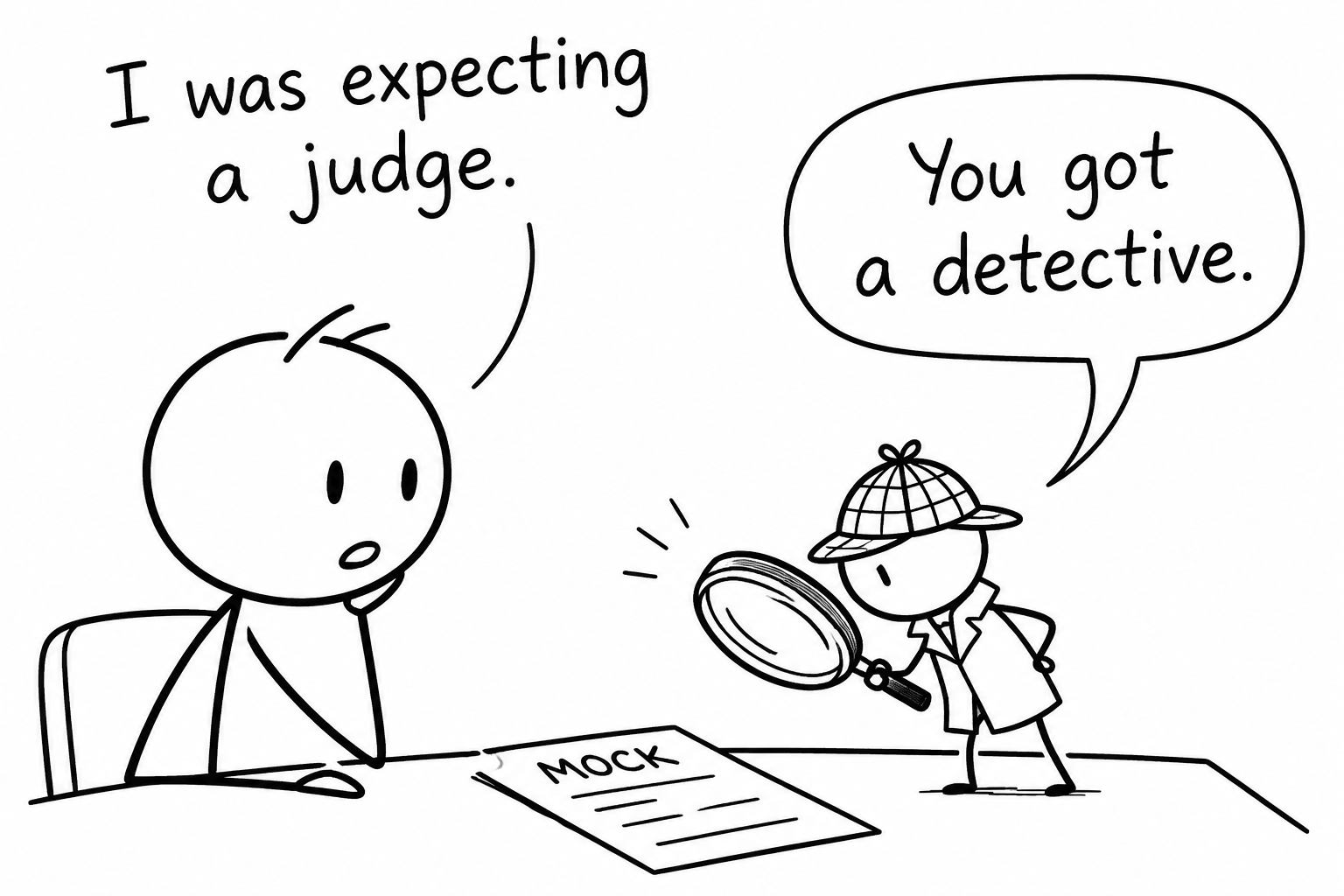 A GCSE mock expects a judge but meets a mathematical detective
A quick problem-solving checklist
When a question looks unfamiliar, use this routine:
- Read the final sentence first so you know the goal.
- Underline quantities, units and restrictions.
- Ask which topics might be connected.
- Write down one useful fact, formula or relationship.
- Break the task into smaller stages.
- Show every meaningful step.
- Check whether the answer is reasonable in context.
- Return later if the question is consuming too much time.
This is not a trick for avoiding difficult maths. It is a way of creating structure when the route is not immediately visible.
Why GCSE maths mocks contain problem-solving questions
GCSE maths is not assessed through routine calculations alone. One of the official assessment objectives, AO3, concerns solving problems within maths and in other contexts. It accounts for 25%25\%25% of Foundation assessment and 30%30\%30% of Higher assessment.
These marks may appear in questions involving several topics at once. A problem could combine ratio with area, percentages with money, or algebra with geometry. You may know every individual skill but still need to decide the order in which to use them.
This explains why simply memorising methods can reach a limit. Knowledge matters, but problem solving asks a second question: can you recognise when that knowledge is useful?
Use GCSE past papers and predicted papers to become familiar with how exam questions combine topics. The goal is not to memorise old questions. It is to notice recurring decisions, such as forming an equation, converting units or comparing two possible outcomes.
The November mock: treat the result as evidence
Imagine a student opening their November result. Several marks have disappeared on long questions near the end of each paper. It is tempting to translate that into a fixed conclusion: “I cannot do problem solving.”
But the paper may tell a more useful story.
Perhaps the student did not attempt the questions. Perhaps they started correctly but failed to show enough working. Perhaps one missing topic, such as fractions or rearranging formulae, blocked several otherwise accessible problems. Those are different diagnoses, so they need different responses.
After each mock, sort lost marks into four categories:
Knowledge gaps
You did not know the required fact or method. Return to the relevant revision lesson and practise that skill before attempting mixed problems again.
Recognition gaps
You knew the method when shown it, but did not recognise that the question required it. Mixed questions and past-paper practice are particularly valuable here.
Process gaps
You understood the problem but skipped steps, used inconsistent units or lost accuracy during a calculation. Slower, clearly organised working is the remedy.
Exam-management gaps
You ran out of time, stayed too long on one question or left blanks. Timed practice is needed, but it should be introduced after the underlying skills are secure.
One carefully reviewed paper can teach more than several papers completed and forgotten. MathsGenie’s guide to when to start GCSE past papers explains how to move from diagnosis towards fuller exam practice.
How to approach an unfamiliar question
A difficult question often becomes less intimidating once you stop expecting the whole route to appear at once.
Establish the destination
Read exactly what must be found, proved or compared. Pay attention to instructions about units, accuracy and whether reasons are required.
A student can perform correct calculations and still miss the marks by answering a different question.
Inventory the information
List the useful facts provided by the diagram, table or text. Mark information that can be calculated from what you already know.
If a diagram is not drawn accurately, trust the stated measurements rather than its appearance.
Look for connections
Ask which familiar topics are hiding inside the context. Words such as “per”, “total”, “increase”, “similar” and “equally likely” may suggest possible relationships, but no single word guarantees a method. Read the whole problem.
Start with a valid step
You do not always need to see the ending before you begin. Calculate a missing length, define an unknown, convert the units or organise the information. A correct intermediate result may reveal the next stage and may also earn method marks.
Review the answer in context
Check the sign, size, unit and required accuracy. If the question involves people, objects or repeated journeys, consider whether the answer must be a whole number and whether rounding should be up rather than simply to the nearest integer.
Moving from November to December
The weeks between mocks are most useful when practice becomes more targeted, not merely longer.
Begin with short sessions on the weakest underlying skills. Edexcel GCSE maths mini tests can help students practise one area under time, with mark schemes and worked solutions available where provided. Once those skills are steadier, move to mixed problem-solving questions where the method is not labelled.
Next, introduce timed sections. The Edexcel GCSE maths 45-minute tests provide a bridge between isolated topic practice and a complete paper. Students can develop stamina without repeating a full mock every evening.
A simple weekly cycle works well:
- Review the mock and select two weaknesses.
- Relearn the necessary content through revision lessons.
- Complete focused practice questions.
- Mark the work and correct every avoidable error.
- Finish with a short mixed or timed test.
- Revisit the same skills several days later.
The MathsGenie revision planner can turn that cycle into a realistic day-by-day plan. This matters because revision should change when the evidence changes. A December plan should respond to November’s paper, not ignore it.
Mock exam tips for parents
Parents can help without becoming the examiner at the kitchen table.
Ask process-based questions rather than focusing only on the grade: Which questions were left blank? Were errors caused by missing knowledge or rushing? What will be practised differently this week?
Encourage the student to keep an error log containing the topic, the cause of the mistake and the action required. “Lost three marks” is history. “Need to practise converting compound units” is a plan.
It is also worth protecting recovery time. Tired students often interpret every difficult question as proof that they are failing. A calm review after a break usually produces better decisions than an immediate argument over the result.
Common mistakes in problem-solving questions
Searching for a single magic formula
Many problems require a chain of ordinary methods rather than one advanced idea. Focus on the first justified step.
Ignoring units
Mixing centimetres and metres, or minutes and hours, can undermine an otherwise correct method. Convert deliberately and label intermediate answers.
Hiding the working
An unsupported answer may lose access to method marks. Lay out calculations in a logical order, even when using a calculator.
Rounding too early
Keep accurate calculator values during intermediate stages and round at the end unless instructed otherwise.
Treating the mark scheme as a score sheet
A mark scheme is also a description of an efficient solution. Compare its structure with your own attempt, then redo the question without looking.
Repeating full papers without fixing weaknesses
More papers do not automatically create progress. The useful loop is attempt, mark, diagnose, relearn and retest. MathsGenie’s advice on how many GCSE past papers to complete explores why review quality matters as much as quantity.
Turn the mock into your next practice paper
By December, the aim is not to erase every weakness. It is to know which weaknesses matter most and to have a repeatable method for tackling unfamiliar questions.
Start with the evidence from your mock. Select the topics and skills that caused lost marks, then use MathsGenie’s free revision lessons, practice questions, mini tests, past papers, predicted papers, mark schemes and video solutions to close those gaps.
When you are ready to test the result, use the GCSE Mock Exam Builder to build a targeted practice paper from past-paper questions. Sit it under realistic conditions, mark it carefully and let the next result refine the plan again.
A mock is a snapshot. What you do with it is the longer story.















