

Pomodoro Technique GCSE English Language and Literature
Pomodoro technique GCSE English Language and Literature advice: when short revision bursts help, when longer sessions work, and how to combine both.

Revision advice often makes concentration sound like a character trait: some students have it, while everyone else must try harder. In reality, starting is usually the difficult part. A vague plan to “revise English tonight” has no clear beginning and no visible end.
The pomodoro technique GCSE English Language and Literature students often use can solve that problem. A short, timed session makes revision easier to begin and helps protect attention from phones, messages and drifting thoughts. But the timer itself does not improve your analysis, quotations or writing. It works only when the task inside the session is useful.
The short answer is this: Pomodoro can be effective for quotation retrieval, language analysis, planning and focused practice. Longer, uninterrupted sessions are usually better for complete essays, full reading tasks and timed papers. The strongest approach combines both.
The practical Pomodoro checklist
Before starting, decide five things:
- Choose one precise English task, not simply “revise literature”.
- Work without interruption for about 252525 minutes.
- Take a genuine break of roughly 555 minutes.
- Repeat the cycle if your concentration remains steady.
- Use longer sessions when the exam task demands sustained writing.
The traditional timings are a starting point, not an exam-board rule. A session of 202020 minutes or 353535 minutes can be equally sensible if it matches the task and your current concentration.
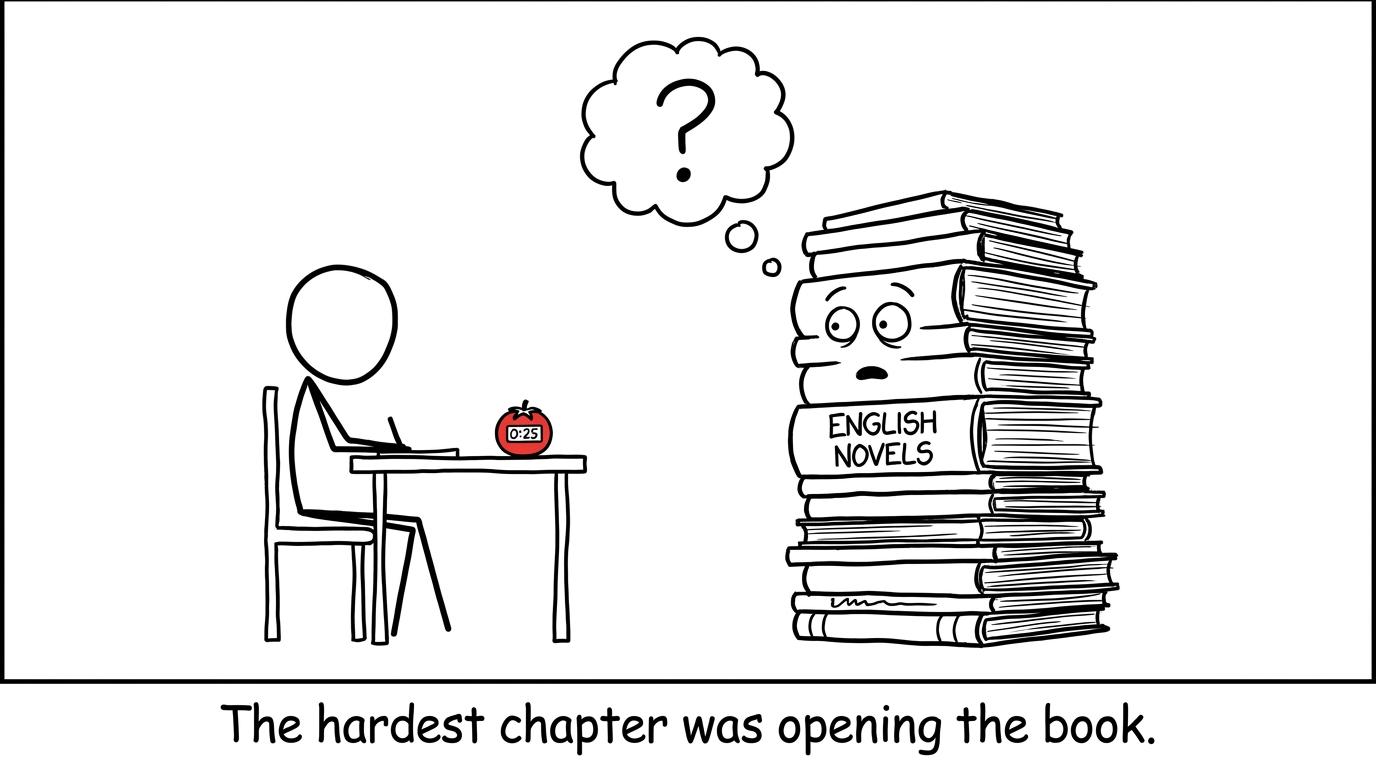 A student begins revision while a giant stack of novels watches the timer
Does the Pomodoro Technique actually work?
It can, but its most valuable effect is behavioural rather than magical.
A timer creates a small commitment. You are not promising to master an entire Shakespeare play or become brilliant at unseen poetry in one evening. You are agreeing to concentrate on one defined task until the alarm sounds. That can reduce procrastination and make distractions easier to postpone.
Short breaks can also help prevent a revision session from becoming an hour of low-quality rereading. However, research supporting spaced practice, retrieval and appropriate rest does not establish that the exact 252525-minute and 555-minute pattern is uniquely effective for every student or subject. There is no reason to believe that learning suddenly stops after 252525 minutes.
The method should therefore be treated as a structure for attention. It is not a learning technique by itself. What you do during the interval matters far more than the shape of the timer.
Why GCSE English Language suits short revision bursts
GCSE English Language involves several skills that can be separated into focused activities. Although question wording and paper structure vary across AQA, Edexcel, OCR and Eduqas, students generally need to read accurately, analyse writers' choices, compare ideas where required and communicate clearly.
A single Pomodoro can be used to:
- annotate a short extract for language and structural choices;
- plan one response using evidence from a source;
- practise writing an opening or conclusion;
- improve one paragraph against an exam-board mark scheme;
- retrieve terminology without looking at notes;
- edit writing for clarity, punctuation and sentence control.
These tasks have a narrow finish line. At the end, you can see what was completed and identify what still needs attention.
English Language revision becomes less effective when the goal is merely to “do a question” without deciding which skill is being trained. A sharper instruction might be: identify three defensible ideas, select concise evidence and explain the effect of each choice. The timer then supports deliberate practice rather than hurried activity.
When Language needs a longer session
The exam does not arrive in convenient 252525-minute pieces. You must also practise sustaining concentration, selecting questions and managing a complete response under realistic conditions.
Do not stop halfway through a developed argument simply because an alarm sounds. Finish the sentence or paragraph, record where you reached and then break. For a full paper or substantial writing task, use the time allowed by your exam board rather than imposing repeated interruptions.
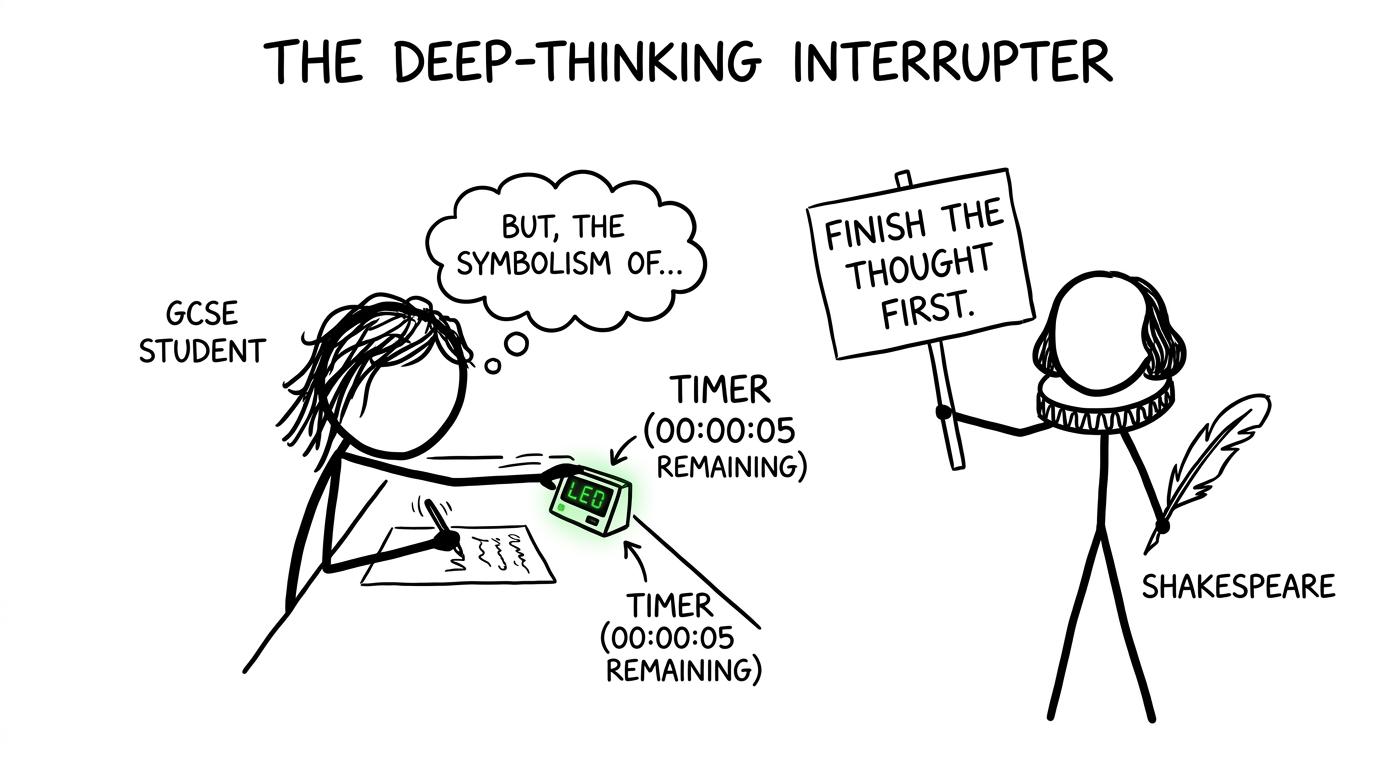 A timer tries to interrupt an essay while Shakespeare asks it to wait
Why GCSE English Literature needs both short and long sessions
Literature revision contains two different kinds of work.
The first is knowledge building. Short sessions are well suited to retrieving quotations, linking themes to characters, reviewing context and testing your understanding of a poem, play or novel. Retrieval is important here: close the book and try to recall the material before checking what you missed.
The second is sustained interpretation. A strong literature essay develops an argument across several paragraphs. It connects evidence to the question and considers how the writer constructs meaning. That chain of thought can take time to form, so rigid breaks may interrupt useful concentration.
A balanced Literature session might therefore use:
- one short interval for quotation retrieval;
- one short interval for planning an argument;
- one longer block for writing the response;
- a final short interval for marking and reflection.
Always follow the requirements of your own specification and teacher. Texts, assessment structures and permitted materials differ between exam boards and qualifications.
Match the timer to the English task
A timer should bend around the task, not force every task into the same container.
| Revision task | Sensible session structure |
|---|---|
| Retrieving quotations | Short, closed-book burst followed by checking |
| Annotating a brief extract | One focused interval |
| Planning an essay | One or two short intervals |
| Writing a complete essay | Longer uninterrupted block |
| Completing a full paper | Official exam timing |
| Reviewing a mark scheme | Short interval with written targets |
If 252525 minutes feels too long when you are tired, begin with 151515 focused minutes. If you regularly enter a productive rhythm and the alarm becomes disruptive, extend the block to 404040 or 505050 minutes. Consistent attention is the objective, not loyalty to a particular number.
What to do during each break
A useful break changes your physical and mental state. Stand up, stretch, drink water or look away from the screen. Avoid opening short-form videos or messages if they tend to capture your attention beyond the planned interval.
The break is not a reward for suffering. It is part of the structure. Yet it should remain short enough that returning does not feel like starting the evening again.
Before leaving your desk, write the next action in a few words. “Choose evidence for paragraph two” is easier to resume than a blank page.
Active revision matters more than the timer
Highlighting pages for 252525 minutes may feel orderly, but it offers limited evidence that you can recall or apply anything. Productive English revision requires an output.
That output might be a plan, a paragraph, a set of recalled quotations, annotations or corrections made after comparison with a mark scheme. At the end of each interval, ask:
- What did I produce?
- What could I recall without support?
- Which weakness appeared?
- What should the next session target?
This principle transfers directly to maths. Watching an explanation can help you understand a method, but improvement requires answering questions and checking the result. MathsGenie's GCSE maths revision lessons combine explanations with questions, while GCSE past papers let you test whether that understanding survives under exam conditions.
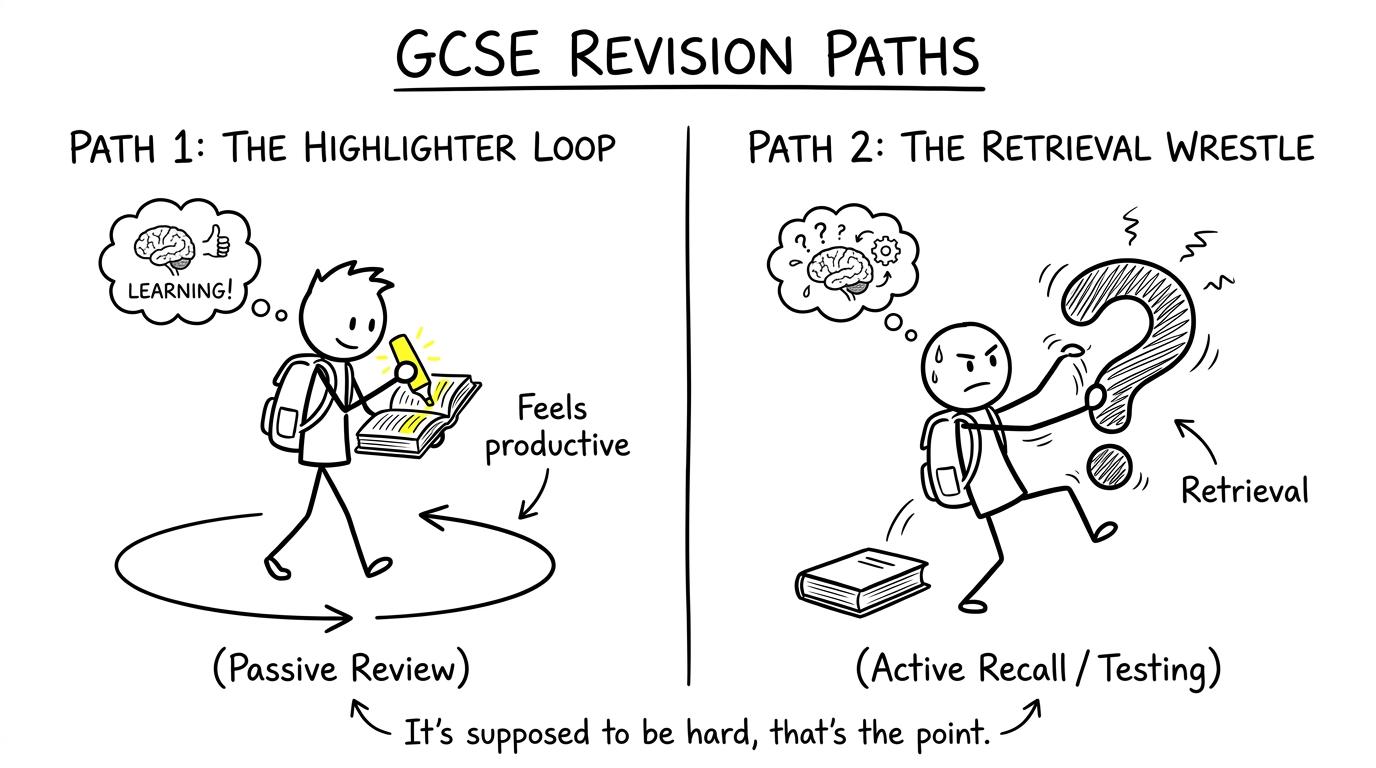 One student highlights in circles while another wrestles with retrieval
How to combine English and maths revision
Many students are not revising one subject in isolation. A long evening of English essays followed by demanding algebra may create fatigue before the maths has even begun.
Use short blocks to alternate carefully, but avoid switching subjects after every interval if that fragments your thinking. Two or three connected English sessions followed by a longer break and a maths block will usually provide more continuity.
For maths, match each interval to a clear resource. You could complete a topic lesson and its practice questions, attempt one of MathsGenie's mini tests, or work through part of a paper. A GCSE revision planner can help you choose topics systematically instead of repeatedly revising whatever feels safest.
As exams approach, predicted GCSE maths papers can add realistic practice. They should complement specification coverage and past papers, not replace either.
Common Pomodoro mistakes
Choosing a task that is too vague
“Revise Macbeth” gives you no obvious finish line. Choose a scene, character, theme, quotation set or essay question instead.
Treating the timer as proof of learning
Four completed intervals measure time, not progress. Check what you can remember and apply without notes.
Breaking concentration unnecessarily
If you are developing a valuable argument, do not abandon it at the exact second the timer sounds. Reach a natural stopping point first.
Using every break for a phone check
A planned 555-minute pause can easily become much longer. Use a separate timer and keep distracting apps out of reach.
Never practising full exam conditions
Short bursts build skills, but they do not reproduce the sustained demands of an English paper. Include complete timed responses and papers in your revision plan.
Ignoring feedback
Repeating essays without analysing mark schemes, teacher comments or weak paragraphs can reinforce the same habits. Every marked attempt should create a specific next step.
The best timer is the one that supports the task
The Pomodoro Technique can make GCSE English Language and Literature revision more approachable, especially when starting feels difficult or distractions keep winning. Its value lies in creating a clear beginning, a protected period of attention and a planned return after the break.
But English also requires depth. Complete essays, extended reading and full papers need longer periods of sustained thought. Use short bursts to build knowledge and practise individual skills, then remove the interruptions when you need to assemble those skills under exam conditions.
The same judgement improves maths revision. Start with MathsGenie's free GCSE revision lessons, then move from practice questions and mini tests to past papers, predicted papers, mark schemes and video solutions. Set the timer if it helps you begin. Let the quality of the work decide what happens next.










