Pomodoro Technique GCSE Astronomy: Does It Work?
Pomodoro technique GCSE astronomy advice: learn when 25-minute bursts help, when longer sessions work better, and how to build a balanced revision plan.

Revision can fail before it begins. You sit down intending to cover stellar evolution, notice how much there is to remember, and suddenly reorganising your pens feels strangely urgent. The Pomodoro technique GCSE astronomy approach offers a simple answer: work for a short, fixed period, take a planned break, then repeat.
Does it work? It can help you start, protect your concentration and divide a large specification into manageable tasks. But there is no strong evidence that the classic 252525-minute schedule directly improves GCSE Astronomy marks, and some activities need longer, flexible sessions. The most effective approach is to use timed blocks for focused revision without allowing the timer to interrupt valuable thinking.
The short answer: use Pomodoro as a framework
The Pomodoro Technique is useful when it supports good revision rather than replacing it. A timer organises your attention; it does not decide what you learn.
A sensible GCSE Astronomy approach is to:
- choose one precise outcome before starting;
- use a 252525- to 353535-minute block for recall, notes or focused questions;
- take a genuine 555-minute break away from your phone;
- mark or check your work immediately;
- continue beyond the timer when a difficult calculation is developing well;
- use longer uninterrupted sessions for observations and full exam practice;
- revisit the topic on another day rather than relying on one long evening.
That last point matters. Evidence for retrieval practice and revision distributed across several days is stronger and more consistent than evidence for one exact work-to-break ratio. Pomodoro provides the timetable; active recall, practice and feedback provide much of the learning.
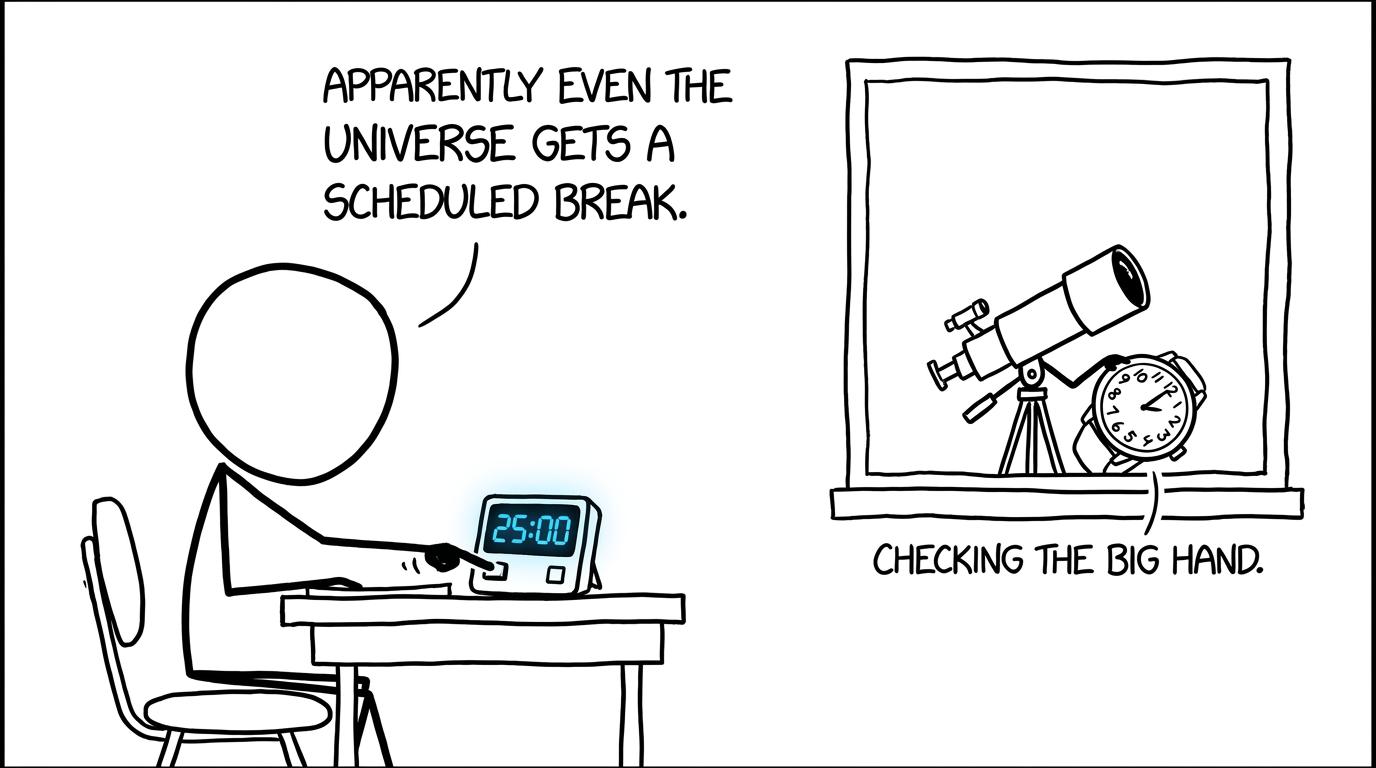 A student and telescope compare revision timers
What the Pomodoro Technique actually does
The traditional routine uses 252525 minutes of focused work followed by a 555-minute break. After several cycles, you take a longer break. The precise numbers are less important than the underlying structure:
focused task→planned break→return\text{focused task} \rightarrow \text{planned break} \rightarrow \text{return}focused task→planned break→returnThis structure reduces the size of the immediate commitment. “Revise cosmology” is vague and intimidating. “Recall the evidence for an expanding Universe for 252525 minutes” is bounded and actionable.
Planned breaks may also stop revision turning into an unfocused stretch of reading, messaging and half-finished questions. Recent studies comparing systematic breaks with self-selected breaks have produced mixed findings, however. Some university students reported better concentration, motivation or lower fatigue with scheduled breaks, while other studies found no clear advantage in productivity, task completion or learning performance. Some participants even experienced faster increases in fatigue under rigid Pomodoro timing.
These studies mainly involved university students rather than GCSE Astronomy candidates. They do not prove that Pomodoro will raise your grade. The fair conclusion is narrower: scheduled breaks can make concentration easier to manage, but no single interval is best for every learner or task.
Why GCSE Astronomy needs more than short bursts
GCSE Astronomy is not simply a collection of facts about planets and stars. The Pearson Edexcel specification combines subject knowledge, mathematical reasoning and observational understanding.
The qualification is non-tiered and has two written papers: Naked-eye Astronomy and Telescopic Astronomy. Each paper lasts 111 hour 454545 minutes and carries 100100100 marks. At least 20%20\%20% of the written examination marks assess mathematical skills, while at least 15%15\%15% assess observational skills. Students must also complete at least one aided and one unaided observation, certified by their centre.
That mix changes how you should use a timer.
Short blocks suit recall and focused maths skills
A single timed block works well for tasks with a clear finish line, such as:
- recalling definitions and stages from memory;
- labelling a diagram without notes;
- converting astronomical units;
- interpreting one graph or data set;
- practising rearrangement and substitution;
- reviewing errors from a previous session;
- answering a small group of questions on one topic.
Astronomy calculations involve skills including ratios, graphs, significant figures, standard form, angles and changing the subject of an equation. If powers of ten are slowing you down, use MathsGenie’s Standard Form revision resources for a focused skills block. For scale comparisons and proportional reasoning, the Ratio revision guide provides another useful bridge between GCSE Maths and Astronomy.
The timer helps here because the target is specific. You are not trying to “do space”. You are training one process until it becomes more reliable.
Longer sessions suit connected reasoning
Some work becomes less effective when it is chopped into identical intervals. Give yourself longer when you are:
- completing an aided or unaided observation;
- planning, analysing or evaluating observational work;
- answering extended-response questions;
- investigating a complicated data set;
- completing a full paper under exam conditions;
- reviewing several connected mistakes;
- deeply engaged in a multi-stage calculation.
Observations are governed by practical conditions, not a kitchen timer. Cloud cover will not respect the end of a revision block. Likewise, stopping halfway through a demanding question can remove the productive struggle that helps you connect ideas.
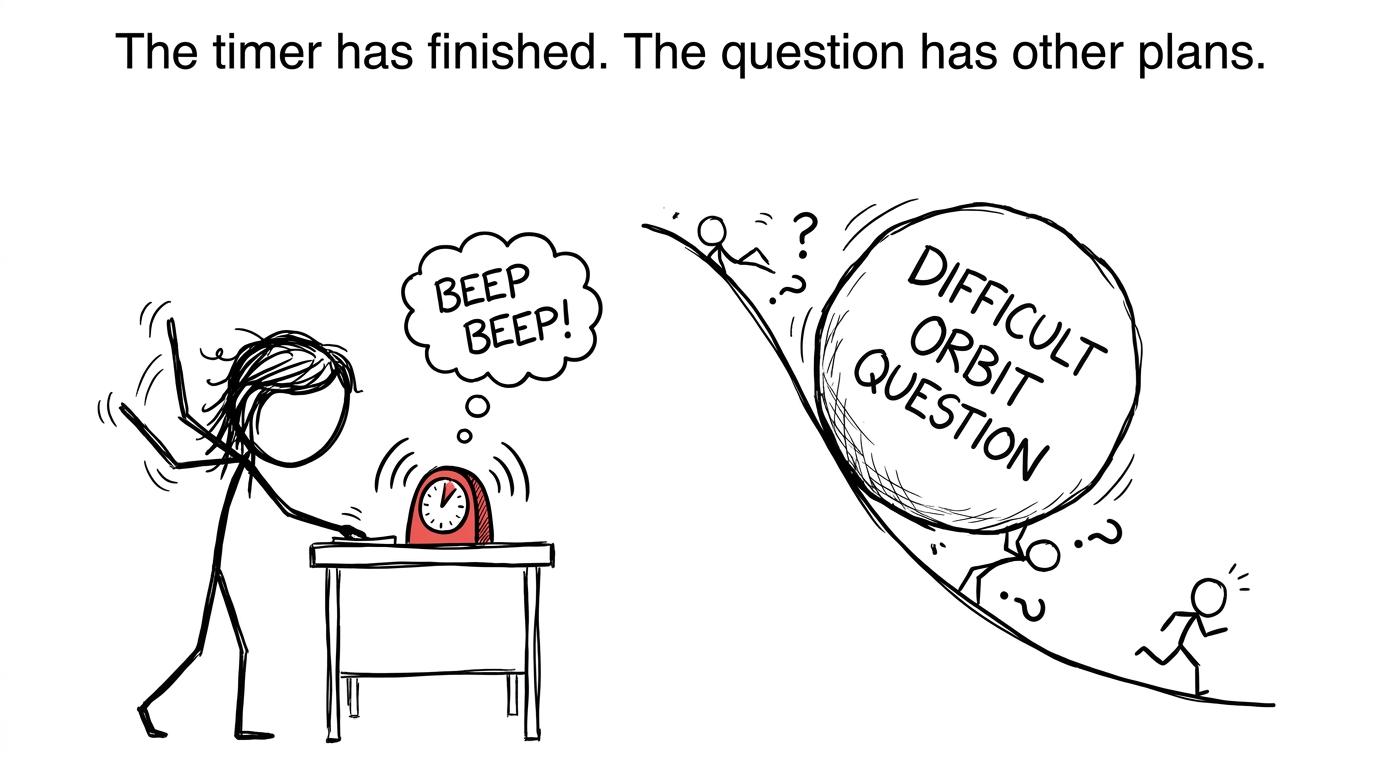 A difficult orbit question ignores the timer
A flexible Pomodoro plan for GCSE Astronomy
The best schedule is not the strictest one. It is the one that repeatedly produces useful work.
Define an outcome before starting
Write a target that can be checked. Good targets include “draw the stellar evolution pathways from memory” or “complete and mark five standard-form questions”. Avoid targets such as “revise stars”, which provide no clear stopping point.
If planning itself is becoming another form of procrastination, use the free MathsGenie revision planner to organise your GCSE Maths priorities alongside Astronomy and your other subjects.
Match the block to the task
Start with one of three formats:
- Short block: 202020 to 252525 minutes for flashcards, definitions or an error review.
- Standard block: 303030 to 404040 minutes for calculations, graphs or focused exam questions.
- Long block: 505050 to 757575 minutes for extended reasoning, paper sections or connected topic review.
These are starting points, not scientific laws. If you regularly reach full concentration after 202020 minutes, a forced stop at 252525 minutes is probably unhelpful. Finish the question or complete the logical section first.
Build retrieval into every cycle
Reading can feel fluent because the page supplies all the answers. Close the book and that confidence may disappear.
Begin each block by recalling what you know without notes. End by answering questions, drawing a diagram from memory or writing a short explanation. Then check it. Research across school and university settings consistently supports retrieval practice, particularly when learners receive feedback and revisit material later.
MathsGenie’s GCSE mini tests demonstrate this short-test principle for maths revision. You can use the same structure for Astronomy: attempt, check, record the gap and return to it later.
Use breaks for recovery, not stimulation
A useful break changes your physical and mental state. Stand up, stretch, drink water or look into the distance. Opening short-form video or social media can turn a planned 555-minute pause into an unplanned disappearance.
Keep the phone outside reach if possible. A separate timer removes the temptation to interact with notifications whenever a block ends.
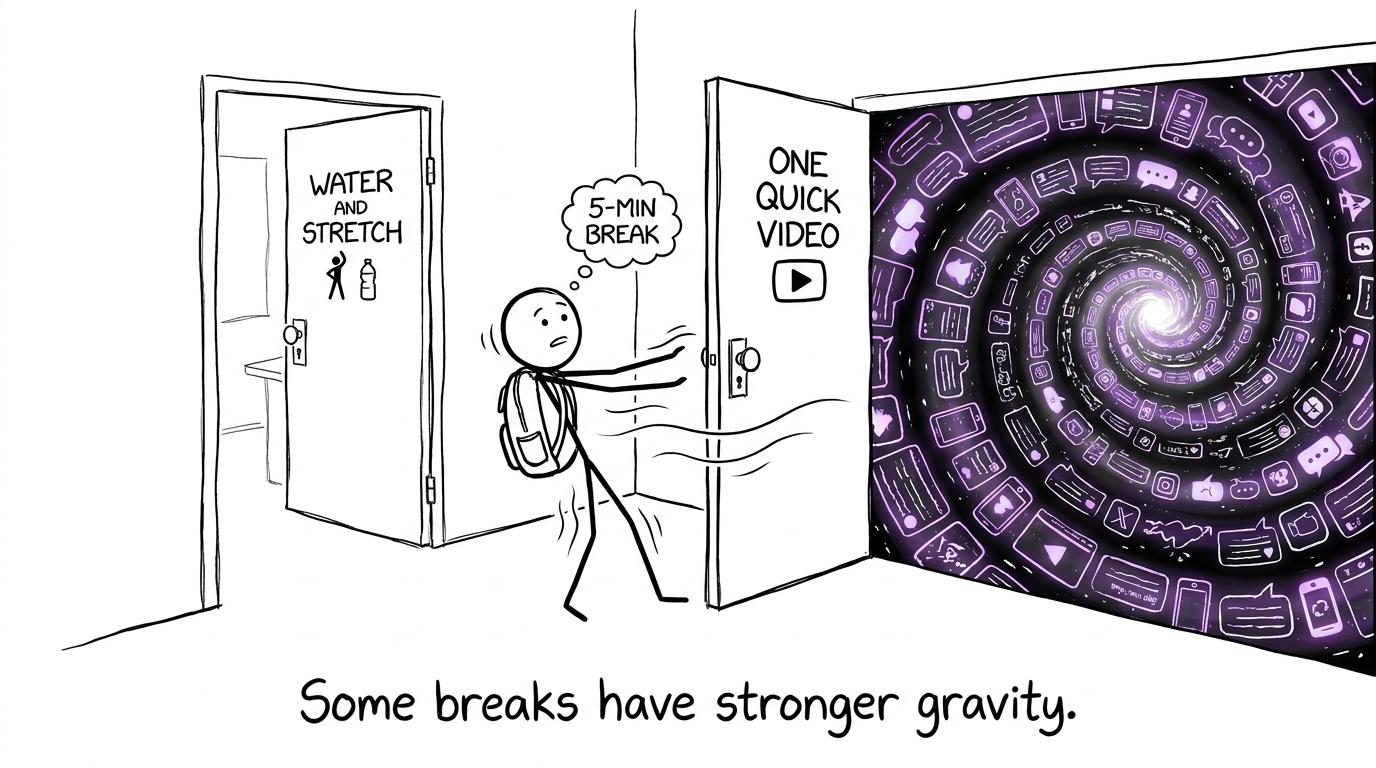 A revision break faces the gravity of phone notifications
Combine Astronomy revision with GCSE Maths practice
Because mathematical skills account for at least 20%20\%20% of the written GCSE Astronomy assessment, improving your underlying maths can make astronomy questions feel less crowded. You can concentrate on the science because fewer mental resources are being spent decoding the calculation.
Use the GCSE Maths revision hub to select the correct exam board and practise relevant number, algebra, ratio, graph and geometry skills. Although Edexcel is the awarding organisation for GCSE Astronomy, your separate GCSE Maths course may be with Edexcel, AQA, OCR, Eduqas, WJEC or CCEA, so use resources matched to the maths paper you will actually sit.
A productive pair of blocks might contain:
- one Astronomy retrieval block;
- one related maths-skills block;
- a break;
- one set of Astronomy questions using that skill;
- immediate marking and an error note.
This is better than spending several cycles rewriting attractive notes. The task moves from knowledge to application, which is closer to what an examination requires.
When to stop using the timer
Abandon or adjust Pomodoro if it repeatedly creates one of these problems:
- you watch the clock instead of the task;
- breaks regularly become longer than work periods;
- you stop whenever reasoning becomes difficult;
- the alarm interrupts concentration at the same stage each time;
- you count completed blocks instead of checking learning;
- short sessions prevent you building exam stamina.
Full papers should eventually be completed under their real time conditions. Short intervals can build the knowledge first, but they cannot fully reproduce a 111 hour 454545 minute Astronomy examination. Maths students face the same progression: topic practice first, then sustained papers. The guide to using GCSE past papers properly explains how to attempt, mark, diagnose and retest rather than treating a paper as a final judgement.
Common Pomodoro mistakes in Astronomy revision
Counting time instead of evidence
Four completed blocks do not automatically equal four blocks of learning. Record an output: questions attempted, ideas recalled, marks earned or errors corrected.
Choosing tasks that are too broad
A whole specification topic may not fit one interval. Break it into knowledge, mathematical application, observations and exam questions.
Stopping in the middle of productive thought
The timer should create a minimum period of attention, not a maximum. When you are making progress on a difficult problem, complete the logical step before resting.
Using passive activities in every block
Highlighting and rereading may help you orient yourself, but they provide weak evidence of what you can reproduce independently. Include retrieval and questions.
Never returning to the topic
Several blocks on one evening are not the same as spaced revision. Revisit important material after a delay. MathsGenie’s one-month GCSE revision plan shows how short retrieval, focused practice and later testing can fit into a wider schedule.
A timer is a tool, not a verdict
The Pomodoro Technique can work for GCSE Astronomy when the main problem is getting started, drifting off task or facing an intimidating specification. It is particularly useful for factual recall, targeted calculations and reviewing mistakes. It is less suitable for observations, full papers and moments when deep concentration has finally arrived.
Start with a manageable block. Set one measurable goal. Retrieve information rather than merely rereading it, mark your attempt and schedule a return. Then lengthen sessions as you move towards exam conditions.
For the mathematical side of your preparation, make MathsGenie your free revision base. Use revision lessons to rebuild weak methods, practice questions and mini tests to test recall, then progress to past papers, predicted papers, mark schemes and video solutions. The timer can help you arrive at the work. Careful practice is what turns that time into marks.