

Podcasts and Audiobooks for GCSE Economics
Podcasts and audiobooks for GCSE Economics can support revision, but not replace exam practice. Learn how to listen actively and build a balanced plan.
Revision can feel productive long before it becomes effective. You put on your headphones, listen to an intelligent discussion about inflation or market failure, and finish feeling more informed. But could you explain the idea without the audio? Could you apply it to a case study under timed conditions?
The short answer is that podcasts and audiobooks for GCSE Economics can help, but they work best as a supplement. They are useful for strengthening vocabulary, context and chains of reasoning. They cannot replace retrieval practice, written questions, quantitative skills or careful use of mark schemes.
The distinction matters. Listening exposes you to knowledge. An examination asks you to retrieve, select, calculate, analyse and evaluate it.
The quick revision checklist
Use listening-based revision when you want to:
- revisit an economics topic you have already encountered;
- hear concepts explained in a different way;
- connect classroom theory with economic events;
- revise terminology during otherwise unused time;
- practise recalling ideas by pausing the recording.
Do not rely on it as your only revision method. A balanced routine should also include:
- specification-based notes;
- closed-book retrieval;
- written exam questions;
- calculations and data interpretation;
- past papers completed under timed conditions;
- mark-scheme analysis.
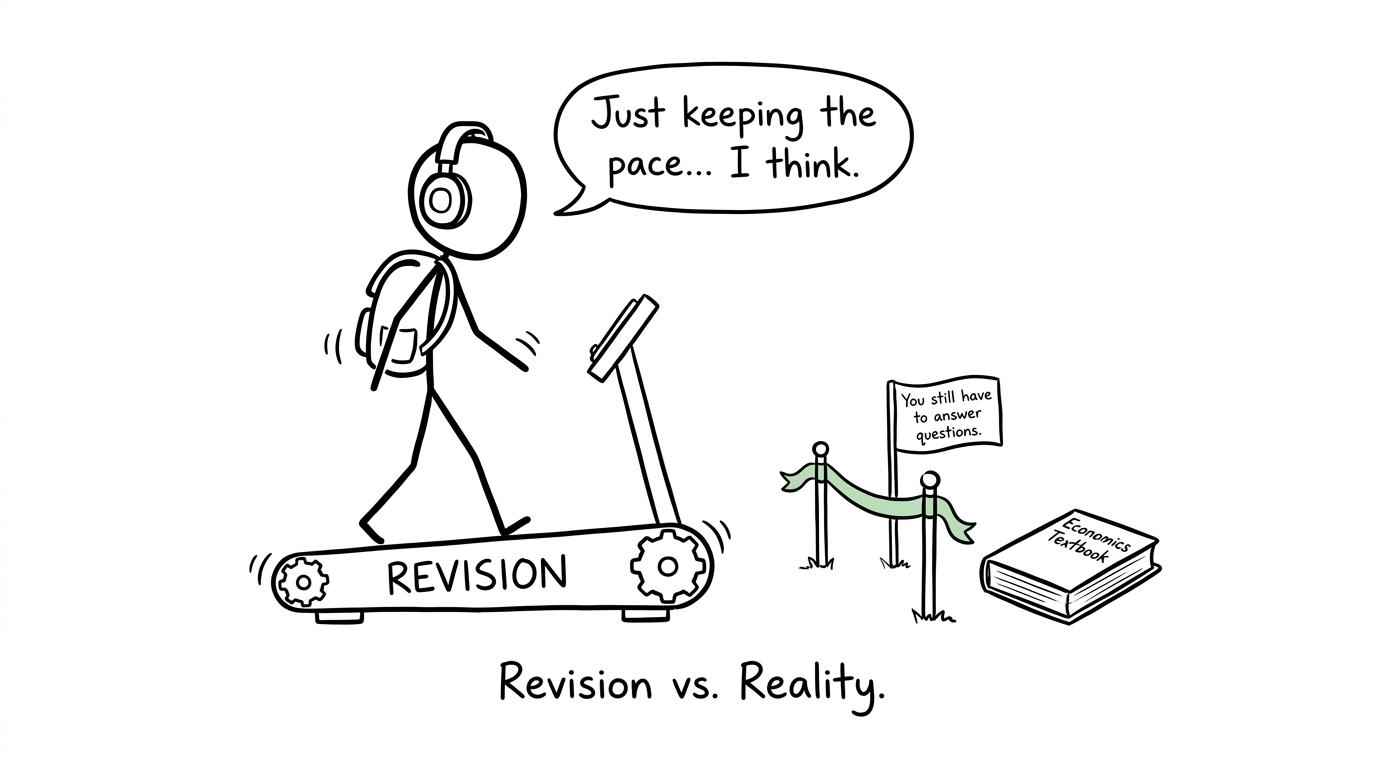 A student discovers that listening is only part of revision
Why economics podcasts and audiobooks can help
Audio has one obvious advantage: it lowers the barrier to starting. Opening a difficult chapter after a long school day can feel demanding. Pressing play feels easier. That makes audio particularly useful when low energy might otherwise mean no revision at all.
They can strengthen economic vocabulary
GCSE Economics contains terms whose everyday and economic meanings are not always identical. Demand, supply, productivity, investment and competition are familiar words, but examination answers require precise use.
Hearing terms used repeatedly in sensible contexts can improve familiarity. A discussion of interest rates, for example, may connect borrowing, saving, consumption, business investment and aggregate economic conditions. Those connections can make isolated definitions easier to remember.
Familiarity is only the beginning, however. After listening, close the app and define the key terms from memory. If you cannot explain a concept clearly, the episode has shown you what to revise next.
They provide context for abstract ideas
Economics becomes easier to understand when theory is connected to decisions made by households, firms and governments. Carefully chosen audio can illustrate why prices change, how incentives influence behaviour or why one policy creates both benefits and costs.
This is particularly helpful for analysis and evaluation. Strong answers do not merely state that a policy is good or bad. They consider its likely effects, affected groups, time period and possible limitations.
Current-affairs programmes must still be treated carefully. They may use terminology beyond your specification, assume prior knowledge or present a particular viewpoint. Use them to add context, not to decide what is examinable. Your exam board's current specification remains the boundary of the course.
They make use of otherwise empty time
Listening while travelling or walking can turn spare time into light revision. But multitasking has limits. If the competing activity demands attention, less of the economics is likely to be processed.
A short, focused listen followed by recall is usually more valuable than a long episode playing in the background. The important measure is not how many hours reached your headphones. It is what you can produce afterwards without them.
Why passive listening is not enough
The uncomfortable truth about passive revision is that recognition feels similar to knowledge. When a presenter explains opportunity cost, the idea may sound obvious. In an examination, the explanation disappears and only the question remains.
That gap is why retrieval practice matters. Trying to recall an idea strengthens access to it and reveals what has been forgotten. Written practice goes further by requiring you to organise knowledge in the form the examination rewards.
GCSE Economics papers may ask you to interpret information, perform calculations and construct extended arguments. Requirements vary across Edexcel, AQA, OCR and Eduqas specifications, so always check the materials for the qualification your school follows. No podcast can reproduce every command word, mark allocation or assessment convention you will meet.
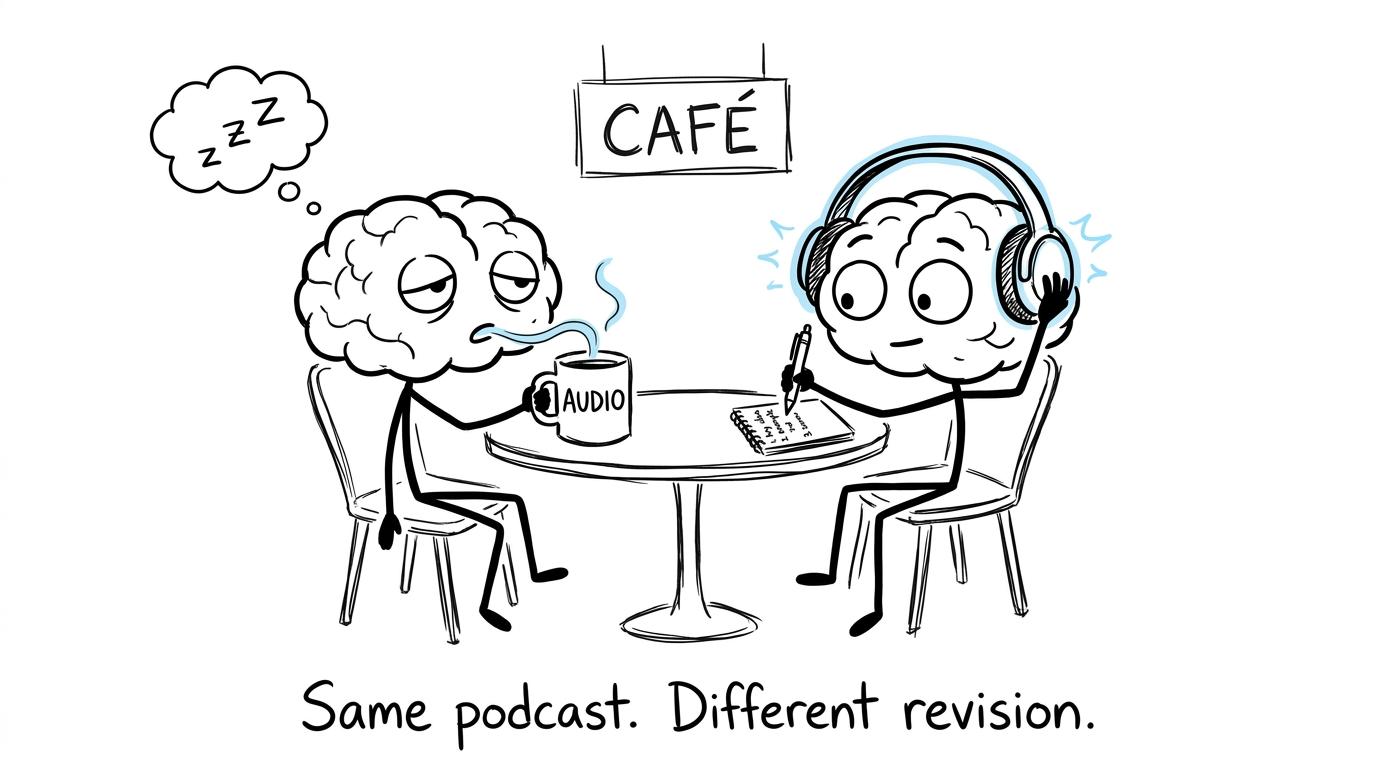 One student listens passively while another pauses to retrieve
How to turn listening into active revision
The value of audio depends less on the platform than on what you do around it. A simple routine can turn entertainment into purposeful revision.
Choose one narrow purpose
Do not begin with the vague goal of revising economics. Choose a topic such as inflation, labour markets, market failure or international trade. Check that it appears in your specification, then select an episode or chapter that genuinely addresses it.
A focused question helps: What are the possible effects of higher interest rates on households and firms? You now have something to listen for rather than merely letting information pass by.
Pause and retrieve
After approximately 101010 to 151515 minutes, pause the audio. Without looking at notes, record:
- three important terms;
- one chain of cause and effect;
- one possible limitation or alternative outcome;
- one point you did not understand.
You can write these down or say them aloud. Then return to the relevant section and check their accuracy. This creates a cycle of input, retrieval and feedback.
Convert ideas into exam output
Listening should lead somewhere visible. Write a definition, produce a short analytical paragraph, annotate a diagram from your course or answer a relevant examination question. Afterwards, compare your response with the mark scheme.
A useful rule is to follow listening with at least one task that does not involve listening. Audio gives you material; independent output shows whether you control it.
Revisit the topic later
One successful recall attempt does not guarantee long-term retention. Return to the topic after a gap and test yourself again. Spacing revision over time is generally more useful than concentrating every encounter into one long session.
A planner prevents enjoyable topics from receiving all your attention while difficult ones remain untouched. MathsGenie's free revision planner can help you organise short, repeated sessions around school and other commitments.
Podcasts, audiobooks and quantitative economics
Audio is least effective when you need to perform a process accurately. Economics questions can involve percentages, percentage change, averages, ratios, index numbers and information presented in charts or tables. You need to see and practise these skills.
For example, the percentage-change relationship is:
Percentage change=changeoriginal value×100\text{Percentage change}=\frac{\text{change}}{\text{original value}}\times 100Percentage change=original valuechange×100Hearing this formula is not the same as selecting the correct original value, substituting accurately and interpreting the result. Those abilities develop through written practice.
If the numerical side of economics feels uncertain, use MathsGenie's GCSE maths revision resources alongside your economics materials. In particular, revise percentages, ratio and averages. These skills also support preparation for foundation or higher tier GCSE Maths.
This is where revision can become more efficient. A secure percentage calculation may earn marks in maths and help you handle economic data more confidently. The subjects are different, but some of the underlying tools travel well.
A balanced weekly approach
Listening should occupy a limited, deliberate place in your revision. A sensible sequence might be:
- begin with the specification and identify one weak topic;
- review the core lesson or textbook material;
- listen to a relevant audio segment;
- pause for closed-book recall;
- complete written or quantitative questions;
- use the mark scheme to diagnose omissions;
- test the topic again several days later.
The precise balance should reflect your needs. If terminology is weak, a little more listening may help. If you understand discussions but lose marks on calculations or extended responses, shift your time towards written practice.
Nearer the examination, complete full papers under realistic conditions. MathsGenie's GCSE maths past papers provide that experience for your maths preparation, while predicted papers can add fresh practice. Use equivalent official materials from your Economics exam board for Economics itself.
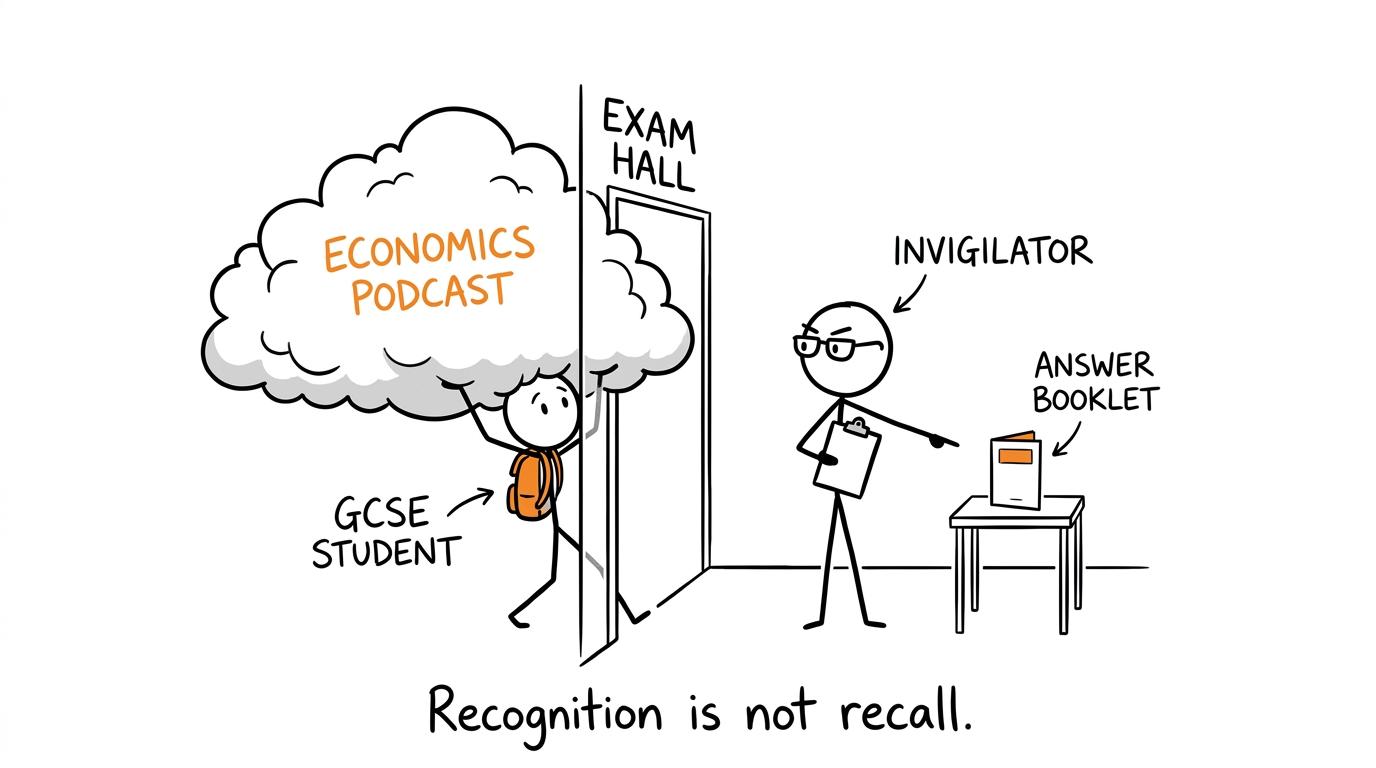 A cloud of remembered audio meets an empty exam answer booklet
Common mistakes with audio revision
Counting listening time as proof of progress
Finishing a six-hour audiobook is an activity, not evidence of learning. Test what you remember and can apply. Output is a better guide than listening time.
Choosing interesting but irrelevant content
A programme may be excellent without matching your GCSE specification. Check the episode against your topic list before investing time in it.
Listening while attention is elsewhere
Audio playing during gaming, scrolling or complex homework is often background noise. Reserve demanding content for moments when you can pause and think.
Copying the presenter's judgement
Economic issues often involve trade-offs. A confident opinion is not automatically balanced evaluation. Ask what assumptions support the claim, who might be affected differently and whether the outcome changes over time.
Avoiding written and numerical practice
Students often repeat the revision method that feels most comfortable. Yet improvement usually requires practising the thing the examination asks you to do. Use MathsGenie mini tests to build short bursts of mathematical practice, then apply the same disciplined approach to Economics questions.
Listening helps most when it leads to action
Podcasts and audiobooks can make GCSE Economics more vivid. They can give technical vocabulary a context, reveal connections between topics and make revision easier to begin. But their value is conditional.
Pause. Retrieve. Write. Calculate. Check.
That sequence turns listening from passive exposure into useful preparation. Keep audio as one part of a broader plan, and let questions and mark schemes show whether the knowledge is becoming usable.
For the mathematical skills behind data-heavy subjects, start with MathsGenie's free revision lessons and practice questions. Then build towards mini tests, past papers and predicted papers. Headphones can open the door, but deliberate practice is what carries you through it.











