Podcasts Audiobooks GCSE Bengali: Do They Help?
Podcasts audiobooks GCSE Bengali advice: discover when listening helps, why it is only a supplement and how to make audio revision more active.
Revision audio makes an attractive promise: press play, carry on with your day and somehow arrive at the exam knowing more. If you searched for podcasts audiobooks GCSE Bengali, the direct answer is that listening can genuinely help with vocabulary, comprehension, pronunciation and familiarity with spoken Bengali. But it works best as a supplement. It cannot replace speaking practice, reading Bengali script, written answers or questions that match your specification.
That distinction matters. Hearing a familiar word can create a feeling of recognition, but an exam asks you to understand it in context, retrieve its meaning and sometimes produce it yourself. Listening becomes useful revision when you pause, recall, respond and check, not when the audio simply fills the silence.
The quick verdict
Use podcasts and audiobooks for GCSE Bengali when you want to:
- hear natural pronunciation, rhythm and intonation;
- improve comprehension of different voices and speaking speeds;
- revisit vocabulary from specification themes;
- turn travel or other quiet moments into light review;
- create prompts for speaking and writing practice.
Do not use them as a replacement for:
- specification-matched listening questions;
- Bengali reading and translation;
- speaking with another person;
- writing under timed conditions;
- feedback from a teacher or mark scheme.
The strongest approach is simple: listen, pause, retrieve, produce and check.
Why listening matters in GCSE Bengali
Before choosing resources, confirm your qualification with your teacher or exam timetable. AQA GCSE Bengali and Pearson Edexcel International GCSE Bangla are different qualifications with different assessment structures. Do not assume that advice or material labelled “Bengali GCSE” matches the paper you will sit.
Under the current AQA GCSE Bengali specification, listening, speaking, reading and writing each contribute approximately 25%25\%25% of the qualification. Students take all papers at the same tier: Foundation covers grades 111-555, while Higher covers grades 444-999.
That makes listening important, but it also reveals the limitation of audio-only revision. Even excellent listening practice directly trains only part of the course. It may support pronunciation, vocabulary and speaking confidence, yet it does not give you enough practice in reading Bengali script or constructing accurate written responses.
There is another important detail: GCSE listening is not simply about following an interesting story. You must identify precise information, distinguish opinions, cope with unfamiliar wording and answer in the required language or format. General audio exposure can build familiarity, but exam-specific questions teach you how that familiarity must be converted into marks.
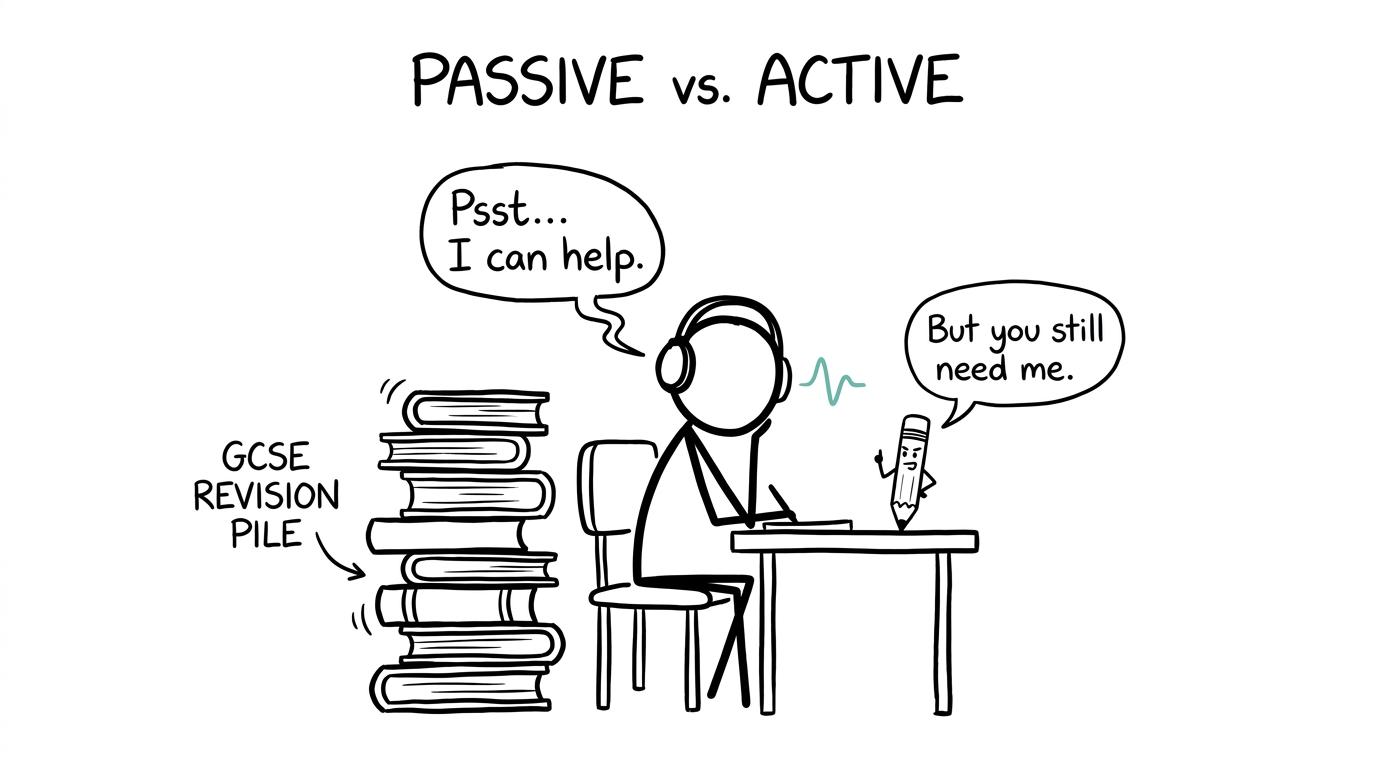 A student, headphones and a pencil debate the limits of passive revision
What podcasts can do well
Podcasts are usually strongest when they are short, focused and close to a GCSE theme. The AQA themes include identity and culture, local and global issues, travel, education and future employment. An episode connected to school life, technology, festivals or the environment can therefore reinforce useful topic language.
A podcast also exposes you to connected speech. Vocabulary lists present words as neat individual objects. Real speech joins them together, changes the pace and surrounds them with other information. Becoming comfortable with that uncertainty is valuable preparation for a listening paper.
Choose an episode that is challenging enough to contain some unfamiliar language but not so difficult that you lose the meaning completely. Ideally, it should have a reliable transcript or summary. A transcript lets you check whether you genuinely heard a phrase rather than guessed it from the topic.
Podcasts are particularly useful for:
- short, repeatable listening sessions;
- contemporary topics and opinions;
- hearing conversational language;
- practising summaries after each section;
- collecting phrases for later speaking practice.
However, a general entertainment podcast may contain regional vocabulary, advanced expressions or topics outside the specification. That is not inherently bad, but it should not take priority over your required themes and exam tasks.
Where audiobooks fit
Audiobooks offer something slightly different. A longer narrative can build sustained concentration and help you follow meaning across several sentences rather than hunting for isolated words. They may also introduce richer vocabulary and more varied sentence structures.
The drawback is alignment. A novel or story is unlikely to follow GCSE themes, reproduce listening-paper pacing or ask you to extract the exact details an examiner wants. Literary language may also be less useful for a role-play, photo card or conversation about everyday experiences.
For most students, an audiobook is therefore enrichment rather than core revision. It is most useful if you already understand the plot, can access the written text, or choose a short section that you are willing to replay closely. If the language is far above your current level, the experience may become prolonged guessing rather than productive practice.
A sensible division is:
- use podcasts for short thematic listening and spoken opinions;
- use audiobooks for sustained comprehension and wider exposure;
- use specification questions and past materials for direct exam preparation.
Turn listening into active revision
Research on learning consistently distinguishes between exposure and retrieval. Hearing information again may make it feel familiar. Trying to recall it without support gives you better evidence of whether it is available when needed. Systematic reviews of classroom research generally find that retrieval practice benefits learning across subjects and age groups, although evidence specifically testing podcasts for GCSE Bengali is limited.
Preview with a purpose
Before pressing play, choose one target. You might listen for opinions, time phrases, reasons, future plans or vocabulary connected to a particular theme. A clear target prevents the session from becoming background noise.
Listen without the transcript
Play a short section once. Note only the main idea and a few details. Do not stop at every unknown word. GCSE listening rewards the ability to continue even when one phrase is unclear.
Pause and retrieve
Stop the recording and say what you remember in Bengali or English, depending on your goal. Then write several keywords from memory. This is the moment that turns listening into revision: the information must come from you rather than the speaker.
Replay and check
Listen again before opening the transcript. Identify what changed between your first and second understanding. Then check the text, dictionary or teacher-approved notes. Record misunderstandings precisely, such as confusing a negative, missing a time reference or mistaking one speaker’s opinion for another’s.
Produce something new
Finish by giving a spoken summary, answering a related question or writing a short response. Production connects listening to the speaking and writing parts of the qualification. It also reveals vocabulary that you recognise but cannot yet use independently.
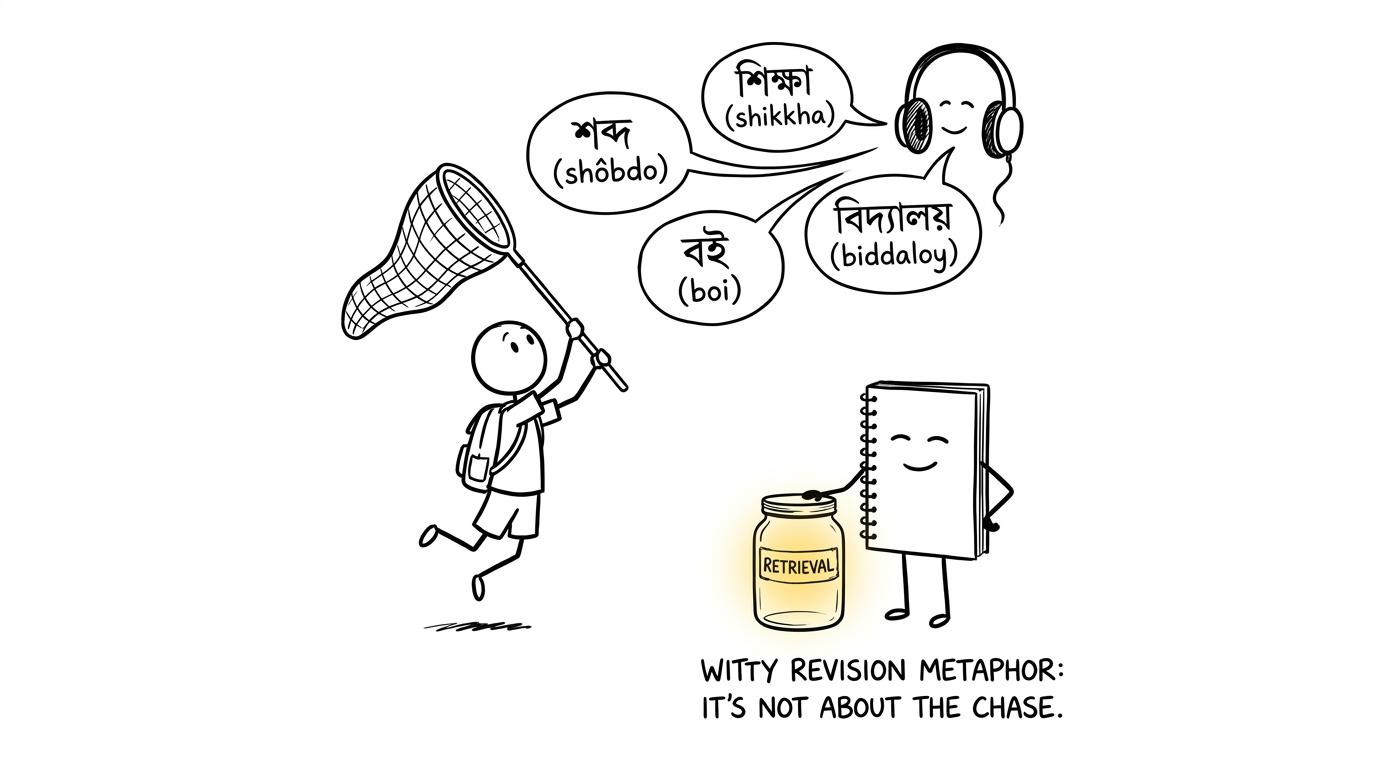 A student catches floating vocabulary while a notebook stores retrieval practice
A practical listening routine
A useful session can be brief:
- Before listening: choose one GCSE theme and one listening target.
- First play: identify the overall message without a transcript.
- Pause: recall the important details aloud.
- Second play: check details and notice language you missed.
- Transcript check: confirm vocabulary, tense and negatives.
- Production: give a summary or answer a related speaking prompt.
- Later revisit: return to the same extract on another day.
Keep a small error log. Categories might include vocabulary, speed, pronunciation, negatives, tense and lost concentration. Over time, patterns become visible. A vague belief that “listening is hard” can then become a manageable observation such as “I often miss opinions introduced after a contrast”. Specific problems are easier to fix.
You can organise Bengali alongside your other subjects with the free MathsGenie revision planner. Give audio a defined place in the week rather than allowing it to replace whichever task feels harder.
Should you listen while revising maths?
Usually, no. Bengali speech competes for attention with reading, reasoning and holding information in working memory. A familiar voice may feel calming, but listening closely and solving a multi-step maths question are both attention-demanding tasks.
Keep podcasts for walking, travelling or a dedicated language session. When practising maths, work in quiet conditions that resemble the exam. The GCSE Maths revision hub provides revision lessons, practice questions and board-specific resources for Edexcel, AQA, OCR and Eduqas. You can then test recall with GCSE Maths Target Tests rather than mistaking background familiarity for secure knowledge.
This separation is especially useful when deadlines collide. Audio can occupy a low-distraction part of the day; desk time can be protected for written Bengali and maths questions. MathsGenie’s twenty-minute maths revision routine offers a compact structure when several GCSE subjects need attention.
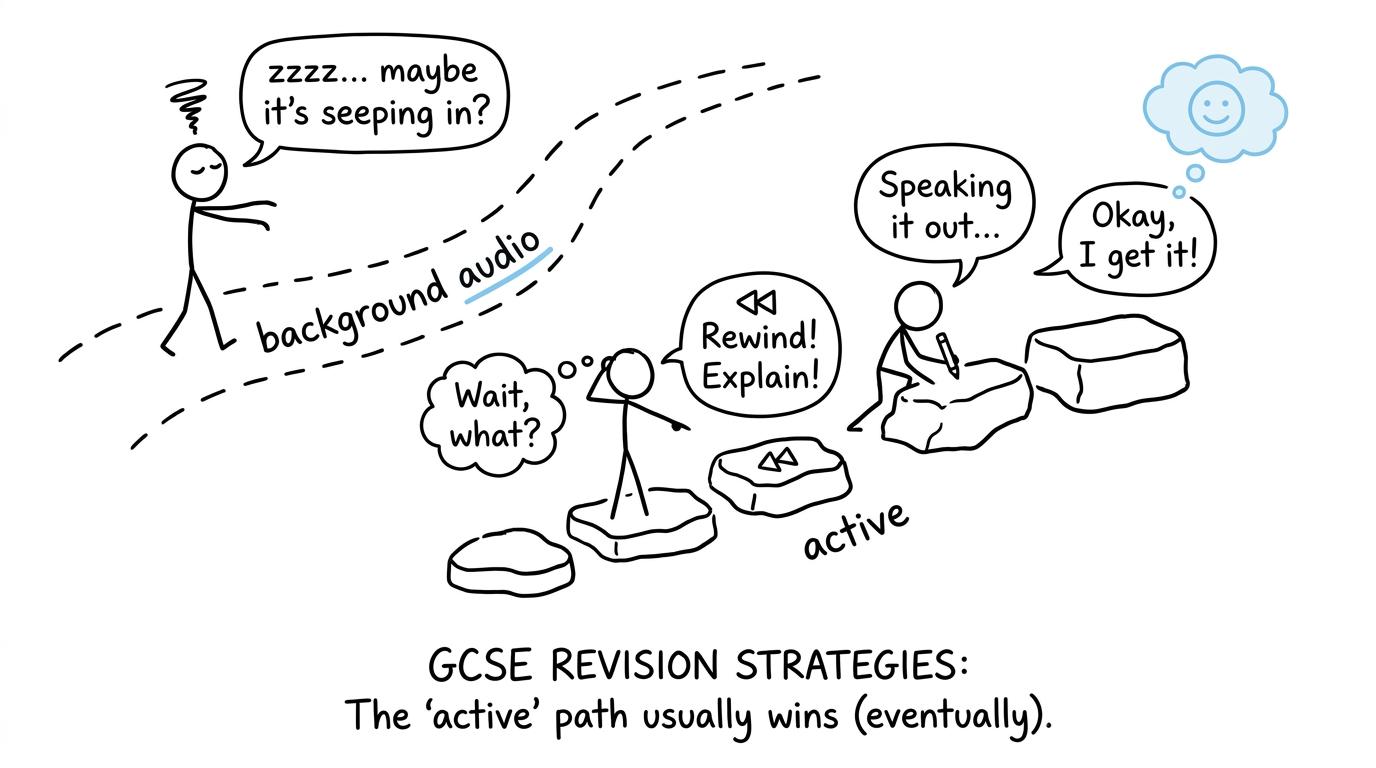 Two revision paths contrast background audio with active listening habits
Common mistakes with podcasts and audiobooks
Counting listening time instead of learning
An hour of audio is not automatically an hour of revision. Judge the session by what you can recall, explain or use afterwards.
Choosing material that is too difficult
Constantly hearing unfamiliar language can feel impressive while producing little usable understanding. Select material where the main message is accessible, then increase the difficulty gradually.
Never checking a transcript
Repeated listening is useful, but unchecked guesses can become habits. Use a trustworthy transcript when available and verify important vocabulary.
Avoiding speaking and writing
Recognition is not production. After listening, create a spoken or written response so that passive vocabulary becomes usable language.
Ignoring the exact qualification
AQA GCSE Bengali and Edexcel International GCSE Bangla do not have identical assessment models. Check the official specification and follow your teacher’s guidance before building a revision plan.
Playing Bengali audio during maths practice
Multitasking can make both activities feel easier because neither receives full attention. Use focused blocks instead. For maths, follow the paper-mark-fix cycle explained in how to use GCSE past papers properly, then practise under timed conditions with Edexcel GCSE Maths past papers if that is your board.
Build a balanced revision week
Listening should sit inside a wider plan. Pair it with Bengali reading, speaking, writing and specification-based questions. Then protect separate sessions for maths, where marks depend on carrying out methods rather than recognising explanations.
If exams are approaching, the GCSE one-month maths revision plan can help you balance topic work, retrieval and paper practice. It is also worth understanding when to start GCSE past papers, because completing papers early enough leaves time to repair the weaknesses they reveal.
The broader lesson applies to both subjects. Resources do not create progress merely by being consumed. Progress comes from responding: retrieving a Bengali phrase, completing a maths question, checking the result and trying again.
Listening helps when you make it work
Podcasts and audiobooks can improve GCSE Bengali listening confidence, vocabulary and familiarity with natural speech. They are worthwhile additions, especially when used in short, purposeful sessions. But they remain additions. Your grade also depends on reading, writing, speaking and the ability to handle the exact tasks in your qualification.
Listen actively. Pause before the answer arrives. Say what you understood. Check what you missed. Then produce language of your own.
For the maths part of your GCSE timetable, make MathsGenie’s free GCSE revision resources your next stop. Use revision lessons to rebuild methods, practice questions and mini tests to retrieve them, then past papers, predicted papers, mark schemes and video solutions to turn understanding into exam-ready performance.