

How to Plan Revision for a December Birthday Year 11
How to plan revision for a December birthday Year 11: protect your celebration, prepare for mocks and create a realistic GCSE schedule you can follow.
Imagine a Year 11 student called Sam. Their birthday falls in December, Christmas is approaching and January mocks may be waiting after the holiday. Enjoying a day off starts to feel like falling behind.
If you are wondering how to plan revision for a December birthday Year 11, start by protecting your celebration, then arrange focused revision around it. Confirm your mock dates, identify weaker topics and leave room for rest. Your birthday can be a fixed point in the plan, without becoming another revision day.
Your December revision checklist
Before filling a timetable:
- Confirm mock dates and assessed topics with your school.
- Add birthday plans, family commitments and rest days.
- Identify weaknesses using recent assessments and teacher feedback.
- Set specific tasks for short revision sessions.
- Leave catch-up space and review progress weekly.
A workable timetable reflects the month you actually have. Planning every available hour leaves little room for homework, tiredness or changing arrangements.
Start with the birthday
Sam might be tempted to schedule every GCSE subject first and squeeze the celebration into whatever space remains. Reverse that order.
Block out the birthday, any separate celebration and travel or family visits. If you expect a late night, allow for a slower start the following morning. These commitments belong inside your plan.
Protecting time off removes the daily argument about whether you should be revising. It also helps you place demanding tasks on days when you can concentrate. If birthday plans change, move a session into spare space rather than cancelling rest altogether.
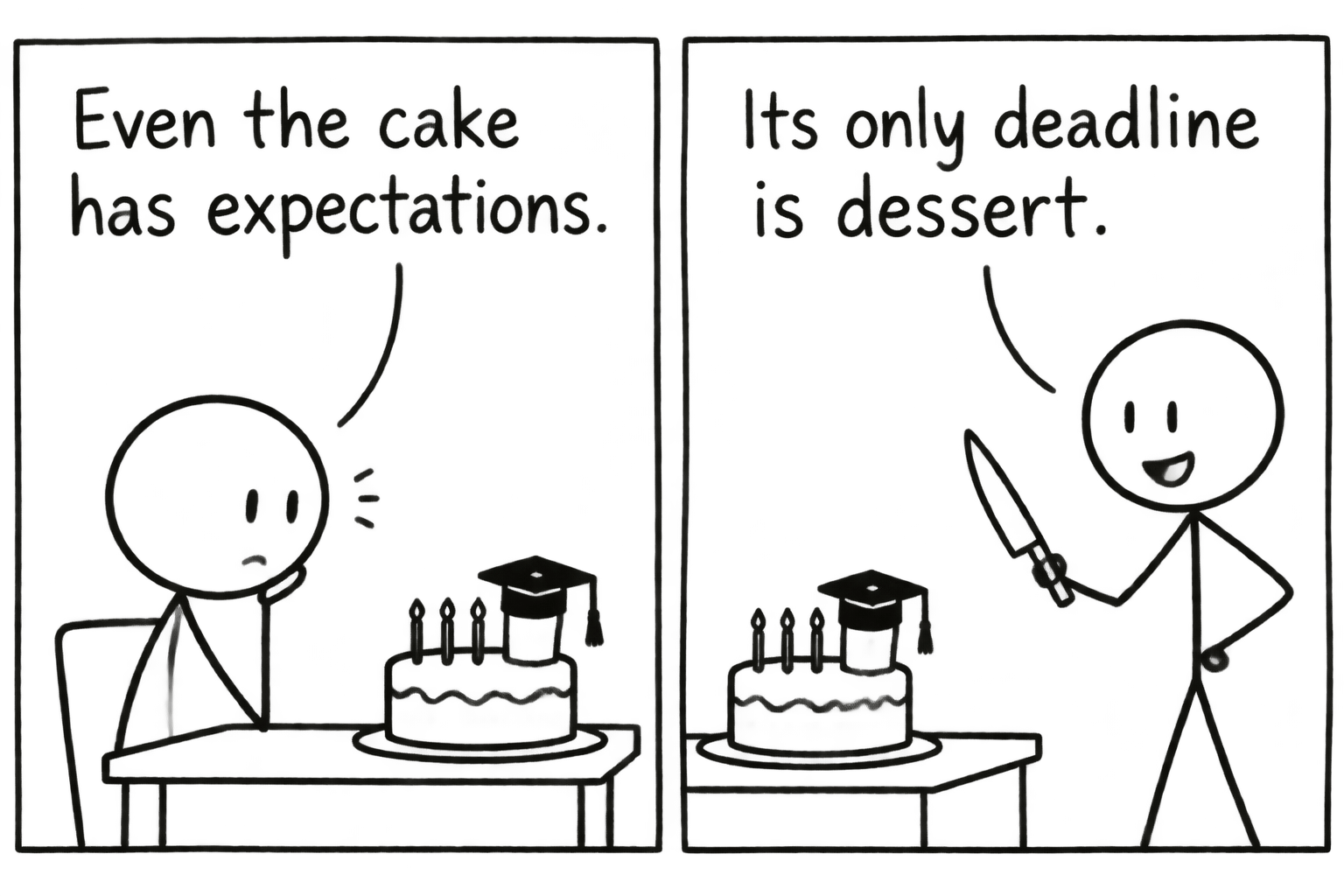 A student discovers that birthday cake has fewer deadlines than GCSE revision
Build a three-phase December plan
An ordinary school week, birthday week and the Christmas holiday need different workloads.
| Phase | Main aim | Suggested pattern |
|---|---|---|
| Before the birthday | Identify weaknesses and build momentum | Short sessions on selected evenings |
| Birthday week | Enjoy the celebration and maintain continuity | Lighter tasks around a protected day off |
| Christmas holiday | Consolidate learning and prepare for mocks | Focused sessions alongside planned rest days |
Before the birthday
Look through assessments, homework and teacher feedback. Label topics as secure, uncertain or weak, then choose a manageable number of priorities.
For maths, use the GCSE Maths revision hub to locate relevant resources. Check that your choices match your exam board, foundation or higher tier, and the topics your school has taught.
Try sessions lasting around 30−4530-4530−45 minutes if that fits your evenings. Treat this as a starting point, adjusting for concentration and homework. Give each session an outcome, such as completing and marking questions on simultaneous equations.
During birthday week
Keep the birthday free and reduce the surrounding workload. Suitable lighter tasks include recalling vocabulary, checking flashcards or correcting questions attempted earlier.
Avoid compensating with an exhausting session beforehand. If you miss planned work, use a catch-up slot and reconsider its priority. Moving every unfinished task to the next evening can make the timetable unmanageable.
Over the Christmas holiday
Choose full rest days first, then add revision to the remaining dates. If mocks follow the break, prioritise the content your school says will be assessed.
The GCSE Statistics Christmas revision plan and GCSE French Christmas revision plan offer subject-specific ways to organise holiday work. Use ideas that fit your subjects and commitments.
A session can move through recall, questions, marking and correction. Leave enough time for the final stages: unfinished marking hides the information you need for tomorrow's plan.
Choose techniques that reveal progress
Reading notes can help you revisit an explanation, but you also need to check what you can remember independently. Close the book, recall the main ideas, then compare your answer with the source and correct omissions.
Return to that material on another day. Mixing new work with earlier topics gives you opportunities to check whether learning has lasted.
For maths, combine revision lessons with practice questions. Mark your answers and identify whether an error came from misunderstanding, arithmetic or misreading the question. MathsGenie's video solutions can help you examine a method when written corrections are unclear.
The guide to using GCSE past papers properly explains how marking and reviewing support practice. Use GCSE past papers organised by exam board when you need mixed questions and timing practice.
Topic questions suit rebuilding a weak method. Mini tests can provide a shorter check before you attempt a full paper. Predicted papers can add practice, but should not determine which specification topics you leave out.
Make each timetable entry specific
The GCSE maths revision timetable guide provides a broader planning framework. For December, write entries that tell you exactly how to begin:
- Recall cell division, then correct missing stages.
- Plan an English Language response under timed conditions.
- Practise trigonometry questions appropriate to your tier and mark them.
- Reattempt algebra questions missed in a recent assessment.
Review the week by asking what you completed, what remains uncertain and what needs moving. Use those answers to choose the next tasks.
Common mistakes to avoid
Treating the birthday as lost time. A planned celebration fits within steady revision. Resume your routine afterwards without adding a punishment session.
Giving every subject equal time. Prioritise weaknesses and upcoming assessments while keeping stronger subjects in rotation.
Filling every gap. Leave catch-up space for unexpected homework or changed plans. A timetable needs some flexibility to remain useful.
Counting hours instead of learning. Look for completed questions, corrected misconceptions and successful later attempts.
Stopping at the mark scheme. Understand why an answer lost marks, then try the question again independently. Recording a correction is only the beginning.
Give December a manageable job
Sam's plan needs to support schoolwork, protect the birthday and make weaker topics easier to tackle. It can change as December unfolds.
Start with your dates and priorities, then build your December-to-mocks schedule with the MathsGenie Revision Planner. Use MathsGenie's free revision resources to turn each planned session into practice, feedback and a clear next step.















