GCSE French Christmas Holiday Revision: A Fair Plan
GCSE French Christmas holiday revision made manageable: use short, balanced sessions, protect family time and return with a clear January plan.
The Christmas break creates a strange kind of pressure. You know mocks and GCSE exams are getting closer, yet you also know that a holiday filled with timetables, flashcards and guilt is not much of a holiday.
The reasonable answer to GCSE French Christmas holiday revision is usually three to five focused sessions each week, lasting around 202020 to 303030 minutes. Students with January mocks may need slightly more, but French should not consume every day. The aim is to keep vocabulary and grammar active, practise all four language skills and identify what needs attention in January, while leaving room for family, friends, sleep and other subjects, especially maths.
A reasonable revision checklist
A balanced Christmas plan should:
- include several completely revision-free days;
- use short sessions rather than exhausting marathons;
- revisit vocabulary through active recall;
- cover listening, speaking, reading and writing;
- focus more time on genuine weaknesses;
- leave space for GCSE maths and other subjects;
- become lighter around important family days;
- finish with a simple plan for returning to school.
This is maintenance with purpose, not an attempt to relearn the entire French course in a fortnight.
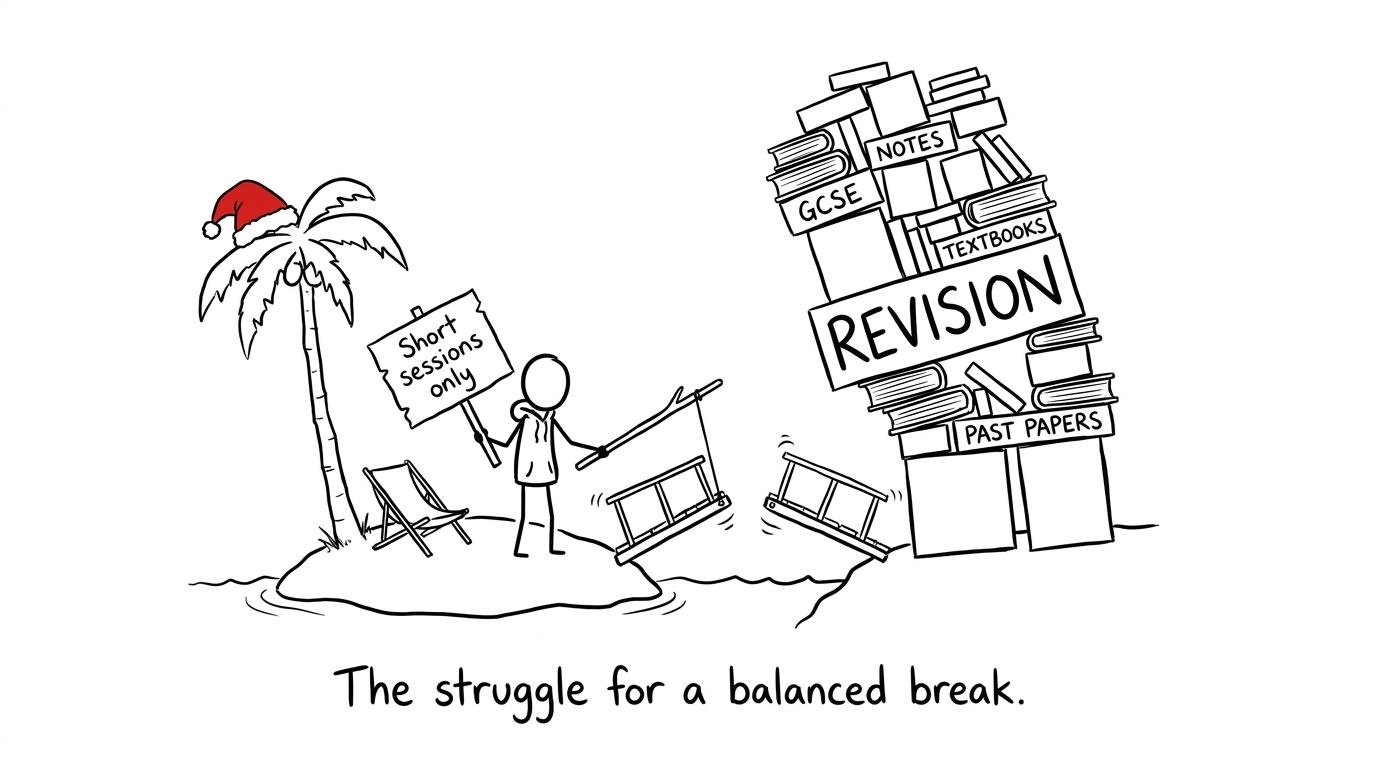 A student protects a peaceful Christmas holiday from an oversized revision pile
How much GCSE French revision is reasonable at Christmas?
For most students, a sensible starting point is between 606060 and 150150150 minutes of French across an ordinary holiday week. That might mean three 202020-minute sessions, five 252525-minute sessions or another arrangement that fits your plans.
The exact amount depends on three things.
How close your mocks are
If your mocks begin immediately after Christmas, four to six short sessions each week may be appropriate. You might also complete one longer exam-style task near the end of the break.
If mocks are later, three or four brief sessions can be enough to prevent important vocabulary and grammar from becoming rusty. There is little value in completing a full paper every day when targeted practice would expose the same weakness more efficiently.
How secure your French currently feels
A student who can recall key vocabulary but struggles to understand recordings needs more listening, not more beautifully organised notes. Someone who communicates confidently but loses accuracy in writing should prioritise verbs, agreements and translation.
Let evidence decide. Look at your latest assessment, teacher feedback and corrected work. Choose two or three weaknesses rather than writing “revise French” on every available morning.
The same principle improves maths revision. The GCSE Maths topics by exam board and tier guide can help you create an equally specific shortlist for foundation or higher tier maths.
What else is competing for your time
GCSE French is only one subject. If maths, English and science mocks are also approaching, an enormous French timetable will simply displace work elsewhere.
Think in terms of a whole-week budget. Decide how many focused blocks you can complete without damaging sleep or family plans, then distribute those blocks across your subjects. MathsGenie's free GCSE Maths revision hub makes shorter maths blocks practical because lessons, topic questions, papers and solutions are organised in one place.
Revise the four French skills, not just vocabulary
Current GCSE French courses assess listening, speaking, reading and writing. The precise task format depends on your exam board and specification, so confirm whether you study AQA, Edexcel, OCR or Eduqas and use the materials recommended by your school.
Vocabulary matters in every skill, but knowing a word on a flashcard is not the same as recognising it at natural speed or using it accurately in a sentence.
Listening
Use short recordings that match your specification. Listen once for the overall meaning, then again for details such as negatives, opinions, time phrases and changes of tense.
Do not pause after every unfamiliar word. GCSE listening questions often require you to keep following the message even when one part is unclear. If your specification includes dictation, include brief transcription practice and check accents, verb endings and sound-spelling links carefully.
Speaking
Speaking revision can be small and frequent. Read a short passage aloud, answer familiar questions without a script or describe a picture into your phone's voice recorder. Listen back for clarity rather than expecting a perfect accent.
For current specifications, tasks may include activities such as role-play, reading aloud, visual stimuli and conversation, depending on the board. Practise the tasks your teacher has identified rather than relying on memories of an older exam format.
Reading
Choose a short text and answer questions without translating every sentence. Mark words that signal contrast or time, then infer unfamiliar vocabulary from the surrounding sentence.
Translation from French into English should sound natural while preserving the original meaning. An answer can contain recognisable English words and still be inaccurate if it changes who performed an action, misses a negative or uses the wrong tense.
Writing
Alternate between short translation tasks and exam-style responses. Plan briefly, write from memory and check your work using a fixed checklist:
- Have the verbs got clear subjects?
- Are adjective agreements accurate?
- Have negatives been completed?
- Are spellings and accents correct?
- Does every sentence answer the task?
- Have different time frames been used where appropriate?
Writing an enormous answer is not automatically better. Controlled, relevant French is more valuable than ambitious language that you cannot use accurately.
What should one revision session contain?
A productive session does not need to fill an afternoon. A simple structure is:
- Recall: test vocabulary or grammar without notes for about 555 minutes.
- Apply: complete one listening, speaking, reading or writing task for 101010 to 151515 minutes.
- Check: compare your work with an answer, transcript or teacher guidance.
- Record: write down one specific error to revisit after a gap.
The checking stage matters. Revision is not merely producing work; it is discovering what your memory cannot yet do reliably.
Spacing sessions across the holiday gives you repeated opportunities to retrieve material. This is generally more useful for long-term retention than placing the same revision time into one final-day cram. It also makes the holiday feel less dominated by schoolwork.
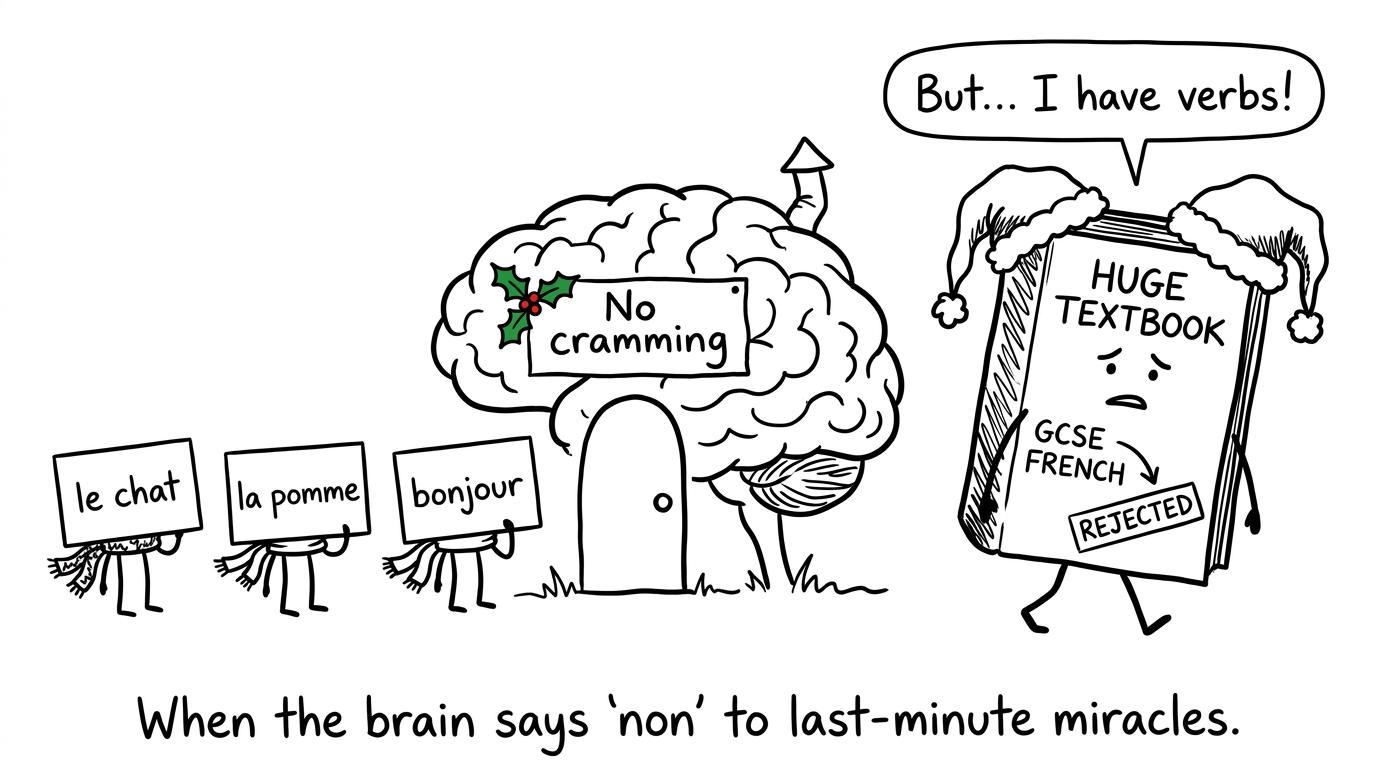 French flashcards enter a brain cottage while a giant cramming textbook is turned away
A flexible Christmas holiday plan
Plan around real life first. Mark family events, travel, celebrations and days when you want no academic work. Revision should fit into the remaining space rather than treating every free hour as available.
At the beginning of the break
Complete a light diagnosis. Review recent French work and select:
- one vocabulary area;
- one grammar weakness;
- one receptive skill, either listening or reading;
- one productive skill, either speaking or writing.
Avoid beginning with a full-course checklist. Christmas revision works best when its purpose is narrow enough to finish.
Through the middle of the holiday
Use short, alternating sessions. You might revise vocabulary and listening on one day, then grammar and speaking after a gap. Mixing skills prevents French revision from becoming a stack of repetitive flashcard sessions.
Keep Christmas Eve, Christmas Day or any other important occasion free if that matters to you. A planned day off is not failed revision. It is part of a sustainable timetable.
Before returning to school
Use one final session to test what has improved. Reattempt a task, recall the same vocabulary or record another spoken response. Then write a short January priority list.
Do not turn the final evening into an emergency marathon. Sleep and a calm return to routine are more useful than exhausted late-night cramming.
How to balance French with GCSE maths
Language revision benefits from frequent recall. Maths usually requires a combination of remembering methods and applying them to unfamiliar questions. That difference allows the subjects to sit together without competing for the same kind of attention.
You could place a brief French recall session beside a focused maths topic block. For maths, choose a precise skill, use a revision lesson, answer questions and mark them. The best order for learning GCSE Maths topics can help if you are unsure what to tackle first.
If you study AQA Maths, the AQA GCSE Maths revision area keeps foundation and higher resources aligned with the correct board. Whatever your board, avoid using every holiday session for full papers. Topic work is often more helpful when you are still repairing gaps.
When you do complete a paper, remember that the learning occurs during the review. MathsGenie's guide to using GCSE past papers properly explains how to mark, log errors and retest weak topics rather than simply collecting scores.
Common Christmas revision mistakes
Planning every day in detail
An inflexible timetable collapses as soon as plans change. Choose weekly priorities and movable revision blocks instead. This gives structure without turning a missed Tuesday session into a crisis.
Spending all the time making resources
Creating a few useful flashcards is reasonable. Recopying every vocabulary list is usually passive and slow. Cover the answers, retrieve from memory and check immediately.
Revising only favourite topics
Familiar topics feel productive because they produce quick success. Your latest marked work provides a better guide. Spend more time on recurring errors, even when they are less comfortable.
Ignoring speaking until school returns
Speaking needs retrieval under pressure. Several short spoken responses over Christmas are more realistic than trying to rebuild fluency immediately before an assessment.
Sacrificing the whole holiday
More time is not always better time. Tired, resentful revision often becomes passive. Protect sleep, movement, family time and genuinely free days.
Letting maths disappear completely
French may be the immediate concern, but maths skills also become less secure without practice. If you are struggling around a pass grade, the guide to GCSE Maths revision when you are stuck at a pass offers a focused alternative to trying to cover everything.
Make Christmas revision small enough to repeat
Reasonable GCSE French Christmas holiday revision should leave you better prepared, not desperate for another holiday. Three to five short sessions per week will suit many students, adjusted for mock dates, teacher guidance and current weaknesses. Keep the four skills in view, retrieve rather than reread, and finish each session knowing what to revisit next.
Then give maths the same calm structure. Start in the MathsGenie GCSE revision hub, use revision lessons and practice questions to repair individual topics, and move towards past papers, mark schemes, video solutions, mini tests and predicted papers as your accuracy improves. If you study Edexcel, the GCSE Maths predicted papers can support later exam preparation once your topic foundations are secure.
A good Christmas plan does not occupy every hour. It protects the holiday while making January easier, which is exactly what reasonable revision should do.