Physical Flashcards vs App: GCSE English Literature
Physical flashcards vs app GCSE English Literature: compare recall, focus, cost and convenience, then build a revision system that works for you.
A blank flashcard can feel strangely productive. So can downloading an app, choosing a colour scheme and importing an impressive deck of quotations. Yet neither action guarantees that you will remember anything in the exam.
The honest answer to physical flashcards vs app GCSE English Literature is that neither format is automatically better. Paper cards usually offer fewer distractions and more freedom to organise ideas visually. An app is easier to carry, search and review regularly. For most students, the strongest choice is a small, carefully written deck in whichever format they will genuinely use, or a simple hybrid of both.
The format matters less than the behaviour it creates. A useful flashcard makes you retrieve an answer before revealing it. A beautiful card that you merely reread is still passive revision.
The quick decision checklist
Choose physical flashcards if you:
- concentrate better away from a screen;
- enjoy sorting cards into physical piles;
- want to sketch links between quotations, themes and methods;
- are easily pulled towards notifications;
- prefer revising with a friend or family member.
Choose an app if you:
- want your deck available wherever you have your phone;
- need quick sessions between lessons or while travelling;
- want cards to be searchable and easy to edit;
- find automated review reminders helpful;
- regularly lose paper notes.
Choose both if you want paper for building understanding and an app for short, repeated retrieval. That is not indecision. It is using each tool for the job it does well.
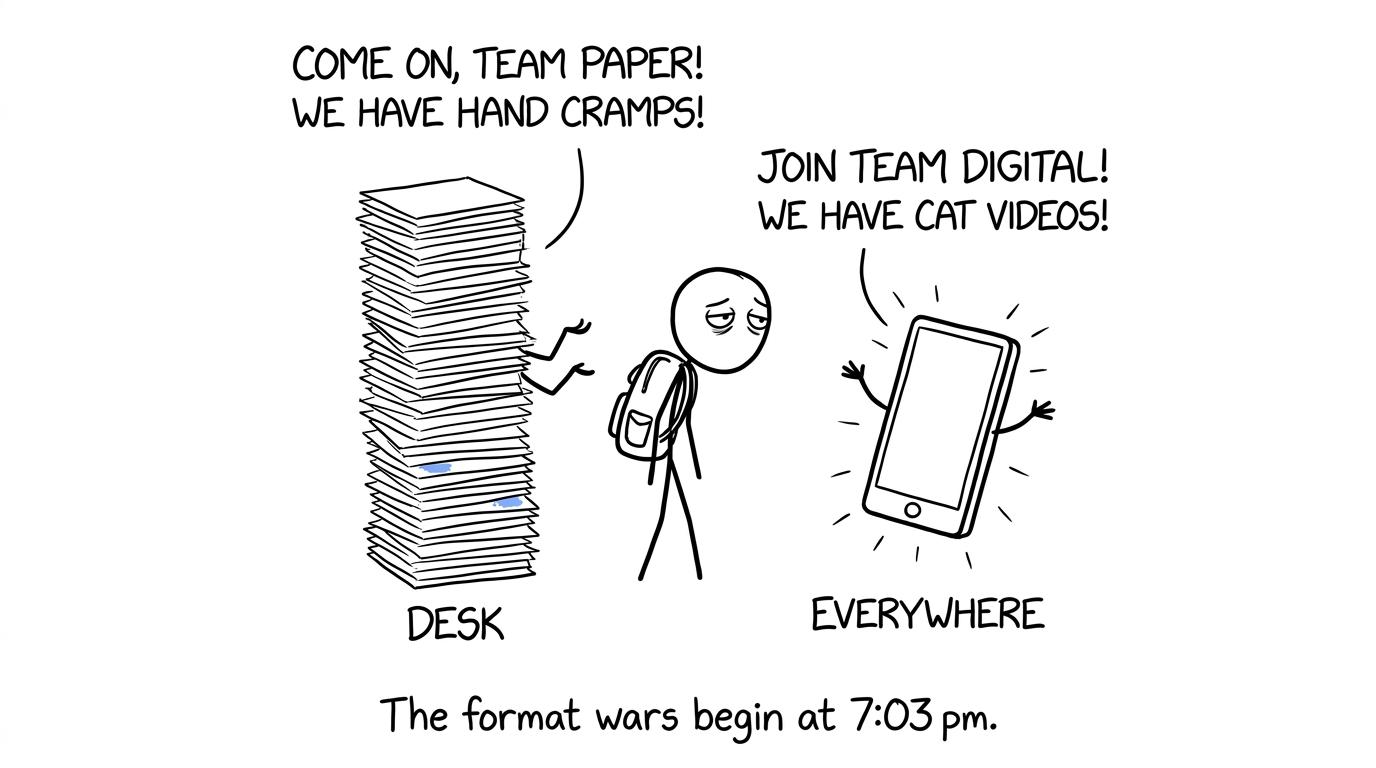 A student caught between rival paper and app flashcard teams
What actually makes flashcards effective?
Flashcards work when they produce retrieval practice: you see a prompt, attempt to recall the answer without support, and only then turn over the card. The mental effort is the important part.
Spacing matters too. Returning to a card across several sessions is generally more useful than reading it repeatedly on one evening. An app can automate that schedule, but paper cards can achieve the same result through simple piles such as:
- not secure;
- nearly secure;
- secure but due for another check.
Whichever system you use, answer aloud or write your response before checking. Thinking “I knew that” after seeing the answer measures recognition, not independent recall.
This principle crosses subjects. In maths, recalling a formula is useful, but students still have to apply it to unfamiliar questions. That is why MathsGenie's guide to stopping GCSE maths content from being forgotten combines active recall with spaced practice and exam questions. English Literature has the same distinction: remembering a quotation gives you material, but you must still interpret it and shape an argument.
The case for physical flashcards
Paper creates a clear boundary around the task. There are no notifications beside the answer and no temptation to leave the deck for something more entertaining. For students whose attention fragments on a phone, that simplicity has real value.
Physical cards are also easy to spread across a desk. You can group evidence by character, theme, writer's method or context, then move one quotation between several groups. That visible rearrangement can reveal something important: strong evidence is often flexible. A short quotation connected to several arguments may be more useful than a long quotation remembered for only one question.
Making cards by hand also forces you to choose what will fit. That can encourage selection and paraphrasing, although handwriting alone does not make learning effective. Copying a revision guide word for word onto cards is still copying. The benefit comes from deciding what matters and later retrieving it.
Where paper becomes inconvenient
Physical decks are slower to edit and awkward to carry once they grow. They cannot automatically identify overdue cards, and a missing bundle can erase weeks of organisation.
They also invite decoration. Colour can clarify categories, but elaborate borders and perfect lettering rarely improve recall. If creating the deck takes longer than testing yourself with it, the tool has started to replace the task.
The case for an app
An app removes friction. Your cards are available in short gaps that would otherwise disappear, and many apps can vary review intervals according to how confidently you answer. Digital decks are also easier to search, duplicate and correct.
For GCSE English Literature, that makes it practical to keep separate groups for texts, characters, themes and terminology without carrying a large box. MathsGenie offers free AQA GCSE English Literature flashcards, organised by topic, as a ready-made starting point. Students revising Priestley's play can also use the focused An Inspector Calls flashcards.
Ready-made cards save setup time, but they should not become an authority above your teacher or specification. Check that any deck matches your exam board, whether AQA, Edexcel, OCR or Eduqas, and the texts your school has selected. Specifications and paper structures differ, so a popular deck may still be irrelevant to your course.
Where apps become inconvenient
The phone holding your quotation deck also holds your messages, videos and games. A planned revision session can become something else after one notification.
Apps can also encourage speed without thought. Tapping a card as “known” is easy; producing a precise answer without seeing it is harder. There may also be limits, advertising or paid features, depending on the app. Check what is free before building a large deck inside one platform.
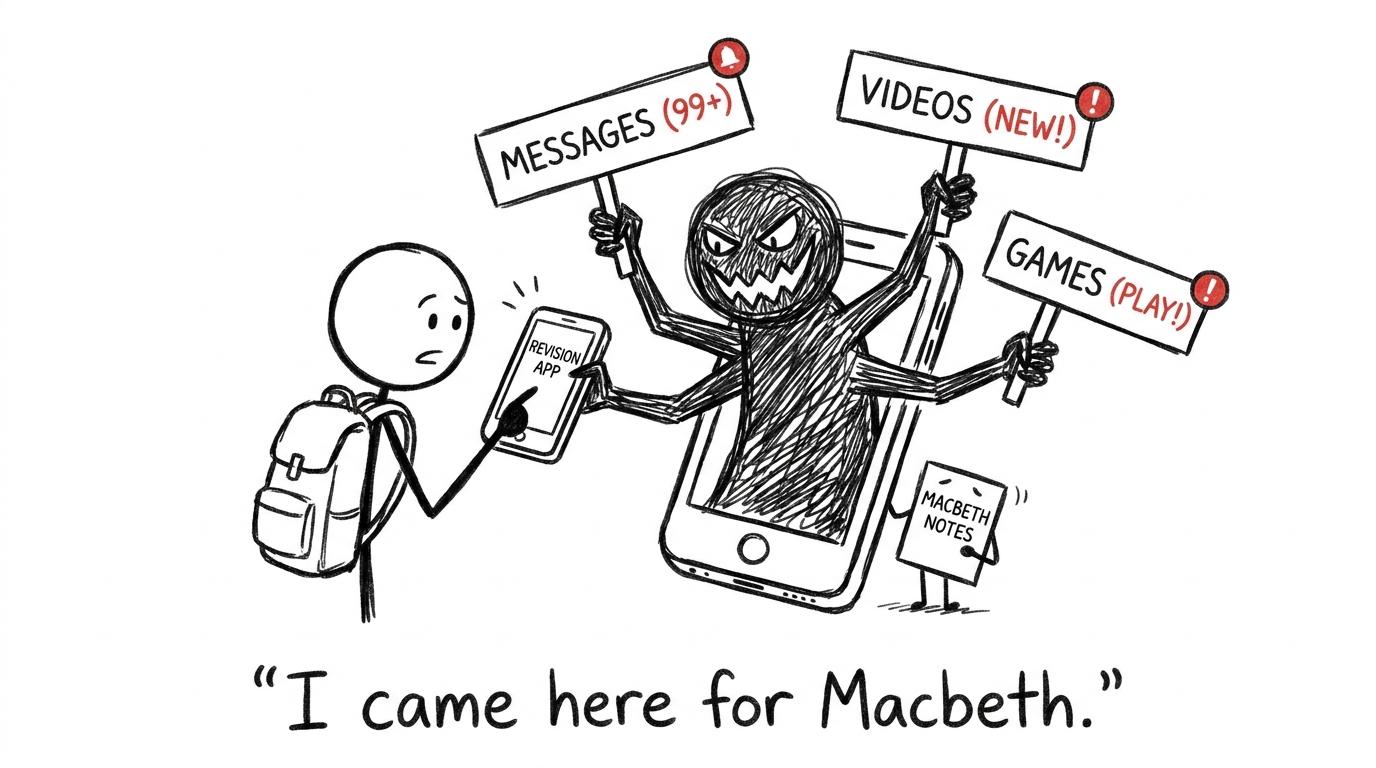 A notification monster interrupts a student trying to revise Macbeth
What should an English Literature flashcard contain?
A good card tests one manageable idea. It should not hide an entire essay behind a broad prompt such as “Everything about ambition”. Useful card types include:
- a character or theme on the front, with a short relevant quotation on the back;
- a quotation on the front, with its speaker, context and possible interpretations on the back;
- a literary method on the front, with a precise definition and purpose on the back;
- an event on the front, with its significance to the wider text on the back;
- a thesis prompt on the front, with two possible lines of argument on the back.
Keep quotations accurate and check them against a reliable copy of the text. Where examinations are closed book, secure recall is particularly valuable, although the material supplied in the examination can vary by paper and exam board. Always confirm the current requirements with your teacher and official specification.
Most importantly, connect evidence to analysis. Knowing words from a text without knowing why they matter leaves revision unfinished. A useful answer might record the method, an inference, an alternative interpretation and another theme the evidence could support.
Flashcards cannot replace essay practice
This is the central limitation of both formats. English Literature examinations reward connected arguments, selection of evidence, analysis of writers' choices and, where relevant, contextual understanding. A stack of isolated facts does not practise organising those elements under time pressure.
Once recall is becoming secure, close the deck and plan an answer to an exam-style question. Then write a paragraph or complete response and review it against teacher feedback or the relevant mark scheme. Flashcards should supply the raw materials for writing, not become a substitute for writing.
The same warning applies to GCSE maths. Formula cards cannot replace solving problems, just as quotation cards cannot replace essays. MathsGenie's GCSE maths revision hub combines revision lessons with practice questions, papers and solutions because exam performance requires application. The GCSE past paper collection then lets students test whether knowledge survives outside a familiar prompt.
A practical hybrid system
A hybrid system works well when each format has a distinct purpose:
- use paper to select quotations, map connections and discuss cards with someone else;
- transfer only the most valuable prompts into an app;
- use the app for brief retrieval sessions away from your desk;
- return to paper for essay plans and timed writing;
- remove cards that are irrelevant, vague or repeatedly too easy.
This keeps the digital deck small enough to review and preserves paper for deeper thinking. If switching formats creates extra administration, however, choose one. The best system is not the most elaborate one. It is the one that keeps producing honest attempts.
Students balancing Literature with foundation or higher tier maths can place these sessions inside a wider routine. MathsGenie's twenty-minute GCSE revision routine shows how a short session can move from recall to questions and marking. The subject changes, but the rhythm remains useful: retrieve, apply, check and fix.
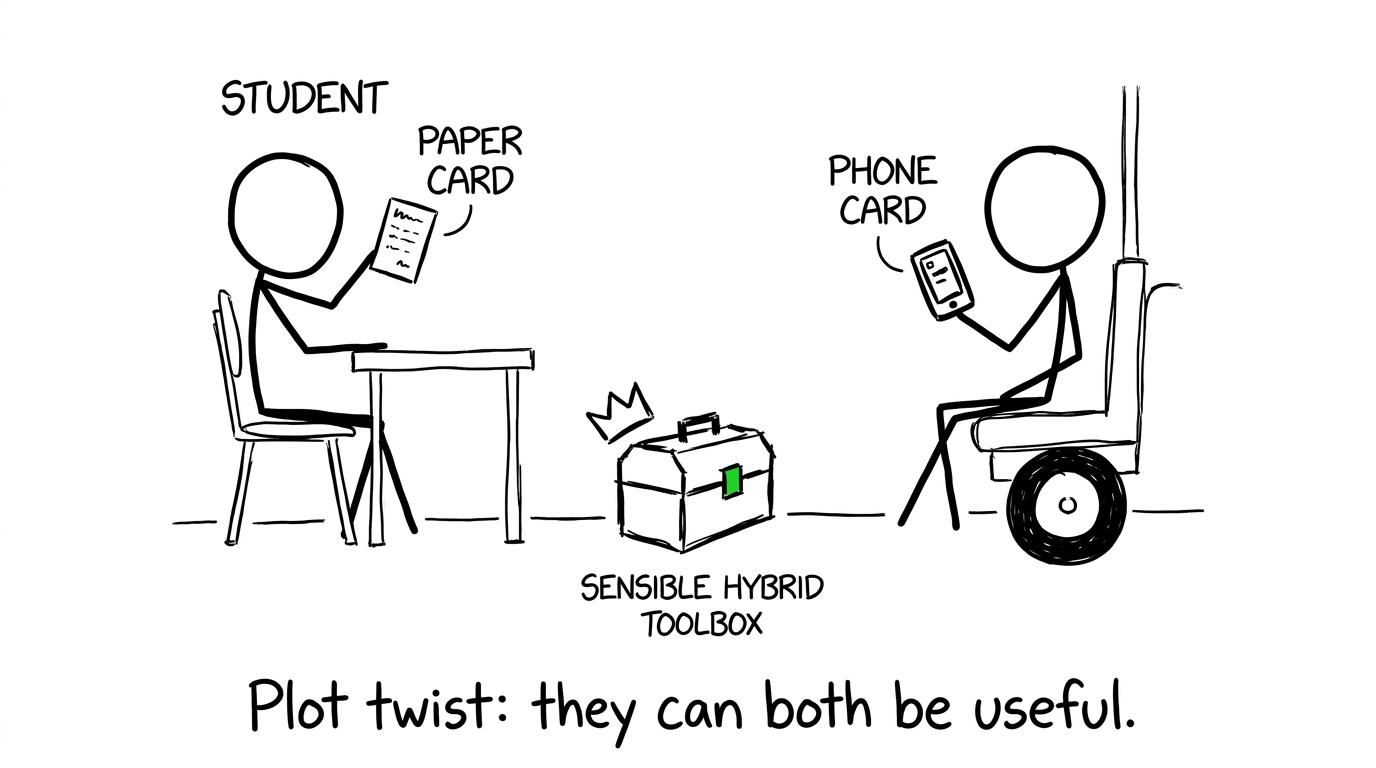 A paper card and phone card share a crowned hybrid revision toolbox
Common mistakes with paper and digital flashcards
Creating too many cards
A huge deck feels comprehensive but becomes difficult to revisit. Prioritise short, flexible quotations, central themes, key vocabulary and gaps revealed by actual practice.
Putting too much on one card
If the reverse contains a page of notes, you cannot judge whether your answer was secure. Split large ideas into focused prompts.
Rereading instead of retrieving
Pause before revealing the answer. Say it, write it or explain it. Without that attempt, the card is functioning as a tiny revision guide.
Trusting someone else's deck without checking it
Imported cards can contain inaccurate quotations, weak interpretations or content from a different text or exam board. Verify them and rewrite vague prompts in language that makes sense to you.
Revising only what feels comfortable
Easy cards provide reassuring progress. Difficult cards reveal where progress is needed. Spend more time on errors, then revisit them later rather than immediately repeating them until they feel familiar.
Treating flashcards as complete exam preparation
Follow recall with essay plans, timed paragraphs and full questions. In maths, make the equivalent move from facts to practice questions, mini tests, careful use of mark schemes, past papers and predicted papers.
Build the system you will still use next week
The debate between physical flashcards and an app sounds like a choice between old and new. In practice, it is a choice about attention, convenience and consistency.
Use paper if it helps you think and stay focused. Use an app if portability and scheduled review make you more consistent. Use both if each has a clear role. Then test the system by asking one question: can you retrieve the knowledge and use it in an exam-style response?
Keep the rest of your GCSE preparation equally practical. Use MathsGenie's free guide to efficient GCSE maths revision to organise revision lessons, practice questions, mini tests, past papers, predicted papers, mark schemes and video solutions. Flashcards can help knowledge stay available. Purposeful exam practice is what teaches you when and how to use it.