

Perfectionism: GCSE English Literature Revision
Perfectionism GCSE English Literature revision can hide as hard work. Learn to stop over-planning, practise imperfectly and protect time for maths exams.
Revision can look impressive without being useful. A quotation sheet is rewritten because the handwriting feels wrong. An essay plan grows to three pages. Twenty minutes disappear choosing a highlighter colour. Meanwhile, no answer has been attempted and your maths practice is waiting.
That is how perfectionism GCSE English Literature revision can quietly become procrastination. The solution is not to lower your ambitions. It is to replace the goal of producing flawless revision with a repeatable cycle: recall, write, check, improve and move on.
This matters particularly if you are balancing Literature with GCSE maths. Every unnecessary hour spent polishing English notes is an hour unavailable for practising algebra, geometry or statistics. Your revision needs to serve the exam, not become an art project of its own.
A quick perfectionism checklist
Perfectionism may be interfering with your revision if you regularly:
- delay writing until you feel fully prepared;
- restart notes because they look untidy;
- collect more quotations than you could realistically use;
- spend longer designing a timetable than following it;
- avoid timed essays because a low mark would feel uncomfortable;
- rewrite successful paragraphs instead of addressing weaker skills;
- compare your unfinished work with polished model answers;
- treat one difficult session as evidence that the entire plan has failed.
A high standard is not automatically a problem. Research distinguishes productive striving from perfectionistic concern: fear of mistakes, harsh self-criticism and worry about meeting expectations. Evidence linking these concerns with procrastination comes largely from university students, so it should not be treated as a precise prediction for every GCSE student. It does, however, describe a recognisable cycle: fear of an imperfect result makes beginning harder, and delay then creates more pressure.
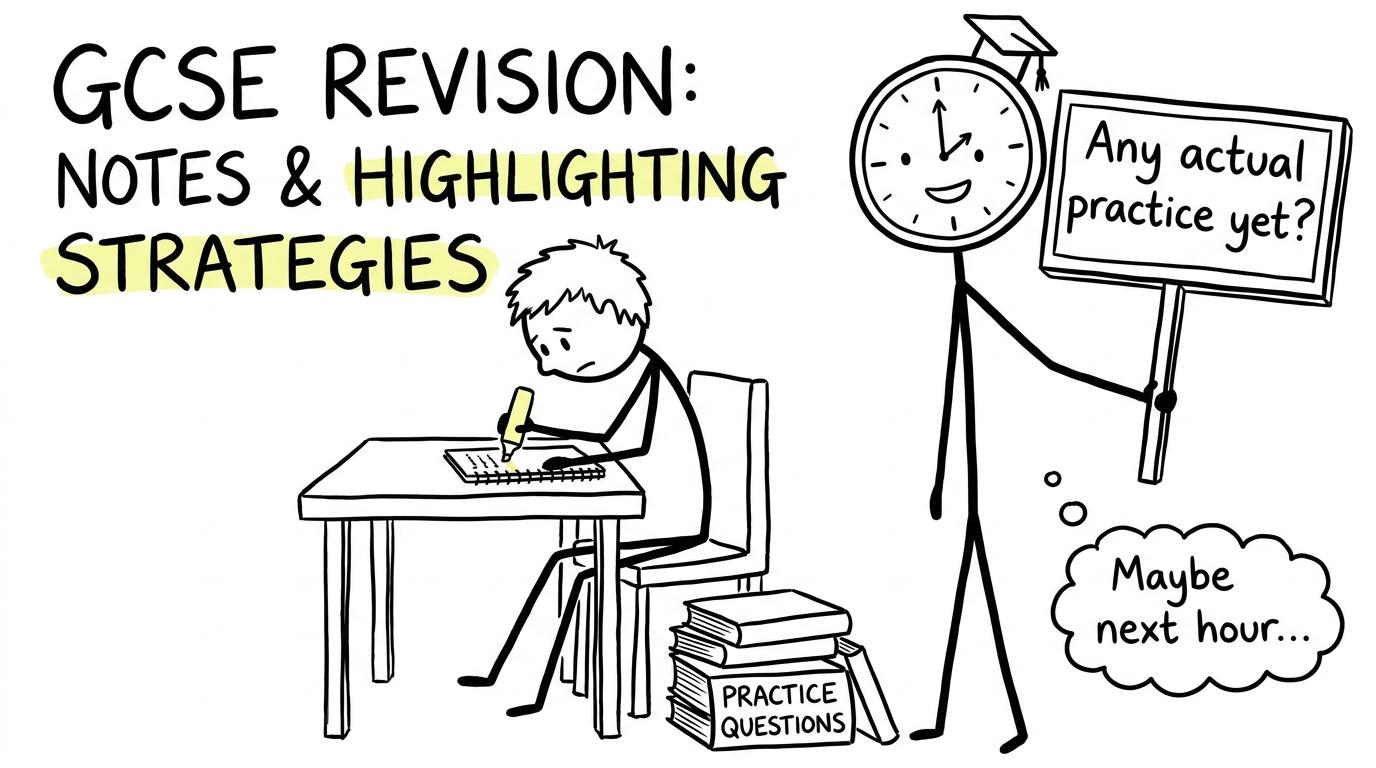 A student colour-coding a revision title while the exam clock asks whether any practice has happened
How perfectionism appears in English Literature revision
Perfectionism rarely announces itself as avoidance. It usually arrives dressed as preparation.
Waiting to know everything before writing
You may tell yourself that you need every quotation, character arc and contextual detail before attempting an essay. But an exam answer requires selection, not total recall.
Across GCSE English Literature specifications, the assessment objectives focus on understanding and responding to texts, supporting interpretations with references, analysing language, form and structure, and understanding context. Precise requirements and paper structures vary between AQA, Edexcel, OCR and Eduqas, so use your own specification and teacher guidance.
None of those objectives asks for every fact you have ever learned. A focused argument supported by relevant evidence is more useful than a warehouse of disconnected knowledge.
Producing beautiful notes instead of retrieving knowledge
Neat notes can be helpful when they clarify a text. The problem begins when presentation becomes the task.
Rereading and copying feel safe because the answer remains visible. Retrieval is less comfortable: close the book, list what you remember about a theme, recall a few flexible quotations or plan a response without notes. That discomfort provides information. It reveals what is secure and what needs another visit.
Educational research strongly supports retrieval practice, although its success depends on sensible challenge and feedback. For Literature, that means checking recalled quotations against the text, reviewing whether your interpretations are defensible and correcting errors before they become habits.
Refusing to complete timed answers
A timed answer makes your current level visible. That is exactly why perfectionism dislikes it.
Yet English Literature exams require decisions under pressure. Depending on the board and question, you may need to interpret an extract, connect it with the wider text, compare poems or respond to unseen material. Planning forever cannot reproduce that experience.
Treat an unfinished or uneven answer as diagnostic evidence. It can show that your opening took too long, your analysis became repetitive or your argument lacked textual support. The answer did not fail. It located the next task.
Trying to perfect every subject simultaneously
A GCSE timetable contains competing demands. If English expands to fill every evening, maths loses the regular practice needed to keep methods familiar.
Use a single planning system for both. The GCSE one-month revision plan offers a useful rhythm for maths: diagnosis, short retrieval, focused practice, marking and later retesting. Apply the same structure to Literature while using subject-appropriate tasks.
For example, an English session might contain brief quotation recall, one paragraph or plan, feedback, and one recorded improvement. Then stop at the planned time and move to maths.
Why perfectionism can be worse than ordinary procrastination
Ordinary procrastination is usually visible. You know you have not started.
Perfectionistic procrastination is harder to detect because you may be busy for hours. You can finish a session tired yet have produced nothing that tests your ability to recall, interpret or write under exam conditions. Activity creates the feeling of progress while protecting you from evidence about your current performance.
It also makes feedback feel threatening. If an answer must prove that you are good at English, every correction feels personal. If an answer is simply one round of practice, corrections become instructions.
This distinction matters in maths too. A wrong answer is not a verdict; it identifies a method to revisit. MathsGenie’s GCSE maths revision hub lets you move from revision lessons to practice questions, mini tests and papers rather than remaining in preparation mode.
The useful question is not, “Is this perfect?” It is, “What did this attempt teach me to do next?”
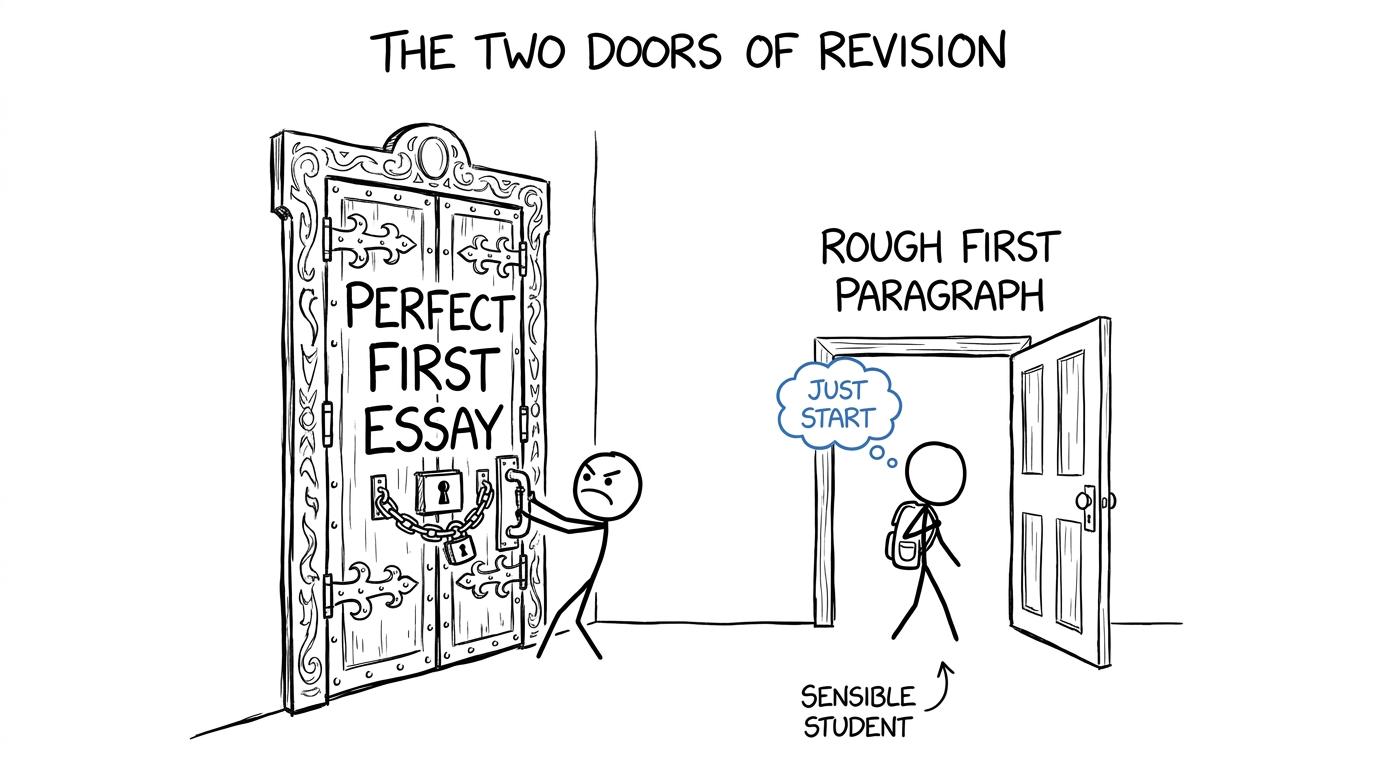 A student chooses a small open door marked rough first paragraph instead of an impossible ornate perfect essay door
A better revision system: minimum, attempt, feedback
A strong system should still work on an ordinary Tuesday when motivation is low.
Define the minimum useful task
Replace vague goals such as “revise Macbeth” with an observable action:
- recall five adaptable quotations and check their wording;
- plan one thematic response;
- write one analytical paragraph without notes;
- compare two poems through one shared idea;
- annotate an unseen poem for a fixed period;
- review one marked answer and identify one recurring weakness.
The task should be small enough to begin immediately. You may continue once momentum arrives, but completion should not depend on feeling inspired.
Put a boundary around preparation
Give yourself a short period to review the relevant material, then attempt something from memory. Do not wait for certainty.
This is also an effective way to protect maths time. After Literature, choose a specific maths activity from the free GCSE maths resources, such as a topic lesson, exam questions or a mini test. A defined handover prevents one subject consuming the entire session.
Use feedback as the finish line
Practice without feedback can repeat misconceptions. After an English response, compare it with your teacher’s success criteria, the official assessment objectives and any authorised mark scheme or exemplar supplied by your school. Record one precise action, such as:
- connect the quotation more directly to the argument;
- analyse the writer’s choice rather than paraphrasing it;
- make context relevant to the interpretation;
- explain the effect of structure across the text;
- use fewer quotations but discuss them more deeply.
In maths, the equivalent is completing a paper and investigating every lost mark. MathsGenie’s past-paper platform brings papers and official mark schemes together, with worked solutions or video walkthroughs available for selected papers.
Revisit rather than rebuild
Spacing practice across several sessions is generally more useful for retention than concentrating everything into one long block. Revisit a quotation set, theme or weak essay skill after a delay. Do not remake the entire resource each time.
Use the same principle for maths topics. The guidance on when to start GCSE past papers explains why papers are most useful while there is still time to repair what they expose.
Keep standards high without demanding perfection
The alternative to perfectionism is not carelessness. It is accuracy with proportion.
You should still check quotations, develop thoughtful interpretations and write clearly. You should also recognise diminishing returns. The fourth rewrite of a flashcard may add almost nothing; a first attempt at an unseen poem may reveal much more.
Set process standards instead of emotional standards:
- begin at the scheduled time;
- attempt before checking;
- finish within the boundary;
- seek feedback;
- record one improvement;
- revisit the weakness later.
These standards are demanding, but controllable. You cannot command yourself to feel confident. You can complete the next useful action.
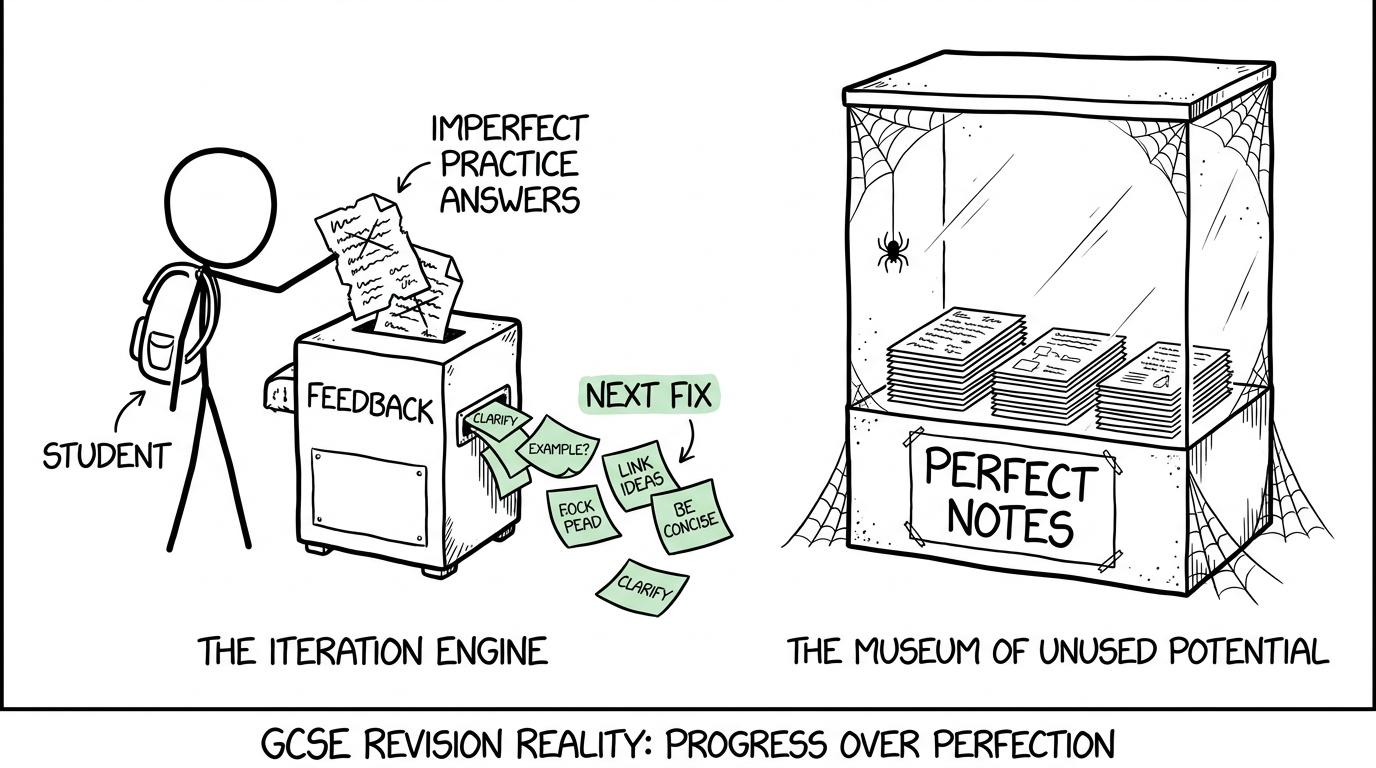 Imperfect practice goes through a feedback machine while perfect notes gather cobwebs
Common perfectionism mistakes to avoid
Making a timetable with no flexibility
A rigid plan can collapse after one missed session. Use a MathsGenie revision planner or a simple weekly schedule, but include catch-up space and prioritise tasks by weakness. A plan should guide decisions, not punish you for being human.
Measuring revision by hours
Two hours of copying may be less useful than a short retrieval task followed by feedback. Record completed outputs: paragraphs written, plans attempted, quotations checked and maths questions marked.
Treating predicted content as certainty
Do not revise only the Literature themes you hope will appear. Similarly, maths predictions are tools for focused practice, not promises. MathsGenie’s guide to using predicted GCSE topics without guessing explains why predicted papers should complement broad specification coverage and official past papers.
Saving exam practice until you feel ready
Readiness often follows practice rather than preceding it. Begin with a paragraph, essay plan, mini test or paper section. Build towards complete timed work.
Turning the final evening into a rescue mission
Perfectionism may insist that one more late session can fix everything. Usually, the better choice is a small amount of targeted practice, practical preparation and rest. The GCSE night-before revision plan offers a restrained approach for maths that can help prevent last-minute revision from expanding uncontrollably.
Progress is allowed to look unfinished
Good revision is rarely beautiful. It contains crossed-out ideas, forgotten quotations, awkward first paragraphs and questions that initially go wrong. Those imperfections are not obstacles to learning. They are the evidence that learning is taking place.
For English Literature, start with one imperfect response and use feedback to improve it. Then protect the rest of your timetable. When it is time for maths, open MathsGenie and follow the same honest cycle: use a revision lesson, complete practice questions, check the mark scheme, watch a video solution where needed and retest the weakness. Add predicted-paper practice closer to the exam, while keeping official past papers at the centre of your preparation.
Perfection asks you to prove yourself before you begin. Effective revision asks only that you begin, notice what happened and take the next useful step.










