Peaking Too Early in GCSE History Revision?
Peaking too early GCSE History revision worries? Learn why confidence fades, how to retain content until May, and balance History with GCSE maths well.

A strange thing can happen halfway through Year 11. Your History notes are complete, the mock went reasonably well and dates seem to arrive in your mind without effort. Then the real examination is still months away. Instead of feeling pleased, you wonder whether your confidence has come too soon.
If you are worried about peaking too early GCSE History revision, the short answer is reassuring: feeling confident early is normal, and it does not mean your knowledge must disappear before May. The aim now is not to maintain maximum intensity. It is to keep retrieving, applying and checking the material at sensible intervals while leaving enough time for GCSE maths and your other subjects.
The quick answer and checklist
You have probably not peaked too early if you can still:
- recall key facts without opening your notes;
- explain causes, consequences, change and significance;
- plan answers to unfamiliar questions;
- analyse sources and interpretations rather than merely describe them;
- identify gaps after quizzes or timed questions;
- return to older topics regularly without revising History every day.
Confidence becomes fragile when it depends on recognition. Durable confidence comes from being able to produce knowledge independently and use it under examination conditions.
Your task between now and May is therefore simple: maintain, test, repair and repeat.
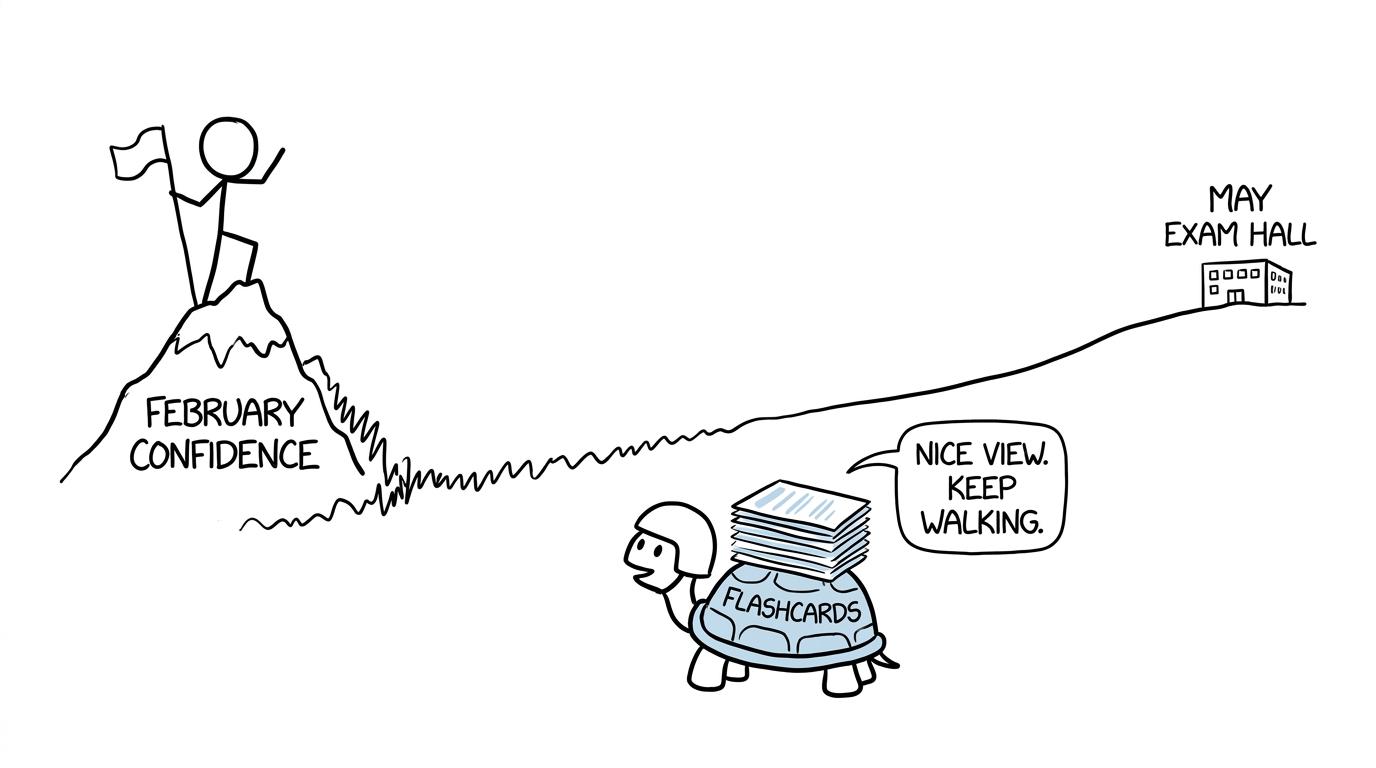 A student discovers that the February confidence peak is only the beginning of the journey towards May
Why students feel most confident months before the exam
Early confidence usually has an understandable cause. You may have recently completed a unit, prepared thoroughly for mocks or spent several concentrated weeks making resources. The content feels available because you have encountered it repeatedly in a short period.
That feeling is useful, but it can be misleading. Reading a familiar page creates recognition: everything looks known when the answer is in front of you. An examination requires retrieval: you must bring the information to mind when only a question and blank answer space are available.
There is also a practical reason confidence can arrive early. During mocks, revision is directed towards a smaller, immediate target. Later in the year, several subjects compete for attention. History begins to feel less secure not necessarily because you have lost everything, but because you are switching between algebra, science, literature and other demands.
For a student also preparing for maths, that competition matters. The solution is not to revise both subjects at full intensity for months. It is to give each subject the type of practice it needs. History needs spaced retrieval and written application. Maths needs repeated problem-solving, feedback and mixed exam questions. The GCSE Maths revision hub can keep the maths side organised while you maintain History with shorter sessions.
Confidence is not a fixed peak
Revision is often imagined as a mountain: work harder, climb steadily and arrive at your highest point on the examination morning. Real learning is less tidy. Confidence rises after a successful mock, drops when forgotten material appears, then rises again after correction.
That dip is not proof that revision has failed. Forgetting some material creates a reason to retrieve it again. Research reviewed by the Education Endowment Foundation supports retrieval practice and spacing learning over time, although no single timetable works perfectly for every student or topic. The practical principle is more important than a rigid schedule: revisit material after a delay and attempt to recall it before checking.
A useful revision pattern is:
- learn or review a topic;
- close the notes and retrieve it;
- check accuracy using trusted material;
- revisit it after a gap;
- apply it to an examination-style task;
- return later to anything that remained weak.
This turns an early burst of confidence into a cycle rather than a one-off event.
What GCSE History actually asks you to retain
Across GCSE History specifications, Ofqual sets four assessment objectives. Exam boards such as Edexcel, AQA, OCR and Eduqas organise papers and topics differently, so always use the specification and question format taught by your school. However, the overall objectives cover:
- knowledge and understanding, weighted at 35%35\%35%;
- explanation and analysis using second-order concepts, weighted at 35%35\%35%;
- analysis and evaluation of contemporary sources, weighted at 15%15\%15%;
- analysis and evaluation of historical interpretations, weighted at 15%15\%15%.
This matters because remembering dates alone is not enough. Strong maintenance revision must preserve three layers:
Secure factual knowledge
Keep essential people, events, dates, policies and turning points available. Focus on facts that help you build an argument rather than trying to memorise every sentence in a textbook.
Historical connections
Practise linking evidence to concepts such as cause, consequence, continuity, change, similarity, difference and significance. Ask why an event mattered, what changed and what remained limited.
Examination performance
Know how your board phrases questions, how marks are allocated and how much explanation is expected. GCSE History is not tiered into foundation and higher papers, unlike GCSE maths, but accurate board-specific practice is still essential.
How to keep GCSE History knowledge fresh until May
The first History examination may be in May, while later papers can extend beyond it depending on the year and exam board. Check your school timetable rather than relying on a date seen online. Then work backwards without treating every week as equally intense.
Use a maintenance phase now
If your knowledge is currently strong, avoid rebuilding every resource. Use brief closed-book checks instead:
- blank timelines;
- flashcards answered aloud;
- brain dumps followed by correction;
- essay-plan outlines;
- short source or interpretation questions;
- mixed quizzes covering more than one unit.
A maintenance session should reveal something. If it only leaves you feeling comfortable, it may be too passive.
Increase application closer to the papers
As examinations approach, move gradually from recall towards timed planning, paragraph writing and complete questions. Save some unseen material so that later practice remains diagnostic.
The same principle helps with maths. MathsGenie's guide to when to start GCSE past papers separates early diagnosis from later full-paper practice. You can use that structure across your timetable: short checks first, longer examination rehearsals later.
Keep an evidence-based error log
After each task, record the specific problem:
- missing knowledge;
- confused chronology;
- weak explanation;
- unsupported judgement;
- source analysis that became description;
- timing or question-choice error.
Then assign one action. “Revise Germany” is too broad. “Rebuild the sequence linking these three developments and plan one causation response” is manageable.
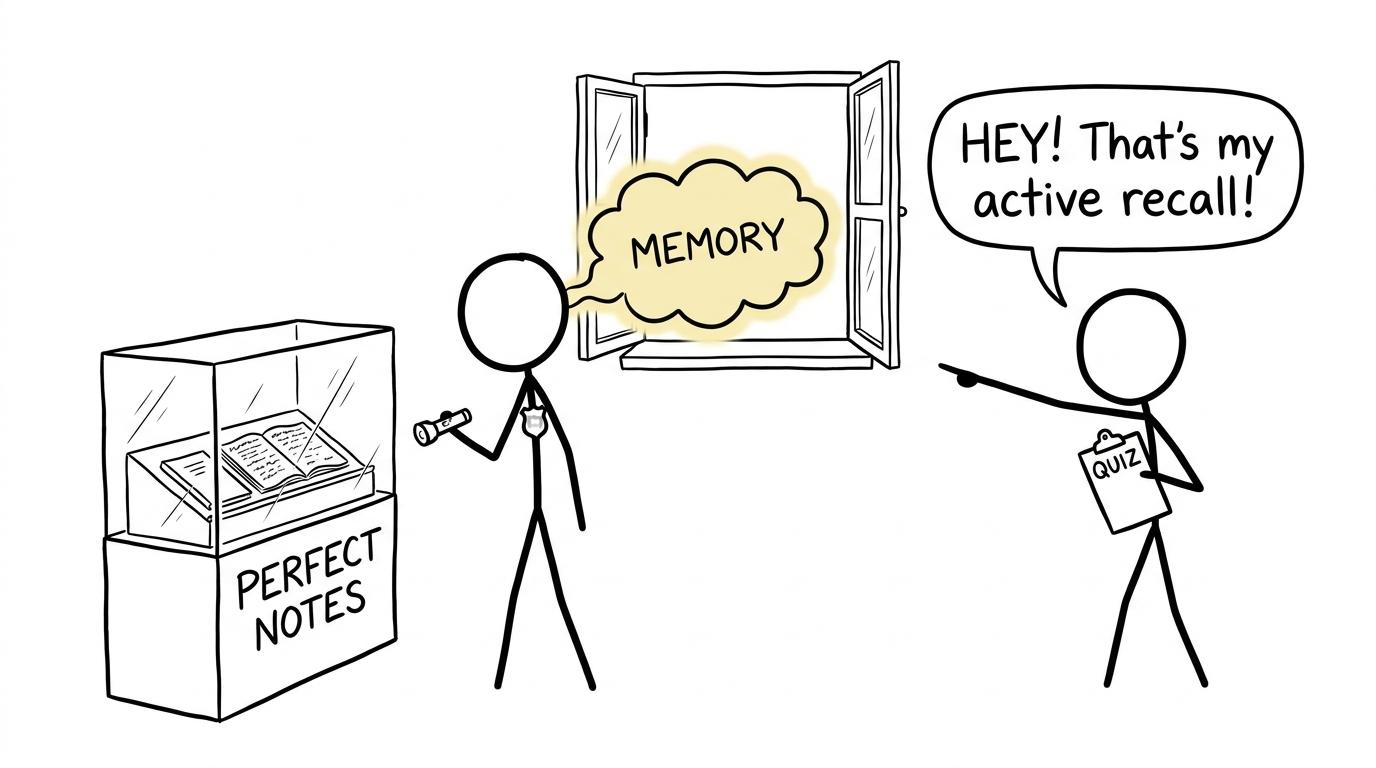 A memory cloud escapes while perfect notes remain safely displayed
A calm weekly rhythm for History and maths
A sustainable week could contain one short History retrieval session, one examination-skills session and one mixed review. The exact days and duration should reflect your school workload, current gaps and examination timetable.
Protect separate maths time rather than allowing the subject causing the most anxiety to consume every evening. Use MathsGenie's advice on learning GCSE maths topics in a sensible order to prioritise prerequisite skills, then use mini tests and topic questions for retrieval.
When you begin full maths papers, choose the correct exam board and tier. The Edexcel GCSE Maths past papers and AQA GCSE Maths past papers include official mark schemes, with worked solutions available for selected papers. Marking is where practice becomes useful: it exposes the gap between confidence and performance.
A balanced routine should leave room for rest. Exhaustion can make familiar knowledge feel unavailable, which is easily mistaken for having “lost” months of revision.
Common mistakes when trying not to peak too early
Re-reading everything from the beginning
Re-reading can refresh context, but it should not dominate. Attempt retrieval first. Your notes then become a checking tool rather than the activity itself.
Revising History at maximum intensity for months
More hours are not automatically better. Flooding your timetable with one subject can crowd out maths, sleep and later examination practice. Regular contact is usually more sustainable than repeated marathons.
Saving all past papers for the final week
Do not use every complete paper early, but do not avoid examination questions altogether. Use individual questions and sections now, then preserve some full papers for timed practice. For maths, how to use GCSE past papers properly explains the paper, mark, repair and retest cycle.
Treating a lower score as evidence of decline
A harder question, stricter marking or a different topic can lower a score. Look at why marks were lost before deciding your knowledge has deteriorated.
Memorising predictions instead of the specification
Predictions cannot replace full coverage. In maths, GCSE predicted papers are best used as fresh rehearsal alongside official papers, not as a promise about what will appear. Apply the same caution to History topic predictions.
Ignoring feedback after retrieval
Retrieving an incorrect fact repeatedly can strengthen the error. Check answers and correct them promptly using your teacher's materials, specification and mark schemes.
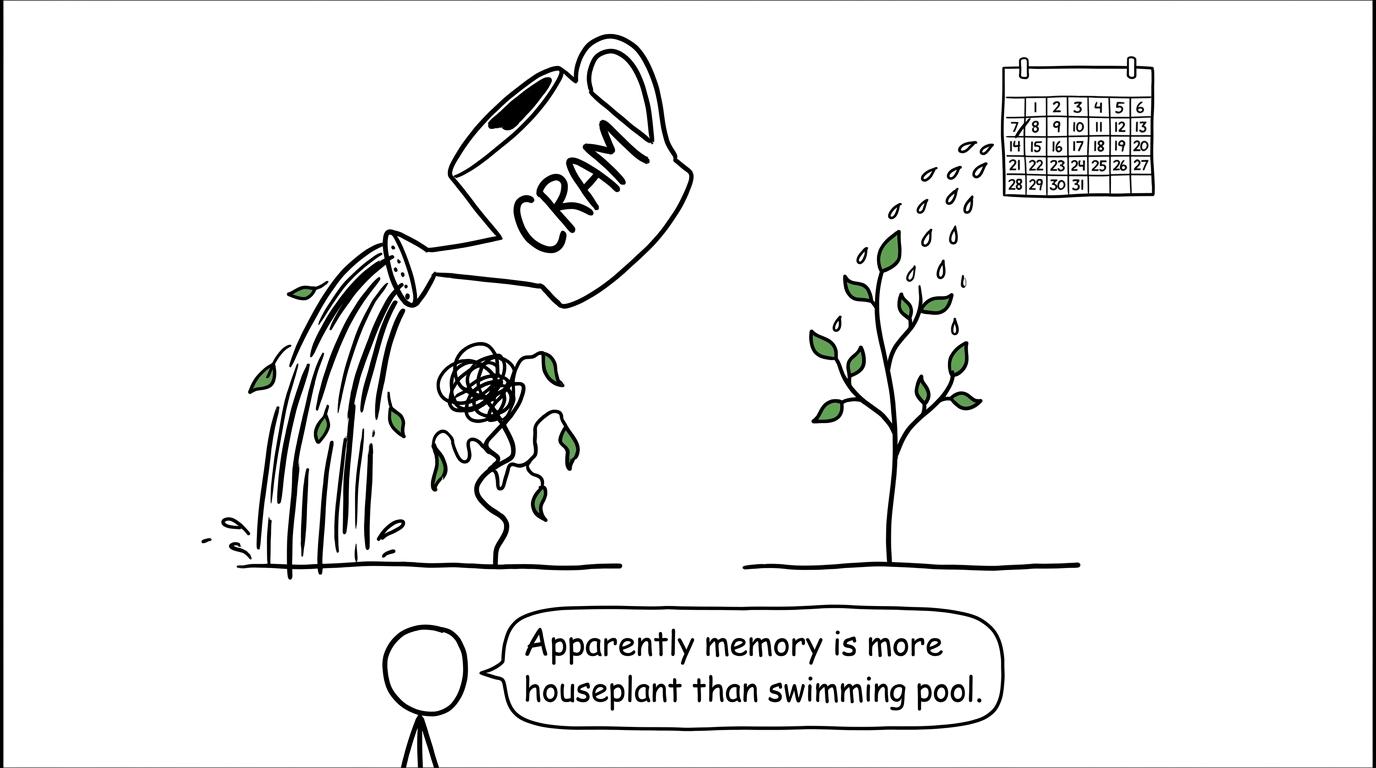 One revision plant is flooded by cramming while another grows through regular review
What to do if your confidence has already fallen
Start with diagnosis, not panic. Choose one unit and complete a short closed-book retrieval task. Separate what you remembered accurately, what was partly secure and what was missing. Repair only the missing or confused material, then test it again on another day.
Do the same in maths with a mini test or paper section. If a full paper feels premature, shorter practice gives clearer information without consuming an entire evening. MathsGenie's one-week GCSE maths revision plan also shows how to move from diagnosis to targeted repair when time becomes tighter.
Most importantly, do not chase the feeling you had after finishing your notes. Chase evidence: facts retrieved without prompts, arguments planned clearly, questions completed within time and mistakes that do not return.
Keep the knowledge moving
Peaking early is the wrong metaphor. Knowledge is not a performance you can deliver only once. It is something you maintain through well-timed use.
If History feels secure now, reduce the volume but keep regular contact. Retrieve content without notes, practise the skills your exam board rewards and increase timed application as the papers approach. If confidence dips, treat that as information rather than failure.
Meanwhile, let MathsGenie make your GCSE maths revision easier to manage. Begin with free revision lessons and practice questions, check progress through mini tests, then build towards past papers, mark schemes, video solutions and predicted papers. A calm plan does not ask you to feel brilliant every day. It keeps bringing you back to the knowledge that matters until you can use it when the examination paper arrives.