

Should Parents Get Involved in GCSE Arabic Revision?
Parents involved in GCSE Arabic revision can help with routine, speaking practice and calm feedback. Learn where support becomes counterproductive at home.
Revision can become strangely tense when everyone wants the same result. A student wants independence. A parent wants to help. Yet a simple question about vocabulary can suddenly feel like an inspection.
So, should parents get involved in GCSE Arabic revision? Usually, yes, but as a source of structure, encouragement and low-pressure practice, not as a substitute teacher. The most effective support helps the student revise independently. It does not take control of the work.
That distinction matters in Arabic, where a parent may speak a home dialect confidently but be less familiar with the standard Arabic, task formats or marking criteria used by the exam board. Good intentions still need the right role.
The short answer for students and parents
Parental involvement is most useful when a parent:
- helps establish a realistic revision routine;
- listens during short speaking practices;
- tests vocabulary using material supplied by the student or teacher;
- removes practical distractions;
- encourages the student to ask their teacher for specialist feedback;
- notices stress without turning every conversation into an exam discussion.
It is less useful when a parent corrects every sentence, rewrites answers, compares the student with relatives or insists that conversational fluency automatically equals exam readiness.
The principle is simple: parents should support the revision process, while teachers and official materials guide the Arabic content.
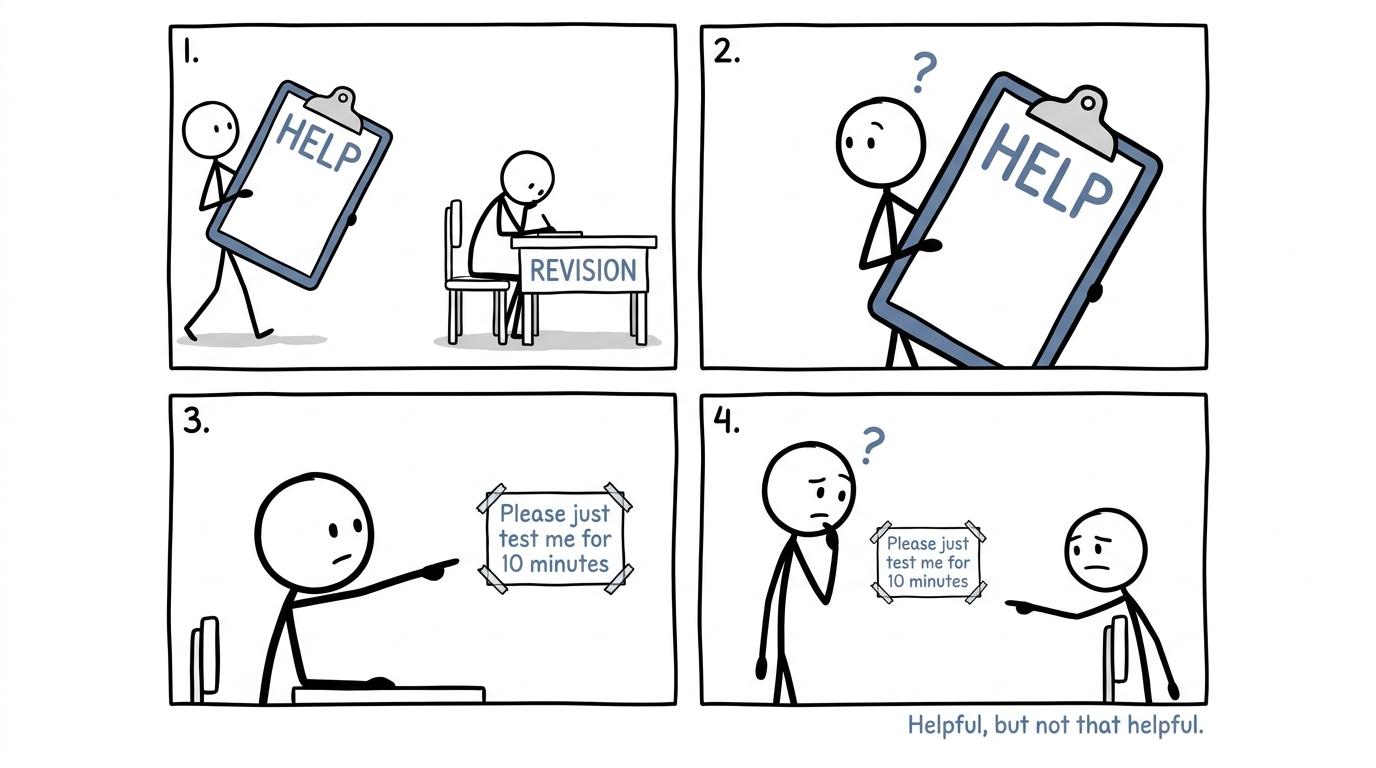 A parent discovers that useful help can fit on a very small clipboard
What GCSE Arabic revision actually involves
Before deciding how a parent can help, it is important to understand the qualification being revised.
The current Pearson Edexcel GCSE Arabic specification has four assessed skills: listening, speaking, reading and writing. Each contributes 25%25\%25% of the qualification. Students enter either foundation or higher tier across the qualification, and dictionaries are not permitted in the assessments, including speaking preparation time.
The speaking assessment includes a role play, discussion of a picture stimulus and conversation. Reading includes a translation into English, while writing includes translation into Arabic. Exact arrangements can change between specifications and exam series, so students should always confirm their board, tier and current instructions with their school.
This creates four different revision needs:
| Skill | Helpful parental role | What should remain with the student or teacher |
|---|---|---|
| Listening | Protect quiet practice time and ask what was understood | Selecting specification-matched recordings and judging exam responses |
| Speaking | Read prompts, listen and encourage complete answers | Teaching pronunciation rules or replacing teacher feedback |
| Reading | Time a short task and ask for a summary | Translating the passage or supplying unknown vocabulary immediately |
| Writing | Check that the task was completed independently | Rewriting sentences or correcting beyond the parent’s expertise |
A parent does not have to speak Arabic to provide most of this support. Organisation, timing and calm feedback are valuable in any subject.
Where parents involved in GCSE Arabic revision can help
Creating a routine that survives busy weeks
Revision plans often fail because they assume every evening will be calm and productive. Real weeks contain maths homework, family commitments, tiredness and forgotten books.
A parent can help the student choose a few repeatable sessions rather than planning an heroic timetable that disappears after three days. MathsGenie’s guide to building a realistic GCSE maths revision timetable offers a useful structure that transfers across subjects: identify weak areas, practise actively, review mistakes and leave room to catch up.
For Arabic, a balanced week might contain separate short sessions for vocabulary retrieval, listening, speaking and writing. The parent’s job is not to supervise every minute. It is to help protect the agreed time and make starting easier.
On crowded school days, the same idea appears in the twenty-minute GCSE revision routine: choose a narrow target, practise actively and finish by identifying the next step. That is more useful than vaguely deciding to “do Arabic”.
Making speaking practice feel ordinary
Speaking improves through speaking. Yet practising alone can feel artificial, and performing every answer for a teacher may feel high stakes.
A parent can become a friendly audience. The student can provide suitable questions, answer without notes and then assess their own response. A useful parent might ask:
- Did you answer the whole question?
- Could you give a reason or an example?
- Which part felt least secure?
- Would you like another attempt?
These questions encourage reflection without pretending to be an examiner. If the parent speaks Arabic, they can take part in natural conversation, but corrections should be selective. Constant interruption can make a student speak less freely and become more cautious.
Testing knowledge without giving it away
Parents can hold vocabulary cards, read English meanings, shuffle topics or keep a list of words that need revisiting. They can also prompt the student to retrieve vocabulary before revealing the answer.
The crucial word is retrieve. Recognition is not enough. Seeing a word and thinking “I knew that” feels comfortable, but an exam requires the student to produce or understand language independently.
This resembles the process of diagnosing weaknesses in maths. The MathsGenie guide to finding weak GCSE topics recommends using evidence from attempted questions rather than guessing what needs work. In Arabic, mistakes in a listening task, vocabulary test or written response provide the same kind of evidence.
Supporting practice without owning the result
The Education Endowment Foundation’s guidance on parental engagement is broadly positive about parents supporting routines, goals and independent learning. However, it advises caution about direct parental assistance with homework at secondary level. The evidence on exactly how schools can improve attainment through parental involvement is mixed, and direct involvement in assignments is not automatically beneficial.
That is an important boundary. A parent can ask whether a writing task is finished. They should not compose the answer. They can encourage a student to email the teacher. They should not overrule feedback because Arabic is spoken differently at home.
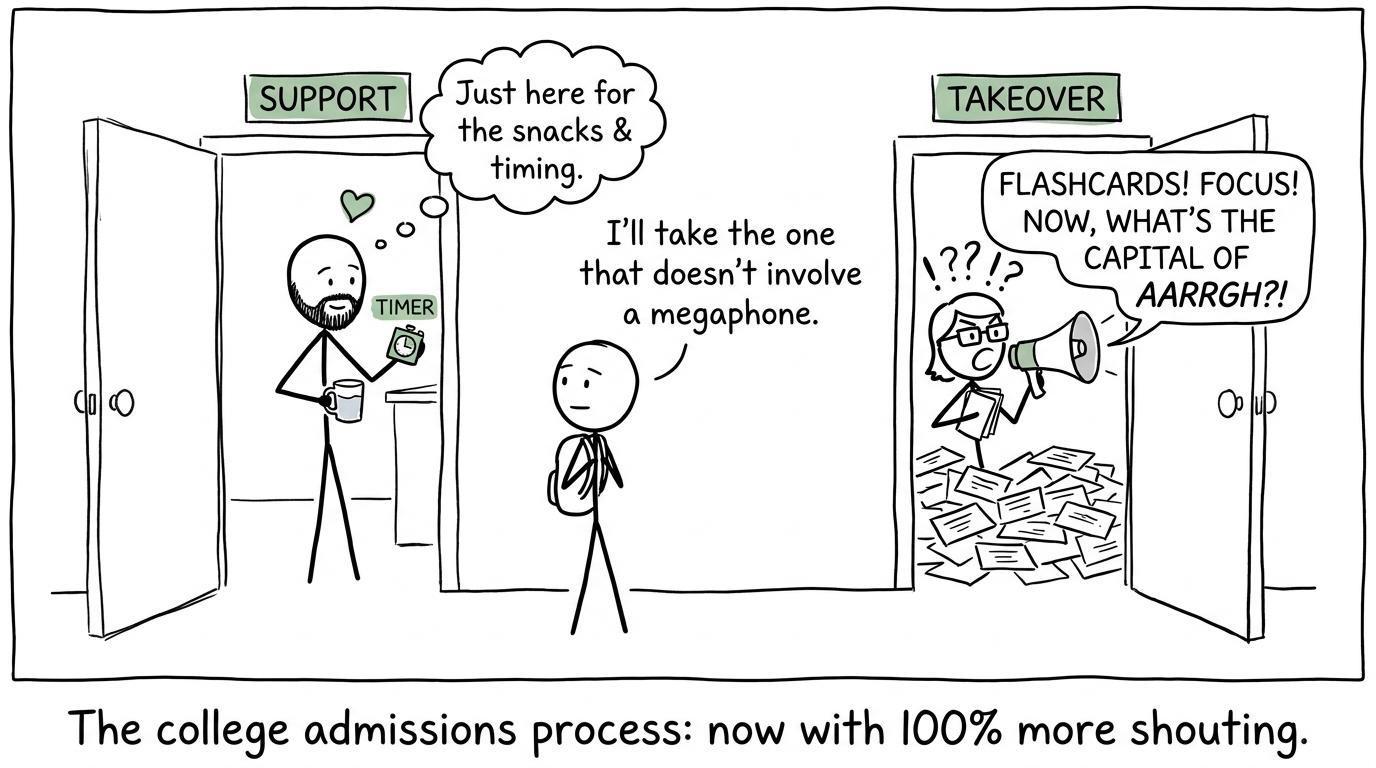 A student chooses support rather than a full parental takeover
When parental help creates friction
When home Arabic and exam Arabic are treated as identical
Arabic is used across many countries and communities, with substantial variation in everyday speech. A student may communicate confidently with family while still needing deliberate practice in the standard language, vocabulary and written conventions expected by the specification.
A parent’s dialect knowledge can enrich conversation, but disagreement over “the correct Arabic” can become distracting. For assessment questions, the student should follow current teacher and exam-board guidance. Questions about acceptable wording belong with the teacher rather than becoming a family debate.
When every error becomes a lesson
Feedback has a limit. If a parent corrects vocabulary, grammar, pronunciation and content after every sentence, the student may stop taking risks. Agree on one focus before starting, such as extending answers or using varied opinions. Record other uncertainties for the teacher.
A useful conversation ends with a clear next action. An unhelpful one ends with a catalogue of faults.
When monitoring becomes surveillance
Repeated questions about revision can communicate anxiety rather than support. Asking once what the plan is can help. Asking every hour whether revision has happened usually does not.
Agree in advance what the parent will check. It might be one weekly planning conversation and two short speaking practices. Outside those times, the student keeps ownership.
When Arabic crowds out other GCSE subjects
A student preparing for Arabic may also be sitting English, sciences and maths. Revision time has an opportunity cost. Parents can help the student see the whole week rather than allowing the most emotionally charged subject to consume it.
For maths, the GCSE maths revision hub brings together exam-board resources for Edexcel, AQA, OCR and Eduqas, among others. Students can combine focused topic work with Edexcel past papers and mark schemes where relevant. The same planning rule applies to Arabic: use resources matching the actual specification and turn mistakes into targeted practice.
A low-friction agreement for home revision
The best arrangement is often explicit rather than assumed. Student and parent can agree on:
- The goal: perhaps more confident spontaneous speaking or stronger listening accuracy.
- The schedule: specific, manageable sessions rather than constant reminders.
- The parent’s role: timer, audience, vocabulary tester or practical supporter.
- The stop rule: either person can pause if the session becomes argumentative.
- The expert route: uncertain language questions go to the teacher.
- The review point: discuss after a week whether the arrangement is helping.
This preserves independence while making support available. The parent holds the safety net, not the juggling balls.
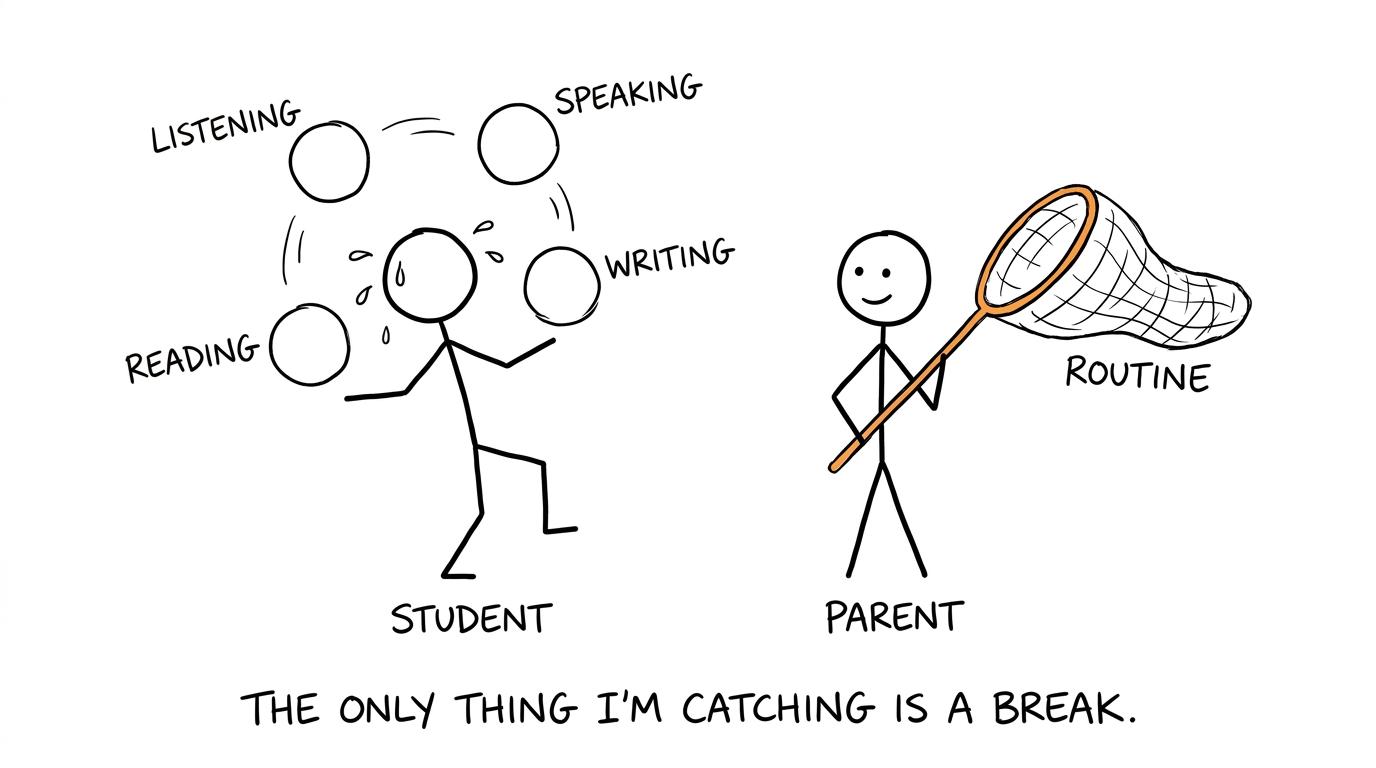 A parent provides the safety net while the student handles the four language skills
Common mistakes to avoid
Assuming fluency guarantees a high grade
Everyday communication is valuable, but GCSE Arabic also tests specific reading, writing, translation, listening and speaking tasks. Familiarity with the exam format still matters.
Using a parent as the final authority
A parent may be a highly capable Arabic speaker without knowing the current mark scheme. Teacher guidance and official exam materials should settle assessment questions.
Practising only comfortable topics
Students naturally repeat vocabulary they already know. Evidence should direct revision towards weaker themes and skills.
Completing work but not reviewing it
A task is not finished when the timer stops. The student needs to identify what went wrong and what to practise next. This is the same principle explained in MathsGenie’s guide to using GCSE past papers properly.
Treating predicted material as certainty
Predicted papers can provide fresh exam-style practice, but they cannot guarantee what will appear. In maths, GCSE predicted papers work best alongside topic revision and official past papers. Arabic revision should follow the same cautious principle: cover the specification rather than gambling on a narrow prediction.
Support should make independence easier
The right kind of parental involvement is often quiet. It looks like a protected revision slot, a willing listener, a shuffled stack of vocabulary cards or permission to stop when concentration has gone.
It does not look like taking over an answer or turning the kitchen into a second classroom.
Students can carry this approach into maths revision too. Start from the free MathsGenie GCSE maths resources, choose the correct board and tier, learn through revision lessons, practise with topic questions and mini tests, then move to past papers and predicted papers. Use mark schemes and video solutions to turn each mistake into a precise next step.
Parents can help protect that process. The student must still do the thinking. That is not a limitation of parental support; it is the reason the support works.










