Online GCSE Chemistry Revision Course: Worth It?
Online GCSE chemistry revision course guide: decide whether paid tuition beats free resources, what to check and how to protect your GCSE maths revision.
A paid revision course can feel like a shortcut through a crowded syllabus. There is a timetable, someone tells you what to do, and the next lesson arrives without you having to plan it. But an online GCSE chemistry revision course is only worth paying for if it solves a problem that free resources, school support and independent practice are not already solving.
For many students, the honest answer is: try a structured free revision plan first. Consider paying when you need regular accountability, personalised explanations or access to a teacher who can diagnose persistent mistakes. If GCSE maths is your main concern, you should also protect enough time for maths-specific practice, even though chemistry includes substantial numerical work.
The quick decision checklist
Before joining a course, ask:
- Does it match your exam board: AQA, Edexcel, OCR or Eduqas?
- Does it cover separate chemistry, combined science or the correct pathway for you?
- Will you answer questions and receive useful feedback, or mostly watch videos?
- Are lessons recorded if you miss a session?
- Can you cancel, pause or try the course before making a longer commitment?
- Does it teach required practicals, calculations and extended responses as well as facts?
- Could free resources and teacher support provide the same help?
- Will the timetable leave enough room for GCSE maths and your other subjects?
If you cannot answer those questions clearly, do not buy quickly. A polished course page tells you how the product looks. Your decision should depend on how you will learn.
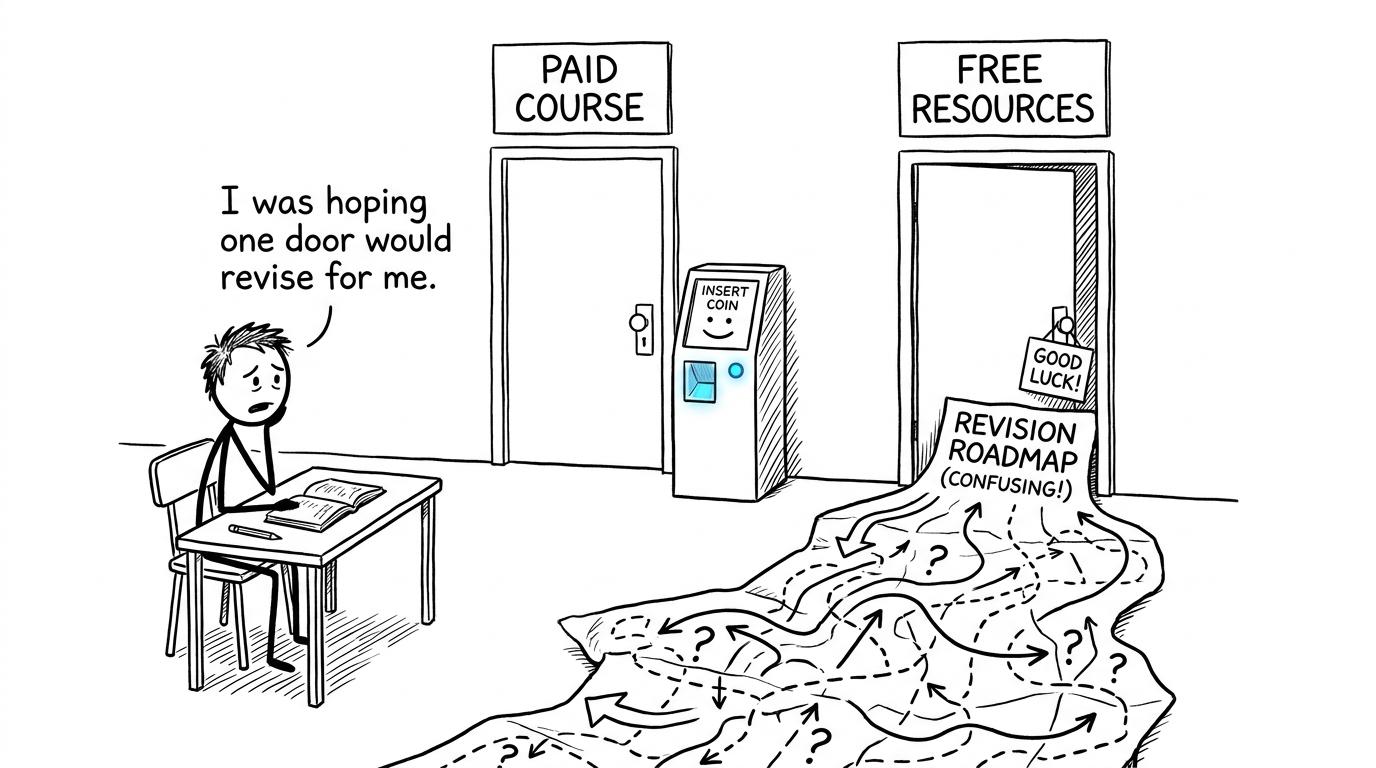 A student choosing between a paid course and free revision resources
What a good online GCSE chemistry revision course should provide
A useful course does more than move textbook content onto a screen. It creates a reliable cycle: learn, retrieve, apply, mark and revisit.
Specification-matched teaching
GCSE chemistry is not one interchangeable course. Exam boards cover broadly similar scientific ideas, but organise content and assessments differently. Separate chemistry and combined science also have different breadth and paper structures.
The provider should state the exact specification it follows. A course labelled only “GCSE science” may be too general. Check that it covers the content you actually sit, including quantitative chemistry, rates of reaction, chemical analysis and required practical knowledge where relevant.
Active practice rather than passive viewing
Video explanations can make an unfamiliar idea feel obvious. That feeling is encouraging, but it is not proof that you can answer an exam question without prompts.
A strong course should include frequent retrieval questions, calculations, graph interpretation and exam-style responses. It should also explain why an answer lost marks. The most valuable feedback identifies the gap: missing knowledge, incorrect calculation, weak use of evidence or failure to answer the command word.
Feedback and accountability
This is where a paid course can justify its cost. A fixed lesson may help if independent revision is repeatedly postponed. Live support can also shorten the time spent stuck on one misconception.
However, accountability only works when you participate. Joining a course but leaving the questions unfinished is like buying a gym membership and revising the timetable. The structure exists; the practice still has to be done.
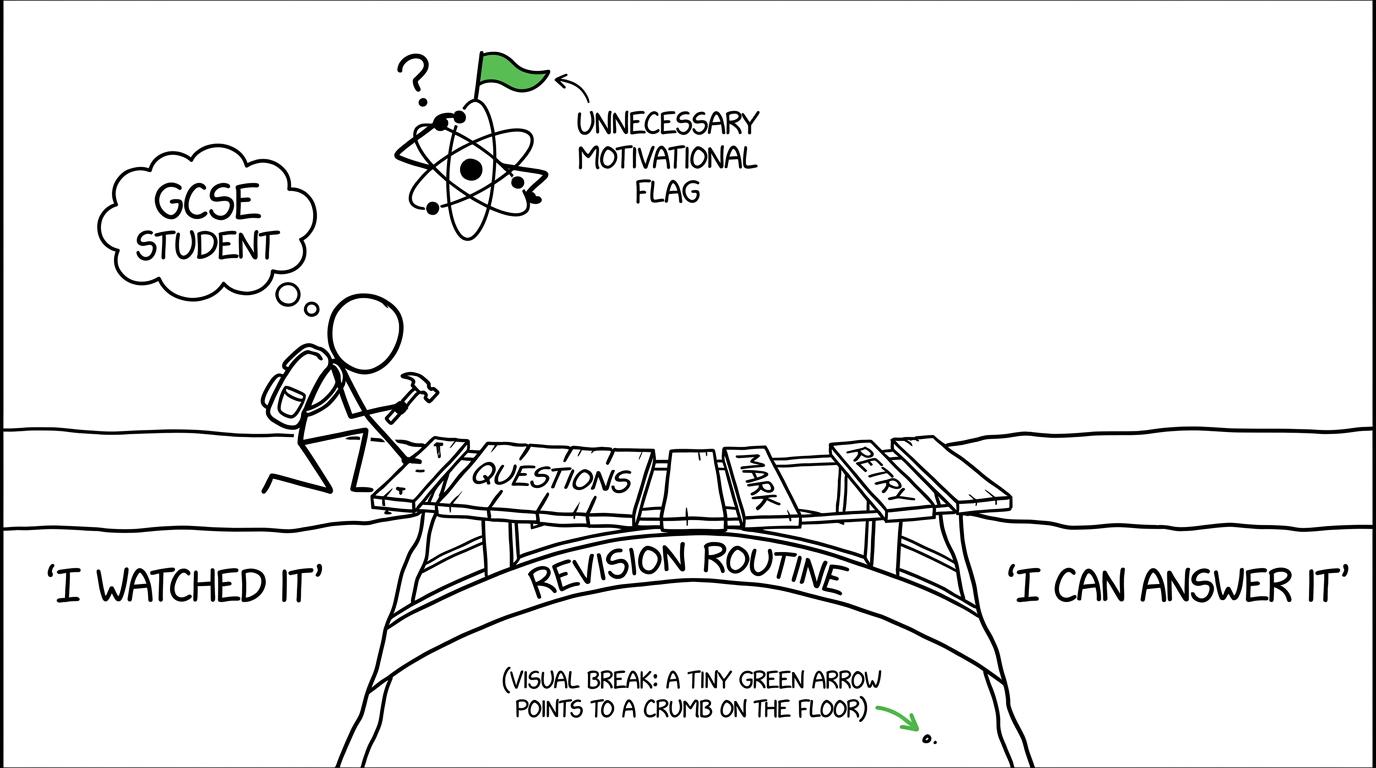 A revision bridge connecting watching a lesson to answering independently
When paying is likely to be worth it
A paid course may offer good value when one or more of these situations applies.
You have persistent, specific gaps
Perhaps quantitative chemistry remains confusing after lessons and independent revision. Perhaps you understand the scientific idea but repeatedly lose marks through units, ratios or rearranging formulae. Targeted instruction can be useful because the tutor can see the pattern behind several errors.
The key word is specific. “I am bad at chemistry” is difficult to act on. “I cannot decide which quantity a mole calculation requires” gives a tutor something concrete to diagnose.
You need a timetable imposed from outside
Some students can build their own plan. Others spend so long choosing resources that very little revision happens. A well-designed course reduces those decisions and provides deadlines.
That convenience has value, but compare it with a free timetable first. The purpose is not to own a schedule. It is to complete the work on it.
You can access meaningful teacher feedback
Recorded content alone has many free alternatives. Payment becomes easier to justify when the course includes live teaching, question support, marked work or individual feedback.
Before enrolling, find out whether feedback comes from a qualified teacher or tutor, how frequently it is available and whether class size limits individual attention. “Tutor support included” can mean very different things between providers.
When free resources are probably enough
Free revision can be fully effective when you already receive reasonable teaching, know your weaker topics and are willing to practise consistently.
A simple independent cycle is:
- Use your specification or school checklist to select one small topic.
- Review the underlying ideas briefly.
- Complete closed-book recall and exam-style questions.
- Mark your answers carefully.
- Record the exact reason for each lost mark.
- Return to the same weakness with a different question later.
This approach costs nothing, but it requires self-management. Free resources are not inferior merely because they are free. Their weakness is often abundance: students collect videos, notes and question banks without turning them into a coherent routine.
Paid courses sell structure as much as information. If you can create that structure yourself, the case for paying becomes much weaker.
Chemistry revision still depends on maths
Chemistry may sit in a different column on your timetable, but a significant part of GCSE chemistry is quantitative. Current GCSE requirements include arithmetic, ratios, fractions, percentages, standard form, significant figures, substitution, rearranging equations and interpreting graphs. For GCSE chemistry, at least 20%20\%20% of the marks must assess mathematical skills in a chemistry context.
That overlap matters if you are preparing for maths exams. Strengthening the underlying skill can support both subjects, although you must still learn how chemistry uses it.
Useful areas include:
- ratios and proportional reasoning in formulae and reacting quantities;
- percentages for yield, atom economy and composition;
- standard form for very large or small quantities;
- rearranging equations before substitution;
- gradients and tangents when interpreting rates;
- unit conversion and sensible significant figures.
MathsGenie provides free topic support for percentages, standard form, changing the subject of a formula and the gradient of a line. Higher-tier students may also benefit from revisiting direct and inverse proportion.
These pages teach the mathematical machinery. Your chemistry revision must then apply it to chemical quantities, practical data and the wording used by your science exam board.
How to compare paid and free revision fairly
Do not compare a complete paid programme with random free videos. Compare two actual plans.
| Question | Paid course | Structured free revision |
|---|---|---|
| Who chooses the sequence? | Usually the provider | You, your teacher or the specification |
| Is live feedback available? | Sometimes | Usually through school support |
| Is attendance scheduled? | Often | Only if you create a timetable |
| Are resources automatically board-matched? | Only if clearly stated | Only if you check them |
| Can the plan adapt to your mistakes? | If personal feedback is included | Yes, if you maintain an error log |
| Financial cost | Varies by provider | Usually none |
| Main risk | Paying without participating | Losing structure or changing resources too often |
A short trial is useful when available. During it, do not judge the course by whether the tutor seems energetic. Judge whether you complete more high-quality practice, understand errors sooner and know what to revise next.
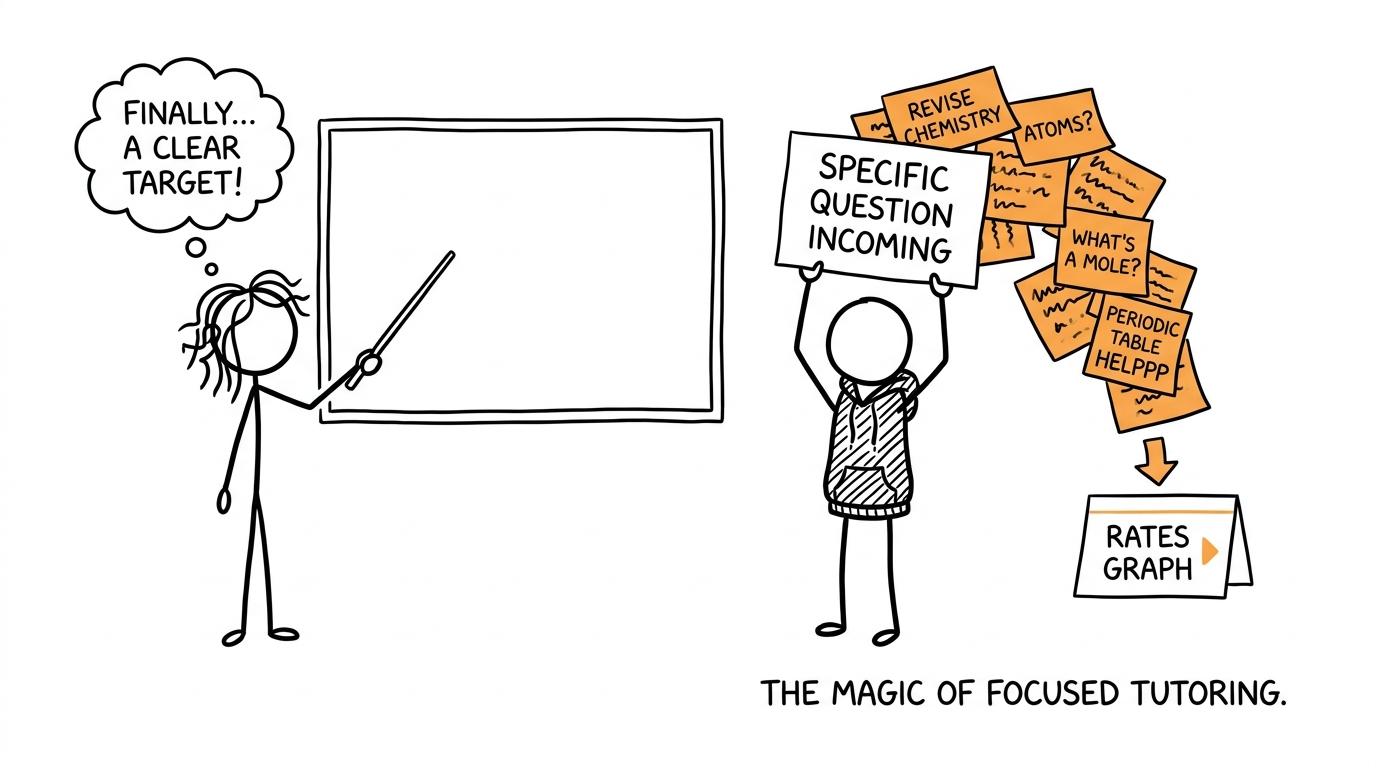 A student turning a vague revision goal into a focused question
Protecting your GCSE maths revision time
A chemistry course can improve scientific calculations, but it cannot replace maths revision. Chemistry questions usually place familiar numerical skills inside subject-specific contexts. Your maths papers demand broader coverage across number, algebra, ratio, geometry, probability and statistics.
Start by checking the GCSE maths topics by exam board and tier. Then divide your week according to evidence from tests rather than the subject that currently feels most urgent.
A sensible routine might contain separate blocks for:
- chemistry knowledge and practical understanding;
- chemistry calculations and graph questions;
- targeted GCSE maths lessons and practice questions;
- mixed maths mini tests or timed paper sections;
- marking, correction and later re-testing.
The MathsGenie resources hub brings together revision material, practice papers and shorter tests. As exams approach, use past papers and predicted papers to test performance under time pressure. Predicted papers are practice tools, not promises about the questions that will appear.
Common mistakes when choosing a chemistry course
Paying before diagnosing the problem
First identify whether you lack knowledge, calculation fluency, exam technique or consistency. Different problems require different support.
Assuming cost guarantees quality
Price does not prove that teaching is specification-matched, interactive or personalised. Inspect sample materials and the feedback arrangements.
Watching lessons without answering questions
Recognition is not recall. Questions must be attempted without the explanation open, then marked and revisited.
Ignoring the exam board or qualification route
Check your board, tier where applicable, and whether you take separate chemistry or combined science. Revision that misses assessed content wastes time; revision that adds unnecessary content can do the same.
Sacrificing every other subject
A fixed course can quietly absorb several evenings once homework and follow-up tasks are included. Count the full weekly time commitment before enrolling.
Cancelling free support too quickly
Your teacher may offer interventions, marked practice and explanations tailored to your class. Use that support before assuming an external programme is essential.
The final verdict
An online GCSE chemistry revision course is worth it when it buys something you genuinely need: dependable structure, expert diagnosis, live explanations or regular personalised feedback. It is less likely to be worthwhile when it mainly provides recorded information that you could access freely, especially if you already revise independently.
Try the free route with discipline before spending. Build a topic list, answer questions, mark them and review your errors. If that system repeatedly fails for a clear reason, choose a paid course designed to fix that reason, not simply the course with the loudest promises.
Meanwhile, keep your maths preparation moving. Use MathsGenie's free revision lessons to repair individual skills, practise with question banks and mini tests, and then test yourself with past papers, predicted papers, mark schemes and video solutions. Start with one weak maths topic today. A small completed revision cycle is worth more than another perfect plan waiting to begin.