

An October Half-Term IGCSE Maths Revision Plan
October half-term IGCSE Maths revision plan for Edexcel and Cambridge students, with a realistic seven-day timetable, topic practice and paper review.
October half-term arrives at an awkward moment. The summer feels distant, mocks may be getting closer, and the list of topics you meant to revisit has quietly grown. An October half-term IGCSE Maths revision plan gives that uncertainty a shape: diagnose your gaps, repair a few important topics, practise exam questions and leave enough room to rest.
The aim is not to complete the entire course in seven days. It is to return to school knowing more clearly what you can do, what still needs attention and what your next revision step should be.
This plan works for students taking Pearson Edexcel International GCSE Mathematics A or Cambridge IGCSE Mathematics. You should adapt the topics and paper practice to your own specification, tier and school timetable.
Your half-term revision checklist
Before the week begins, collect:
- your exact exam board and syllabus or specification
- a recent assessment, homework or mock paper
- the corresponding mark scheme
- a list of topics covered so far at school
- a calculator and geometry equipment where appropriate
- a notebook or document for recording mistakes
- protected time for rest and other subjects
The GCSE Maths revision timetable guide is the wider planning guide for this revision cluster. It explains how to turn broad intentions into sessions with a defined topic, resource and finishing point.
Check your Edexcel or Cambridge course first
Do not begin with a random list of difficult-looking topics. Start with the course you are actually taking.
Pearson Edexcel International GCSE Mathematics A uses Foundation and Higher tiers. Its two papers permit calculators and can assess content from number, algebra, geometry and statistics. Cambridge IGCSE Mathematics uses Core and Extended routes. Under the current Cambridge syllabus, students take a dedicated non-calculator paper and a calculator paper at their route.
That difference matters. A Cambridge student should include regular non-calculator work, while an Edexcel student still needs strong arithmetic but should also practise using a calculator accurately and efficiently. In both courses, check your current specification rather than relying on an old topic checklist.
Your first planning decision is therefore simple:
- write down your exam board
- confirm your tier or route
- identify which content your class has already studied
- use papers and questions that match that course
A seven-day IGCSE revision timetable
Imagine a student opening half-term with eighteen topics highlighted in red. Trying to cover all eighteen would create a busy timetable, but probably not much learning. A stronger plan selects a few priorities and revisits them deliberately.
Use this timetable as a framework rather than a rigid command. Each main session could last about forty-five minutes, followed by a short review. If you have several subjects to revise, one focused maths session on most days is enough.
| Day | Main task | Useful outcome |
|---|---|---|
| Monday | Complete a mixed diagnostic set | Identify three priority topics |
| Tuesday | Repair priority topic one | Complete focused practice and correct errors |
| Wednesday | Repair priority topic two | Explain the method without notes |
| Thursday | Rest or complete a short retrieval session | Recall Tuesday's and Wednesday's methods |
| Friday | Repair priority topic three | Complete increasingly difficult questions |
| Saturday | Attempt a timed paper section | Practise choosing methods under pressure |
| Sunday | Mark, correct and plan the next fortnight | Produce a short list of follow-up tasks |
If drawing this IGCSE revision timetable by hand feels like another task, build the same seven-day structure in the Revision Planner and adjust it around your half-term commitments.
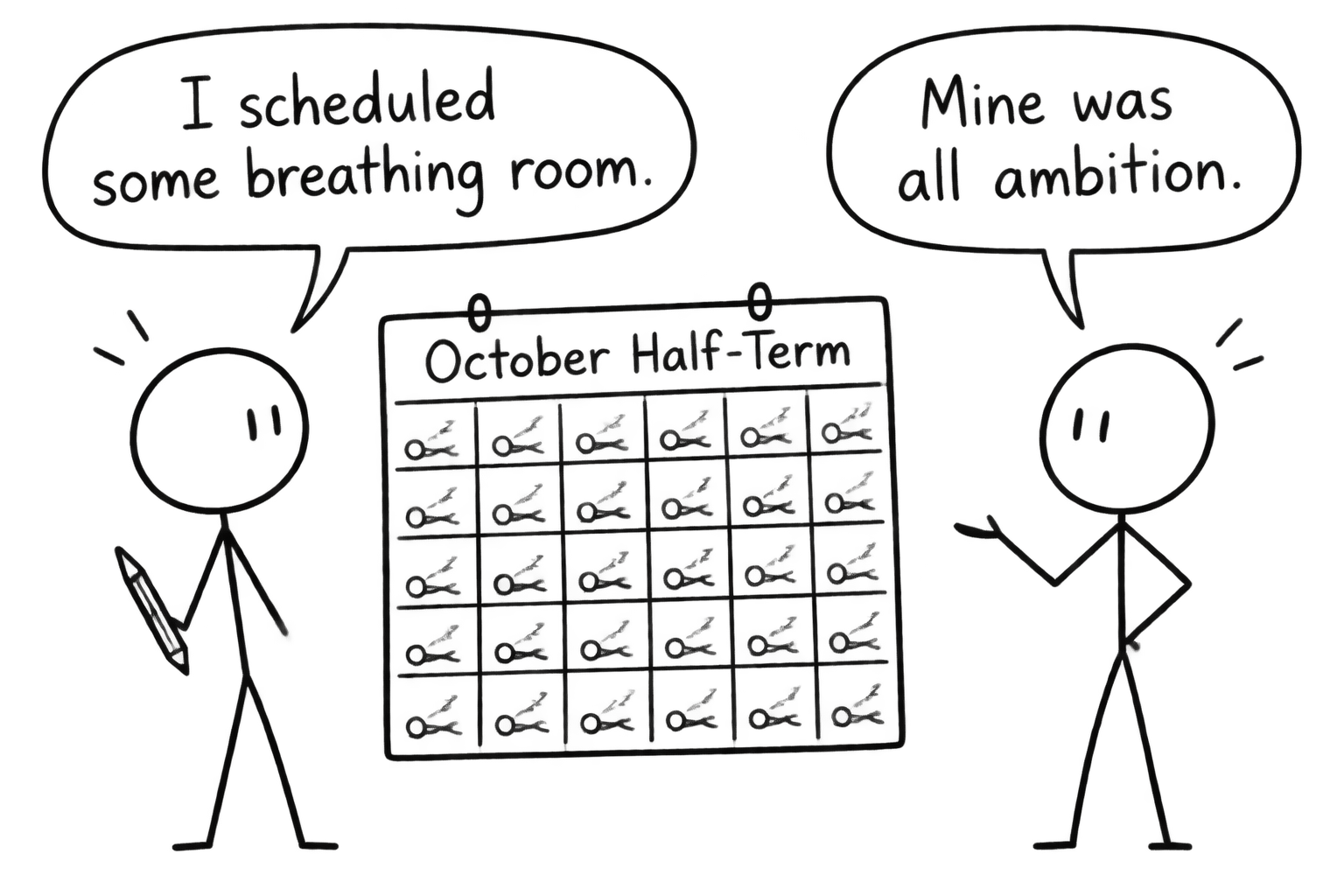 XKCD-style comic showing one student creating an overambitious revision calendar while another schedules breathing room
Make every revision session produce evidence
A session called “algebra” is difficult to start and impossible to measure. A session called “practise expanding and factorising, mark the questions, then redo every error” tells you what success looks like.
A reliable session has four stages:
Retrieve
Spend five minutes writing down what you remember without looking at notes. Include methods, vocabulary and any formulae you are expected to know. This exposes gaps before familiarity can disguise them.
Relearn
Use a concise revision lesson or video solution to repair the specific gap. Avoid watching several videos in a row. The explanation should lead quickly into independent work.
Practise
Complete questions without copying the model solution. Begin with direct questions, then move towards multi-step or unfamiliar problems. MathsGenie practice questions and mini tests can help you move from explanation to application without turning revision into passive reading.
Review
Mark the work carefully. For each mistake, record whether the cause was missing knowledge, a poor method choice, inaccurate working or a misread question. Then complete the question again without the solution.
This approach is more useful than measuring revision only in hours. The guide to realistic GCSE revision hours can help if you are trying to balance maths with the rest of your subjects.
Choose the right three priority topics
Your three topics should come from evidence, not anxiety. Use your diagnostic questions, marked work and teacher feedback.
A sensible selection often contains:
- one foundational weakness that affects several other topics
- one recently taught topic that has not yet become secure
- one problem-solving area where you struggle to choose a method
For example, weak manipulation of fractions can affect algebra, probability and ratio. Repairing that foundation may be more valuable than attempting an advanced topic you have not yet covered in class.
Use a simple confidence code after marking:
- Red: you could not begin or used the wrong method
- Amber: the method was mostly correct but needed support
- Green: you completed the question independently and accurately
Green does not mean “never revise again”. It means revisit later through mixed questions. Red topics deserve instruction and focused practice rather than repeated full papers.
Use past papers without wasting them
A complete paper can be useful, but it is not always the best starting point in October. If substantial content has not yet been taught, a full paper may measure missing lessons rather than revision quality.
Instead, choose a timed section containing topics you recognise. Work in exam conditions, show each stage clearly and mark it with the official mark scheme. Video solutions can then help you understand why a method failed, while the mark scheme shows what examiners reward.
Keep an error log with four columns: topic, mistake, corrected method and review date. Reattempt difficult questions after a few days. The delay matters because remembering a solution immediately is not the same as being able to reproduce the method later.
If you are balancing several courses, the related GCSE Statistics half-term plan, Chemistry half-term revision guide and English Language and Literature half-term plan offer the same principle: choose a manageable target, practise actively and protect recovery time.
Common mistakes to avoid
Planning every hour
A timetable with no spare space breaks as soon as a family plan changes or a session takes longer than expected. Leave at least one lighter day and some unscheduled time.
Revising only comfortable topics
Completing familiar questions feels productive, but it produces little new information. Begin with diagnostic evidence and spend most of your effort on carefully selected weaknesses.
Watching instead of practising
A clear explanation can create confidence before the method is secure. Close the video, attempt questions independently and use the solution only when marking.
Ignoring the mark scheme
Correct answers matter, but so do valid methods, clear working and appropriate accuracy. Mark schemes help you notice where your written solution is losing marks.
Treating one bad paper as a verdict
A paper is evidence from one moment, not a prediction of your final grade. Use it to decide what to do next. MathsGenie's revision blog contains further guidance on timetables, exam practice and sustainable revision routines.
Build your October schedule
You now have the structure: diagnose, select three priorities, practise actively and finish with timed exam work. The remaining gap is turning those intentions into sessions you will actually follow when half-term begins.
Build your October half-term schedule in the Revision Planner, place each weak topic into a realistic day and start with your diagnostic session.















