GCSE Statistics February Half-Term Revision Plan
GCSE statistics February half-term revision: use this seven-day plan to fix weak topics, practise exam questions and protect time for all other subjects.
February half-term can create a strange kind of pressure. Exams feel close enough to worry about, yet far enough away for revision to become vague: a few notes read, several tabs opened, not much remembered.
A useful GCSE statistics February half-term revision plan is simpler. Diagnose your weakest statistical skills, complete four or five focused sessions, mark everything carefully, then schedule short follow-up practice for the weeks ahead. Half-term should begin the improvement cycle and not become the only week in which you revise.
This plan is primarily for the statistics content within GCSE Maths. If you take the separate qualification, begin with the Edexcel GCSE Statistics revision hub and adapt the same routine to your specification.
Your half-term revision checklist
By the end of the break, aim to have:
- checked your exam board, tier and topic list;
- identified three statistical weaknesses;
- refreshed the methods behind those topics;
- completed exam-style practice without notes;
- marked your answers and recorded recurring errors;
- attempted one short mixed or timed assessment;
- planned when you will revisit each weakness after half-term.
This is deliberately contained. GCSE Maths includes far more than statistics, and you may also be revising English, science and other subjects. A plan that leaves space for those responsibilities is more likely to survive beyond Monday morning.
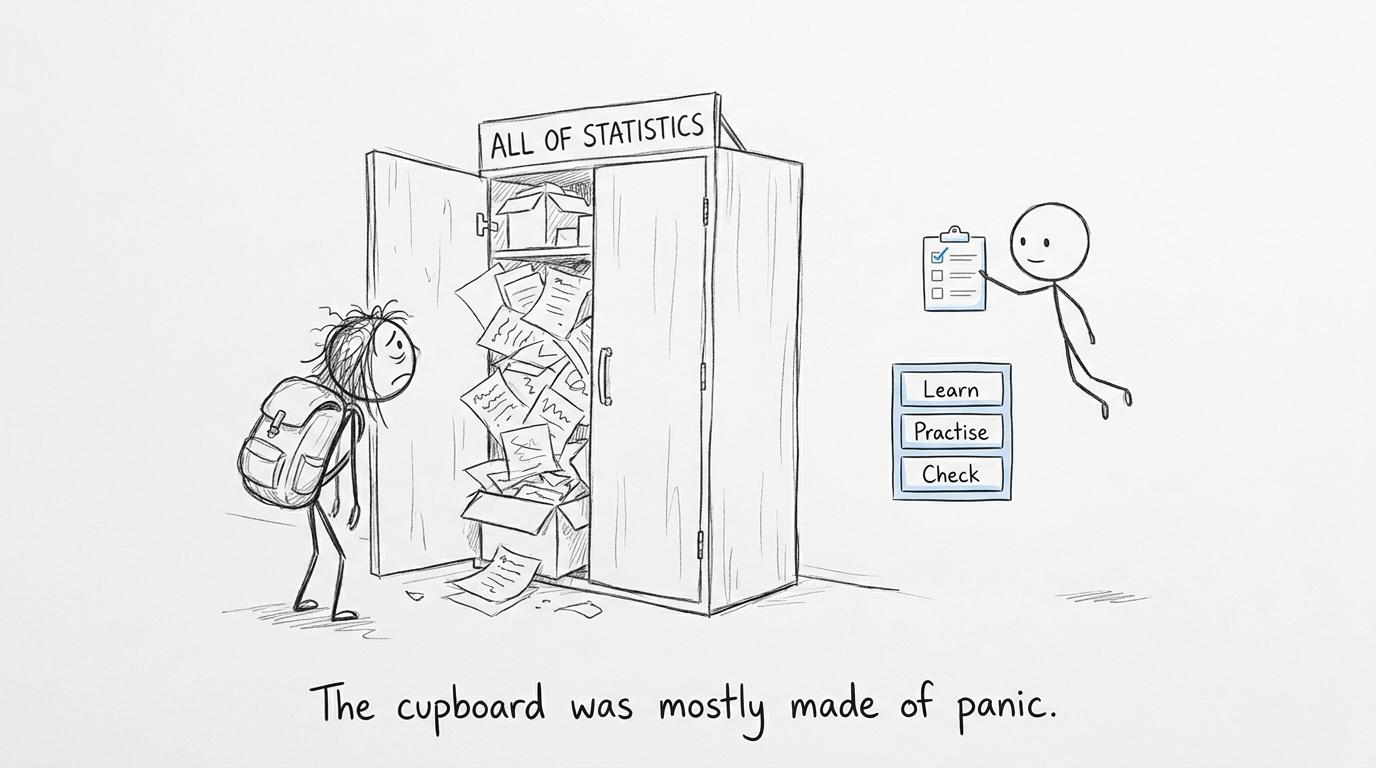 A student discovers that the enormous statistics cupboard is mostly made of panic
Start by diagnosing, not rereading
The tempting approach is to begin at the first page of your notes. The efficient approach is to begin with questions.
Choose a short selection from the MathsGenie GCSE Maths revision hub, matched to your exam board and tier. Attempt questions covering several areas of statistics without looking at examples. You are not trying to earn an impressive mark. You are collecting evidence.
Classify each question using three labels:
- Secure: you completed it accurately and could explain the method.
- Shaky: you made progress but needed help or made an avoidable error.
- Priority: you could not begin, chose the wrong method or misunderstood the data.
Select no more than three priorities for half-term. A student who chooses twelve weaknesses usually practises none of them deeply. A student who fixes three has something concrete to carry into the next school week.
Choose statistics topics by the marks you lose
Your exact content depends on your qualification, exam board and tier. Edexcel, AQA, OCR and Eduqas organise their specifications differently, so use your teacher's topic list and the specification for the paper you will sit.
The following clusters provide a practical way to organise GCSE Maths statistics revision.
Averages and frequency tables
You should be able to interpret and calculate measures of central tendency, including the mean, median and mode, and measures of spread such as the range. With a frequency table, the mean is found using:
mean=∑fx∑f\text{mean}=\frac{\sum fx}{\sum f}mean=∑f∑fxFor grouped data, class midpoints are used, so the result is an estimate rather than an exact mean. That distinction matters: exam questions may ask you to explain why an answer is estimated.
If this is a priority, use the averages from frequency tables topic page, followed by the frequency-table practice questions. Even if the linked topic page is organised under OCR, check that the skill matches your own board's specification before using it.
Statistical diagrams and comparisons
Revise how information is represented, but also how it is interpreted. Depending on your course and tier, this may include frequency polygons, cumulative frequency graphs, box plots, histograms, scatter graphs and time series.
Comparison questions need more than a visual description. Compare a measure of location, usually the median or mean, and a measure of spread, such as the range or interquartile range:
IQR=Q3−Q1\text{IQR}=Q_3-Q_1IQR=Q3−Q1Always interpret the comparison in context. Saying one box is wider merely describes the diagram; saying that its larger interquartile range indicates less consistent times explains the data.
The box plots revision guide and cumulative frequency revision guide can rebuild these connected ideas before you attempt the cumulative frequency and box plot questions.
Sampling, data collection and interpretation
Statistics is not only calculation. You may need to identify biased questions, assess a sampling method, understand populations and samples, or comment on whether a conclusion is justified.
Build a short vocabulary list containing terms such as random sample, stratified sample, census, primary data, secondary data, discrete data and continuous data. Do not stop at memorising definitions. Practise recognising why a method may be biased or unrepresentative.
A reliable evaluation asks:
- Who belongs to the population?
- How was the sample selected?
- Is any group more likely to be included?
- Is the question neutral and unambiguous?
- Does the evidence support the conclusion being made?
Probability linked to data
Probability and statistics often meet through relative frequency, experimental data and two-way tables. A basic experimental estimate has the form:
P(A)=frequency of Atotal number of trialsP(A)=\frac{\text{frequency of }A}{\text{total number of trials}}P(A)=total number of trialsfrequency of ARemember that an experimental estimate is based on observed results. It does not guarantee what will happen next. Larger samples can provide more stable evidence, but they do not remove randomness.
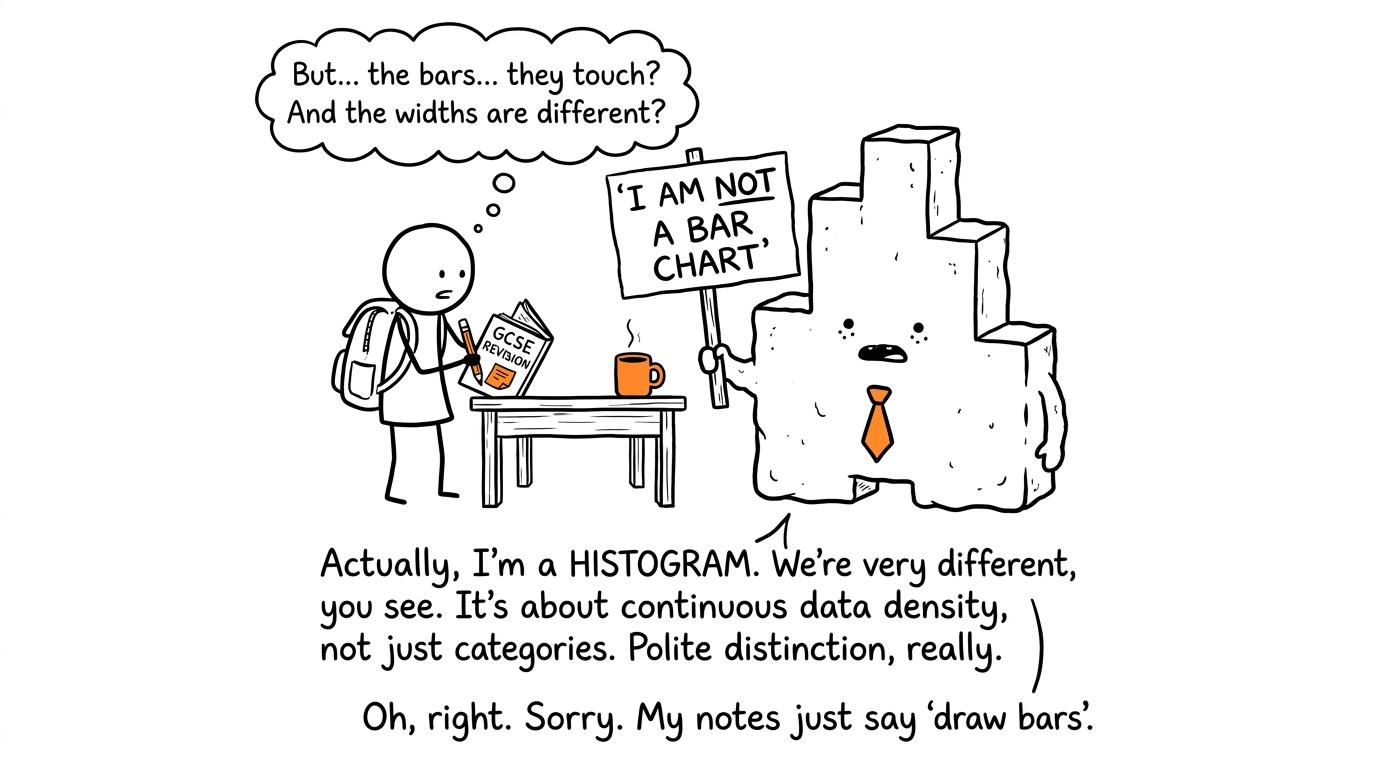 A histogram-shaped monster politely explains that it is not a bar chart
A focused seven-day half-term plan
School holiday dates vary across the UK, and academies or individual schools may set different dates. Treat the schedule below as a sequence rather than attaching it to particular weekdays.
| Session | Focus | What to do |
|---|---|---|
| First | Diagnose | Attempt a short mixed set, mark it and choose three priorities. |
| Second | Priority one | Review one lesson or guide, then complete focused questions. |
| Third | Priority two | Repeat the learn, practise and mark cycle. |
| Fourth | Rest or other subjects | Leave statistics alone and allow recovery time. |
| Fifth | Priority three | Rebuild the method, complete questions and correct errors. |
| Sixth | Mixed timed practice | Attempt a mini test or a section of a suitable paper without notes. |
| Seventh | Review and plan | Redo mistakes, summarise key fixes and schedule later retrieval. |
Most focused sessions can last about 303030 to 505050 minutes. The important unit is not time spent at a desk; it is a completed cycle:
attempt, mark, understand, correct, and reattempt.
Use a timer if it helps you begin, but stop measuring revision by minutes alone. A carefully corrected set of six questions can reveal more than an unmarked paper completed at speed.
Make every session active
Begin each topic session with a brief recall attempt. Write down the relevant definitions, formulas or graph features from memory. Then use a MathsGenie revision lesson or guide to check what is missing.
Move quickly into questions. Keep notes closed for the first attempt so that you test retrieval rather than recognition. When you mark the work, record each lost mark under one of four headings:
- knowledge: you did not know a fact or definition;
- method: you selected or applied the wrong process;
- accuracy: arithmetic, plotting or calculator work went wrong;
- communication: you omitted working, units, labels or a contextual conclusion.
Finish by correcting the answer and completing a similar question later. The correction is the valuable part. A red cross identifies a weakness; a successful reattempt begins to remove it.
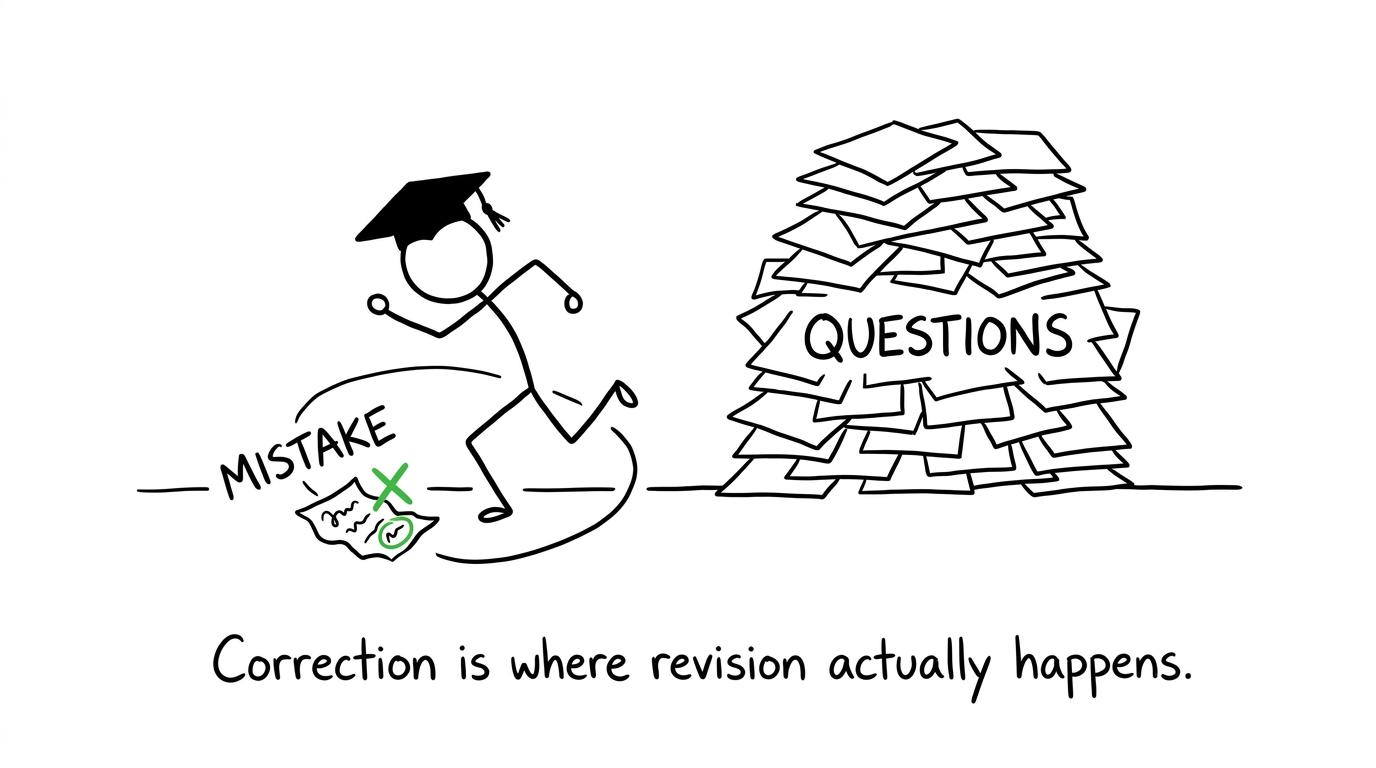 A student celebrates a corrected mistake while the next questions wait patiently
Protect time for the rest of GCSE Maths
Statistics should not consume the entire break simply because it currently feels uncomfortable. Give it a clear boundary: perhaps four topic sessions, one mixed assessment and one brief review.
Use the remaining maths time for other weaknesses from number, algebra, ratio, proportion or geometry. The wider GCSE Maths resource collection provides revision guides, practice questions, mini tests, past papers and predicted papers organised around GCSE preparation.
It also helps to separate learning from testing. Topic questions are best for rebuilding a method. Past papers show whether you can recognise that method when it is hidden inside a mixed exam. Predicted papers can add further practice closer to the relevant exam series, but they should complement specification coverage and past-paper work rather than replace them.
What happens after February half-term
Without follow-up, a productive week can become an isolated burst. Before the break ends, place three short sessions into your revision planner:
- revisit priority one within the next few days;
- revisit priority two the following week;
- complete a mixed statistics check later in the month.
Each follow-up can be short. Start by reattempting a previous mistake without looking at the correction. If the method now feels secure, move to a fresh question. If it does not, return briefly to the explanation and try again.
As the exams approach, broaden your practice. Use board-appropriate past papers and mark schemes to see statistics alongside the rest of the course. Video solutions can help when a written mark scheme tells you what earned the marks but not why the method works.
Common mistakes in GCSE statistics revision
Confusing a histogram with a bar chart
A histogram represents grouped continuous data, and frequency is connected to bar area. Where required, frequency density is:
frequency density=frequencyclass width\text{frequency density}=\frac{\text{frequency}}{\text{class width}}frequency density=class widthfrequencyDo not judge frequency from height alone when class widths differ.
Forgetting that grouped means are estimates
Using a class midpoint assumes values are represented by that midpoint. Keep full calculator accuracy during the calculation, round only at the end and describe the result as an estimate where appropriate.
Comparing diagrams without using statistics
A complete comparison normally refers to both location and spread. Use values from the graph, then explain what those values mean in context.
Plotting cumulative frequency at the wrong boundary
Cumulative totals are plotted against upper class boundaries. Check that the final cumulative frequency equals the total frequency before drawing the curve.
Marking without correcting
Reading a solution and thinking "that makes sense" is not the same as reproducing it independently. Close the solution, redo the question and record the precise reason for the original error.
Treating half-term as the finish line
The purpose of the break is to create momentum. Statistics becomes dependable through spaced revisits and mixed exam practice, not one heroic week.
Turn one focused week into a lasting revision habit
A good February plan is modest enough to complete and useful enough to continue. Diagnose three weaknesses. Learn only what you need. Practise under gradually more realistic conditions. Mark with care. Then return to the same skills after the holiday.
MathsGenie gives you one free place to run that cycle: revision lessons and guides for understanding, practice questions and mini tests for fluency, mark schemes and video solutions for feedback, and past papers and predicted papers for exam preparation.
Open the GCSE Statistics revision hub if you take Edexcel GCSE Statistics, or choose your exam board from the GCSE Maths revision area. Pick one diagnostic set today. Half-term does not need to solve the whole course; it only needs to make your next step clear.