

An October Half-Term GCSE Maths Revision Plan
October half-term GCSE Maths revision plan with topic triage, focused sessions, past-paper practice, rest days and advice for catching up.
October half-term often arrives with two competing feelings. You need a break, but mocks may be close enough to make doing nothing feel uncomfortable. If you searched for a October half-term GCSE Maths revision plan, the useful answer is not seven days packed with work. It is a realistic week combining topic triage, focused practice, a past paper and genuine rest.
Imagine a student looking at a long specification on Saturday morning. Everything appears equally urgent, so deciding where to begin consumes the time meant for revision. A better GCSE revision plan makes three decisions in advance: what matters most, when it will be practised and what can wait.
For broader planning beyond half-term, start with the GCSE Maths revision timetable guide. This article turns that longer-term approach into one manageable holiday week.
Your half-term checklist
By the end of the week, aim to have:
- identified three priority topics;
- completed four focused revision sessions;
- attempted one timed paper or substantial paper section;
- marked your work and recorded recurring errors;
- revisited the weakest topic;
- kept at least one complete rest day;
- prepared a short plan for the first week back.
This is deliberately modest. Half-term revision should create direction, not exhaustion.
Begin with topic triage
Topic triage means sorting topics by need rather than revising whichever one feels easiest. Use recent class tests, homework, teacher feedback or an unfinished past paper as evidence.
Create three groups:
| Priority | What it means | What to do |
|---|---|---|
| Red | You cannot reliably begin the questions | Relearn the method, then practise basic questions |
| Amber | You understand the method but make errors | Complete exam-style questions and analyse mistakes |
| Green | You can answer independently | Use brief retrieval practice to maintain it |
Choose two red topics and one amber topic. More than three priorities usually turns a plan into a wish list.
Be specific. “Algebra” is too broad, while “solving simultaneous equations” gives you a clear task. “Geometry” is vague, while “circle theorems” or “surface area of prisms” can fit into one session. Check that each topic belongs to your exam board and foundation or higher tier through the GCSE Maths revision hub.
A realistic GCSE Maths revision timetable
The following structure assumes a Monday-to-Sunday half-term. Move the days around if you have family plans, homework for other subjects or commitments outside school.
| Day | Main task | Suggested time |
|---|---|---|
| Monday | Diagnose weaknesses and revise red topic one | 45-60 minutes |
| Tuesday | Revise red topic two | 45-60 minutes |
| Wednesday | Rest day | No scheduled maths |
| Thursday | Practise the amber topic and revisit red topic one | 45-60 minutes |
| Friday | Timed past-paper section | 45-60 minutes |
| Saturday | Mark, correct and retry mistakes | 30-45 minutes |
| Sunday | Short review and plan the return to school | 20-30 minutes |
Each focused topic session can follow the same pattern:
- Learn: review a revision lesson or video solution.
- Practise: answer questions without copying the method.
- Check: use the answers or mark scheme.
- Record: write down one error and the correction.
- Retry: answer a similar question without notes.
This rhythm matters because watching a solution can create a feeling of familiarity without proving that you can reproduce the method. The independent questions provide the evidence.
You now have the structure; if arranging it around your own week feels cumbersome, build the half-term schedule in the Revision Planner instead of drawing every session by hand.
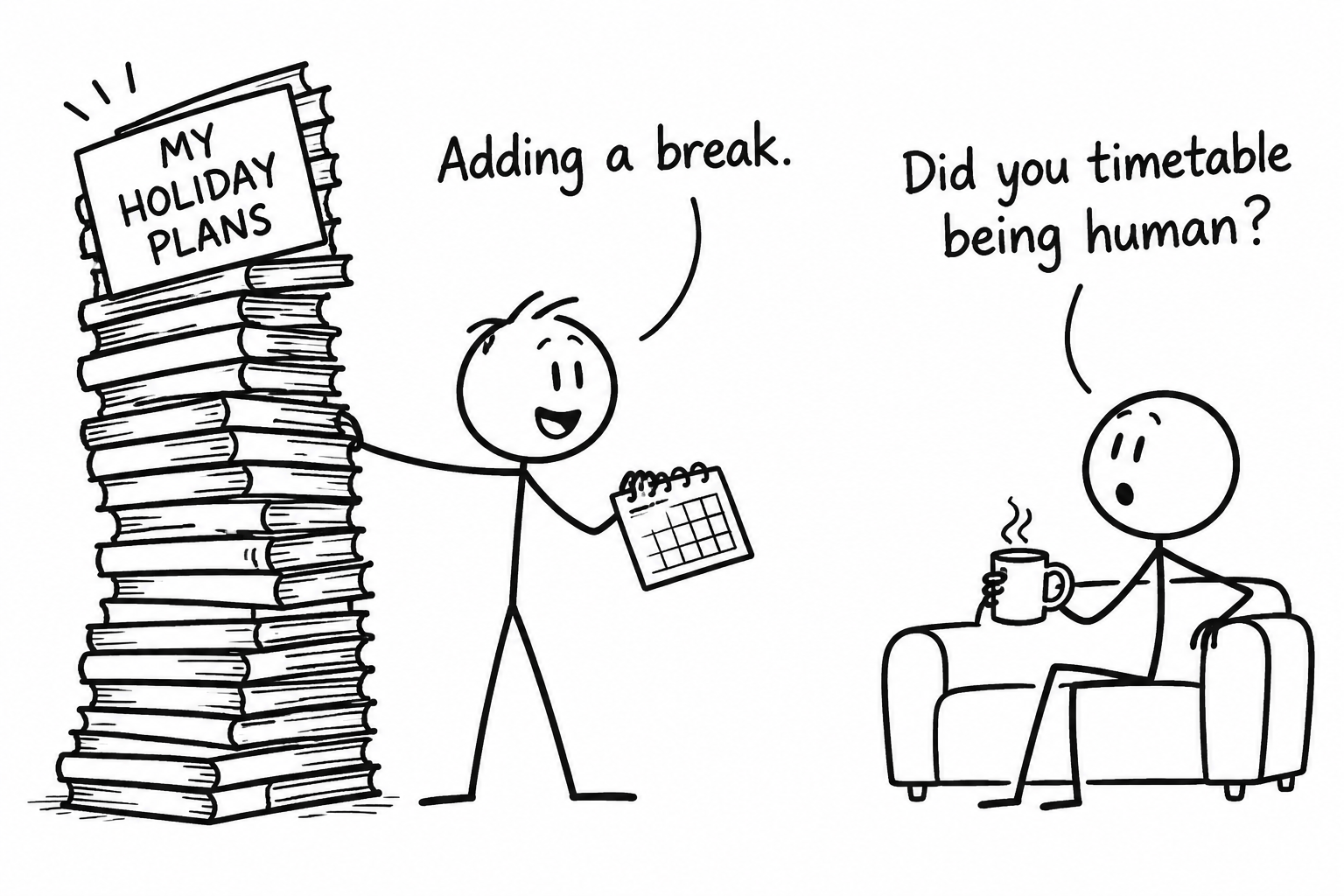 A student wisely adds a break to an overloaded holiday plan
Use a past paper as a diagnostic tool
October is usually too early to expect every part of the specification to have been taught. That does not make past papers useless. It simply changes how you use them.
Choose a paper for your exam board and tier from the GCSE past papers collection. If your school follows Edexcel, the Edexcel GCSE Maths past papers include question papers, mark schemes and worked solutions where available.
You have three sensible options:
- complete only questions on content already covered in class;
- attempt a timed section rather than an entire paper;
- complete a full paper but label unfamiliar, untaught questions separately.
When marking, do not stop at the total mark. Classify each lost mark:
- Knowledge gap: you did not know the method.
- Process error: you knew the method but made an algebraic or arithmetic mistake.
- Reading error: you overlooked a condition, unit or instruction.
- Exam technique: you did not show enough working or abandoned the question too soon.
Your corrections should influence Saturday’s session. If three errors come from fractions, fractions deserve attention more than a random topic chosen in advance. This is how a timetable becomes responsive rather than decorative.
Protect rest without losing momentum
A rest day is part of the plan, not evidence that the plan failed. Half-term is also time away from the ordinary school routine. Filling every day leaves no flexibility when life changes, and it can make returning to school feel harder.
Keep Wednesday completely free in the sample timetable. You can also protect most evenings by placing revision earlier in the day. One focused session followed by time off is usually more realistic than an open-ended instruction to “do maths”.
If you want a longer framework after the holiday, the one-month GCSE Maths revision plan extends the same cycle of diagnosis, targeted practice and checking.
What to do when you fall behind
Suppose Friday arrives and you have completed only Monday’s session. The tempting response is to squeeze four sessions into the weekend. That preserves the original timetable on paper while removing the rest that made it workable.
Instead, reset the plan:
- keep the highest-priority red topic;
- shorten the past paper to a selected section;
- move the amber topic into the first week back;
- retain the correction session;
- keep some protected rest.
Never double every remaining session. Missing work is information: the first plan asked for more time than you had. Adjusting it is good planning, not giving up.
On Sunday, carry forward only one or two unfinished tasks. A long backlog makes each new week begin with failure. The purpose of a GCSE Maths revision timetable is to guide the next useful action, not preserve every past intention.
Common mistakes to avoid
Revising only comfortable topics
Green topics feel rewarding because questions go quickly. Maintain them briefly, but spend most of the week on carefully chosen red and amber areas.
Making sessions too vague
“Revise number” gives you no finish line. Name the exact topic, resource and task before the session begins.
Completing questions without marking them
Unmarked work cannot show whether your method was correct. Use mark schemes and video solutions to understand where marks were gained or lost.
Doing a paper without correcting it
The paper identifies weaknesses; the correction session improves them. Keep both in your plan.
Treating missed work as debt
Revision is not improved by guilt. Reduce, move or replace tasks according to what the evidence now says you need.
Turn the plan into your schedule
A sensible October half-term plan leaves you with clearer priorities, corrected mistakes and enough energy to return to school. Knowing that structure is helpful, but following it becomes easier when every session has a place and unfinished work does not disappear into a notebook. Build your October half-term schedule in the Revision Planner.















