Find Your Weakest GCSE Maths Topics (OCR)
GCSE OCR maths revision made simple: learn how to find your weakest topics using past papers, mark schemes and YesGenie lessons for faster progress.
GCSE revision can feel oddly unfair. You sit down with the best intentions, open a paper, and within minutes everything looks familiar, but nothing feels secure. That’s the moment most OCR students miss the most useful question in GCSE Maths: what, exactly, am I weakest at? Not what you “don’t like”. Not what you “haven’t done in ages”. The real weakest topics are the ones that leak marks quietly, again and again, while you keep telling yourself you’ll fix them later.
Later rarely arrives. Measurement does.
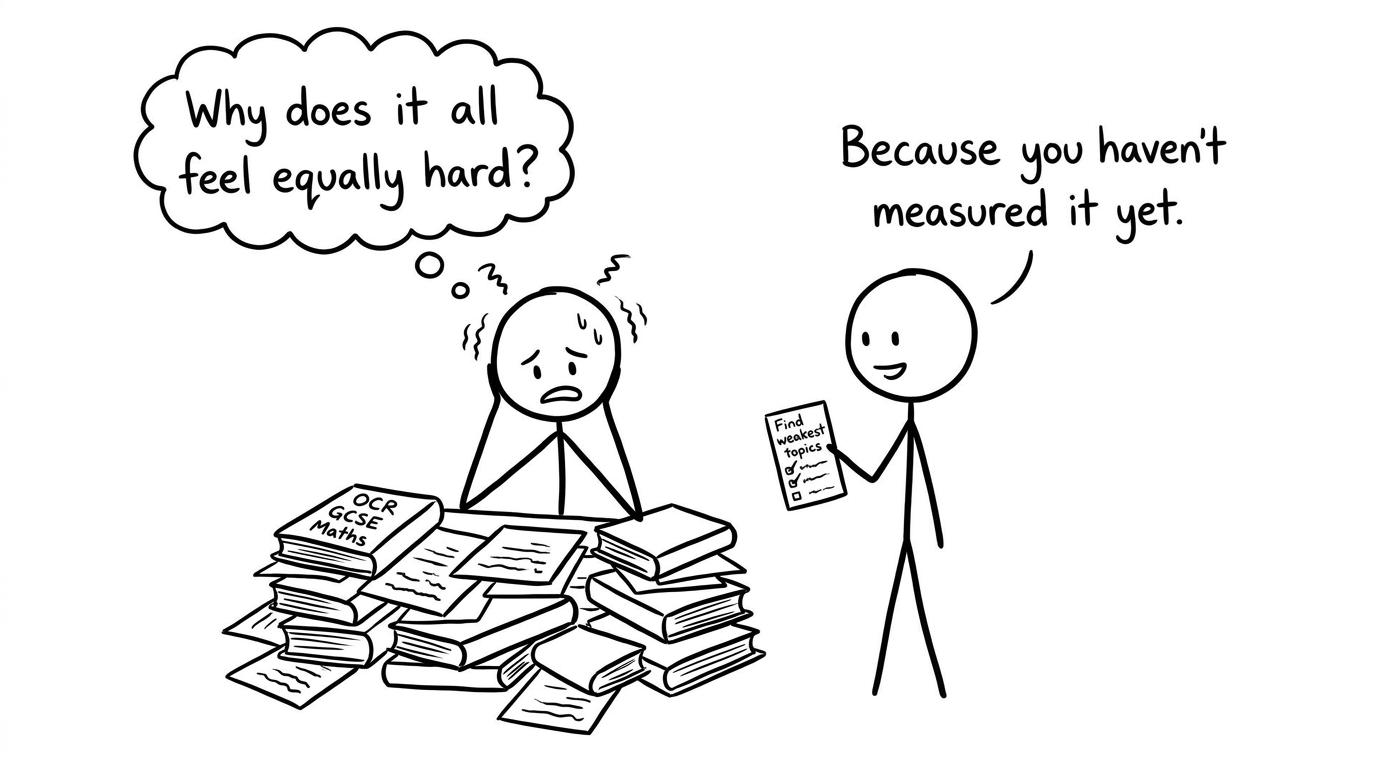 A stressed student meets a calm checklist
A quick checklist to find your weakest topics (OCR GCSE)
If you want a simple plan that actually changes your GCSE outcomes, do this:
- Sit one short, timed paper section (or a mini test) under exam conditions.
- Mark it using the mark scheme and be strict.
- Convert every lost mark into a topic label (not just “careless”).
- Rank topics by marks lost per minute spent.
- Fix the top 3 first using lessons, revision guides, exam questions and video solutions.
- Retest the same topics within 48 hours.
The goal isn’t to “revise more GCSE Maths”. The goal is to revise the right GCSE Maths.
Start where OCR starts: the OCR GCSE Maths hub
OCR papers have their own rhythm: how they phrase questions, how they structure multi-step problems, and how they expect working to be communicated. That means your weakest topics are best found using OCR-style GCSE questions.
Begin with the OCR GCSE Maths page. It’s a good home base because it brings together topic resources and exam practice in one place. When you later diagnose a weakness (say, bounds or sine rule), you want to be able to jump straight into targeted practice, not disappear into a folder of random worksheets.
You can also keep the wider GCSE Past papers collection nearby for comparison across exam boards (AQA, Edexcel, OCR, Eduqas). Even if you sit OCR, it’s useful to see how the same GCSE skill is tested elsewhere.
Why “doing more papers” doesn’t always reveal weak topics
A lot of students do full papers, get a percentage, and stop there. The number feels like feedback, but it’s often just a mood. If you got 47/8047/8047/80, you might think, “I’m a grade 6-ish.” That’s not a plan.
Weak topics show up when you:
- log which marks you lost,
- notice patterns, and
- tie each pattern to a GCSE topic on the specification.
A paper score is a temperature reading. A topic breakdown is a diagnosis.
The YesGenie method: turn every lost mark into a topic label
Here’s the discipline that changes everything: every time you lose marks, write a topic next to it.
Examples of useful labels:
- “Linear equations” (not “algebra”)
- “Ratio as fractions” (not “ratio”)
- “Circle theorems: angle in semicircle” (not “circle”)
- “Bounds in a calculation” (not “bounds”)
Once you’ve labelled 30-60 lost marks, your weakest topics in GCSE Maths become obvious. Not because you suddenly became more motivated, but because the data got louder than your feelings.
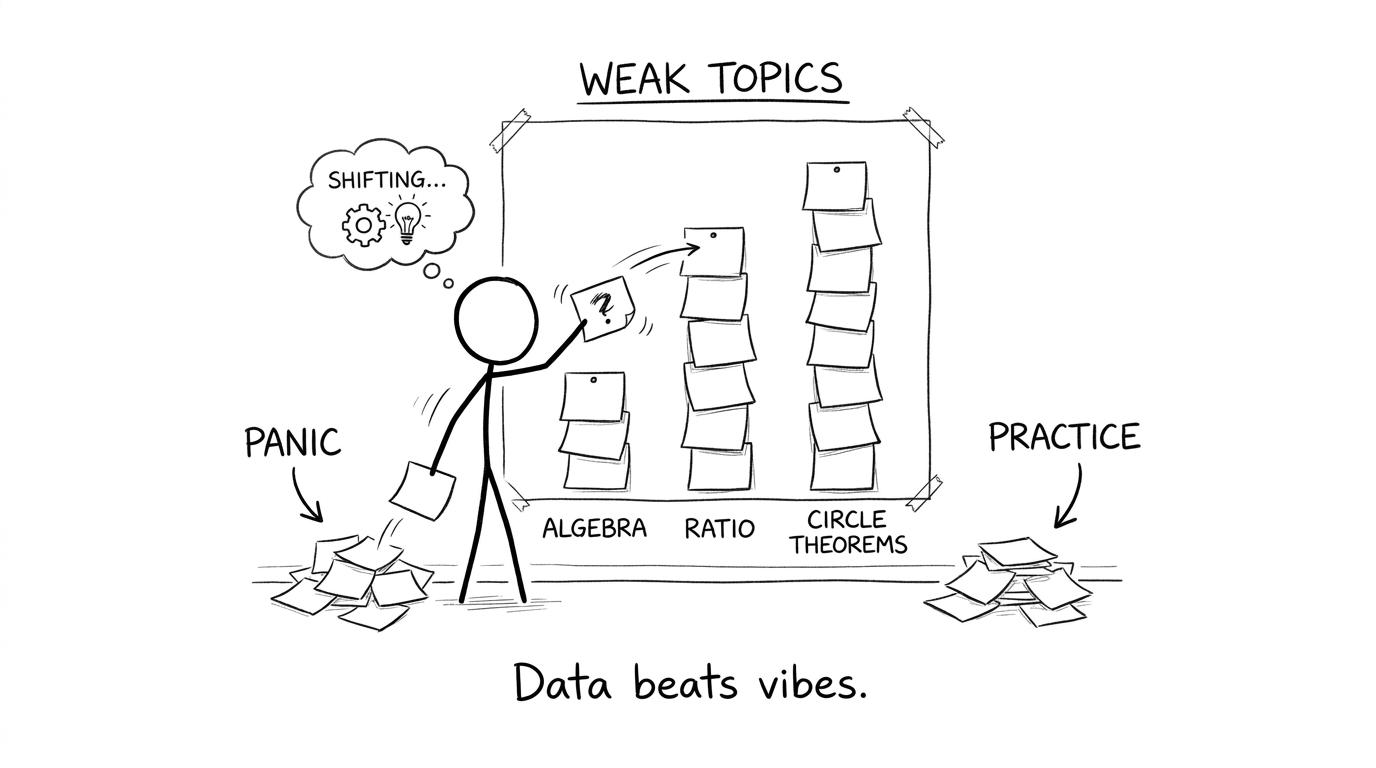 Sticky notes ranking weak topics
A simple ranking formula (so you fix what matters)
Not all weak topics cost you the same.
If Topic A loses 8 marks every paper and Topic B loses 2 marks, Topic A is the better investment. But time matters too.
A practical ranking score is:
Priority score=marks lostminutes spent on those questions \text{Priority score} = \frac{\text{marks lost}}{\text{minutes spent on those questions}} Priority score=minutes spent on those questionsmarks lostHigher score == quicker marks back.
This is especially powerful for OCR GCSE students because some topics repeat frequently and are very learnable with the right method (ratio, bounds, rearranging formulae, probability structures).
Worked example: diagnosing a “careless mistake” properly (GCSE algebra)
Suppose you lost 2 marks on this OCR-style GCSE question:
Solve 3(2x−5)=4x+73(2x-5)=4x+73(2x−5)=4x+7.
You wrote:
6x−5=4x+7 6x-5=4x+7 6x−5=4x+7Then:
2x=12⇒x=6 2x=12 \Rightarrow x=6 2x=12⇒x=6It feels careless. But the diagnosis matters.
Correct method
Expand correctly:
3(2x−5)=6x−15 3(2x-5)=6x-15 3(2x−5)=6x−15So:
6x−15=4x+7 6x-15=4x+7 6x−15=4x+7Subtract 4x4x4x from both sides:
2x−15=7 2x-15=7 2x−15=7Add 151515:
2x=22 2x=22 2x=22Divide by 222:
x=11 x=11 x=11Topic label (the useful bit)
Your weakness isn’t “careless”. It’s expanding brackets accurately under time pressure.
That’s a GCSE micro-skill you can practise directly. When you label it correctly, you stop arguing with yourself and start fixing the real thing.
Use targeted resources to fix weaknesses fast (OCR GCSE)
Once a topic shows up as weak, don’t just “redo the question”. Build a mini-loop:
- Learn the method.
- Practise 10-20 exam-style questions.
- Check solutions and learn from the mark scheme.
- Retest within two days.
YesGenie is built for this loop.
- For OCR-specific topic learning, use pages like Using a Calculator (OCR GCSE) when you notice method and accuracy issues.
- If your weakest topics are problem-solving and money maths, Best Buy Questions (OCR revision guide) is perfect because it shows the thinking as well as the calculation.
- If you keep dropping marks in coordinates and graphs, revisit Coordinates (OCR revision guide).
- If higher tier trigonometry is a weak topic, learn and practise from The Sine Rule (OCR GCSE).
- If you keep losing marks in accuracy and rounding, Bounds (OCR revision guide) is one of the highest-return topics in GCSE Maths.
When you fix a weakness, keep it alive using mixed practice; weaknesses often return when the question is disguised.
Worked example: turning a weak topic (bounds) into marks
Bounds is a classic OCR GCSE weak topic because it looks like “wordy rounding”, but it’s actually a method.
A length LLL is 8.2 cm8.2\text{ cm}8.2 cm correct to 1 decimal place. Find the lower and upper bounds of LLL.
Method
Correct to 1 d.p. means the step is 0.10.10.1, so half a step is 0.050.050.05.
Lower bound:
8.2−0.05=8.15 8.2 - 0.05 = 8.15 8.2−0.05=8.15Upper bound:
8.2+0.05=8.25 8.2 + 0.05 = 8.25 8.2+0.05=8.25So:
8.15≤L<8.25 8.15 \le L < 8.25 8.15≤L<8.25What to write in your weakness tracker
If you got this wrong, the label isn’t “bounds”. It might be:
- “Half the rounding interval”
- “Inequality notation for bounds”
- “Interpreting ‘correct to 1 d.p.’”
That’s how you turn vague GCSE revision into precise GCSE improvement.
How to build a weak-topic tracker that actually gets used
Keep it small. A tracker fails when it becomes a project.
Create a simple table with five columns:
- Date
- Paper / mini test
- Question
- Topic label
- Fix (lesson + questions done)
If you want short tests to generate data quickly, open Resources on YesGenie and use mini tests or topic booklets. The point is to create enough attempts that your weakest topics in GCSE Maths become undeniable.
Common mistakes OCR GCSE students make when finding weak topics
Treating the score as the feedback
A score tells you how you did overall. It doesn’t tell you what to do next. Weak topics hide inside the score, so you need a topic breakdown to find them.
Calling everything “careless”
“Careless” often means one of three GCSE weaknesses: accuracy with negatives, accuracy with fraction operations, or poor layout when showing working. Label the real micro-skill and you can practise it deliberately.
Only revising topics you enjoy
Enjoyment is a trap if it keeps you safe. GCSE grades move fastest when you repair the leaky topics you avoid, especially the ones that repeat across papers.
Not retesting after revision
Revision without retesting is just exposure. Weak topics only become strong when you can reproduce the method from memory under time pressure.
Mixing tiers without noticing
OCR GCSE has foundation and higher tier demands. Some weaknesses are about tier mismatch: for example, trying higher tier algebra before your foundation algebra fluency is automatic.
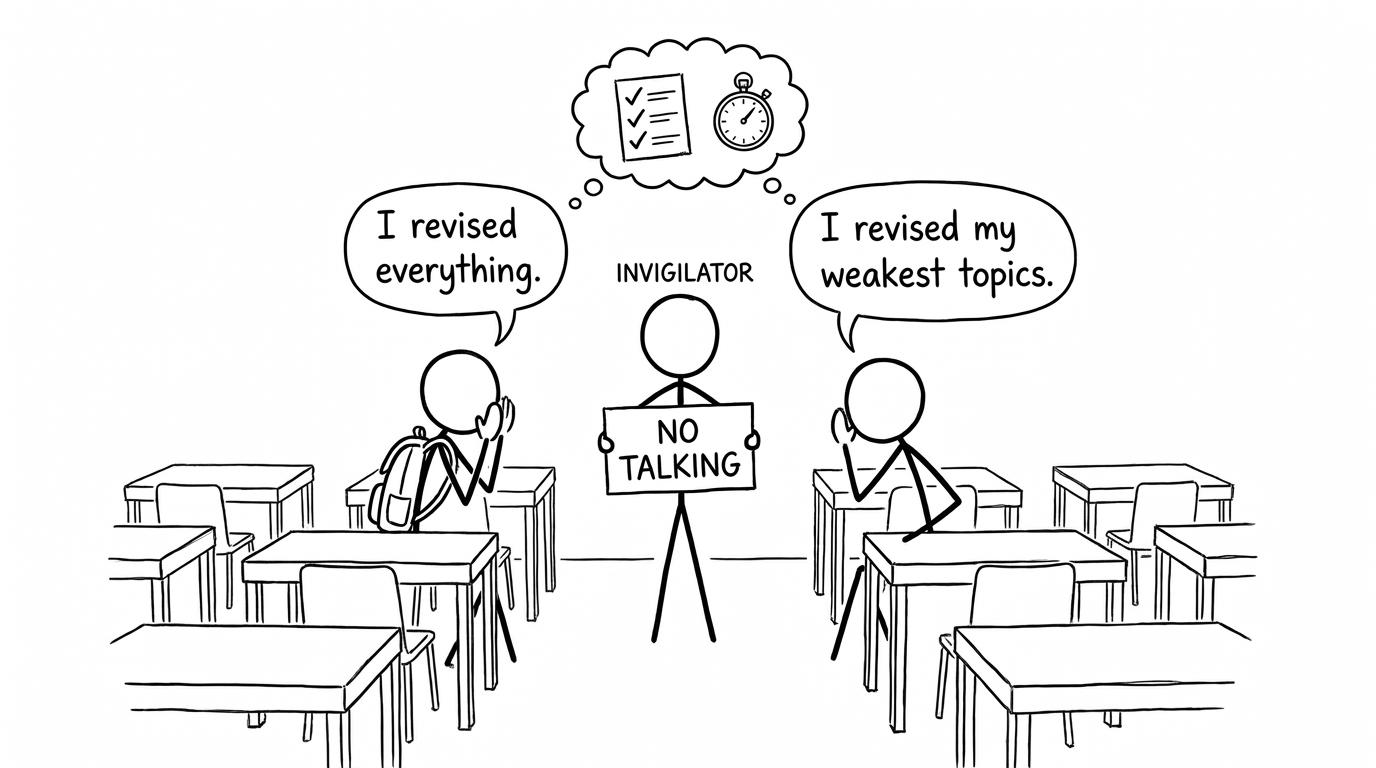 Two students in the exam hall compare strategies
Bring it together: your weakest topics are your fastest GCSE marks
The quiet truth about GCSE Maths is that most students don’t need to become “good at everything”. They need to stop losing the same easy marks in the same weak topics. Once you can see those topics clearly, revision becomes calmer, because you’re no longer guessing what to do.
If you’re an OCR student, start at the OCR GCSE Maths hub, use short practice to generate honest data, then fix the top weaknesses using revision guides, lessons, question banks, exam booklets, mark schemes and video solutions. Keep your tracker simple, retest frequently, and let your weakest topics shrink one by one.
Your next step: pick one OCR GCSE paper section or mini test tonight, mark it строго, and label every lost mark. Then use YesGenie to practise the top three weak topics until they stop being weak. That’s how GCSE improvement starts feeling less like hope and more like a plan.