OCR Foundation Maths Resit Guide: J560 Strategy
OCR foundation maths resit guide to J560 paper structure, timing per mark, priority topics and a practical revision plan for a stronger GCSE result.
Resitting GCSE Maths can feel frustrating because you are returning to familiar ground without always knowing what must change. The best OCR foundation maths resit strategy is not to restart the entire course blindly. Understand the three J560 papers, identify the topics costing you accessible marks, practise under timed conditions and use mark schemes to turn mistakes into a focused revision plan.
Foundation tier offers grades 1−51-51−5. You sit three papers worth 100100100 marks each, giving 300300300 marks in total. Every paper lasts 111 hour 303030 minutes, and Paper 2 is the only non-calculator paper. That structure gives you several opportunities to recover marks. One difficult question, or even one difficult paper, does not decide the final result.
Your J560 foundation resit checklist
Before building a timetable, make sure you can answer yes to these questions:
- Do you know which paper is non-calculator?
- Have you completed at least one full J560 foundation set?
- Are you recording mistakes by topic rather than only recording scores?
- Can you complete routine number, fraction, percentage and ratio calculations confidently?
- Are you showing enough working to earn method marks?
- Have you practised deciding when to skip and return to a question?
- Is your calculator in the correct mode, with working batteries?
Start with the OCR GCSE Maths revision hub, where MathsGenie brings together lessons, worksheets, exam questions and papers for the correct exam board.
OCR J560 foundation paper structure
OCR Foundation Mathematics uses components J560/01, J560/02 and J560/03. Each contributes one third of the qualification.
| OCR maths paper | Calculator | Marks | Time | Weighting |
|---|---|---|---|---|
| J560/01 Paper 1 | Permitted | 100100100 | 909090 minutes | 3313%33\frac{1}{3}\%3331% |
| J560/02 Paper 2 | Not permitted | 100100100 | 909090 minutes | 3313%33\frac{1}{3}\%3331% |
| J560/03 Paper 3 | Permitted | 100100100 | 909090 minutes | 3313%33\frac{1}{3}\%3331% |
The papers assess the same overall foundation specification, so do not revise one narrow list for each component. A topic should not be ignored because it appeared in a previous paper or past series. Past papers reveal styles and weaknesses, not a guaranteed prediction of what comes next.
You can become familiar with the layout through the OCR GCSE Maths past papers. Use complete sets when possible. Sitting Paper 1 from one series, Paper 2 from another and Paper 3 from a third makes your combined score less useful because grade boundaries apply to a complete series.
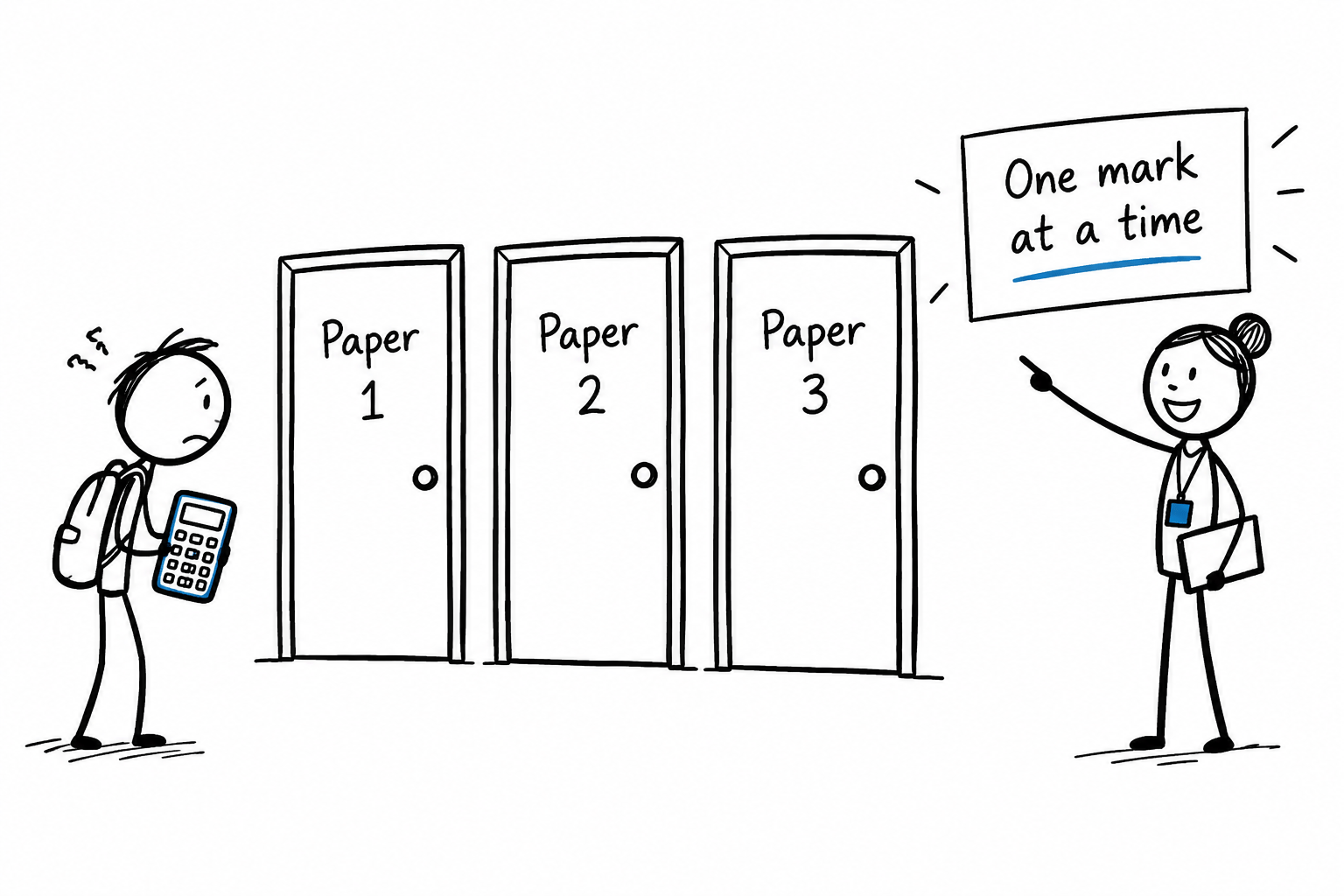 A GCSE resit student facing three exam-paper doors while a teacher points to the words one mark at a time
Timing per mark on an OCR maths paper
Each paper gives you 909090 minutes for 100100100 marks. The average time available per mark is therefore
90100=0.9 minutes=54 seconds.\frac{90}{100}=0.9\text{ minutes}=54\text{ seconds}.10090=0.9 minutes=54 seconds.This is a guide, not a command to spend exactly 545454 seconds on every mark. A one-mark calculation may take only a few seconds. A four-mark problem may require several minutes of reading, planning and checking.
A practical approach is to reserve about 151515 minutes for returning to skipped questions and checking. That leaves 757575 minutes for the first pass:
75100=0.75 minutes per mark=45 seconds per mark.\frac{75}{100}=0.75\text{ minutes per mark}=45\text{ seconds per mark}.10075=0.75 minutes per mark=45 seconds per mark.Move on when you have made no useful progress after roughly the time suggested by the marks. Circle the question number, leave your partial working and return later. Remaining stuck for eight minutes on a three-mark question is expensive because it can remove time from several more accessible questions.
A sensible three-pass method
First pass: collect the marks you recognise quickly. Write clear working, but do not turn a straightforward calculation into a long investigation.
Second pass: return to questions that need more thought. Break each one into what you know, what you need and which operation or formula could connect them.
Final check: look for unanswered questions, missing units, unreadable figures, calculator entry errors and answers that are unreasonable in context.
Topics to prioritise for J560 foundation
The right priority depends on evidence from your own papers. Still, some areas deserve early attention because they support many other topics and regularly appear in multi-step problems.
Number, fractions and percentages
Secure arithmetic first: negative numbers, place value, rounding, estimation, factors, multiples and order of operations. Then build confidence with fractions, decimals and percentages, including calculations such as
ab×c\frac{a}{b}\times cba×cand percentage multipliers such as
new amount=original amount×(1±p100).\text{new amount}=\text{original amount}\times\left(1\pm\frac{p}{100}\right).new amount=original amount×(1±100p).Fractions and percentages also appear inside probability, ratio, measures and financial questions. Weakness here spreads. Strength here does the same. Use MathsGenie's OCR fractions revision guide before moving to exam-style percentage questions.
Ratio, proportion and rates
Prioritise simplifying ratios, sharing in a ratio, recipes, scale drawings, unit pricing, exchange rates, speed and direct proportion. Learn to identify what one part represents before scaling to the required amount.
Units matter. For speed calculations, the relationship is
speed=distancetime.\text{speed}=\frac{\text{distance}}{\text{time}}.speed=timedistance.However, the calculation only works cleanly when the distance and time units match the requested answer. Many lost marks come from conversion rather than difficult mathematics.
Core algebra and graphs
Foundation algebra includes simplifying expressions, substitution, solving equations, sequences, inequalities, expanding brackets and using formulae. You should also practise coordinates and straight-line graphs.
Do not revise algebra only by watching solutions. Write each line yourself. Correct algebra depends on maintaining equality and applying inverse operations consistently. The OCR GCSE Maths lessons provide a structured route from explanation to exam-style practice.
Geometry and measures
Give attention to angle facts, perimeter, area, volume, transformations, constructions, bearings and Pythagoras. Memorising a formula is not enough. You must recognise which measurements belong in it and give suitable units.
For example, area uses square units and volume uses cubic units. A numerical answer without cm2\text{cm}^2cm2 or cm3\text{cm}^3cm3 may not fully communicate the quantity found.
Probability and statistics
Revise probability scales, relative frequency, sample spaces, frequency trees, two-way tables, averages and interpreting charts. Read labels and scales carefully. A correct method applied to the wrong column is still answering a different question.
Grade 4 and 5 material
Once the core is reliable, include topics around the upper end of foundation: compound change, standard form, forming equations, sequences, Pythagoras, trigonometry, probability trees and more demanding proportional reasoning.
Do not spend the whole resit revising only the hardest questions. A grade is built from total marks. Securing routine questions, then adding some grade 4 and 5 marks, is usually more productive than chasing the final question while leaving basic gaps.
The OCR exam booklets and worksheets let you target these weaknesses without completing a whole paper every evening.
How to revise between now and the resit
A useful weekly cycle has four stages:
- Diagnose: complete a timed section or paper without notes.
- Mark: use the official-style mark scheme and record every lost mark.
- Repair: complete a revision lesson and focused questions on the weakest topics.
- Retest: answer fresh questions without copying the previous method.
Classify mistakes as knowledge, method, reading, calculator or timing errors. This matters because each requires a different response. A missing formula needs teaching. A mistyped value needs a calculator-checking habit. A misunderstood command word needs slower reading.
Near the exam, complete full papers in the correct 909090-minute conditions. MathsGenie provides OCR papers with mark schemes and worked solutions, while the OCR predicted grade calculator can help you interpret marks using boundaries from different years. Boundaries change between series, so treat any estimate as guidance rather than a promised grade.
If organising revision is the main obstacle, use the free MathsGenie revision planner to turn the remaining time into manageable daily tasks. Predicted papers can provide extra practice, but they should supplement rather than replace past papers and full specification revision.
Common OCR foundation resit mistakes
Revising passively: watching several videos can feel productive, but improvement must be tested through questions completed independently.
Ignoring Paper 2 skills: calculator practice does not replace written arithmetic, fraction fluency and estimation for the non-calculator paper.
Writing only an answer: method marks can matter when the final value is wrong. Show substitutions, intermediate calculations and algebraic steps.
Rounding too early: keep accurate calculator values during a method and round only at the requested stage.
Assuming grade boundaries are fixed: raw marks required for each grade can change, so avoid building a plan around one historical boundary.
Using papers without repairing gaps: completing five papers and repeating the same percentage mistake is not five useful revision sessions. The value of a paper lies in what you do after marking it.
Make the resit different from the first attempt
A resit does not require a new personality or endless hours. It requires a better feedback loop. Learn one topic, answer questions, mark honestly, repair the error and return to it later. Small improvements become valuable because there are 300300300 marks available across three papers.
Begin with one timed OCR foundation paper on MathsGenie. Mark it, select the three topics costing you the most accessible marks and add them to your revision planner. With free revision lessons, practice questions, past papers, mark schemes and video solutions in one place, MathsGenie gives your J560 foundation resit a clear starting point and a practical route forward.