November GCSE Resit Dates 2026: Full Timetable
November GCSE resit dates 2026: full maths and English timetable, paper lengths, planning tips and the confirmed January 2027 results day.
Missing a GCSE grade can make the months ahead feel uncertain. The practical answer is simpler: confirm your exam board, record each paper date and build revision backwards from the first exam.
The main November GCSE resit dates 2026 run from Tuesday 3 November to Monday 9 November. English Language papers are on 3 and 5 November. GCSE Maths papers are on 4, 6 and, for three-paper specifications, 9 November. Results are due on Thursday 14 January 2027.
These dates reflect the final timetable information available for AQA, Edexcel, OCR and WJEC/Eduqas. Your statement of entry remains the final authority because specifications, paper codes and arrangements can differ.
November 2026 GCSE resit timetable
Here is the core timetable.
| Date | Examination |
|---|---|
| Tuesday 3 November 2026 | GCSE English Language Paper 1 |
| Wednesday 4 November 2026 | GCSE Maths Paper 1 |
| Thursday 5 November 2026 | GCSE English Language Paper 2 |
| Friday 6 November 2026 | GCSE Maths Paper 2 |
| Monday 9 November 2026 | GCSE Maths Paper 3, where applicable |
| Thursday 14 January 2027 | GCSE resit results day |
Do not rely on a general timetable for your arrival time. Check the time on your statement of entry and follow your exam centre's instructions.
Before planning revision, confirm:
- your exam board and specification code
- your foundation or higher tier entry for maths
- the location and arrival time for each paper
- whether your maths specification has two or three papers
Private candidates must arrange entry through an approved exam centre rather than entering directly with an exam board.
Board-by-board dates and paper durations
The main specifications do not all follow the same structure. WJEC qualifications in Wales and Eduqas qualifications in England are related but not interchangeable, so check the exact qualification title.
| Exam board | English Language | GCSE Maths |
|---|---|---|
| AQA | Paper 1 on 3 November and Paper 2 on 5 November, each lasting 1 hour 45 minutes | Three papers on 4, 6 and 9 November, each lasting 1 hour 30 minutes |
| Edexcel | Paper 1 on 3 November lasts 1 hour 45 minutes. Paper 2 on 5 November lasts 2 hours 5 minutes | Three papers on 4, 6 and 9 November, each lasting 1 hour 30 minutes |
| OCR | Papers on 3 and 5 November, each lasting 2 hours | Three papers on 4, 6 and 9 November, each lasting 1 hour 30 minutes |
| Eduqas | Component 1 on 3 November lasts 1 hour 45 minutes. Component 2 on 5 November lasts 2 hours | Two maths components, normally lasting 2 hours 15 minutes each |
For AQA, Edexcel and OCR Maths, Paper 1 is non-calculator and Papers 2 and 3 are calculator papers. Eduqas also separates non-calculator and calculator components. Alternative specifications can have different durations, so contact your exams officer if any guide conflicts with your entry.
What can be retaken in November?
The November series is primarily for GCSE Mathematics and GCSE English Language. Other GCSE subjects are generally available during the summer series.
For maths, you must retake the complete qualification. You cannot keep a mark from one written paper and repeat only another. AQA, Edexcel and OCR candidates normally complete three papers, while Eduqas candidates normally complete two components.
Tier entry matters too. Foundation gives access to grades 111 to 555, while higher gives access to grades 444 to 999, subject to the specification's grading rules. Discuss the appropriate tier with a teacher or exams officer rather than deciding from one previous result.
MathsGenie's free GCSE maths revision resources organise topics by grade. Students working towards a standard pass can use the grade 4 revision topics, while those targeting a stronger result can move to the grade 5 revision topics.
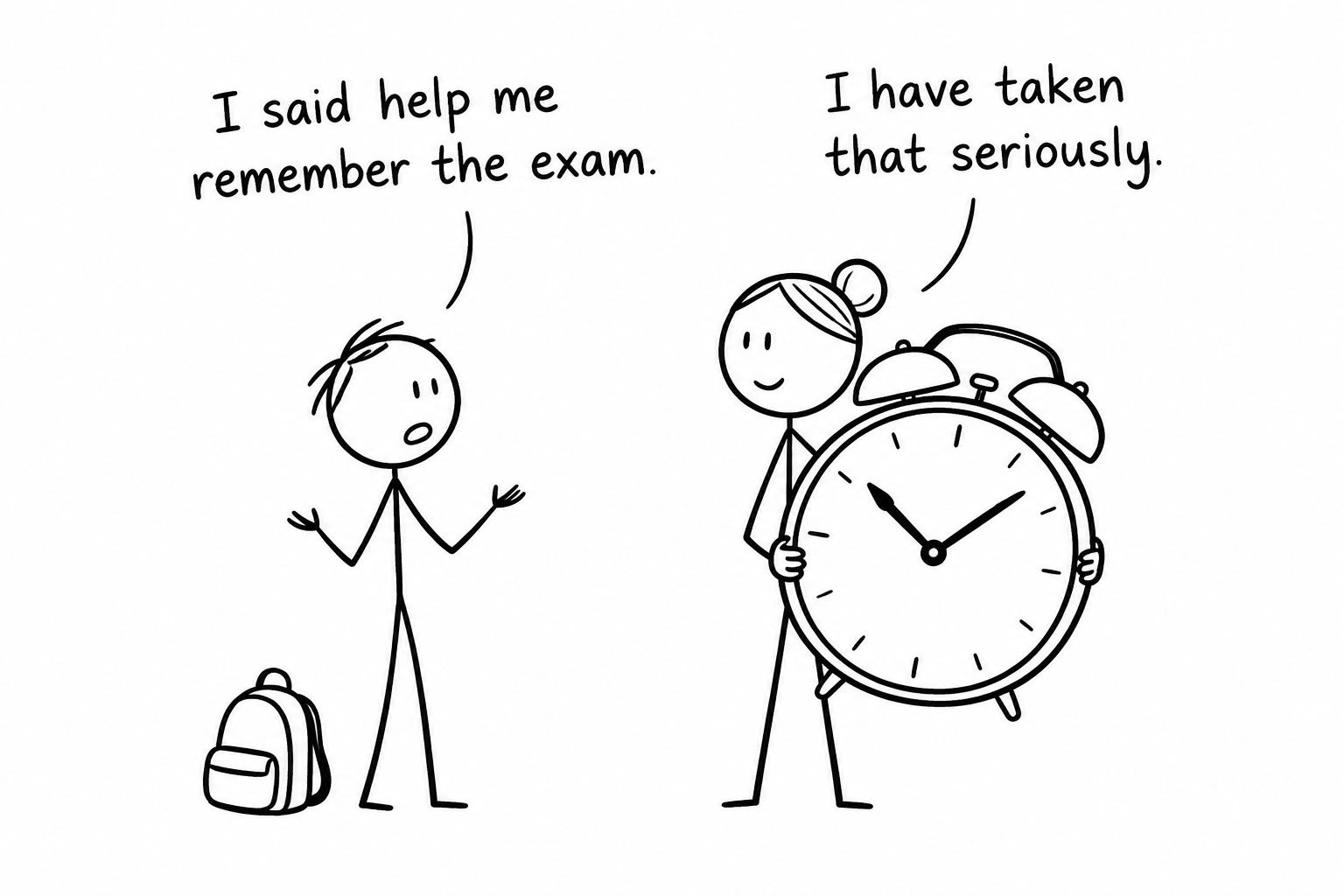 A stick-figure student and parent guarding an enormous alarm clock labelled exam day
How to plan for the November timetable
November arrives quickly. The useful question is not how many weeks remain, but what each week needs to achieve.
Begin with a complete paper under timed conditions. Mark it honestly, then divide lost marks into three groups: topics you did not understand, methods you could not recall and avoidable errors such as misreading questions or omitting working.
Use that list to choose revision lessons, practice questions, video solutions and mini tests. MathsGenie's GCSE maths past papers help you practise content and timing. Closer to the examinations, GCSE predicted papers provide further full-paper practice, but they should complement past papers rather than replace them.
A practical weekly routine is:
- revise two or three weak topics
- answer focused questions without viewing solutions
- mark the work and correct every error
- complete one timed paper or substantial section
- record recurring mistakes for the following week
English and maths alternate across four consecutive days, followed by the third maths paper on Monday for relevant boards. Keep both subjects active throughout your revision. The November GCSE resits guide explains entries and preparation in more detail.
GCSE resit results day
The GCSE resit results day for the November 2026 series is Thursday 14 January 2027. Schools and colleges decide whether candidates receive results online, by email or in person, so confirm the arrangements before the Christmas break.
If the result is below your requirement, the next opportunity will usually be the summer 2027 series. You can also ask your centre about access to scripts, clerical re-checks or reviews of marking.
Common mistakes to avoid
Do not assume every board uses three maths papers. AQA, Edexcel and OCR normally do, but Eduqas usually uses two longer components.
Check that revision resources match your tier. Foundation and higher overlap, but their question balance and difficulty differ. Also record your arrival time, not only the exam date.
Finally, avoid spending every session watching solutions. Videos help when learning a method, but improvement comes from answering questions independently, checking the mark scheme and returning to mistakes.
Put the dates to work
A timetable cannot improve a grade by itself. Its value is that it turns uncertainty into manageable deadlines.
Confirm your entry, add every paper to your calendar and identify where marks were lost. Then use MathsGenie's revision lessons, practice questions, past papers, predicted papers, mark schemes, video solutions, mini tests and revision planner to build a focused routine. Start with the weakness costing you the most marks.