

Native Speaker GCSE Arabic Advantage Explained
Native speaker GCSE Arabic advantage explained: learn where home fluency helps, what the exam still tests, and how to plan focused revision for higher marks.
Does speaking Arabic at home make GCSE Arabic easy?
You can understand family conversations, reply without translating in your head and recognise expressions that never appeared in a textbook. It is tempting to assume the exam is already won.
The native speaker GCSE Arabic advantage is real, but it is uneven. Speaking Arabic at home can provide stronger listening comprehension, quicker recall and greater confidence in conversation. It does not automatically provide accurate formal writing, secure reading, translation skills or familiarity with the exam format.
That distinction matters. The current Pearson Edexcel GCSE Arabic qualification assesses listening, speaking, reading and writing separately, with each skill contributing 25%25\%25% of the qualification. A student can therefore sound fluent and still lose substantial marks elsewhere.
The best approach is not to ignore your home Arabic. It is to treat it as a head start, then identify what the specification asks for that everyday conversation has not taught you.
A quick checklist for native and heritage speakers
Before planning your revision, ask yourself:
- Can I understand standard spoken Arabic as well as my family’s dialect?
- Can I read unfamiliar passages accurately and at exam speed?
- Can I write extended answers in appropriate standard Arabic?
- Can I control grammar, spelling and sentence structure consistently?
- Can I translate meaning rather than replacing words one by one?
- Do I understand the role-play, picture task and conversation requirements?
- Have I completed timed papers and marked them carefully?
A confident “yes” to speaking alone is not enough. The examination measures four related but distinct abilities.
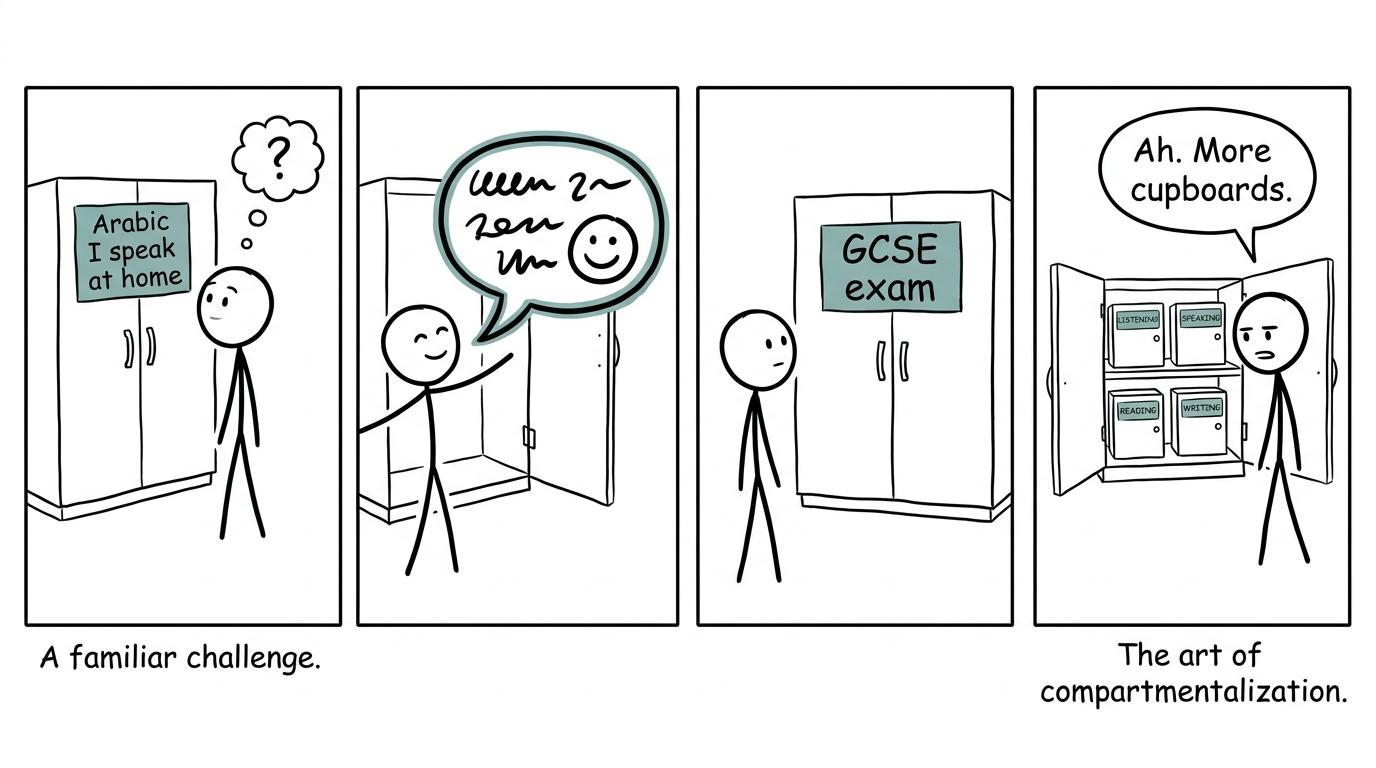 A student discovers that home Arabic and GCSE Arabic contain several different cupboards
Where speaking Arabic at home genuinely helps
Listening can feel more natural
Regular exposure develops an instinct for pace, emphasis and meaning. Native and heritage speakers may recognise common vocabulary without consciously decoding every word. They can often follow a speaker even when a sentence includes an unfamiliar term because context fills the gap.
That is valuable in the listening paper, which uses recordings featuring different speakers in public and social contexts. It may also leave more mental space for reading the question and selecting the precise information required.
However, the assessment focuses on standard spoken Arabic. Familiarity with one regional dialect does not guarantee instant understanding of every recording, formal phrase or topic-specific expression. Listening practice should therefore include the language and pace used in official assessment materials.
Speaking confidence is a meaningful advantage
Students who use Arabic regularly may be less afraid of hesitation. They often have stronger pronunciation, faster recall and experience responding when a conversation changes direction.
These qualities can support all three parts of the speaking assessment: the role-play, questions based on a picture stimulus and the conversation. In particular, regular speakers may find interaction and spontaneity more comfortable than students who have learnt Arabic mainly in lessons.
Yet natural conversation at home is not identical to assessed speaking. The examiner rewards relevant communication, development, interaction, linguistic range and accuracy. A fluent answer that avoids the question or relies entirely on dialect can be less successful than a controlled answer that fulfils the task precisely.
Everyday vocabulary provides a useful base
Home speakers often possess rich vocabulary relating to family, food, routines, celebrations, travel and relationships. These areas overlap with GCSE themes, so existing knowledge can reduce the amount of vocabulary that must be learnt from the beginning.
The advantage becomes smaller when topics move beyond familiar conversation. School systems, employment, environmental issues, social concerns and formal opinions may require vocabulary that rarely appears around the dinner table.
Cultural familiarity can improve interpretation
Knowing how Arabic is used in different social situations can help students recognise tone, politeness and implied meaning. This can support comprehension and make speaking responses sound purposeful rather than memorised.
Cultural familiarity is not a replacement for evidence, though. In a reading or listening question, marks come from the information in the source. What is usually true in your experience may not be what the speaker or writer says.
Where the native speaker advantage stops
Dialect and standard Arabic are not interchangeable
Many students speak Egyptian, Levantine, Gulf, Maghrebi or another variety at home. GCSE assessment materials use standard Arabic, and writing needs appropriate formal language and grammatical control.
This does not make dialect “wrong”. It means the exam has a defined lane. A word, ending or sentence pattern that communicates perfectly at home may not demonstrate the standard form expected in an assessed response.
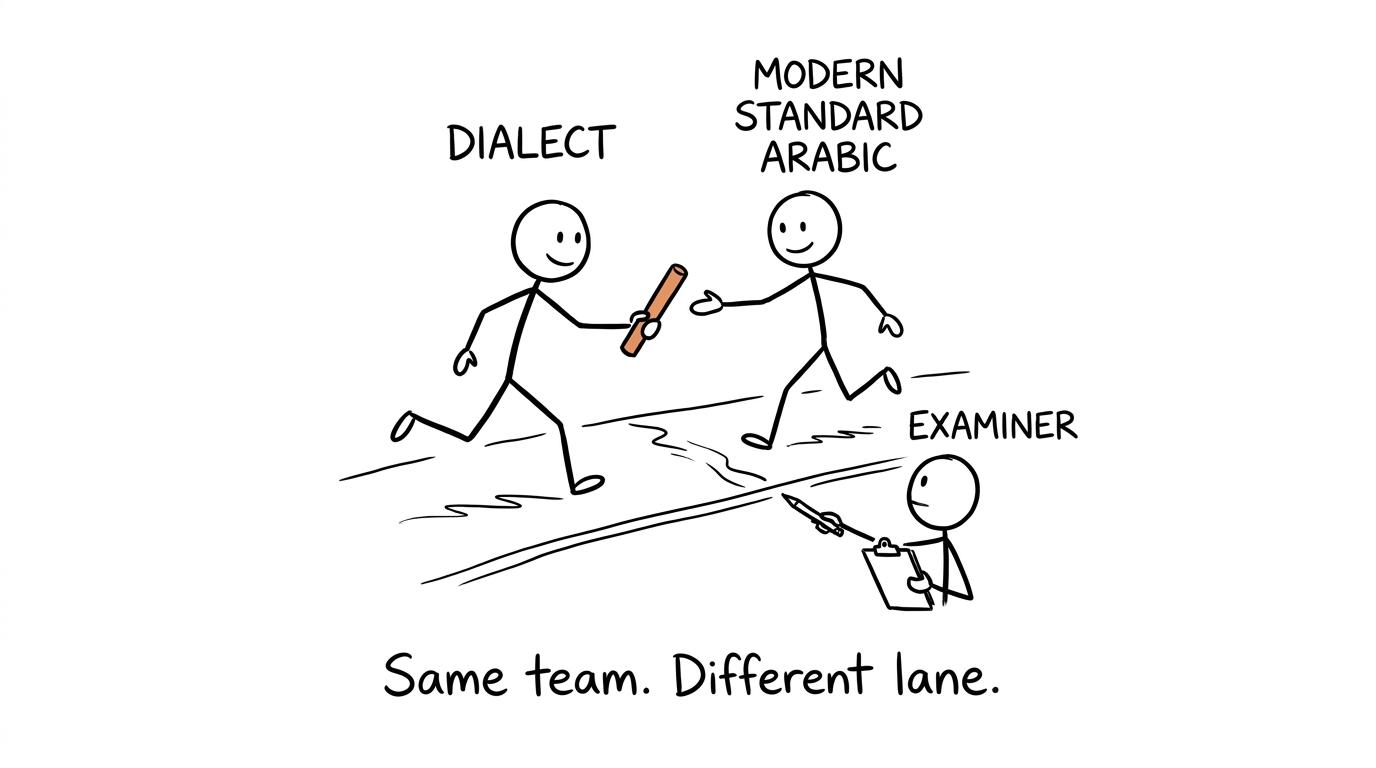 Dialect and Modern Standard Arabic pass a baton in the correct exam lane
The practical solution is comparison, not rejection. Keep a personal list of expressions you naturally use in speech alongside the standard forms you need for reading and writing. This turns an invisible gap into something you can revise.
Reading is its own skill
Some heritage speakers understand and speak Arabic well but have had less regular experience reading it. Unfamiliar vocabulary, longer texts and similar-looking letter patterns can slow comprehension.
The reading paper may include advertisements, emails, letters, articles and literary material, as well as translation from Arabic into English. Success requires careful extraction of detail, not merely a general sense of the topic.
Reading aloud can support recognition, but silent timed reading matters too. The aim is to find evidence quickly, distinguish positive from negative statements and notice small words that change meaning.
Writing exposes gaps that speech can hide
Conversation is forgiving. A listener can use context, expression and follow-up questions. Writing has none of those supports.
In the writing paper, students must communicate for different purposes and audiences, express ideas and opinions, and complete a translation into Arabic. Accuracy becomes visible: spelling, agreement, verb forms, pronouns, connectives and sentence structure all matter.
A native or heritage speaker may know what sounds natural without knowing how to write it accurately. This is normal, but it needs deliberate practice. Writing should be checked against the task and mark scheme, not judged only by whether it “sounds Arabic”.
Translation requires precision
Translation is not a test of whether you understand the general message. It asks whether you can preserve meaning while producing natural language.
Heritage speakers sometimes move too quickly because the source feels familiar. That can lead to omitted details, unnecessary additions or a response shaped by what someone would normally say rather than what the text actually says.
Slow down for negatives, time references, quantities, opinions and changes of tense. These are small details with a large effect on meaning.
Exam technique is not inherited
No one speaks in mark-scheme categories at home. You still need to know how long an answer should be, which prompts must be covered, how to develop an opinion and when concise accuracy is better than ambitious but uncontrolled language.
Dictionaries are not permitted in the Edexcel assessments, including the preparation time for speaking. Retrieval must therefore become reliable before the examination.
How to revise if you already speak Arabic
The most efficient plan begins with evidence. Complete a separate timed task for listening, speaking, reading and writing, then record where marks were lost. The method is similar to using a maths paper to find your weakest GCSE topics: feelings tell you what seems comfortable, while marked work reveals what needs attention.
Divide mistakes into four groups:
- language knowledge, such as vocabulary or grammar;
- standard Arabic versus dialect;
- task fulfilment, such as missing a bullet point;
- exam technique, including timing or misreading instructions.
Then use short revision cycles. Learn one gap, practise it without notes, check the response and revisit it later. MathsGenie’s guide to stopping GCSE content from being forgotten explains the same principle through spaced and retrieval practice.
For Arabic, this might mean alternating between a short listening task, formal vocabulary recall, a timed reading passage and a brief writing response. Do not spend every session practising speaking simply because speaking feels rewarding.
Balance Arabic with maths revision
Many students taking GCSE Arabic are also preparing for several compulsory subjects. Revision works better when each session has a defined job.
Use the free GCSE Maths revision hub for maths revision lessons, exam questions, past papers and solutions. Then give Arabic its own focused slot rather than allowing one subject to consume an entire evening.
A useful principle from MathsGenie’s guide to revising GCSE maths efficiently is to learn, practise, mark and fix. That loop transfers neatly to language revision:
- learn the formal structure or vocabulary;
- retrieve it in an exam-style task;
- check against guidance or a mark scheme;
- rewrite the inaccurate section;
- test it again on another day.
As examinations approach, increase timed practice. The advice on when to start GCSE past papers can help you sequence topic repair before full-paper practice. For maths, MathsGenie also offers mini tests, predicted papers, mark schemes and video solutions; for Arabic, use the corresponding official materials supplied for your qualification.
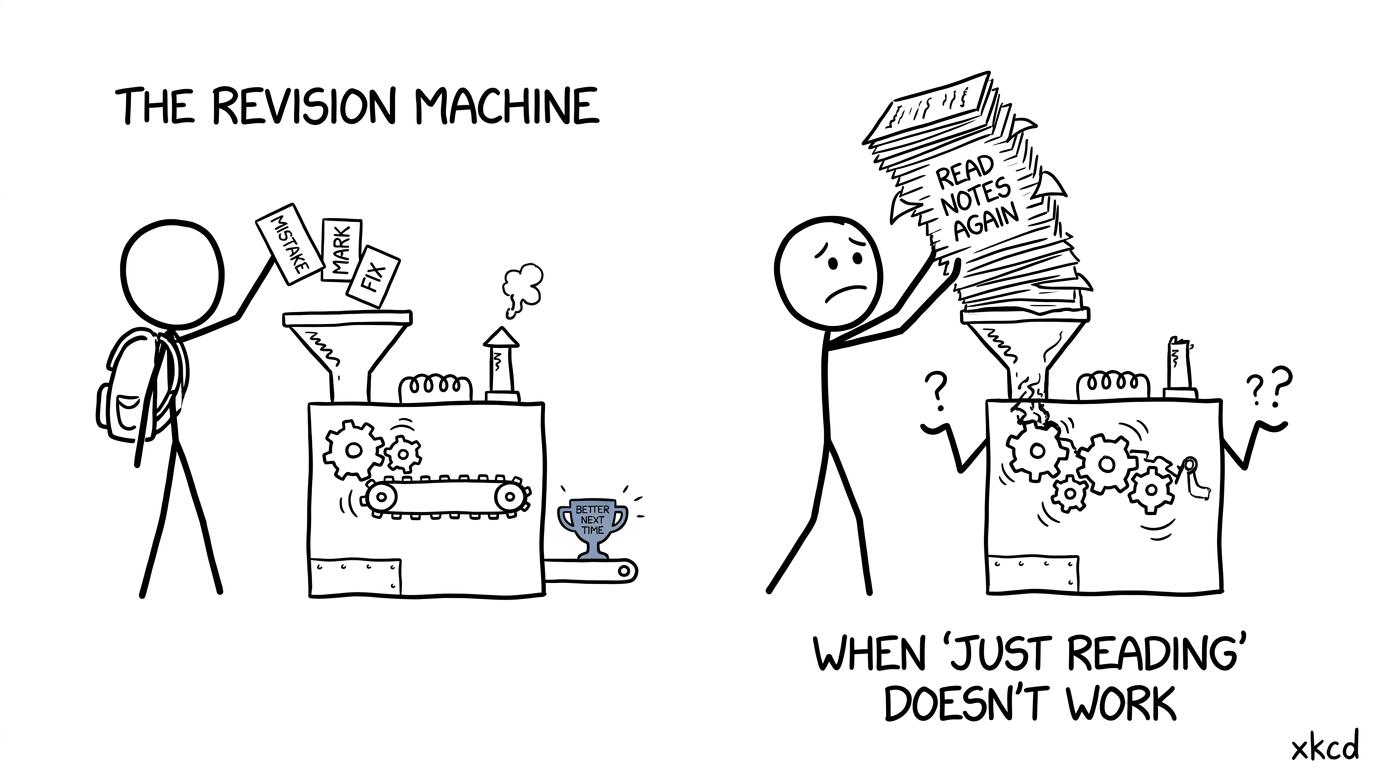 A revision machine rewards the cycle of mistakes, marking and fixing
Common mistakes native and heritage speakers make
Assuming fluency guarantees a top grade
Fluency helps, particularly with listening and speaking, but grades reflect performance across all four skills. Treat reading and writing as separate subjects within the subject.
Writing exactly as you speak
Dialect may communicate clearly in daily life while failing to show the standard vocabulary and structures expected by the assessment. Practise switching register deliberately.
Ignoring the specification themes
A broad vocabulary is not always an exam-ready vocabulary. Check every theme and identify formal or unfamiliar topic areas.
Answering from experience instead of the source
In comprehension questions, use what the passage or recording states. Personal cultural knowledge should support interpretation, not replace evidence.
Practising without marking
Repetition alone can make an error more familiar. The useful moment comes after practice, when you identify why a mark was lost. MathsGenie’s GCSE topics and three-pass strategy shows why coverage, targeted questions and paper practice should work together.
Leaving timed practice too late
Knowing Arabic is not the same as completing every task under pressure. Build timing gradually rather than testing it for the first time in the real exam. If anxiety rises near the assessment, adapt the calm structure in the GCSE maths night-before plan: choose a small task, review recurring mistakes and stop before tired revision becomes careless.
Turn your head start into an exam skill
Speaking Arabic at home gives many students something valuable: familiarity, intuition and a living connection to the language. But an examination can only award marks for the skills demonstrated on the day.
The goal is not to prove that you are a “real” speaker. It is to show listening, speaking, reading and writing in the forms the specification assesses. Diagnose each skill honestly, learn to move between dialect and standard Arabic, and practise the exact task types under timed conditions.
Meanwhile, keep your wider GCSE preparation organised with MathsGenie. Start with the free GCSE Maths revision resources, use revision lessons and practice questions to repair gaps, then test yourself with past papers, predicted papers, mini tests, mark schemes and video solutions. A natural advantage becomes useful only when it is paired with deliberate practice, in Arabic, maths and every exam that matters.










