Moving Schools Mid-GCSE Arabic: Stay on Track
Moving schools GCSE Arabic guide: confirm exam entries, identify course gaps and build a catch-up plan while keeping GCSE maths revision on track too.
Changing schools halfway through GCSEs can make familiar subjects feel strangely uncertain. Your old class may have covered different topics, your new teacher may use another order, and nobody seems to have the complete picture yet.
When moving schools, GCSE Arabic continuity depends on acting early. Confirm the specification, tier, exam entry and speaking arrangements with both schools. Then compare what you have already studied with what your new class has covered. You do not need to restart the course. You need a clear map of the gaps, while protecting enough time for GCSE maths and your other subjects.
Your immediate moving-school checklist
Complete these actions as soon as the move is confirmed:
- Ask your old school for your exam board, specification code and intended tier.
- Request copies of assessments, speaking notes, vocabulary records and teacher feedback.
- Ask whether an examination entry has already been made.
- Give your new school the contact details for your old examinations officer.
- Confirm who will conduct and submit your speaking assessment.
- Compare the topics covered by your old and new classes.
- Tell the new SENCO or examinations officer about any access arrangements.
- Create separate catch-up plans for Arabic and maths.
The administrative questions come first because revision cannot repair an incorrect entry or a missing speaking arrangement.
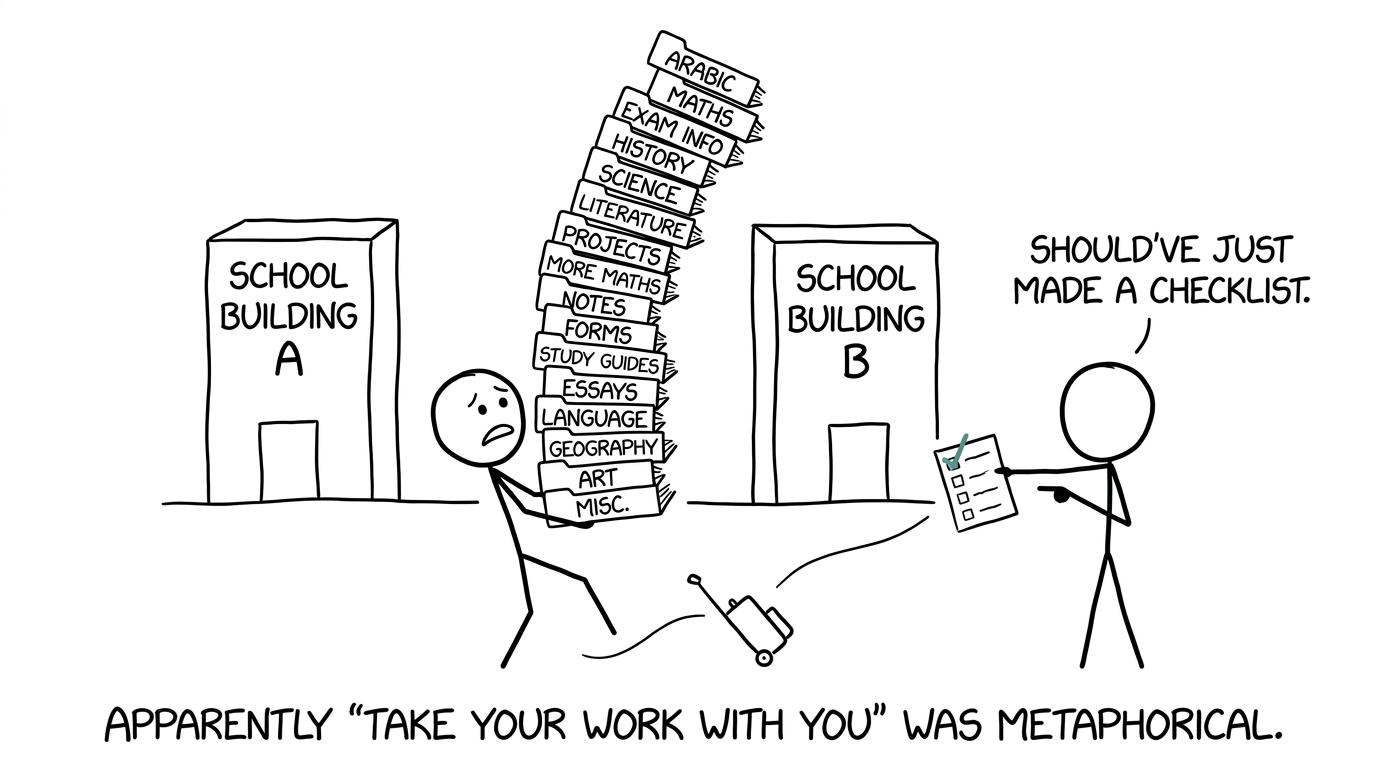 A student discovers that taking schoolwork to a new school does not require carrying every folder at once
Confirm exactly which Arabic qualification you are taking
For students taking the current Pearson Edexcel GCSE in Arabic, the specification code is 1AA0. It assesses listening, speaking, reading and writing, with each skill contributing 25%25\%25% of the qualification. Students take either foundation or higher tier and must be entered for the same tier across all four components.
That matters because a school move can create several kinds of mismatch. Your new school might not routinely teach Arabic. It might support the qualification through a visiting teacher or external language tutor. It may also need time to arrange an examiner, room, recording equipment and submission process for speaking.
Ask for written confirmation of:
- the qualification title and specification code;
- your foundation or higher tier entry;
- the examination series;
- the centre responsible for your entry;
- the location of each assessment;
- the person responsible for your speaking assessment.
Do not assume that because Arabic appears on your new timetable, the examination arrangements are complete. Equally, do not assume that moving school automatically cancels an existing entry.
If the move happens after examination entries
Your old and new examinations officers should communicate directly. JCQ transferred-candidate arrangements can, in eligible circumstances, allow a candidate to sit externally assessed timetabled written examinations at another approved centre while the original entry remains with the entering centre.
However, those arrangements do not simply solve every component. Standard transferred-candidate procedures generally focus on timetabled written examinations and exclude non-examined or practical components. GCSE Arabic speaking is conducted by a teacher and externally assessed, so the schools should check the current Pearson and JCQ instructions rather than treating it like an ordinary written paper.
If you receive access arrangements, contact the new school’s SENCO promptly. Current arrangements must reflect your needs and normal way of working at the new centre. Previous evidence may help, but the new centre still has administrative responsibilities.
Build a precise Arabic handover pack
A folder full of worksheets is not the same as a useful handover. The goal is to show your new teacher what you can do, what you have covered and what still needs attention.
Include:
- your most recent reading, listening and writing assessments;
- teacher feedback and approximate working grade;
- a list of completed themes;
- grammar and vocabulary lists;
- prepared speaking material and conversation notes;
- any mock results or marked past-paper sections;
- details of support or access arrangements;
- unanswered questions about your entry.
For the current Edexcel course, content is organised around identity and culture; local area, holiday and travel; school; future aspirations, study and work; and the international and global dimension. Use those themes as broad headings, but check the detailed specification rather than relying on headings alone.
One school may teach travel early while another leaves it until later. That can look like falling behind when it is really a difference in teaching order. The useful question is not, “Am I behind?” It is, “Which assessable knowledge and skills have I not yet secured?”
Diagnose the gap before trying to close it
The temptation after moving is to revise everything. That feels responsible, but it wastes time and can crowd out maths.
Create a simple audit using three labels:
- Secure: you can complete an exam-style task without notes.
- Developing: you recognise the content but need prompts or make repeated errors.
- Not yet covered: you have not been taught or practised it properly.
Apply those labels separately to listening, speaking, reading and writing. A student can know the vocabulary for a theme yet struggle to understand it at natural speed. Another may speak confidently at home but need practice with the formal task structure and Modern Standard Arabic expected in the assessment.
Use an unseen task where possible. Familiar classwork often measures memory of the lesson rather than independent performance. The same principle strengthens maths revision: the MathsGenie guide to finding your weakest topics explains how to turn lost marks into a focused repair list.
Prioritise by assessment impact
Start with gaps that affect more than one component. High-value areas commonly include:
- core vocabulary appearing across several themes;
- accurate use of past, present and future time frames;
- understanding examination instructions in Arabic;
- translation in both directions;
- giving and justifying opinions;
- listening for negatives, times, quantities and changes of view;
- speaking without relying on a fully memorised script.
Keep separate lists for missing content and weak technique. A vocabulary gap needs retrieval practice. A timing problem needs timed tasks. A speaking-confidence problem needs regular spoken rehearsal, not another hour of highlighting notes.
Protect GCSE maths while catching up with Arabic
A school move affects every subject, but Arabic can demand extra coordination because it may sit outside the new school’s ordinary timetable. The risk is allowing one urgent subject to consume every revision session.
Use the MathsGenie revision planner to reserve maths sessions before adding Arabic catch-up blocks. Your plan should distinguish three types of work:
- Arabic maintenance: short vocabulary, listening or speaking retrieval.
- Arabic repair: focused work on an identified gap.
- Maths progression: revision lessons, questions, marking and retesting.
Short, specific sessions are easier to sustain than vague instructions such as “revise Arabic” or “do maths”. A useful Arabic target might be to practise one speaking theme and record the errors. A useful maths target might be to complete one algebra topic and mark every question.
Start from the GCSE maths revision hub, where resources can be selected by board and tier. Edexcel, AQA, OCR and Eduqas GCSE maths cover the national subject content, but their paper structures and presentation differ. Confirm your new school’s maths board rather than assuming it matches your previous one. The GCSE maths topics by exam board and tier guide can help you check the transition.
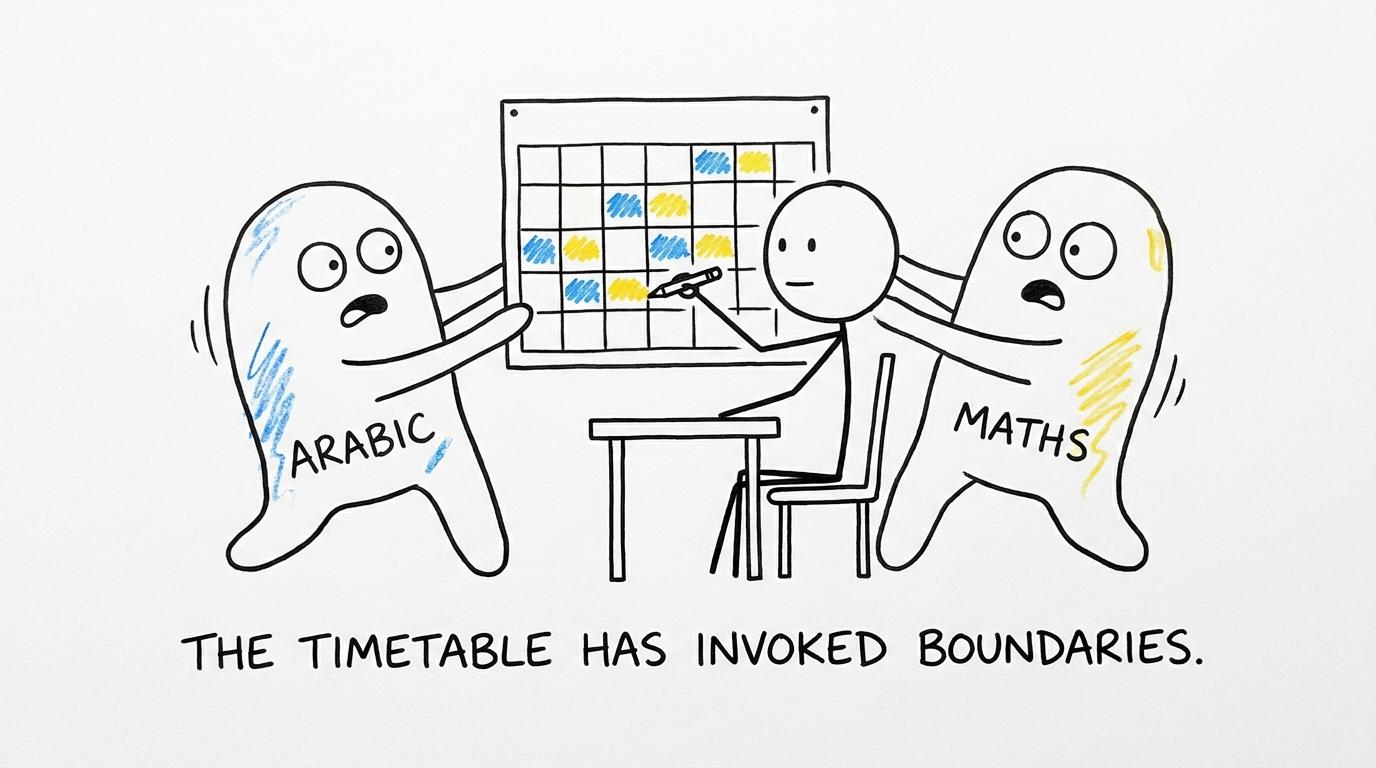 Arabic and maths discover that a calm timetable has boundaries
Use a weekly catch-up rhythm
A stable routine is more valuable than an ambitious plan that lasts three days.
Early in the transition
Use most Arabic time to identify missing content and establish speaking arrangements. Keep maths moving with short topic sessions and mini tests. If your maths teaching order has also changed, follow the principles in the best order to learn GCSE maths topics.
Once the gaps are clear
Choose one or two Arabic priorities each week. Combine retrieval, an exam-style task, immediate marking and a later retest. Do not wait until every theme is “finished” before attempting assessment tasks.
For maths, alternate focused topic practice with mixed questions. If you need a broader structure, adapt the GCSE one-month maths revision plan around your actual examination dates and available time.
Near the examinations
Move towards complete tasks under the correct conditions. For maths, use board-specific papers rather than relying only on topic worksheets. Students taking Pearson Edexcel can use the Edexcel GCSE maths past papers and mark schemes.
Predicted papers are useful for fresh practice, but they should supplement official past papers rather than replace them. The guide to starting GCSE past papers explains how to progress from short tests to complete timed papers.
Common mistakes after moving schools
Waiting for adults to notice every problem
Schools should manage entries and assessment administration, but you can still keep a written list of unanswered questions. Ask politely and early, involving a parent or carer where appropriate.
Assuming the course is identical because the subject name matches
Check the specification, tier, teaching order and assessment format. This applies to Arabic and maths.
Restarting the whole Arabic course
Begin with diagnosis. Relearning secure content uses time that should go towards genuine gaps.
Revising only vocabulary
Vocabulary matters, but GCSE Arabic also assesses listening under pressure, extended writing, translation, interaction and accurate communication.
Memorising a speaking script word for word
A memorised response can become fragile when a question changes. Learn adaptable structures and practise responding to unexpected prompts.
Letting Arabic catch-up replace maths revision
Urgency can distort priorities. Protect scheduled maths sessions, especially if your new school uses a different board, tier or teaching sequence.
Completing papers without reviewing them
A score tells you where you are. The mark scheme, corrections and retest help you move. Use MathsGenie’s revision lessons, practice questions and video solutions to repair the specific maths methods that cost marks.
A calm move is built from clear information
Changing schools mid-course creates disruption, but disruption is not the same as inevitable decline. Once the specification, tier, entry and speaking arrangements are confirmed, GCSE Arabic becomes a manageable set of themes, skills and gaps.
Keep the plans separate but coordinated. Use focused Arabic practice to preserve all four language skills, and make MathsGenie’s free GCSE maths revision resources your base for maths lessons, practice questions, mini tests, past papers, predicted papers, mark schemes and video solutions.
Your first step is small: send the examination questions, assemble your handover pack and book the next two revision sessions. Certainty rarely arrives all at once. It is usually built one answered question at a time.