

Moving Schools GCSE English Language: Stay on Track
Moving schools GCSE English Language advice: compare exam boards, map missed skills, transfer speaking records and rebuild a calm revision routine.
Changing schools during GCSEs can make an ordinary lesson feel like arriving halfway through a film. Everyone else seems to know the characters, the plot and which folder to open. If you are moving schools GCSE English Language need not become a lasting gap. Your first priorities are to identify the new exam board, compare what each school has covered, confirm the status of your spoken language endorsement and agree a short catch-up plan with your new English teacher.
The important distinction is between different and behind. Your new school may teach texts, question types and units in another order. That does not automatically mean you have missed essential learning. A careful comparison will show what you already know, what needs translating into the new exam board's language and what genuinely needs attention.
Your first-week checklist
Try to complete these actions as soon as possible:
- Ask which GCSE English Language exam board and specification your new school follows.
- Tell your English teacher which board, units and assessments you completed previously.
- Provide recent marked work, feedback sheets and mock results where available.
- Ask whether your spoken language endorsement evidence or result has transferred.
- Obtain the new school's curriculum map, assessment dates and recommended resources.
- Complete any diagnostic task offered by the department.
- Agree which gaps matter now rather than attempting to repeat the entire course.
- Protect your maths revision routine while English settles into place.
That last point matters. A school move affects every subject, and anxiety can persuade you to revise whichever subject feels most urgent that evening. A written plan prevents one disruption from quietly creating another.
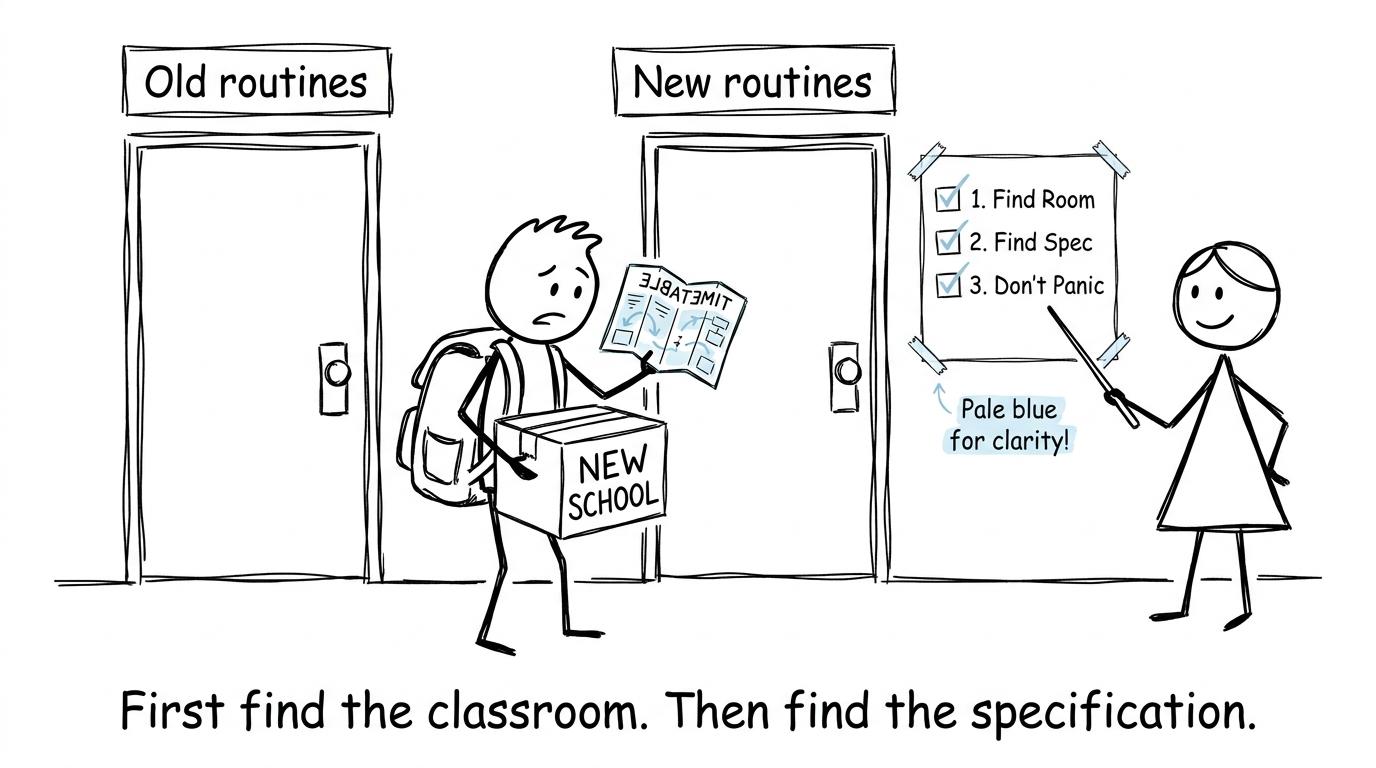 A student finding the specification after changing schools
Find out exactly what has changed
GCSE English Language qualifications share broad national expectations around reading, writing and spoken language, but Edexcel, AQA, OCR and Eduqas do not arrange their examinations identically. Paper structures, source combinations, timings, question wording and mark allocations can differ. The exact specification code matters too, so do not rely only on the name of the board.
English Language is not divided into foundation and higher tier in the way GCSE Maths is. You therefore need to understand the complete assessment structure used by your new school rather than asking which tier you have joined.
Request clear answers to the following questions:
- What is the full qualification title and specification code?
- How many written papers are there?
- Which reading and writing skills appear on each paper?
- What are the examination timings?
- Which internal mocks or assessments are coming next?
- Which terminology does the department expect in analytical responses?
- Has the class completed any work that you have not encountered?
Use the current specification and materials supplied by your school or exam board. Examination documents can change, so an old revision guide or another student's notes should not be treated as the final authority.
Build a coverage map before revising
The most useful document after a move is not a huge pile of notes. It is a one-page coverage map.
Create three headings: secure, partly covered and not yet covered. Then organise your English Language skills beneath them. Useful categories include:
- retrieving and interpreting information;
- analysing language and structure;
- comparing viewpoints or writers' methods;
- evaluating a text;
- summarising or synthesising information;
- writing to describe or narrate;
- writing to explain, argue or persuade;
- organising ideas for clarity and effect;
- sentence control, vocabulary, spelling and punctuation;
- planning and delivering spoken language work.
Ask your teacher to check the map. This turns an uncertain feeling, “I might have missed everything”, into a finite list of actions.
Some apparent gaps will simply be differences in sequencing. You may have practised persuasive writing while the new class studied narrative writing. In that case, both groups have learning to exchange rather than one student being permanently behind.
Translate your existing skills to the new exam board
A change of exam board does not erase what you have learnt. Close reading, selecting evidence, explaining effects, comparing ideas and controlling written language remain valuable. What may change is how those skills must be demonstrated under particular question instructions and time limits.
Begin by matching familiar skills to unfamiliar question formats. For each paper, record:
- what the question is assessing;
- which sources or sections it uses;
- how much time your teacher recommends;
- the expected response style;
- what the mark scheme rewards.
Practise recognising command words, but do not reduce English to a memorised formula. A rigid paragraph structure can provide temporary support; it cannot replace a relevant argument, well-chosen evidence or precise explanation.
Use one current specimen or past paper initially as a map rather than a test. Read the instructions, label the skills and note where the format differs from your previous course. Later, complete timed sections and use the official mark scheme alongside your teacher's feedback.
Confirm your spoken language endorsement
Spoken language is an important administrative question when changing centres. In GCSE English Language qualifications in England, speaking and listening performance is generally reported separately from the numerical GCSE grade. Exam boards set conditions for how schools assess, record and authenticate this work.
Ask your new school's examinations officer or English department whether your previous centre has supplied the relevant result or evidence. Do not assume that an ordinary exercise book contains everything needed. If the endorsement has not been completed or cannot be confirmed, ask what the new school requires and when another opportunity will be available.
This is a conversation for the schools to manage with you. Your role is to raise it early and keep any messages or documents you receive.
Create a catch-up plan that you can sustain
Trying to “catch up” by revising English for an entire weekend is comforting because it feels decisive. It is often less useful than several focused sessions spread across the week.
A practical plan might contain separate sessions for:
- learning the structure of one paper;
- planning one writing task;
- completing one reading question under timed conditions;
- checking a response against a mark scheme;
- improving that response using teacher feedback.
Each session should have a visible finish line. “Revise English” is too vague; “identify the purpose of every question on Paper 1” is measurable.
Keep an error log containing only patterns worth revisiting. These might include unsupported analysis, imprecise quotations, weak paragraph links, rushed conclusions or missed proofreading. Record the action that will correct each pattern. Revision becomes more efficient when it responds to evidence rather than mood.
Keep maths from slipping during the move
English may be the immediate concern, but a school transfer can also change the order of your GCSE Maths topics, your tier entry or the examination board used by the department. Ask the same basic questions in maths: what has been covered, what comes next and where are the genuine gaps?
MathsGenie's GCSE revision lessons let you revisit individual topics through videos and practice questions, which is particularly useful when two schools have followed different teaching sequences. If your new class is working towards a particular level, the grade 444 revision topics, grade 555 revision topics and grade 777 revision topics can help you locate suitable material without restarting the whole course.
Use GCSE Maths past papers and mark schemes to diagnose weaknesses, not merely to collect scores. A missed mark should lead to a topic lesson, several practice questions and then another check. Near the examination period, MathsGenie's predicted papers can provide further practice alongside official past papers. Predicted papers are practice resources, not a guarantee of the questions that will appear.
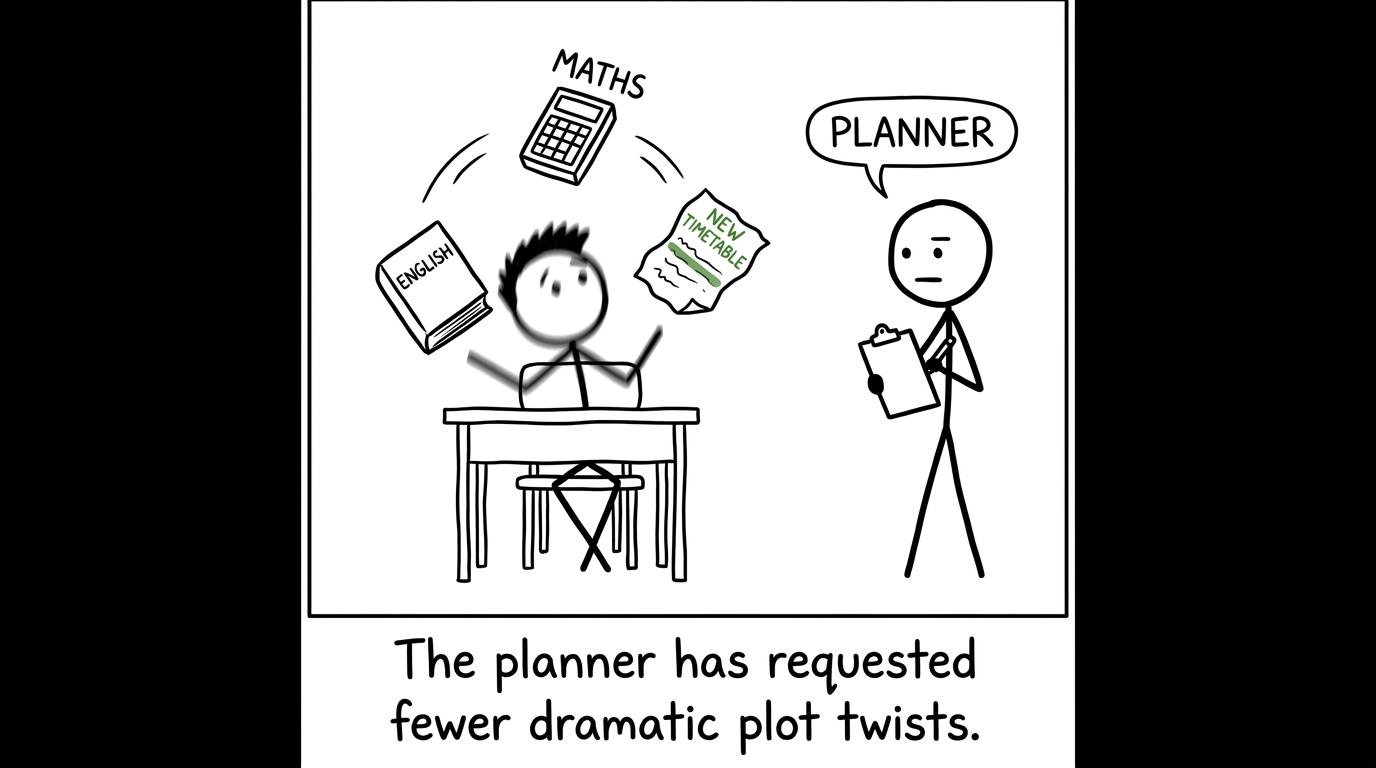 A revision planner coaching a student juggling subjects
Ask for help with specific evidence
Teachers can respond more effectively to a precise concern than to “I am behind”. Bring your coverage map, previous assessment feedback and a sample from the new specification. Then ask focused questions such as:
- Which missing skill should I prioritise before the next assessment?
- Does my previous analytical method fit this question type?
- Which task would best show whether I understand the new paper?
- What should I stop doing because it belongs to a different question format?
If moving schools has affected attendance, access arrangements, wellbeing or your ability to obtain records, speak to your form tutor, head of year, special educational needs coordinator or examinations officer as appropriate. Arrangements and evidence requirements are formal matters; they should be checked by the school rather than guessed from general online advice.
Common mistakes after changing schools
Assuming a different teaching order means failure
Departments make different sequencing decisions. Compare content before deciding that you are behind.
Revising from the wrong specification
Resources from your previous board may still develop useful skills, but they may not represent the new paper structure. Use materials confirmed by your current teacher.
Throwing away previous work
Marked responses reveal what you can already do and give your new teacher valuable evidence. Keep digital or paper copies where possible.
Ignoring the spoken language record
Raise the endorsement with the English department or examinations officer early. Administrative uncertainty becomes harder to resolve when left until the examination season.
Completing full papers before learning their structure
A full timed paper is useful only when you understand what each section demands. Begin with orientation and targeted sections, then progress to complete papers.
Letting English consume every revision session
Urgency is not the same as priority. Maintain a balanced timetable that includes maths and your other subjects. The free resources on the MathsGenie home page make it easier to continue short, focused maths sessions while you adjust.
A school move changes the route, not the destination
Changing school partway through GCSE English Language creates uncertainty, but uncertainty becomes manageable once it is written down. Identify the specification. Map your coverage. Confirm the spoken language endorsement. Practise the unfamiliar paper format, seek feedback and review progress after each assessment.
At the same time, keep the rest of your GCSE revision moving. Use MathsGenie's free revision lessons, videos, practice questions and grade-based topic pages to repair specific maths gaps. Then use past papers, mark schemes and predicted papers to build examination confidence. You do not need to recover everything at once. You need to identify the next useful step, and take it consistently.










