

Moving Schools GCSE Art and Design: Stay on Track
Moving schools GCSE Art and Design? Protect your portfolio, confirm assessment arrangements and keep your GCSE maths revision firmly on track.
Changing schools during a GCSE course can make familiar work suddenly feel uncertain. Your sketchbooks may belong to a project designed by one teacher, your new school may use another exam board, and the deadline you understood last week may no longer apply in quite the same way.
If you are moving schools GCSE Art and Design does not automatically have to fall behind. The immediate answer is to secure your work, arrange a teacher-to-teacher handover and confirm your exam board, title, component status and deadlines in writing. Do this before trying to redesign the project yourself.
There is also another pressure. Art coursework can absorb every spare evening, leaving less time for GCSE maths and other examined subjects. A controlled handover protects more than your portfolio. It protects your whole revision timetable.
Your moving-school checklist
Use this list as soon as the move becomes likely:
- Ask whether the new school offers the same GCSE Art and Design title.
- Confirm the old and new exam boards, such as AQA, Edexcel, OCR or Eduqas.
- Ask which portfolio work can continue and what evidence is still missing.
- Arrange for both art departments and exams officers to communicate directly.
- Make a careful digital record of your work, where your school permits it.
- Confirm who will store, authenticate, mark and submit each component.
- Check that any access arrangements are reviewed by the new centre.
- Build a short catch-up plan that leaves protected time for maths revision.
Do not rely on a verbal message passed between several people. Names, dates and responsibilities should be written down.
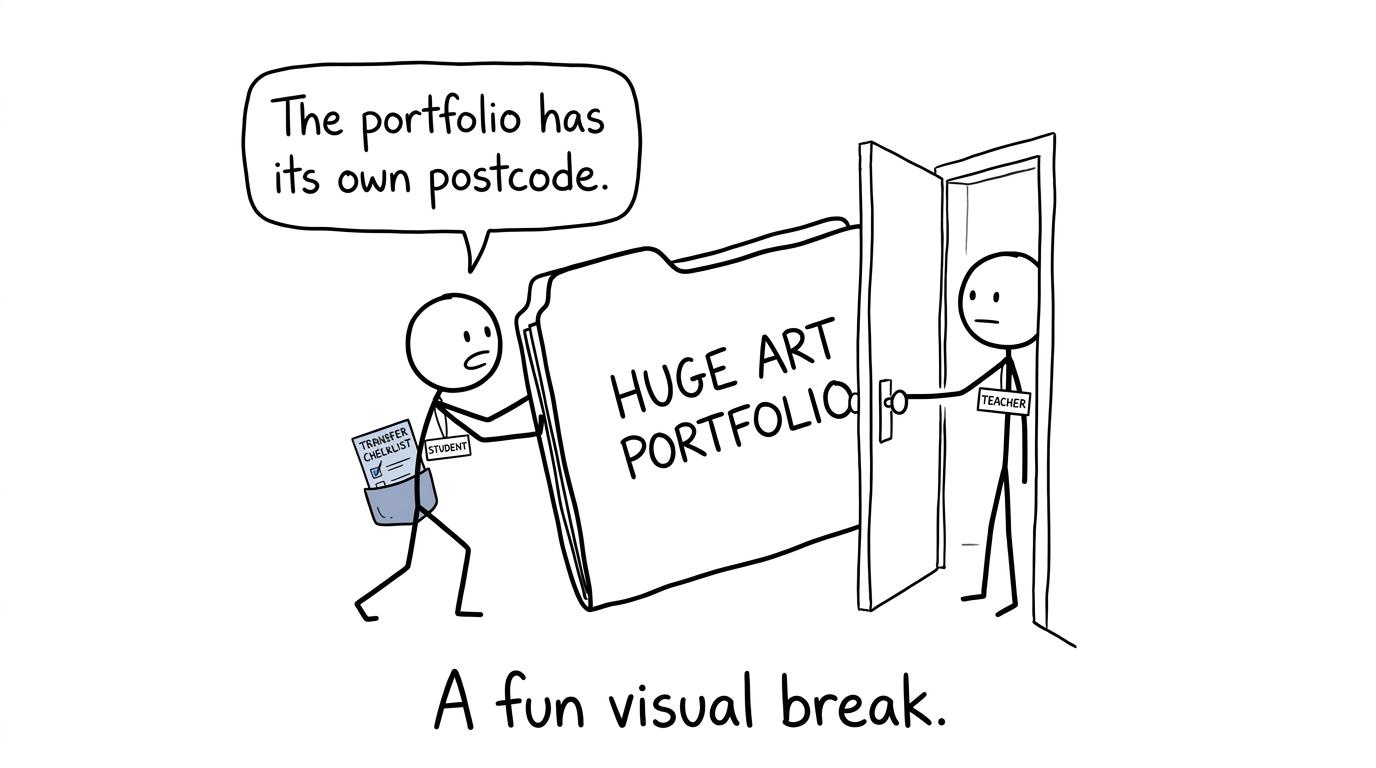 A student carrying an enormous art portfolio between schools
Establish exactly what course you are transferring
“GCSE Art” can refer to several titles and areas of study. Depending on the board, a school might offer Art, Craft and Design, Fine Art, Graphic Communication, Photography, Textile Design or Three-Dimensional Design. A similar classroom label does not guarantee an identical qualification entry.
Ask your new head of art or exams officer to confirm:
- the awarding body and specification;
- the qualification title and entry code;
- your current component and project;
- whether your existing work fits the new title;
- the assessment objectives already evidenced;
- the internal deadlines used by the new school.
Across the main specifications, GCSE Art and Design is generally built around a portfolio worth 60%60\%60% and an externally set component worth 40%40\%40%. The externally set component normally includes preparatory work followed by 101010 hours of supervised sustained work. However, the task wording, permitted approach, administration and evidence requirements must be checked against your actual board and examination series.
The reassuring part is that the broad assessment journey is similar. Students investigate sources, develop ideas, experiment and refine, record observations, and present a personal response. Existing work may therefore remain useful even when the specification changes. But only the receiving school and relevant awarding body can decide how it may be submitted.
Build a proper portfolio handover
A portfolio is not merely a folder of finished pieces. It is evidence of decisions made over time. If the final outcome arrives without the research, experiments, failed attempts, annotations and refinements that led to it, part of that journey becomes invisible.
Your handover should account for:
- sketchbooks, loose sheets and mounted work;
- photographs of large, temporary or three-dimensional pieces;
- digital files in their original formats;
- artist and contextual research;
- source acknowledgements;
- teacher feedback and progress records;
- project briefs and starting points;
- dates or notes showing when work was produced;
- records of any supervised assessment sessions.
Ask your old teacher to prepare a short progress summary. It should explain the project context, work completed, remaining gaps and any relevant assessment information. This is more useful than asking your new teacher to infer the story from a stack of pages.
Live non-examination assessment is subject to security and authentication rules. Do not assume you should personally remove every original from school or upload it to a personal account. Agree the transfer method with both centres. Where copying is allowed, create clear scans or photographs and keep an organised file index rather than an unexplained camera roll.
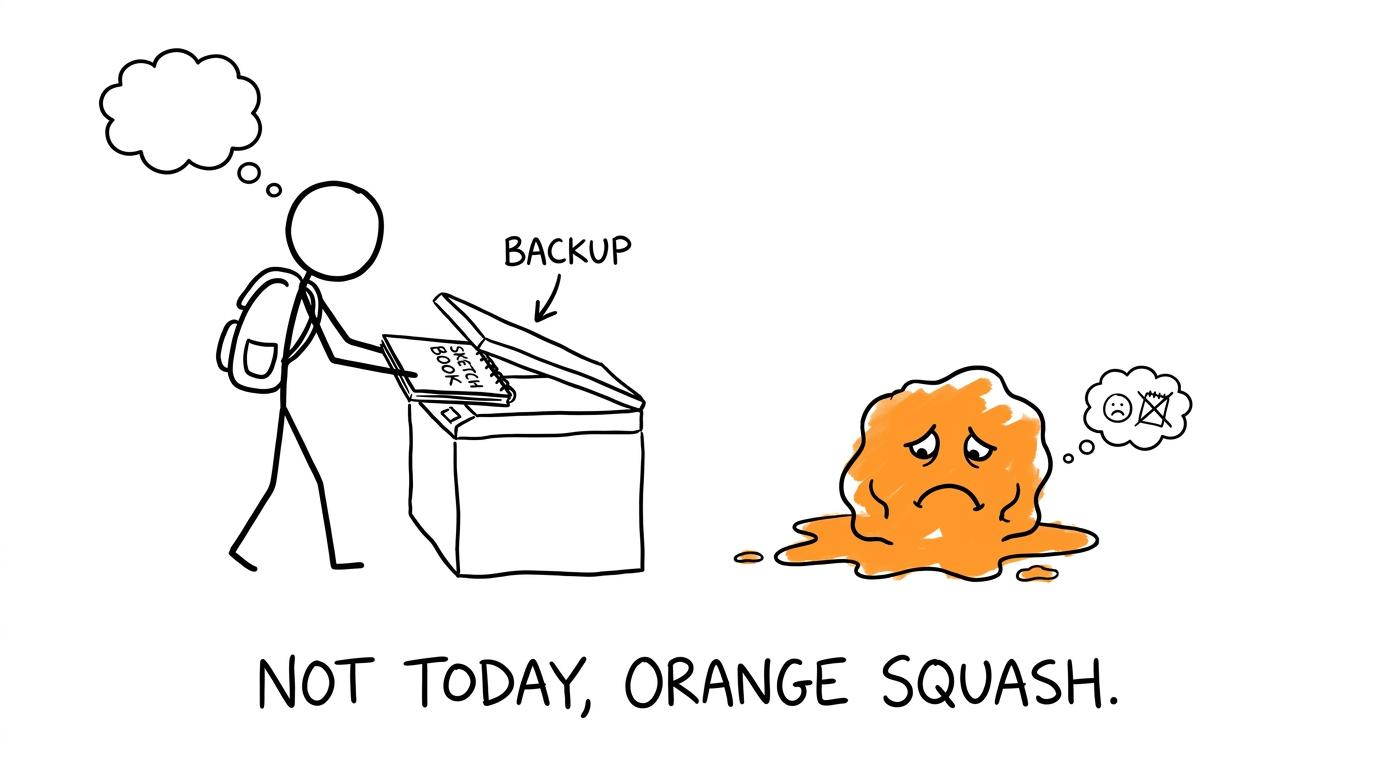 A digital backup protecting a sketchbook from orange squash
Understand who is responsible for the assessment
Moving school and transferring an examination entry are not always the same administrative event. JCQ transferred-candidate arrangements are designed for eligible timetabled examinations. Portfolios, coursework, practical assessments and other non-examined components are excluded from that standard arrangement.
That distinction matters for Art and Design because the qualification is assessed through non-examination assessment. Your schools may need specific guidance from the awarding body about entries, authentication, marking, moderation and the movement of work.
Students should not be expected to solve this administration alone. Ask for one named contact at each school, ideally involving:
- the head of art or subject teacher;
- the exams officer;
- your head of year or pastoral lead;
- the special educational needs co-ordinator where relevant.
If examination entries have already been made, raise the issue immediately. If they have not, the new school still needs enough time to decide what it can offer and how your previous evidence fits.
Access arrangements also require attention. The new centre must make sure that an arrangement reflects your current need and normal way of working. Previous evidence can be important, but the new school may need to submit a fresh application or complete additional documentation under the current JCQ rules.
Compare the portfolio with the new specification
Once the administrative position is clear, ask your new teacher to conduct a portfolio audit. The purpose is not to assign a speculative grade immediately. It is to identify evidence that is secure, evidence that can be developed and genuine gaps.
A useful audit considers four broad questions:
- Have you investigated relevant artists, designers, craftspeople or contextual sources?
- Have you tested materials and shown meaningful refinement rather than simple repetition?
- Have you recorded observations, ideas and intentions as the project developed?
- Does the work lead towards a personal, coherent response?
You may discover that the move has created less of a gap than it first appeared. A different teacher might use different project names while still seeking comparable evidence. Equally, a polished final piece cannot compensate automatically for missing development.
Ask for a short priority list. “Improve the portfolio” is too vague. “Add first-hand observations, explain the change of materials and connect the final composition to earlier experiments” gives you something you can act upon.
Keep GCSE maths revision protected
A school move creates decision fatigue. Each small uncertainty consumes attention, and unstructured art catch-up can expand to fill every evening. Maths then gets postponed because its deadlines feel less immediate.
The answer is not to abandon art or attempt heroic revision sessions. Give each subject a defined place. Use the MathsGenie revision planner to reserve recurring maths sessions before filling the remaining space with portfolio tasks.
A balanced week might contain:
- two short maths topic sessions;
- one maths mini test or timed paper section;
- two focused art catch-up blocks;
- one flexible block for whichever subject has the nearest genuine deadline;
- one evening without scheduled catch-up work.
Keep the maths sessions specific. The GCSE maths revision hub lets you select your board, tier and topic rather than losing time deciding what to revise. If your school move also changes your maths board, use the GCSE topics by exam board and tier guide to map the transition.
Students taking Edexcel can continue with Edexcel GCSE Maths revision lessons and questions, while OCR students can use the OCR GCSE Maths revision hub. The underlying national subject content has substantial overlap, but board-specific papers help you learn the wording and structure you will actually face.
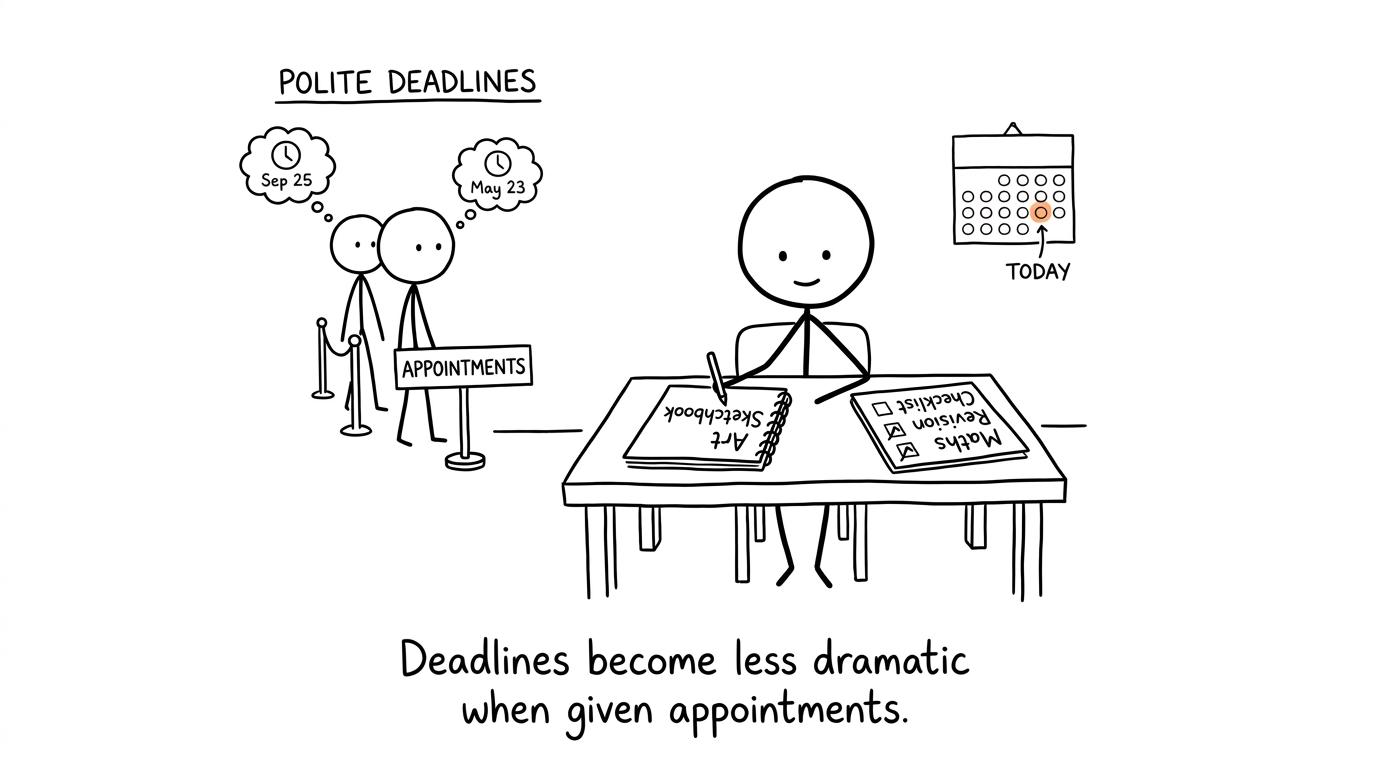 Art and maths deadlines waiting in an orderly queue
Use a minimum viable routine during the transition
For the first weeks after moving, consistency matters more than volume. Set a minimum routine you can complete even while timetables, rooms and expectations are unfamiliar.
For maths, that could mean one revision lesson followed immediately by practice questions and marking. At the weekend, complete part of a board-specific paper. The AQA GCSE Maths past papers and Edexcel GCSE Maths past papers include the papers and mark schemes needed for a simple attempt, mark, repair and retest cycle.
Nearer the examinations, Edexcel GCSE Maths predicted papers can add fresh exam-style practice. Predicted papers are useful preparation, not forecasts of guaranteed questions. Use them after topic revision, then return to lessons and practice questions for anything that costs you marks.
The same principle applies to your portfolio. Complete the smallest task that produces useful evidence: one purposeful annotation, one documented experiment or one carefully recorded observation. Ten disconnected decorative pages are not necessarily better than one page that clearly explains development.
Common mistakes when changing schools mid-course
Waiting for the new teacher to reconstruct everything
A new teacher cannot know which work was supervised, what feedback was given or how a project began. Request a formal handover from your previous department.
Assuming the same subject name means the same course
Titles, entry codes and permitted submissions can differ. Confirm the exact awarding body and specification before changing your work.
Taking or sharing assessment work without permission
Schools must protect live assessment material and establish authenticity. Follow their instructions for transporting originals, scans and digital files.
Starting the portfolio again too quickly
A board change does not always make earlier evidence unusable. Audit it against the new requirements before discarding months of development.
Spending every evening on art catch-up
Urgency can become a habit. Protect regular maths sessions, use short mini tests and let the results identify the topics needing attention.
Treating a predicted grade as portable
Teaching sequences and internal judgements vary. Bring feedback and evidence, but allow the new school to review your work against its specification and assessment process.
Turn the move into a controlled handover
Changing school midway through GCSE Art and Design is disruptive, but disruption is not the same as failure. The students who regain control fastest are not necessarily those who work the longest. They are the ones who make the invisible details visible: the correct entry, the location of every piece, the missing evidence, the next deadline and the person responsible for each decision.
Begin with the handover. Secure your portfolio, connect the two art departments and ask the exams officers to confirm the assessment arrangements. Then protect the rest of your GCSE preparation with a timetable you can genuinely maintain.
MathsGenie can keep the maths side of that plan steady. Use free revision lessons and practice questions to repair individual topics, mini tests to check recall, and past papers, predicted papers, mark schemes and video solutions to prepare for the real examination. When one part of school life changes, a reliable revision routine becomes especially valuable. Open the GCSE maths hub, choose your board and complete one focused session today.











