

Mixed-Topic Practice Before Maths Mocks
Mixed-topic practice before mocks builds confidence, uncovers weak areas and turns each GCSE maths mock into a focused revision plan that works.
November can make GCSE maths feel suddenly serious. A mock timetable appears, several subjects compete for attention, and the comfortable revision strategy of completing one familiar worksheet at a time begins to feel less convincing.
This is where mixed-topic practice before mocks becomes valuable. It helps you practise choosing a method, not merely repeating one you have just been shown. Start with short mixed sets, mark them carefully, repair the weakest topics and gradually progress towards timed papers.
Most importantly, remember what a mock is for. It is a diagnostic, not a verdict. Its job is to show you what to do next.
Your mixed-topic practice checklist
A useful November-to-December plan has five parts:
- begin with manageable mixed sets rather than full papers every evening
- complete questions without notes wherever possible
- mark every attempt and record why marks were lost
- revisit weak skills using focused lessons and practice questions
- repeat those skills later in another mixed set
You can find topic resources for AQA, Edexcel, OCR, Eduqas and other specifications through MathsGenie's GCSE maths revision hub. Your school chooses the content and format of its mocks, so check the tier, exam board and papers with your teacher before planning.
November: move beyond comfortable worksheets
Imagine a student beginning mock revision in early November. They spend Monday completing ratio questions and feel encouraged because every question looks familiar. On Tuesday, they practise expanding brackets with similar success.
But an exam paper does not announce, “This is a ratio question.” It asks the student to recognise the structure for themselves.
That recognition is one of the main purposes of mixed practice. A set might move from fractions to angles, then probability, algebra and area. The individual methods may be familiar, but the student must decide which one applies.
Begin with sessions of about 25-40 minutes. A sensible session could contain:
- two number questions
- two algebra questions
- two ratio or proportion questions
- two geometry questions
- one statistics or probability question
The exact balance should reflect what your class has covered. Year 10 students should not fill practice papers with content they have not yet been taught. Year 11 students can usually draw from a wider part of the specification.
Use the MathsGenie revision videos when a method needs rebuilding, then answer questions without copying the video. Revision becomes useful when support is gradually removed.
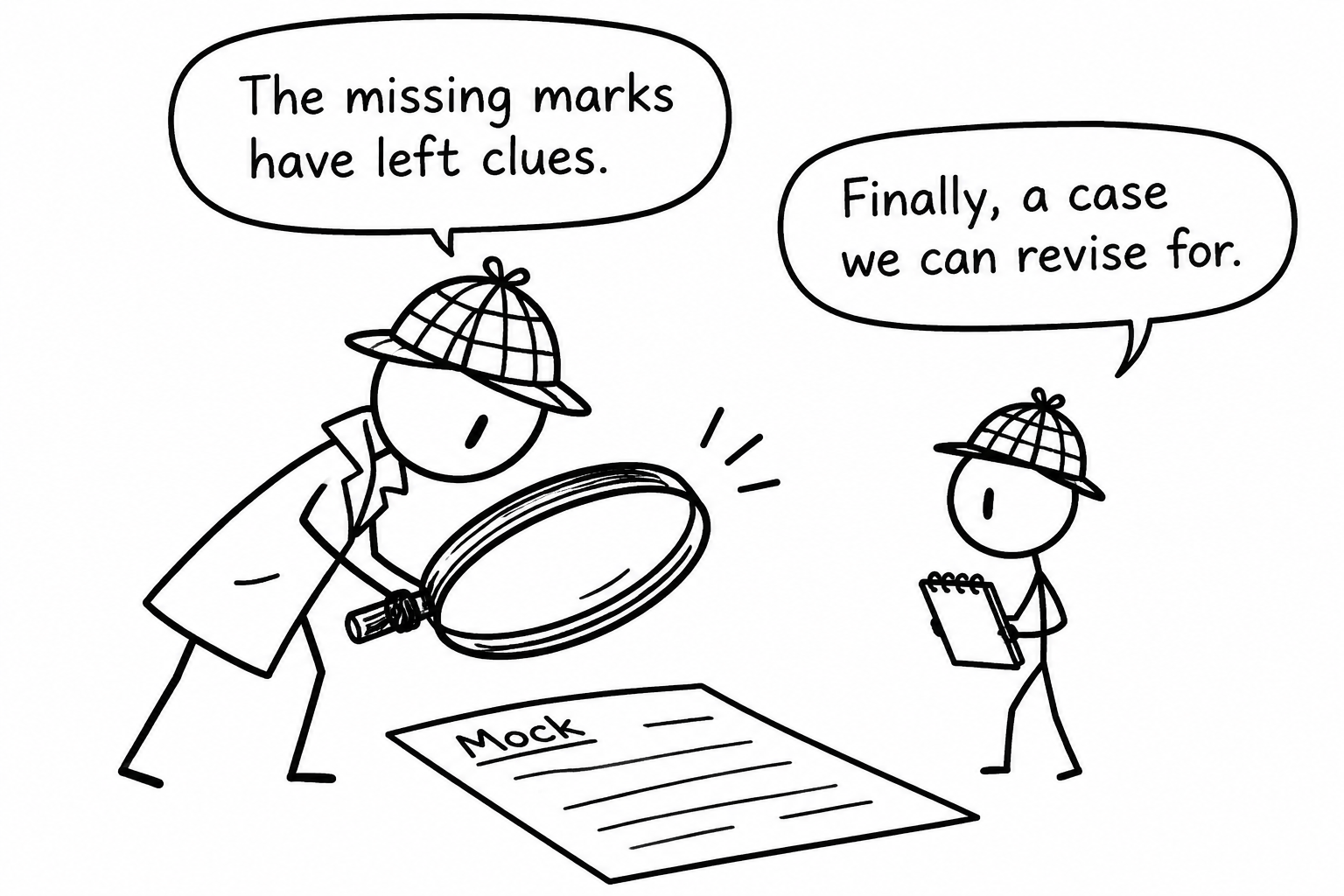 A student detective investigates missing marks on a mock paper
Mark for information, not just a score
A score tells you how the session ended. The working tells you why.
After each mixed set, sort lost marks into four categories:
- Knowledge: you did not know or remember the required fact or method.
- Selection: you knew the method but did not recognise when to use it.
- Execution: you selected the right approach but made an algebraic, arithmetic or calculator error.
- Communication: you reached part of the solution but did not show enough working or give the answer in the required form.
This distinction matters. Rewatching an entire lesson may help a knowledge gap, but it is inefficient if the real problem was one incorrect calculator entry. Equally, doing twenty more identical questions may not fix difficulty selecting a method from a mixed paper.
Use official-style mark schemes carefully. Award marks for what is visible on the page, not what you intended to write. MathsGenie provides Edexcel GCSE maths mini tests for short checks, as well as practice questions and worked solutions across its revision resources.
Keep an error log with four brief details: the topic, the type of mistake, the corrected method and the date to try it again. This turns marking into a plan rather than a judgement.
Build a weekly rhythm before GCSE maths mocks
Mixed practice works best when it sits alongside focused topic repair. It should not replace it.
A practical November week might look like this:
- Monday: complete a short mixed set and mark it.
- Tuesday: revise the two weakest topics found on Monday.
- Wednesday: complete focused practice questions without notes.
- Thursday: return to a different mixed set.
- Weekend: complete a longer timed section and update the error log.
This creates a simple loop: test, diagnose, repair and retest.
A GCSE maths revision timetable can help make that loop realistic around homework and other subjects. The MathsGenie revision planner can also organise work day by day, but the plan should change when your results reveal a new priority.
Parents can help without taking over. Useful questions include, “What did today’s practice reveal?” and “Which topic will you retest?” Asking only for the score can accidentally make every home practice feel like another exam.
December: progress towards realistic papers
As mocks approach, increase the resemblance to exam conditions. This does not mean completing a full paper every night. Tired, unmarked papers provide less value than one carefully reviewed attempt.
Start by timing a section. Remove notes, silence notifications and use only the equipment permitted for that paper. Later, complete a full paper within the stated time.
Past papers are particularly useful once you have enough knowledge to attempt a broad range of questions. Read when to start GCSE maths past papers for guidance on balancing papers with topic revision. Edexcel students can also use GCSE maths predicted papers, while remembering that predicted papers are practice resources, not promises about the questions that will appear.
When completing timed work, practise these mock exam habits:
- read the command and identify what the final answer requires
- show each meaningful stage of working
- write units where needed
- move on temporarily if a question is consuming too much time
- return to skipped questions before checking completed answers
- estimate where possible to spot implausible calculator results
These habits protect marks across many topics, which is why they belong inside mixed practice rather than in a separate last-minute checklist.
Common mixed-practice mistakes
Starting with full papers too early
A full paper can expose weaknesses, but it may overwhelm a student who has several large knowledge gaps. Begin with shorter mixed sets, repair those gaps and lengthen the practice gradually.
Looking at notes after every difficult question
Immediate help feels productive, but it removes the retrieval and decision-making that the mock requires. Finish a short set first, mark it, then seek support.
Recording only the total mark
Two students with the same mark may need completely different revision. One may lack knowledge; the other may be losing marks through rushed arithmetic. Record causes, not just totals.
Repeating only favourite topics
Confidence matters, but comfort can disguise gaps. Use the specification, class assessments and marked practice to choose topics objectively.
Ignoring correct answers with weak working
A correct answer may still contain a fragile method or an unspotted error that happened to cancel out. Compare your reasoning with the solution, particularly on multi-step questions.
Let the mock tell you what comes next
By December, the student who began with scattered November worksheets has something more useful than a pile of completed pages. They have evidence. They know which methods are secure, which mistakes recur and which questions deserve the next revision session.
That is the right way to view GCSE maths mocks. A disappointing mark can feel personal, but it is still information gathered before the final examinations, while there is time to respond.
Your next step is to build a targeted practice paper in MathsGenie's Mock Exam Builder. Choose exam-style questions that reflect your weak areas, complete the paper under sensible conditions, mark it and feed the results back into your plan. A mock is not the end of the story. Used well, it becomes the map for the next part.















