Miss GCSE Arabic Exam Illness: What Happens?
Miss GCSE Arabic exam illness guidance: learn what to tell your school, when special consideration may apply and how your final grade is decided.
The alarm rings, but this is not ordinary exam-day nerves. You are feverish, being sick or genuinely unable to leave bed. Almost immediately, another worry arrives: what happens if you miss GCSE Arabic exam illness prevents you from sitting?
The short answer is reassuring. A genuine temporary illness may qualify for special consideration, provided your school supports the application and you meet the awarding body's rules. If you have completed enough of the qualification, the exam board may still award a grade using your performance in the components you did complete. It is not an automatic pass, a teacher-predicted grade or a guaranteed mark increase.
Your first job is not to solve the grading process yourself. It is to contact your school or exam centre immediately.
What to do if illness makes you miss GCSE Arabic
Use this checklist as soon as you know you may be absent:
- Tell your parent or carer and contact the school using its exam-day absence procedure.
- Ask specifically for the exams officer, examination manager or another named member of staff.
- Explain your symptoms honestly and when they began.
- Follow the school's instructions about medical evidence or other supporting information.
- Ask whether the centre intends to apply for special consideration.
- Attend your remaining examinations if you are well enough and the school advises you to do so.
- Keep a written record of messages, calls and any medical advice received.
Do not simply stay at home and assume the school will know why you are missing. An unexplained absence and an illness reported promptly are not treated in the same way.
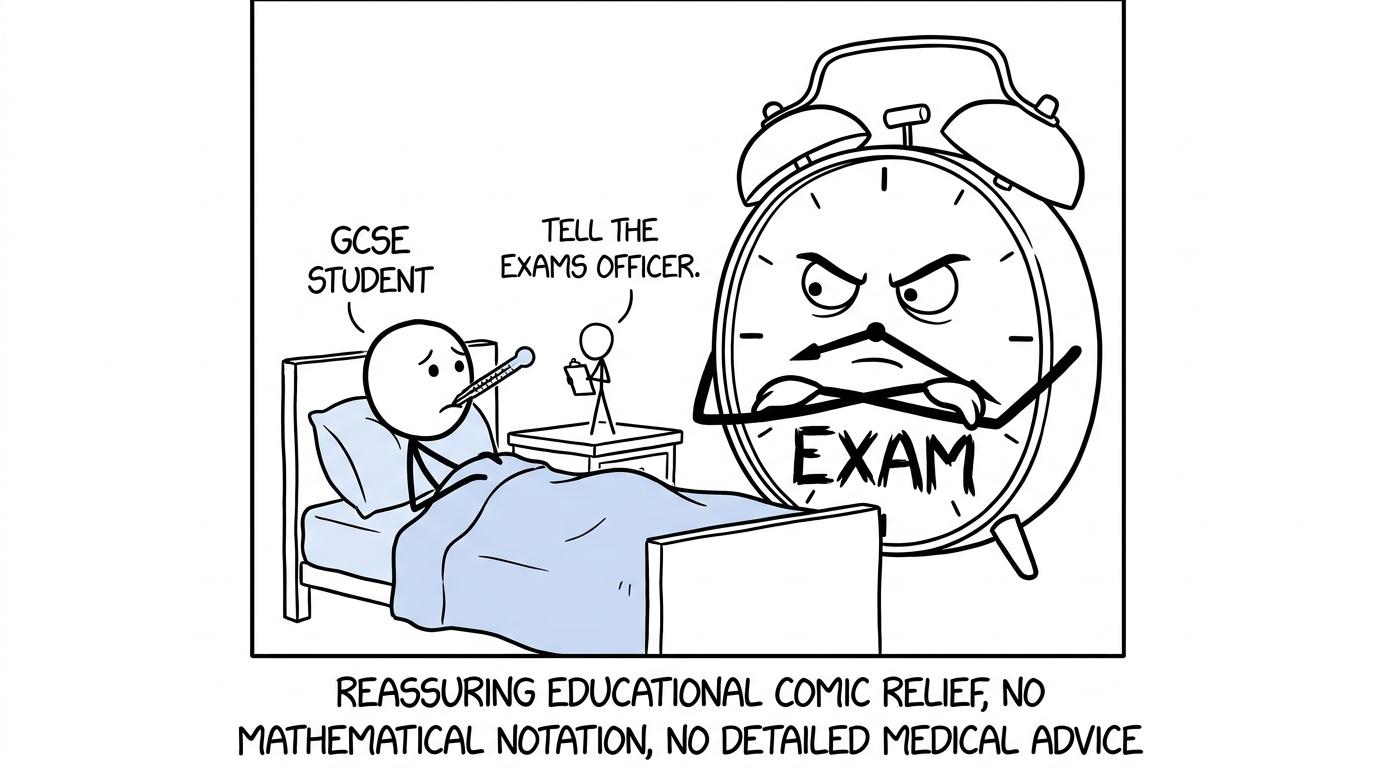 A poorly GCSE student being reminded to contact the exams officer
What special consideration actually means
Special consideration is a post-assessment process for candidates whose ability to take an assessment, or demonstrate their normal attainment, has been materially affected by circumstances outside their control.
Under the Joint Council for Qualifications guidance for the 2025-26 academic year, temporary illness at the time of an assessment can be an eligible circumstance. The candidate must normally have been fully prepared and have covered the whole course. The illness also needs to have had, or be reasonably likely to have had, a real detrimental effect.
Your school or examination centre makes the application to the relevant awarding body. Students and parents do not normally submit it directly. Private candidates should contact the centre that entered them for the qualification.
Special consideration does not mean that an exam board simply awards the grade you hoped to receive. Its purpose is narrower: to reduce the unfair impact of a temporary event without changing the standard of the qualification.
If you miss the paper completely
When illness is accepted as the reason for missing a timetabled component, the awarding body may use its enhanced grading procedure. It considers the candidate's performance in the completed parts of the qualification and the performance of the wider cohort in comparable components.
This is not a simple average, and your school does not invent a mark for the paper. The awarding body carries out the calculation according to its procedures before determining the qualification result.
For GCSE qualifications covered by the JCQ rules, a candidate normally needs to have completed one whole component worth at least 15%15\%15% of the total assessment. The candidate must also have covered the course and been fully prepared.
If you sit the exam while ill
A different form of special consideration may apply if you attend but your performance is materially affected by illness. In eligible cases, the awarding body may apply an allowance to the affected component.
The maximum JCQ allowance is 5%5\%5% of the total raw marks available for that component, reserved for the most exceptional circumstances. It does not mean adding 5%5\%5% to your mark, adding five marks automatically or raising your final grade by a fixed amount. Smaller tariffs may apply, and an adjustment may not change the final grade at all.
If you become unwell during the exam, alert an invigilator immediately. That creates a contemporaneous record and allows the centre to respond appropriately. Trying to struggle silently through the paper can make it harder for the school to explain what happened later.
How the GCSE Arabic assessment structure matters
Pearson Edexcel GCSE Arabic is divided into four skills:
- listening
- speaking
- reading
- writing
Each component contributes 25%25\%25% of the qualification. Students take either foundation or higher tier across the qualification rather than mixing tiers between papers.
Because one completed Arabic component represents 25%25\%25% of the qualification, it exceeds the standard JCQ minimum of one whole component worth at least 15%15\%15%. Therefore, a student who has completed at least one full component may meet that particular minimum requirement if illness causes a later absence.
That does not guarantee special consideration. The centre must support the application, the absence must have an acceptable reason, and all other eligibility conditions must be satisfied.
If every component is missed, the minimum completion requirement is not met. Special consideration cannot normally create a GCSE result where the awarding body has no completed assessment evidence.
Can the Arabic exam be taken on another day?
For a nationally timetabled written examination, there is not normally an individual catch-up paper later in the same exam series. Allowing one candidate to see or hear the assessment after other candidates have taken it would create obvious security problems.
The speaking assessment is different because it is conducted by the centre during an authorised assessment window and then externally assessed. If illness affects the original speaking appointment, the school may investigate whether it can rearrange the assessment within the permitted window and under the required conditions.
Rearrangement is not always possible, particularly if the assessment window has closed. Contacting the school immediately gives it the best chance to consider the available options and obtain advice from Pearson where necessary.
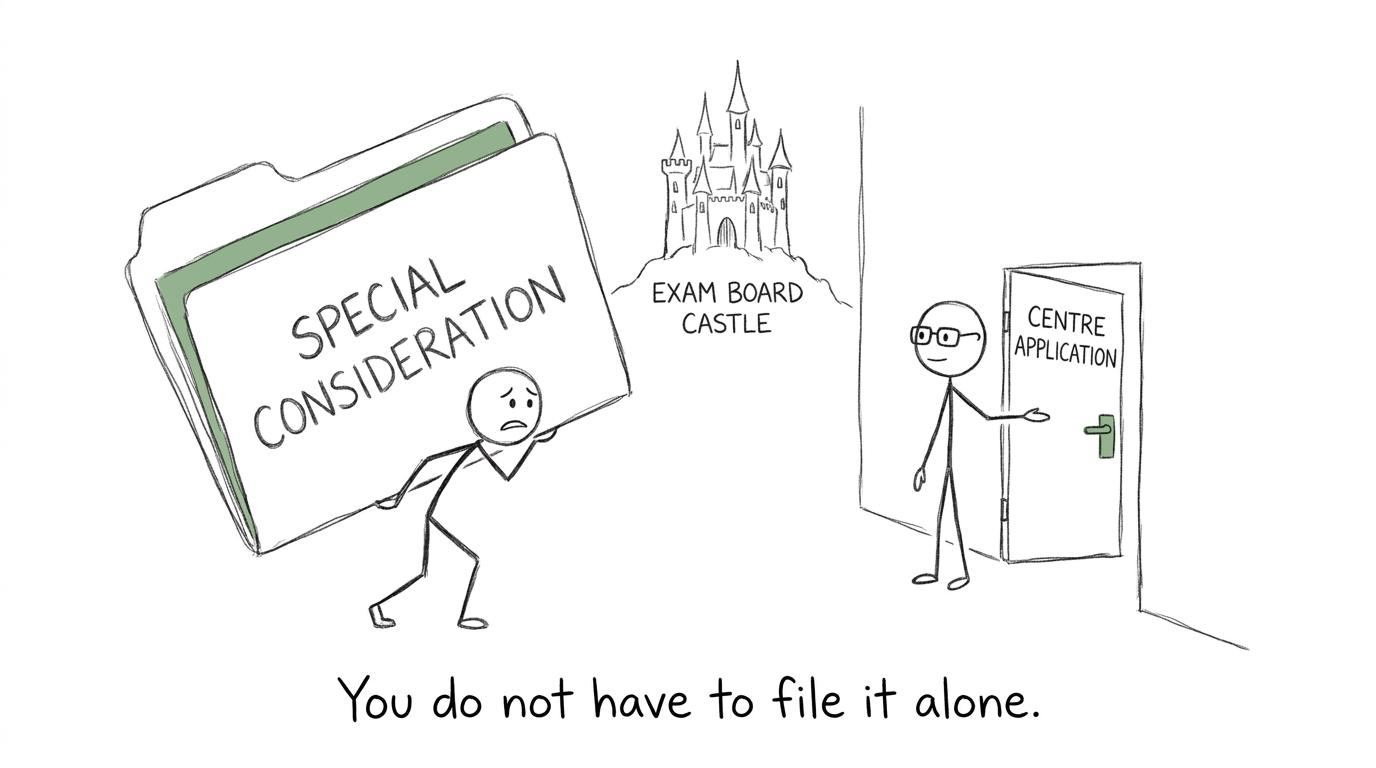 A student learning that the school submits a special consideration application
What evidence might your school request?
There is no sensible reason to promise that one particular document will always be required. Evidence expectations can depend on the circumstances, the component and the awarding body's process.
Your centre may ask for information such as:
- when the illness started and how it affected you
- details of any medical appointment or professional advice
- a record from the school's first-aid or pastoral team
- information supplied by a parent or carer
- confirmation that you were fully prepared for the examination
Do not exaggerate symptoms or seek unnecessary medical appointments purely to obtain a note. Give the school accurate information and follow its instructions. The exams officer is responsible for deciding what should accompany or support the centre's application.
What special consideration does not cover
The process is designed for temporary problems at or near the assessment. It does not compensate for every difficult experience during Year 11.
Under JCQ guidance, special consideration would not normally apply simply because a candidate:
- misread the examination timetable
- arrived at the wrong place or time
- went on holiday or attended a personal event
- did not revise enough
- missed teaching earlier in the course
- experienced ordinary exam anxiety without an eligible circumstance
- was affected by a long-term condition that should instead have been addressed through appropriate access arrangements
A long-term condition can involve more complicated circumstances, particularly if it suddenly worsens at the time of the exam. The school should discuss individual cases with its awarding body rather than assuming the outcome.
Access arrangements and special consideration are also different. Access arrangements are generally organised before an assessment to allow an eligible student to access it fairly. Special consideration responds to a temporary illness, injury or event affecting an assessment at the time it occurs.
Keep the missed Arabic exam separate from maths revision
Once the school has the information it needs, there is little value in repeatedly trying to calculate an imaginary Arabic result. That uncertainty can consume the time and concentration needed for the examinations still ahead.
Think of the situation as two separate files. The exams officer handles the special consideration file. You handle recovery and the next paper.
When you are well enough to revise, return gently rather than trying to compensate with an exhausting session. Open the GCSE Maths Revision hub, confirm your board and tier, and choose one manageable task. The GCSE maths topics by exam board and tier guide can help you avoid revising material that does not match your entry.
A useful restart might be:
- one short revision lesson
- a small set of practice questions
- immediate checking with the mark scheme
- a break before deciding whether to continue
If a full paper would be too demanding while you recover, use a mini test or a shorter timed section. The aim is to restore rhythm, not punish yourself for being ill.
For longer-term organisation, follow the GCSE one-month maths revision plan or build a sustainable routine with the GCSE maths revision timetable. Nearer the exam, the GCSE maths night-before plan keeps preparation focused without encouraging late-night panic.
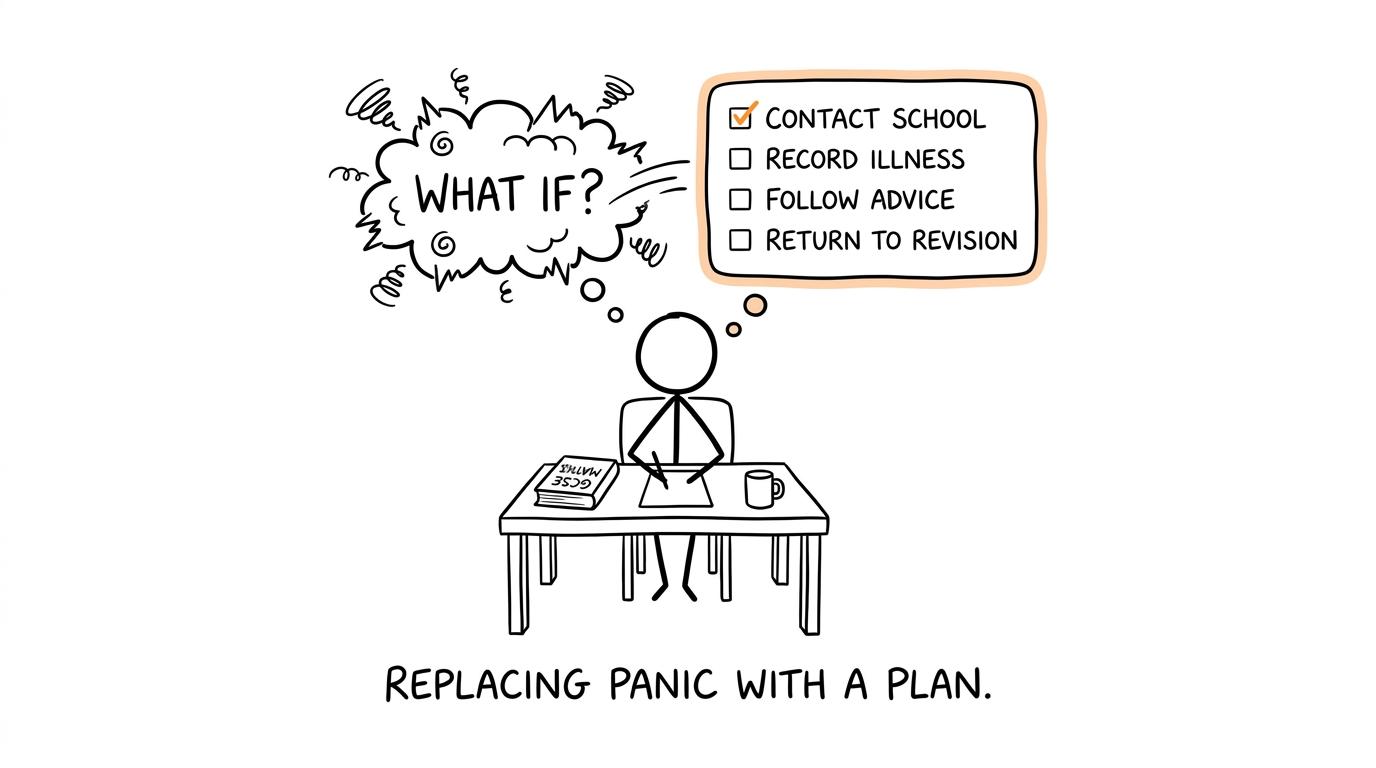 A student replacing anxious thoughts with a clear exam plan
Common mistakes after missing an exam
Waiting several days before contacting the school
Special consideration is administered to awarding-body deadlines. Report the absence immediately, even if you do not yet have every detail or document.
Assuming illness guarantees a predicted grade
The exam board decides whether the criteria are met and how the result is determined. A teacher prediction is not simply substituted for a missed paper.
Believing the maximum allowance is automatic
The maximum 5%5\%5% tariff concerns eligible candidates who sat an affected component and is reserved for exceptional cases. It is not the standard response to every illness and is not the mechanism normally used for a completely missed paper.
Missing later exams because the first one was missed
One absence does not mean the whole exam series has been abandoned. Follow medical and school advice, recover, and attend later components when you are fit enough.
Letting uncertainty take over every other subject
Once the absence has been reported, return attention to what remains controllable. Use GCSE past papers to practise the correct format, or choose Edexcel GCSE Maths past papers if that is your board. Mark each attempt carefully rather than rushing into another paper.
The calm next step
Missing GCSE Arabic through genuine illness can feel final in the moment, but it does not automatically mean losing the entire qualification. Prompt reporting, an honest account of what happened and a supported special consideration application give the awarding body the information it needs to make a fair decision.
Then let the process do its work. Your remaining energy belongs to recovery and the examinations still within your control.
MathsGenie can make that return simpler. Begin with free revision lessons and practice questions, build confidence through mini tests, and move on to past papers with mark schemes and video solutions. When your core skills are secure, use Edexcel GCSE Maths predicted papers to sharpen your final preparation. One clear next action is more useful than an afternoon spent worrying about a decision your exam board has not yet made.