Make Your Own GCSE English Practice Questions?
Make own GCSE English Language and Literature practice questions that reveal weak knowledge, sharpen analysis and support effective exam revision.
Revision notes can create a comforting illusion. You recognise the quotations, remember the characters and understand the language techniques on the page. Then the notes close, an unfamiliar question appears, and certainty disappears.
So, is it worth trying to make own GCSE English Language and Literature practice questions? Yes, provided your questions match your exam board and you later answer them without notes. Writing a good question forces you to identify what matters, connect it to an assessment objective and anticipate what a strong response would need. However, homemade questions should supplement official past papers, not replace them.
This is especially useful if you are balancing English with GCSE maths revision. Both subjects reward the same honest cycle: retrieve, attempt, check, correct and return. The content changes. The habit does not.
The quick answer and revision checklist
Use this process:
- Confirm your exam board: Edexcel, AQA, OCR or Eduqas.
- Check the current specification and assessment objectives.
- Choose one small section of your notes.
- Turn each important idea into a question rather than copying it.
- Write a brief answer guide or success criteria.
- Leave the questions for a few days.
- Answer them from memory, initially without notes.
- Check your response against your notes, specification and teacher guidance.
- Use official past papers to test whether your homemade questions are realistic.
- Keep English practice short enough that it does not displace your planned maths revision.
That final point matters. Creating questions is revision, but designing an elaborate booklet for three hours may be less useful than writing five precise questions and answering them properly.
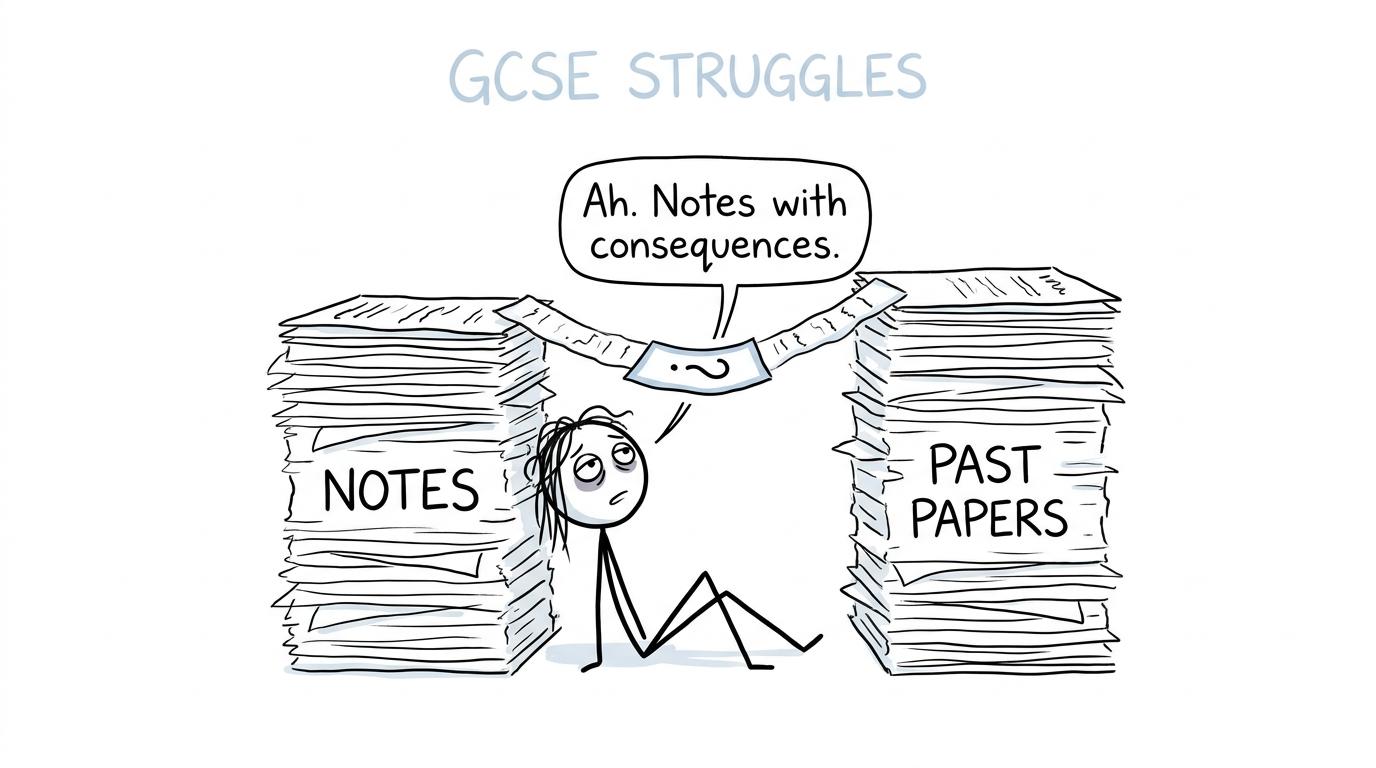 A student discovers that homemade questions can bridge the gap between notes and past papers
Why writing questions can improve your revision
Rereading asks, “Does this look familiar?” An exam asks, “Can you produce and apply this independently?” Those are different tests.
Research into retrieval practice generally supports actively bringing knowledge to mind rather than relying only on repeated reading. Research specifically concerning student-generated questions is more mixed: creating questions can encourage organisation, elaboration and attention to important ideas, but poorly chosen self-tests may miss essential content. That is why the strongest method combines homemade questions with teacher feedback, assessment objectives and official exam-board materials.
You must decide what is important
Suppose your Literature notes contain plot details, quotations, themes, context and language analysis. Turning those notes into questions makes you distinguish central ideas from decorative detail.
A useful question might require you to:
- develop an interpretation of a character or theme;
- select supporting textual references;
- analyse language, form or structure;
- connect relevant context to the writer’s ideas;
- compare texts or poems where the specification requires it.
This is closer to the intellectual work of the examination than highlighting another paragraph.
You begin to think like an examiner
A question is not merely a sentence ending in a question mark. It directs a particular kind of thinking.
For GCSE English Language, the official assessment objectives cover retrieving and interpreting information, analysing language and structure, comparing viewpoints, evaluating texts, communicating effectively and writing accurately. For English Literature, the objectives focus on informed responses, textual evidence, analysis of language, form and structure, relevant context, and accurate written expression.
The objectives are common across exam boards, but paper structures, texts, mark allocations and wording differ. An AQA-style prompt should not be assumed to reproduce an OCR, Edexcel or Eduqas paper. Always follow the board you are actually taking.
Question writing reveals gaps early
Sometimes you cannot write a fair question from a page of notes because you do not yet understand the page. That is useful evidence.
You may realise that you know a quotation but not why it matters, or that you can name a technique without explaining its effect. The difficulty is not a failure of revision. It is the diagnosis revision is supposed to produce.
The same principle applies in maths. A timed set reveals what recognition hides. MathsGenie’s GCSE maths revision hub provides free lessons, worksheets, exam questions and board-specific resources for testing understanding rather than merely reviewing it.
How to turn English Language notes into questions
English Language is primarily a skills-based qualification. Your homemade questions should therefore test transferable reading and writing decisions rather than memorisation alone.
Start with the assessment objective
Label the skill before writing the question. For example:
- Retrieval and inference: find, interpret or synthesise information.
- Language and structure: explain how choices create meanings or effects.
- Comparison: connect writers’ perspectives and methods across texts.
- Evaluation: form and support a critical judgement.
- Writing: adapt content, organisation, tone and register for purpose and audience.
- Accuracy: control vocabulary, sentence structures, spelling and punctuation.
Then select an appropriate unseen extract or writing stimulus. Use copyright-safe material supplied by your school, an official specimen paper or an exam-board past paper. Do not spend most of the session searching for a “perfect” text.
Copy the function, not the wording
Study how your board phrases official questions. Notice the command words, the section of text students must use, the assessment objective and the response length expected. Then create a fresh prompt performing the same function.
For writing tasks, vary form, purpose and audience. A prompt might require an article, speech, letter, description or narrative only where that form fits your specification. Your answer guide should note the intended audience, tone, structure and technical accuracy rather than prescribing one “correct” response.
How to turn English Literature notes into questions
Literature question writing begins with the relationship between text, theme and writer’s method.
Build from themes and characters
Take one heading from your notes, such as power, conflict, responsibility, isolation or change. Ask what the text suggests about that idea and which moments best reveal it.
A strong Literature question usually opens more than one defensible interpretation. If your prompt can be answered by recalling a single fact, it is probably a flashcard rather than an exam-style essay question.
Create a balanced bank containing:
- character-focused questions;
- theme-focused questions;
- questions about relationships or change;
- extract-to-whole-text prompts where required;
- poetry comparison prompts where required;
- unseen poetry questions;
- questions connecting context to the meaning of the text.
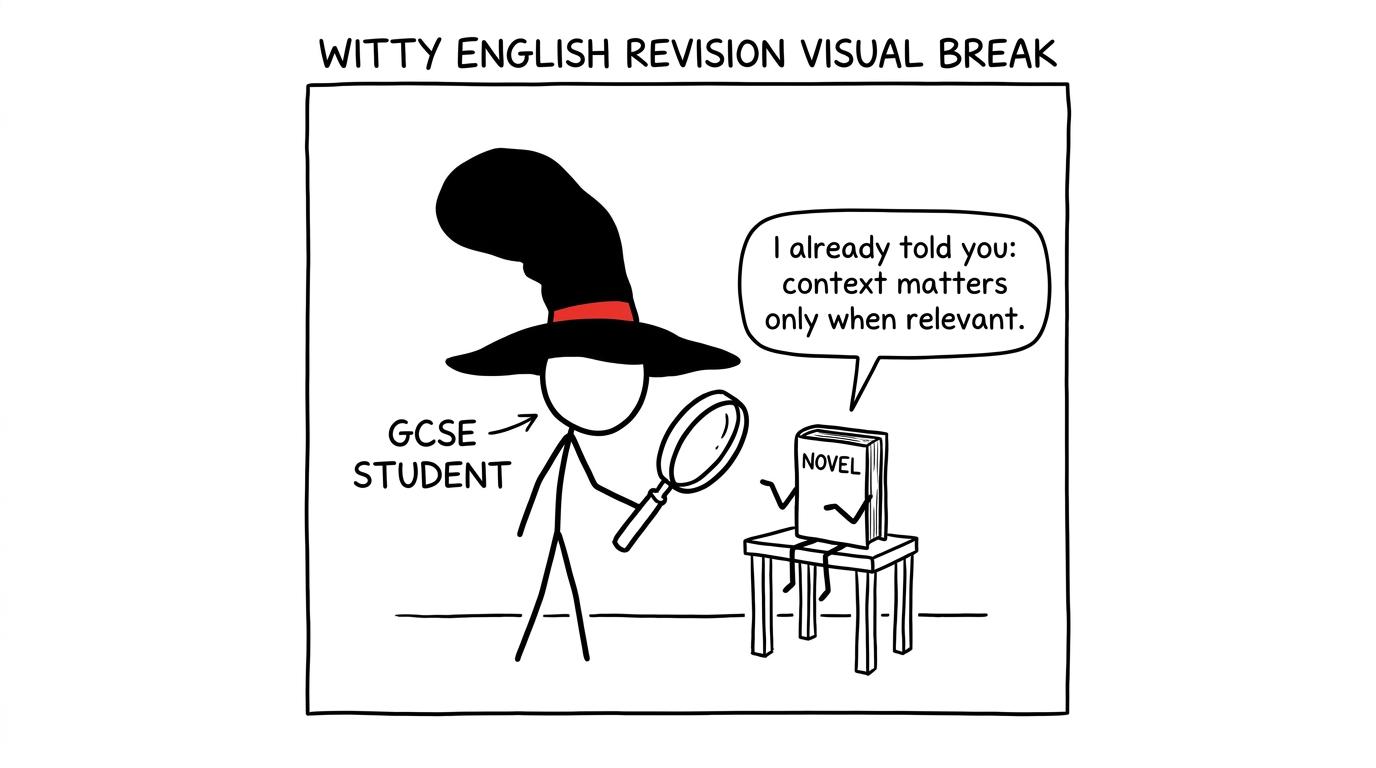 A student wearing an examiner hat questions an unusually cooperative novel
Add a compact answer guide
Do not write a complete model essay every time. That can turn question creation into a slow copying exercise. Instead, record:
- the assessment objectives being tested;
- two or three plausible arguments;
- useful textual references;
- writer’s methods worth analysing;
- relevant contextual connections;
- features of a coherent response.
Context should illuminate the text, not sit beside it as an unrelated history paragraph. Similarly, naming a metaphor earns little by itself; the important work is explaining how the writer’s choice shapes meaning.
How to check whether a homemade question is good
A useful practice question passes five checks.
It matches your specification
Confirm the text, component, task type and assessment objective. Official specifications and specimen materials should be your reference point because exam-board formats are not interchangeable.
It is answerable from suitable material
A Language analysis question needs an extract rich enough to analyse. A Literature prompt should allow a developed argument supported by the studied text. Avoid questions so broad that no focused answer is possible.
It has a clear demand
Words such as compare, evaluate, analyse and describe are not synonyms. The command word should point towards the intended thinking.
It includes checking criteria
Without an answer guide, you may rehearse weak interpretations or reward yourself too generously. Use your notes, the official mark scheme and teacher feedback to calibrate your criteria.
It is eventually answered under pressure
Question writing is preparation, not the final performance. After a delay, answer selected questions without notes. Progress from plans to paragraphs and then to timed responses.
This mirrors an effective maths sequence. MathsGenie’s Edexcel GCSE maths mini tests offer short checks, while Edexcel GCSE maths past papers build full-paper familiarity. The guide to using Edexcel past papers properly explains how marking, error logging and retesting turn an attempt into improvement.
A practical routine for English and maths revision
If maths is one of your priority exams, do not allow English resource-making to consume the whole evening. Use a controlled session:
- select one page of English notes;
- create a small group of focused questions;
- write brief checking criteria;
- schedule a future attempt;
- move to your planned maths topic or paper section.
A weekly rhythm might include one English question-writing session, two sessions answering previously created questions and one official-paper task. Maths can run alongside this through topic lessons, practice questions, mini tests and timed papers.
For structure, adapt the routine in MathsGenie’s GCSE maths revision timetable or the one-month GCSE maths revision plan. When examinations are closer, the guide to when you should start GCSE past papers can help you move from short diagnostics towards timed work.
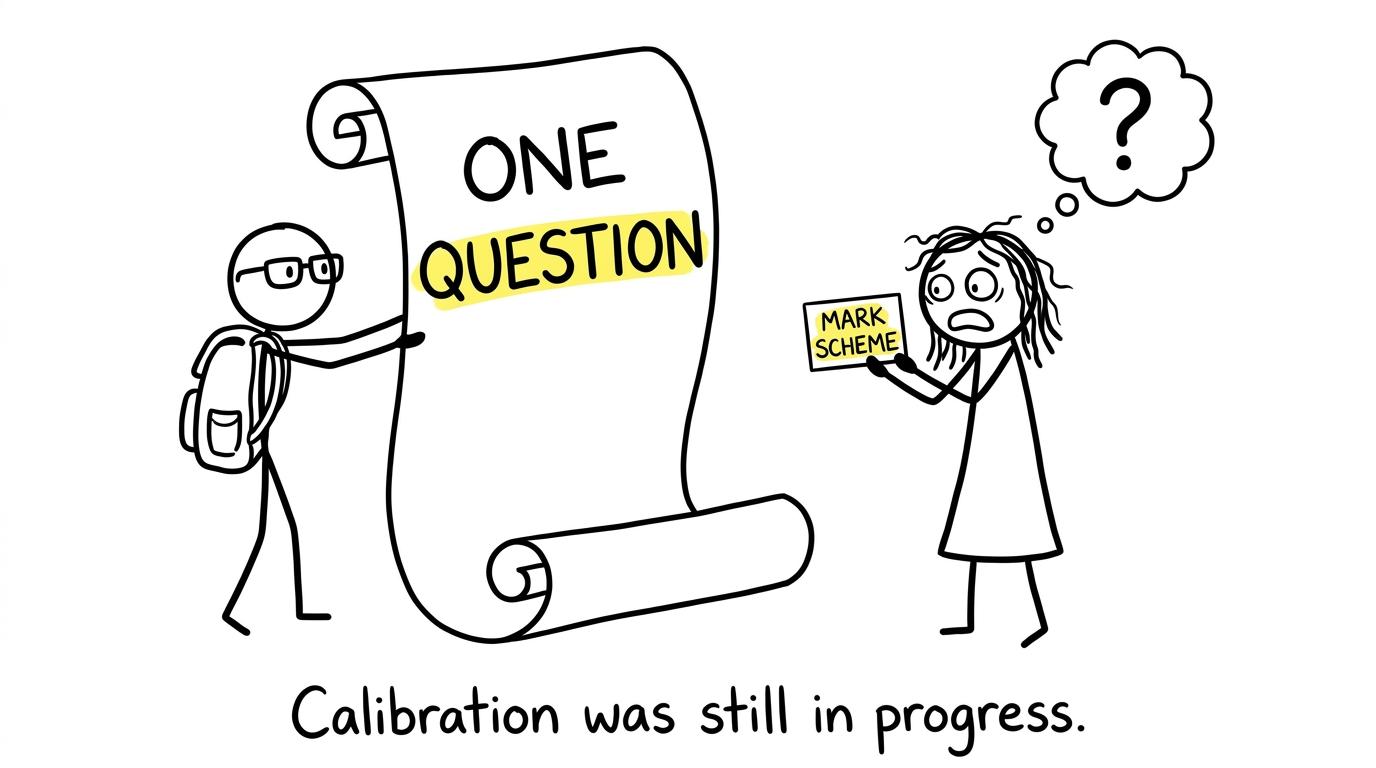 Two students discover that writing a question and writing its marking criteria are different challenges
Common mistakes when making practice questions
Recreating notes as easy recall prompts
Questions such as “What happens in this chapter?” have a place, but they do not adequately rehearse analysis, evaluation or comparison. Include questions that demand evidence and explanation.
Ignoring the exam board
A plausible English question is not necessarily a valid question for your paper. Check the latest specification, specimen papers and teacher guidance for Edexcel, AQA, OCR or Eduqas.
Writing only favourite questions
Students naturally create questions about material they already understand. Begin with uncertain quotations, weak themes and difficult skills instead. Revision should expose discomfort while there is still time to act on it.
Making the question harder than the exam
Complicated wording does not create depth. Keep the task precise and let the text supply the complexity.
Creating without answering
A beautiful question bank has little value if it is never used for retrieval and timed writing. Put attempt dates beside your questions.
Replacing official papers
You cannot perfectly reproduce an examiner’s judgement or paper design. Homemade questions increase variety and deepen processing; official materials provide authenticity. You need both.
Marking by feeling
“I mentioned the theme” is not the same as developing an argument. Check whether evidence is relevant, analysis explains effects, context supports interpretation and writing remains coherent.
Maths students should apply the same strictness to numerical work. Use mark schemes and video solutions rather than awarding marks because an answer was “nearly right”. The MathsGenie guide to finding your weakest GCSE topics shows how to turn mistakes into specific revision targets.
Make the question bank earn its place
Making your own GCSE English Language and Literature questions is worthwhile when the process makes you think: What matters here? Which skill is being tested? What evidence would support a convincing answer?
Keep the bank small, specification-led and connected to actual attempts. Compare your prompts with official materials, ask a teacher to review uncertain questions and retire anything vague or misleading. The aim is not to impersonate an examiner perfectly. It is to become a more alert candidate.
Then carry that active habit into maths. Start with the free MathsGenie GCSE maths revision resources, learn weak topics through revision lessons, practise with exam questions and mini tests, and test your progress using past papers, predicted papers, mark schemes and video solutions. Write fewer notes that merely look familiar. Create more opportunities to prove what you can do.