Learning Styles GCSE Bengali: Do They Matter?
Learning styles GCSE Bengali: see what evidence says, why matching revision to VAK labels falls short, and which methods better prepare you for all four papers.

A revision method can feel right without working particularly well. Colour-coded vocabulary lists look organised. Listening to Bengali while tidying your room feels productive. Copying model answers creates pages of reassuring evidence that you have revised. Yet the real question is simpler: what can you remember and use without help?
For students searching for learning styles GCSE Bengali advice, the evidence-led answer is clear: you do not need to match revision to a fixed visual, auditory or kinaesthetic learning style. Preferences are real, but research has not shown that students reliably learn better when teaching is matched to a VAK label. For GCSE Bengali, your revision should instead match the skill being assessed and require active recall, practice, feedback and revisiting.
The short answer and revision checklist
Do not restrict yourself to one learning style. Use different formats when they serve different parts of the course.
- Check your exam board, specification and tier.
- Revise listening by listening and responding without a transcript.
- Practise speaking aloud rather than only reading prepared answers.
- Read unfamiliar Bengali texts under controlled conditions.
- Write from memory, then correct your language carefully.
- Retrieve vocabulary instead of repeatedly rereading it.
- Revisit difficult material across several sessions.
- Use mark schemes and teacher feedback to identify specific weaknesses.
- Test progress under timed conditions.
- Keep maths moving with short, active sessions rather than passive notes.
The principle is the same one that supports effective maths revision: learn, retrieve, apply, mark and return. MathsGenie's GCSE Maths Revision hub brings those stages together through lessons, questions, papers and solutions.
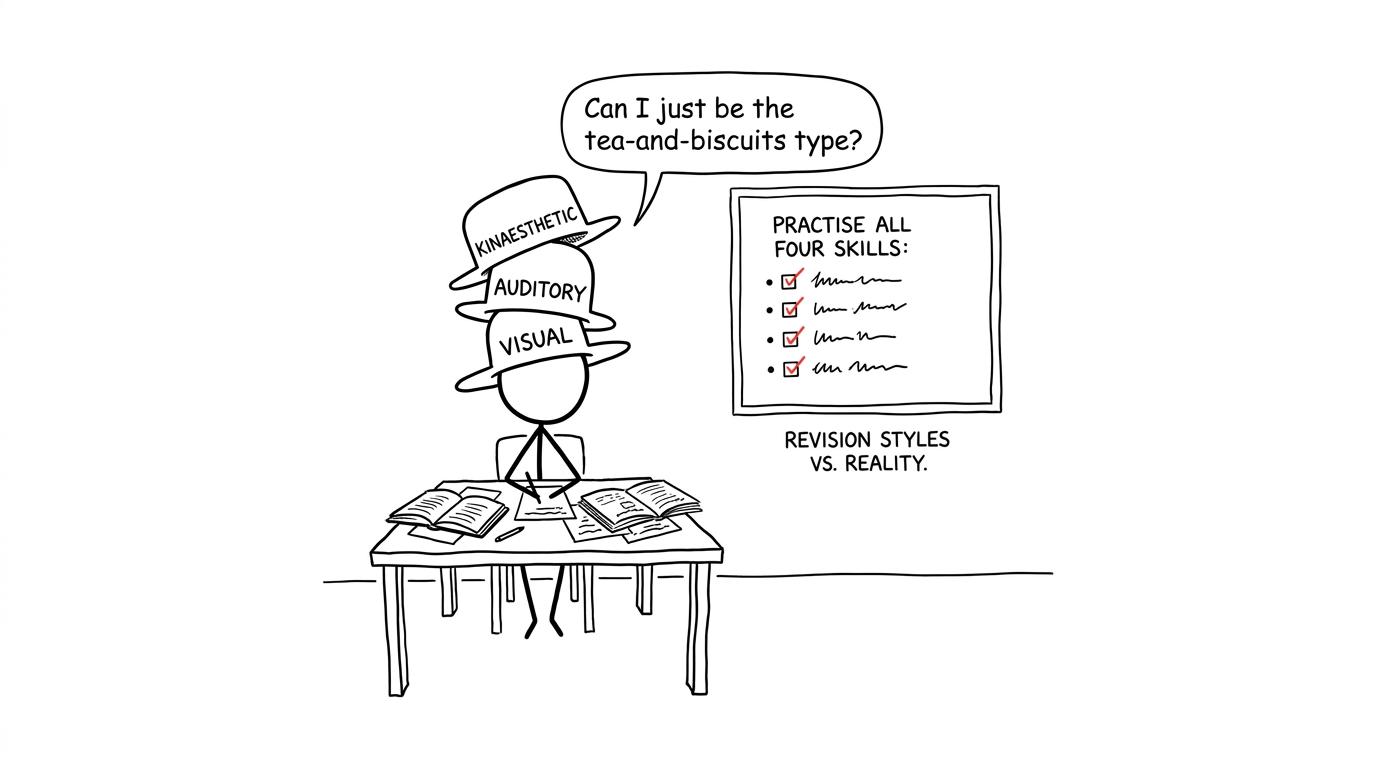 A student wearing three learning-style hats beside a checklist encouraging practice across every skill
What people mean by learning styles
The popular learning-styles idea suggests that people belong to categories such as visual, auditory or kinaesthetic learners. Its stronger claim is not merely that students have preferences. It is that learning improves when teaching is matched to the preferred category: diagrams for a visual learner, recordings for an auditory learner or physical activity for a kinaesthetic learner.
Those are different claims.
You may genuinely prefer attractive diagrams or spoken explanations. A preference can affect attention, confidence and willingness to begin. It does not follow that this is the only, or even the most effective, way for you to learn everything.
The important research question is whether students identified as different types perform better when the presentation method is matched to their supposed style. This is sometimes called the matching or meshing hypothesis.
What the evidence actually shows
The Education Endowment Foundation says there is very limited evidence for consistent learning styles that can reliably identify pupils' learning needs. It also warns that assigning learners to fixed categories can be unhelpful. Students are unlikely to possess one style that applies across every task and situation.
Major research reviews have reached a similar conclusion. Well-designed tests of the matching hypothesis need to identify students' supposed styles, assign them to matched and unmatched methods, and then compare everyone using the same assessment. The expected pattern, each group benefiting specifically from its matching method, has not been demonstrated reliably.
A 2024 meta-analysis did report a small average benefit across the studies it included. However, evidence of the particular crossover pattern required to support matching appeared infrequently, study quality was low, and the authors concluded that the effects were too small and inconsistent to justify widespread adoption. That nuance matters: research rarely fits neatly into a slogan, but it still does not give students a good reason to organise GCSE revision around fixed VAK labels.
This does not mean that diagrams, audio and movement are useless. It means their value depends mainly on the content and task, not on a permanent identity assigned to the learner.
Why GCSE Bengali requires more than one mode
For the current AQA GCSE Bengali specification, students complete listening, speaking, reading and writing assessments. Each contributes a distinct part of the qualification. The course has foundation tier, covering grades 111 to 555, and higher tier, covering grades 444 to 999. All four assessments must be taken at the same tier and in the same series.
That structure makes a one-style strategy especially limiting.
Listening needs purposeful listening
Listening practice should train you to recognise meaning from spoken Bengali. Begin without a transcript, note what you understand and listen again for missed detail. A transcript can help afterwards, but reading it first changes the task into reading practice.
An auditory preference is not required. Everyone sitting the listening paper must build this skill.
Speaking needs retrieval under pressure
Reading a prepared answer silently may improve familiarity, but it cannot fully prepare you to pronounce words, respond spontaneously or recover when a question is phrased differently. Speak aloud, record short responses and ask a teacher or fluent speaker for precise feedback where possible.
The goal is not to sound rehearsed. It is to retrieve useful language while communicating clearly.
Reading needs unfamiliar texts
A beautifully highlighted text can support analysis, but the examination requires you to understand language that is not already colour-coded. Practise identifying key details, opinions, time references and unfamiliar words from context before checking support materials.
Writing needs independent production
Copying a model answer can show you what strong writing looks like. It does not prove that you can produce accurate Bengali independently. Close the model, respond to a prompt from memory and then compare your work with the original, marking guidance or teacher feedback.
The mode should follow the examined skill. That is task-matched revision, not learning-style matching.
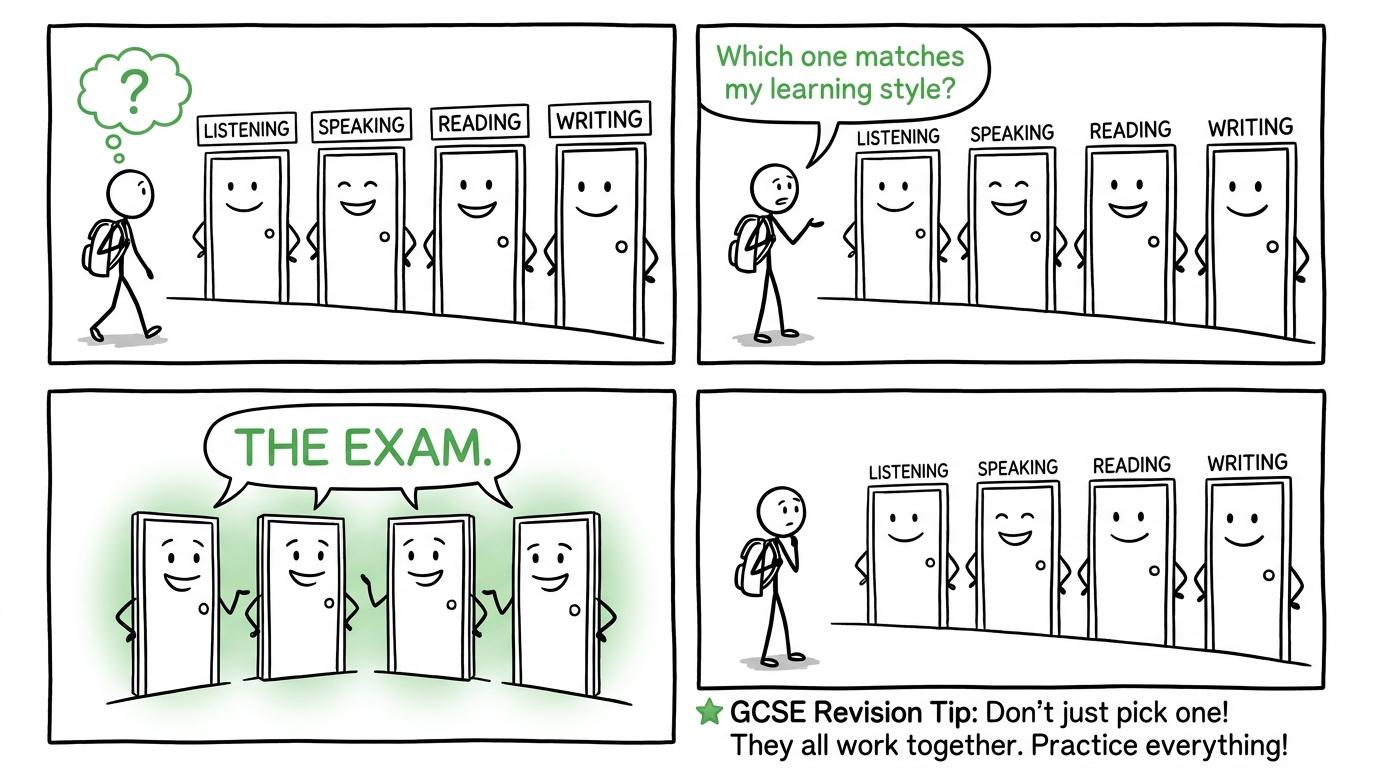 Four examination-skill doors reminding a student that every skill matters
Revision methods that matter more than labels
Once the learning-style question is set aside, revision becomes more practical. You can judge a method by whether it creates durable, usable knowledge.
Use retrieval practice
Retrieval means attempting to recall something before looking at the answer. For Bengali, that could involve recalling vocabulary from a prompt, giving a spoken response without a script or planning a written answer with notes closed.
Retrieval can feel harder than rereading because it exposes gaps. That discomfort is useful information. The same principle applies when you turn GCSE maths notes into active recall: the attempt reveals what your notes had been remembering for you.
Space revision across time
Instead of revising a vocabulary set once for a long period, return to it on different days. Keep difficult items in circulation while allowing secure material to appear less frequently. A missed word should become a future prompt, not merely a red mark.
Spacing also helps when Bengali is competing with maths, science and other GCSE subjects. MathsGenie's one-month GCSE maths revision plan demonstrates how short retrieval, focused practice and regular testing can fit into a wider timetable.
Mix closely related skills
A revision session can connect skills without confusing them. You might listen to a short passage, summarise its message aloud and later write a brief response. The benefit comes from processing and producing the language in different ways, not from satisfying three learning-style categories.
Keep the assessment conditions clear. Listening with subtitles is not equivalent to listening unaided, and speaking from a complete script is not spontaneous speaking.
Seek corrective feedback
Practice only helps if errors are noticed and repaired. Check vocabulary precisely, ask why a grammatical form needs changing and keep a short error log. Sort errors into useful categories such as vocabulary, script accuracy, tense, agreement, comprehension or incomplete development.
Maths students can use exactly this diagnostic mindset with the guide to finding weak GCSE topics quickly. A weakness becomes manageable once it is specific enough to practise.
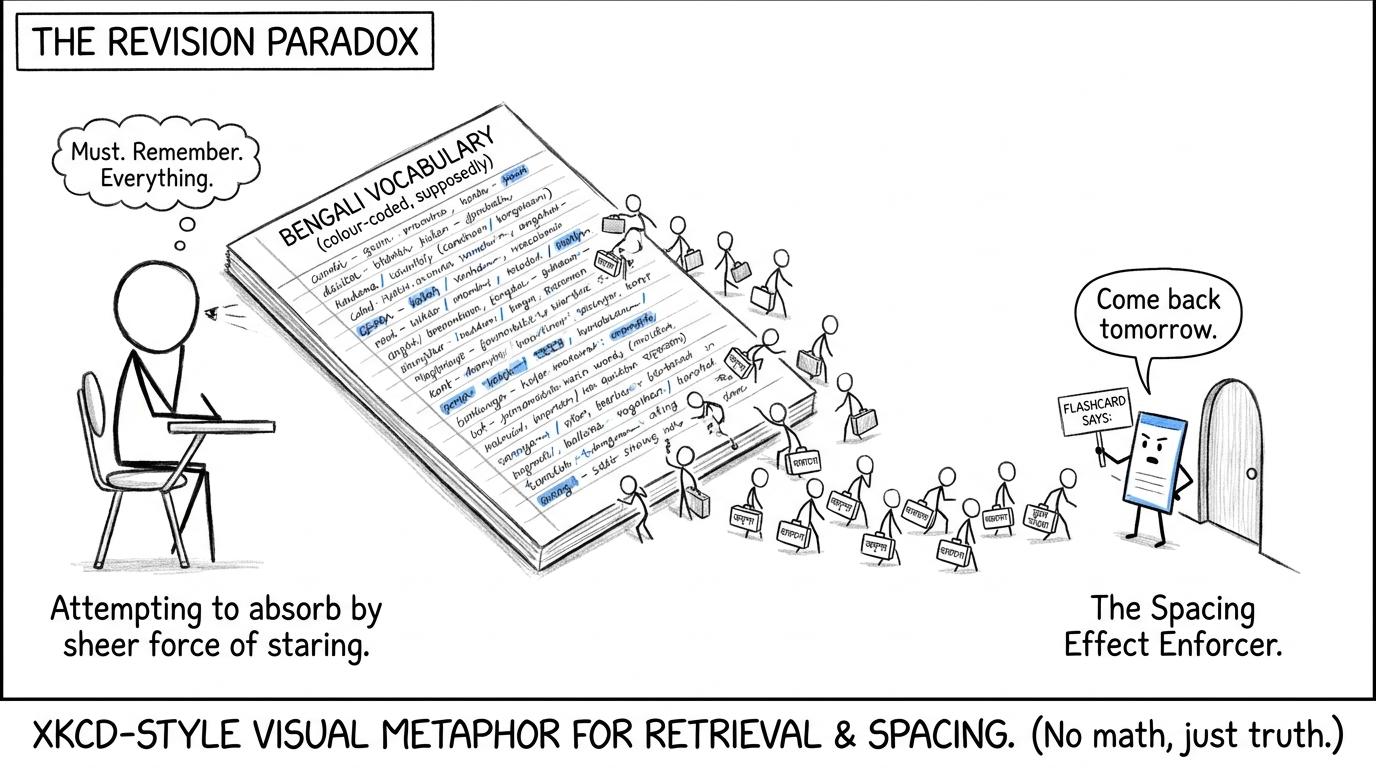 Forgotten vocabulary trying to escape while a flashcard schedules its return
A balanced weekly approach for Bengali and maths
Students preparing for GCSE Bengali are rarely revising only one subject. The danger is allowing the subject that feels easiest to organise to consume the timetable.
Use a simple cycle:
- Diagnose: complete a short Bengali task and a short maths test without notes.
- Select: choose one language weakness and one maths weakness.
- Repair: use focused instruction and targeted questions.
- Retrieve: attempt the material again without support.
- Apply: complete an unfamiliar or timed task.
- Review: record the error and schedule another attempt.
For maths, short tests such as GCSE Target Tests can provide a manageable diagnostic starting point. As confidence develops, use board-specific material such as Edexcel GCSE Maths past papers or AQA GCSE Maths past papers.
This routine respects preference without being controlled by it. You can begin with the format that helps you engage, but you still finish with the kind of independent performance the assessment demands.
Common mistakes with learning styles and Bengali revision
Treating a preference as a permanent limit
Saying “I am not an auditory learner” can become permission to avoid listening. Yet listening improves through structured listening practice. A current weakness is not a fixed identity.
Making resources instead of retrieving knowledge
Flashcards, mind maps and recordings are resources, not results. Their value appears when you use them to answer, recall, speak or write without immediate support.
Choosing variety without purpose
Using audio, pictures and movement may make a session lively, but variety alone does not guarantee learning. Ask what each activity makes you retrieve or practise.
Avoiding uncomfortable exam skills
Students naturally return to activities that feel fluent. Someone who enjoys reading may neglect speaking; someone confident in conversation may avoid accurate writing. Allocate revision according to evidence from marked work, not comfort.
Confusing recognition with recall
Recognising a Bengali word on a page is easier than producing it independently. Test both directions where appropriate and place vocabulary inside meaningful phrases or responses.
Using predicted material as certainty
No predicted paper can guarantee exact examination content. In maths, predicted papers are best used as fresh assessment practice after topic revision, while official papers show authentic board style. The same caution applies to topic predictions in any GCSE subject.
Revise for the task, not the label
Learning preferences can make revision more pleasant, and that matters when they help you start. But the evidence does not support confining GCSE Bengali revision to a visual, auditory or kinaesthetic identity. A stronger plan trains all four assessed skills through retrieval, spacing, purposeful practice, correction and realistic testing.
Carry that principle into maths. Start with the free MathsGenie GCSE Maths Revision hub, use revision lessons and practice questions to repair individual gaps, then test your progress with mini tests, past papers and predicted papers. Mark schemes and video solutions show where methods need to change.
The most useful revision method is not the one that resembles your label. It is the one that leaves you able to perform when the notes are closed and the paper begins.