Should You Keep Revising After Your GCSE Resit?
Keep revising after GCSE resit exams with a light routine until January. Protect your progress and create a sensible summer 2027 backup plan.
Finishing a November resit brings a peculiar kind of relief. The exam is over, but the result is not yet known. You may feel hopeful, exhausted, uncertain, or all three within the same afternoon.
So, should you keep revising after GCSE resit exams? Yes, but lightly. You do not need to continue at full exam-season intensity. A short weekly routine until results day can preserve the knowledge you have built, reduce anxiety and leave you with a summer resit backup plan if the result is not what you need.
Think of it as keeping the engine warm, not driving at full speed.
The short answer
Between the November exam and January results, aim to:
- rest properly during the first week after your final paper;
- complete two short revision sessions each week;
- maintain both GCSE Maths and English Language skills;
- correct familiar weaknesses rather than learning everything again;
- wait for your confirmed result before beginning serious summer preparation.
The November series is available for GCSE Maths and English Language to eligible students aged 161616 or over. Results for the November 2026 AQA series are scheduled for 121212 January 2027. Your school or college should confirm when and how you will receive your own results, particularly if you sat another exam board.
That creates a waiting period of several weeks. Doing nothing is tempting, but a small amount of purposeful work is usually the safer choice.
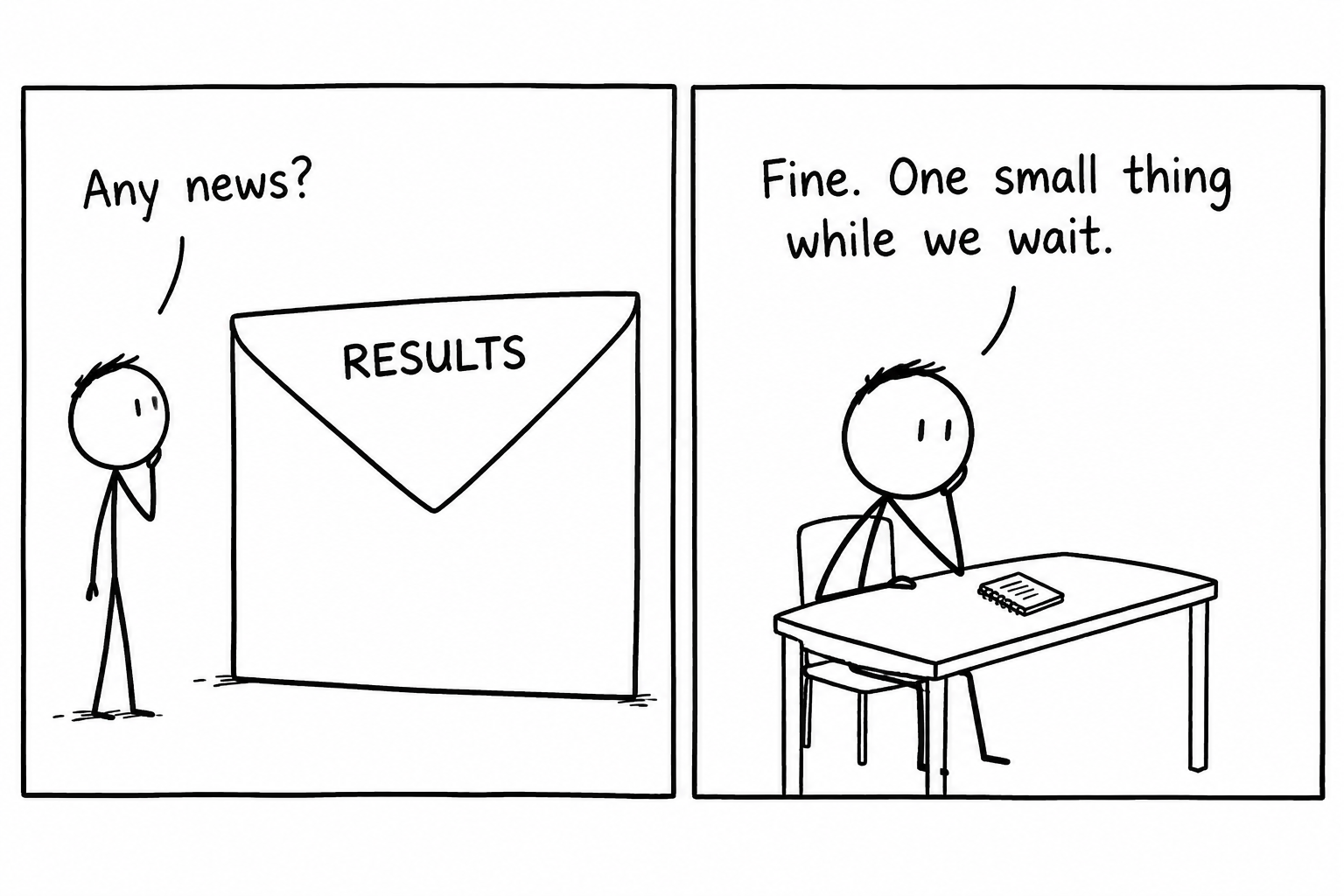 A student calmly keeps a tiny revision notebook while waiting for an enormous silent results envelope
Why light revision is worth continuing
Revision has a hidden cost: restarting.
When a method or skill is still familiar, practising it takes relatively little effort. After a long break, the first task is often remembering what you once knew. That is why short sessions can matter even when you are reasonably confident about passing.
Continued revision also protects you against uncertainty. You cannot change the paper you have submitted, but you can control whether your skills fade while you wait. This is particularly useful when a grade 444 matters for your course, apprenticeship or next step.
There is an emotional benefit too. Waiting can encourage you to replay difficult questions and estimate marks without enough information. A modest routine gives that nervous energy somewhere useful to go. It is preparation, not a prediction that you have failed.
A low-effort routine until January
The right plan should be small enough to survive busy weeks. Aim for two sessions of 252525 minutes, with one optional catch-up session. That is only 505050 minutes of planned revision each week.
| Session | GCSE Maths | GCSE English Language |
|---|---|---|
| First 252525 minutes | Answer a short set of mixed questions | Read one article or extract and identify the writer's main ideas |
| Second 252525 minutes | Revisit one weak topic and check the mark scheme | Plan one response or write one focused paragraph |
| Optional 202020 minutes | Correct mistakes from the week | Improve an earlier paragraph using feedback |
Use the free MathsGenie revision planner to give these sessions a fixed place in your week. Keep the plan deliberately modest. If it begins to resemble your pre-exam timetable, reduce it.
What to practise for GCSE Maths
Start with the mistakes that followed you into the resit. Perhaps fractions still slow you down, equations become confusing under pressure, or you lose marks by missing units and showing too little working.
The GCSE Maths revision hub lets you choose your exam board and reach relevant revision materials, past papers and mark schemes. Edexcel students can use the grade-by-grade Edexcel revision lessons to target an appropriate level rather than wandering through the whole specification.
A sensible session has three parts:
- spend about 555 minutes recalling a method;
- spend about 151515 minutes answering questions without notes;
- spend about 555 minutes marking and correcting your work.
If you are targeting grade 444, focus first on secure foundation and crossover skills. The Edexcel GCSE Maths question bank is useful for focused practice, while the GCSE Maths exam booklets can help you practise groups of exam-style questions.
Do not complete a full paper every weekend. That creates more work than this waiting period requires. Save full papers and predicted papers for later if summer preparation becomes necessary.
What to practise for English Language
English Language benefits from continuity too. You can maintain useful skills without repeatedly writing complete papers.
Read a quality news article, essay or non-fiction extract and ask:
- What is the writer trying to communicate?
- How is the piece structured?
- Which words create a particular tone?
- What evidence would support my interpretation?
On another day, plan a creative or transactional response. Write an opening, one developed paragraph or a conclusion. Concentrate on clear communication, paragraphing, vocabulary, sentence control and accurate punctuation.
Use materials supplied by your teacher or college and check that tasks match your exam board's specification. English Language papers are not identical across Edexcel, AQA, OCR and Eduqas, so generic practice should not replace board-specific questions and mark schemes.
Revising before results without burning out
The purpose of revising before results is maintenance. It is not punishment for feeling uncertain.
Choose predictable days and stop when the session ends. Keep one short record containing:
- the task completed;
- one thing you did well;
- one mistake to revisit;
- the next small action.
This record prevents every session from becoming a fresh decision. It also gives you useful evidence if you need to speak to a teacher after results day.
Rest remains part of the plan. Continue with your course, work, hobbies and sleep. Missing one optional session does not undo your progress. Consistency is built by returning, not by being perfect.
Building a summer 2027 backup plan
A backup plan should exist quietly in the background. You do not need to assume that another resit will be necessary.
Before January, check four practical details with your school, college or exam centre:
- who will give you your result;
- what grade you need for your next step;
- who to contact if you want to discuss the result;
- how a summer 2027 entry would be arranged if required.
If you receive the grade you need, you can stop resit preparation and move forward. If you do not, you will not be restarting from nothing. Your notes, corrections and weekly practice will show where to begin.
At that point, increase revision gradually. Use revision lessons to rebuild understanding, practice questions and mini tests to check individual skills, then timed past papers to develop stamina. Mark every paper carefully. A mark scheme is most useful when it changes what you do next.
For Maths, begin from the main GCSE subjects and resources page, then select your board and tier. Foundation and higher papers overlap in some content, but your summer plan must reflect the tier entered by your centre.
Common mistakes after a November resit
Stopping completely because the paper felt good
A good feeling is encouraging, but it cannot confirm a grade. Maintain a small routine until the official result arrives.
Revising as though the next exam is tomorrow
Full papers, long evenings and constant checking are unnecessary now. Light maintenance should leave room for recovery.
Only practising favourite topics
Comfortable work feels productive but may avoid the skills costing you marks. Include one weak area each week.
Treating every mistake as evidence of failure
A mistake in December is useful information. Correct it, note the lesson and continue. It says nothing certain about your November result.
Making plans from remembered marks
Unofficial mark estimates can be unreliable. Wait for the confirmed grade, then ask your centre about appropriate next steps and any available post-results options.
Keep the next step small
The weeks after a resit can feel suspended between two possible futures. One contains the grade you need. The other may contain another attempt in summer 2027. You do not yet know which path is yours, and you do not need to behave as though the worse outcome is certain.
Keep revising, but keep it light: two short sessions each week, one weakness at a time, followed by honest marking. Then let January's confirmed result determine the scale of your next plan.
Start with the free MathsGenie GCSE Maths resources, choose a focused lesson or question set, and add your next session to the MathsGenie revision planner. A small routine now preserves your progress and keeps every option open.