

Is the EBacc Ending? What Parents Need to Know
Is the EBacc ending? Get a clear answer on England’s policy change, what GCSE maths reforms mean for your child, and which specification to revise now.
Yes, the EBacc is ending as a school performance measure in England, with removal taking effect for the 2025-2026 academic year. If you are asking “is the EBacc ending?”, that is the straight answer. It does not mean GCSE maths is being abolished or that your child should switch to a new maths syllabus.
Policy update: October 2026. Review annually and when further GCSE reform arrangements are confirmed.
Imagine a parent reading a headline about the EBacc being scrapped, then another about a new curriculum. A reasonable question becomes an anxious one: is my child revising for exams that are about to change?
The useful distinction is between how schools are measured, what children are taught and which qualification they take. These changes have different timetables.
The parent’s quick checklist
- The EBacc is a school performance measure, not a separate qualification.
- Removing it does not remove the GCSE subjects within it.
- Wider curriculum and GCSE reforms follow a later timetable.
- Your child should revise the specification their school confirms for their examination year.
What exactly is ending?
The English Baccalaureate measures entry and achievement across a combination of GCSE subjects: English, maths, sciences, history or geography, and a language.
A child takes individual GCSEs within that combination. They do not sit an additional EBacc examination. “Scrapping the EBacc” can sound like cancelling a qualification, but the decision concerns school accountability.
The independent Curriculum and Assessment Review’s final report, published in November 2025, recommended removing the EBacc performance measures. It argued that they constrained subject choice and were no longer working as intended.
The Department for Education accepted that recommendation. Its November 2025 response stated that EBacc headline and additional measures would be removed for the 2025-2026 academic year, with corresponding performance information published in autumn 2026.
This is an announced government decision, rather than simply a Review proposal.
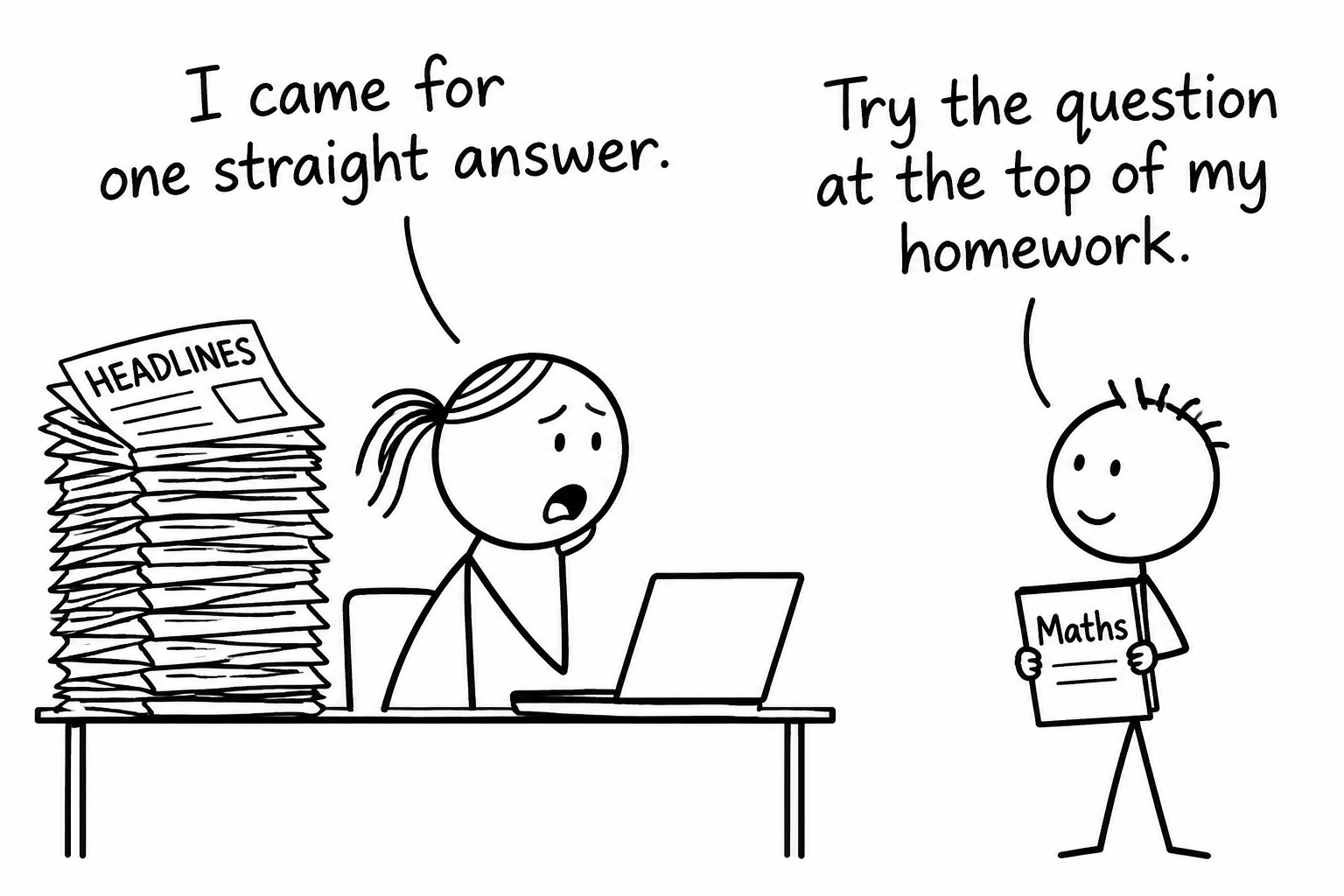 A stick-figure parent overwhelmed by education headlines while their child holds a maths exercise book
Does this change GCSE subject choices?
Potentially, it changes one influence on how schools organise their options. It does not guarantee an immediate expansion of subjects at your child’s school.
Removing the measure gives schools a different accountability context, but your starting point remains the school’s published options and advice. Three questions are useful:
- Which subjects suit your child’s interests, strengths and possible next steps?
- Which combinations can the school timetable?
- Are particular subjects required for a course they may want to take later?
Avoid treating the change as advice to drop a language or humanities subject. Equally, the old EBacc combination should not be mistaken for a separate certificate every child must obtain.
The government also proposed changes to Progress 8 and Attainment 8. Those accountability measures are a separate issue: removing the EBacc does not tell you how every other measure will operate.
Are GCSE maths changes happening at the same time?
The EBacc decision and wider GCSE reform belong to the same policy discussion, but have different implementation dates.
The government’s November 2025 response set out a revised national curriculum for first teaching in September 2028. It also planned updated GCSEs in phases, with first teaching from September 2029 and September 2030.
These are first-teaching dates, not dates when every pupil takes a replacement examination. Do not read “new curriculum in 2028” as “all GCSE maths exams change in 2028”. Those broad dates should not be presented as a confirmed subject-specific launch date for new GCSE maths.
MathsGenie’s GCSE maths topics by exam board and tier provides a useful reference for current content. Your school should confirm which specification applies to your child’s cohort.
One separate maths change parents should understand
Formulae sheets illustrate why reading beyond the headline matters.
Ofqual’s published decision confirms formulae sheets for GCSE maths for the lifetime of the current specifications, including arrangements from 2028 onwards. This followed the DfE’s February 2026 decision to change its expectations about memorising formulae under those specifications.
That is an assessment arrangement within current qualifications, not evidence that a new GCSE maths course has replaced them.
Your child still needs to recognise when a formula applies and use it correctly. A sheet cannot do that thinking for them.
A workable plan for your child now
First, ask the school to confirm your child’s exam board, examination year, specification and foundation or higher tier. Keep these details together so future announcements can be checked against the right course.
Second, use classwork or teacher feedback to identify topics needing attention. The GCSE maths revision hub helps you locate resources, while the OCR GCSE maths page offers a board-specific starting point.
Third, choose one topic at a time. Revisit the explanation, attempt questions independently and return to errors later. MathsGenie’s guidance on the order to learn GCSE maths topics explains how earlier skills support later work.
A parent does not need to predict every reform to help a child make progress this week.
Common mistakes when reading reform headlines
Confusing England with the whole UK. This EBacc decision concerns England. Do not automatically apply its timetable to qualifications elsewhere in the UK.
Assuming immediate timetable changes. Ask what will change for your child’s year group, rather than assuming an announcement rewrites this term’s options.
Buying “new GCSE maths” resources without checking. A clear match to your child’s specification matters more than a current-looking cover.
Waiting for reform before addressing difficulties. Fractions or algebra problems deserve attention now. Future announcements cannot resolve today’s misunderstanding.
Help your child focus on their current course
Ending the EBacc measure and changing GCSE maths are separate processes. Turn that clarity into focused revision: start with Maths Genie Lessons for your child’s current specification and choose the topic they need help with next.















