

Is GCSE German Worth It? Honest Pros and Cons
Is GCSE German worth it? Explore the benefits, workload, exam format and drawbacks, plus how to balance German with GCSE maths revision effectively.
Choosing GCSE options can feel strangely permanent. One form asks you to predict what your future self will enjoy, what universities might value and how much revision you can manage two years from now.
So, is GCSE German worth it? For many students, yes, particularly if you enjoy languages, are prepared to practise regularly and want a subject that develops communication as well as memory. It can support progression to A Level German, contribute to the English Baccalaureate subject combination in England and complement careers involving international communication. But it is not automatically the right choice. German requires consistent vocabulary, grammar, listening and speaking practice, and choosing it purely because it “looks good” can lead to an unhappy two years.
The best decision is not the most impressive-looking one. It is the one that fits your interests, strengths and realistic workload.
GCSE German decision checklist
Before choosing, ask yourself:
- Do I enjoy understanding how language works?
- Am I willing to learn vocabulary in short, regular sessions?
- Can I tolerate making mistakes while speaking?
- Have I looked at the specification used by my school?
- Would German support an A Level, degree or career I may consider?
- Can I fit it around compulsory subjects, especially maths, English and science?
- Am I choosing it for myself rather than following friends?
You do not need to answer yes to everything. However, if your honest response is no to most of the list, another option may suit you better.
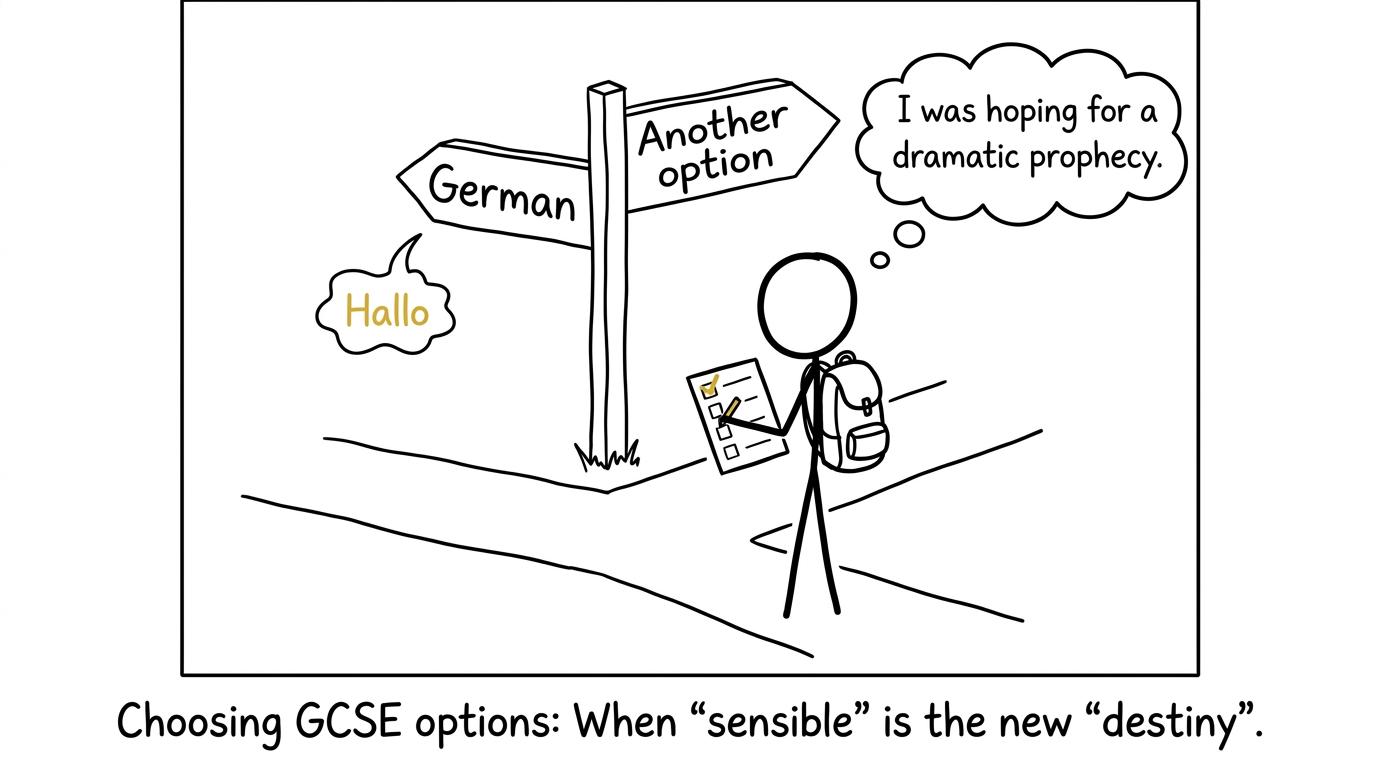 A student waiting for a dramatic prophecy at the GCSE options crossroads
What does GCSE German actually involve?
GCSE German is not simply a vocabulary test. You develop four connected skills: listening, speaking, reading and writing. Translation, pronunciation, grammar and accurate communication also matter.
For students in England following the revised French, German and Spanish GCSE subject content, first taught from September 2024 and first assessed in summer 2026, qualifications use defined vocabulary and grammar content. Current AQA and Pearson Edexcel specifications assess speaking, listening, reading and writing in separate components, with each component contributing one quarter of the qualification. They offer foundation and higher tiers, and students take the same tier across the qualification.
Exact tasks, timings and arrangements depend on your exam board and cohort. Schools may use AQA, Pearson Edexcel or another available specification, while qualifications and arrangements in Wales can differ. OCR is a familiar GCSE maths board, but you should not assume your German board is the same as your maths board. Ask your teacher for the qualification name and specification code before comparing courses.
Modern assessments can include activities such as reading aloud, role-play, conversations based on visual material, dictation and translation. This variety is either a benefit or a drawback, depending on how you prefer to demonstrate knowledge.
The honest advantages of taking GCSE German
It develops a genuinely different skill
Maths often asks you to communicate through logical steps and precise notation. German asks you to communicate meaning through vocabulary, grammar, pronunciation and context. The subjects feel different, but both reward patterns, careful checking and regular practice.
If you like systems, German grammar may be more appealing than you expect. Word order, verb forms and cases follow structures. They are not always simple, but they are learnable. Students who enjoy spotting patterns in algebra can sometimes appreciate the same sense of order in language.
It keeps language study open
GCSE German provides a route towards A Level German and language-related university courses. It may also complement subjects such as history, business, politics, engineering or economics.
That does not mean one GCSE determines your career. It does mean that stopping German at Key Stage 3 may make restarting later more difficult. If you think there is a reasonable chance you will want to continue, taking the GCSE preserves that option.
It counts towards the EBacc in England
The English Baccalaureate is a school performance measure covering English, maths, sciences, history or geography, and a language. German can satisfy its language element.
The EBacc is not a separate qualification, and completing it is not a universal university entry requirement. Its relevance also differs outside England. Treat it as one consideration rather than the entire reason for choosing German.
It can add breadth to a technical subject combination
A timetable containing maths, science and computing may be strong but heavily technical. German introduces conversation, culture and extended communication. That breadth can make your week more varied.
It can also demonstrate that you are willing to develop a skill over time. Still, no subject title compensates for poor engagement. A well-chosen option in which you can work consistently is usually more useful than a supposedly prestigious option you dislike.
The honest drawbacks of GCSE German
The workload is continuous
German is difficult to rescue through one large revision session. Vocabulary fades when it is not retrieved, listening becomes less familiar without exposure, and speaking needs rehearsal.
The workload does not have to mean hours every evening. It does mean returning frequently. A short session completed several times a week is generally more sensible than waiting until the night before a test.
This matters when maths also needs sustained practice. The GCSE maths revision hub helps reduce planning time by putting revision lessons, questions and exam-board resources together, but you still need enough space in your timetable for both subjects.
Speaking can feel uncomfortable
Some students enjoy conversation. Others find being assessed aloud more stressful than sitting a written paper. Preparation makes speaking more manageable, but it cannot remove the need to speak.
Ask yourself whether this is ordinary nervousness or a serious barrier. Being slightly uncomfortable can be part of learning. Persistent anxiety that affects your wellbeing deserves a conversation with your teacher about support and assessment arrangements.
Accuracy matters
German involves details that English speakers may not use in the same way: noun gender, cases, verb position and adjective endings. Higher-tier responses also demand a broader and more flexible command of language.
You do not need flawless German. You do need to accept correction and revisit mistakes. If you strongly dislike learning vocabulary or checking grammatical detail, the course may feel laborious.
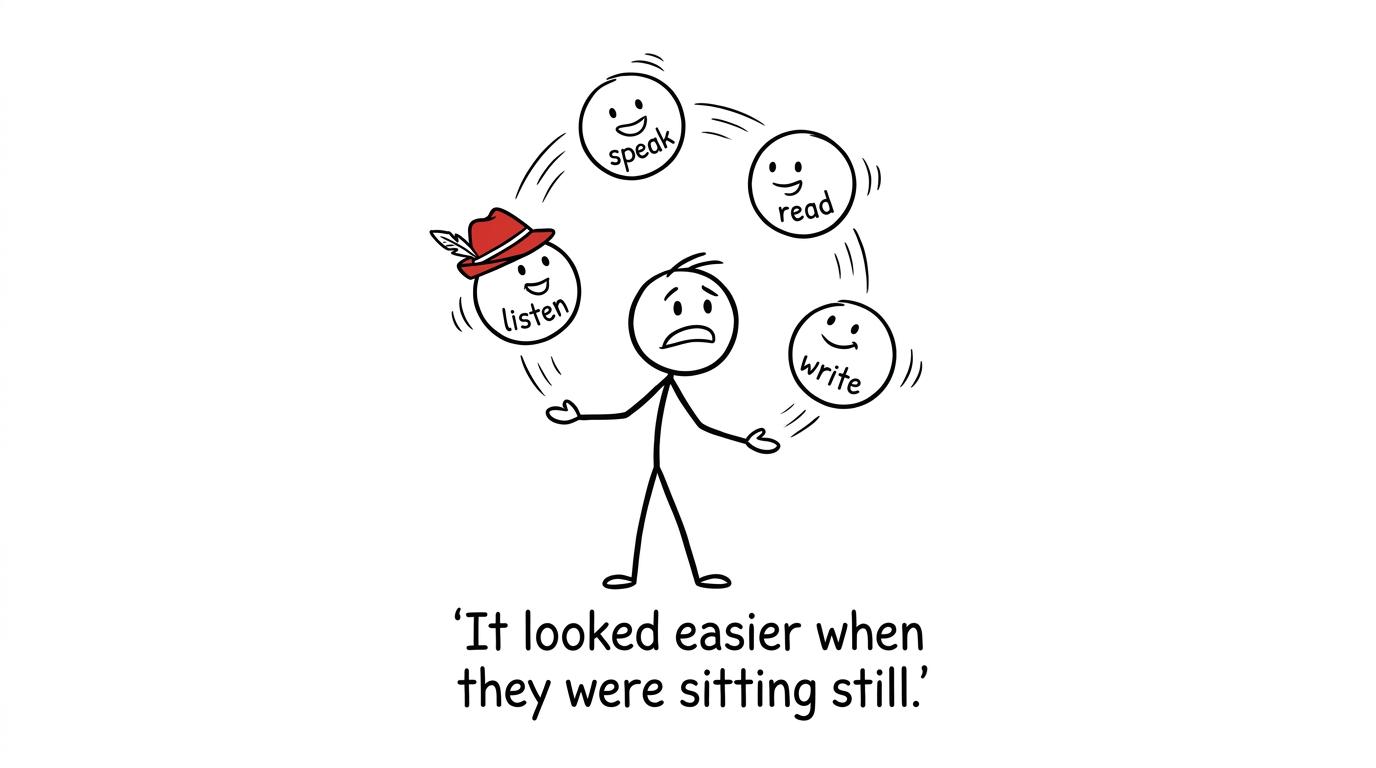 A student juggling the four GCSE German skills
How much work does GCSE German really take?
There is no honest universal number of hours. Your starting point, school timetable, target grade and exam board all affect the answer. A student already comfortable with Key Stage 3 vocabulary will need a different plan from someone rebuilding the basics.
A realistic routine might include:
- short vocabulary retrieval on several days;
- one grammar or writing task;
- regular listening practice;
- brief speaking rehearsal;
- immediate correction using teacher feedback or mark criteria.
The important word is regular. German rewards accumulated familiarity. Ten calm encounters with vocabulary are more useful than one heroic attempt to memorise an entire unit.
The same principle protects your maths grade. A 20-minute maths revision routine can keep maths moving on days when German homework is heavier. For a broader plan, use the GCSE maths revision timetable guide or build towards exams with the one-month maths revision plan.
How to decide whether German suits you
Look at evidence, not one recent lesson
A difficult vocabulary test can make German look impossible. An entertaining lesson can make it look effortless. Neither is enough evidence.
Review your performance across a term. Which tasks do you enjoy? Where are you improving? What does your teacher think your strengths are? If possible, inspect sample assessment materials from the exact specification your school teaches.
Compare the real alternatives
Do not compare German with an imaginary subject requiring no work. Compare it with the actual options available at your school, including their assessment styles and content.
You might prefer coursework, performance, practical work or written examinations. The better question is not “Which GCSE is easiest?” but “Which type of difficulty am I most willing to practise?”
Test your timetable
Sketch a normal week containing lessons, homework, activities and rest. Add short German sessions without removing maths practice or sleep. If the plan only works when every day goes perfectly, it is too fragile.
Use the guide to finding weak GCSE topics to keep maths revision targeted rather than endlessly expanding. When paper practice begins, the guide to using past papers properly will help you turn lost marks into specific actions.
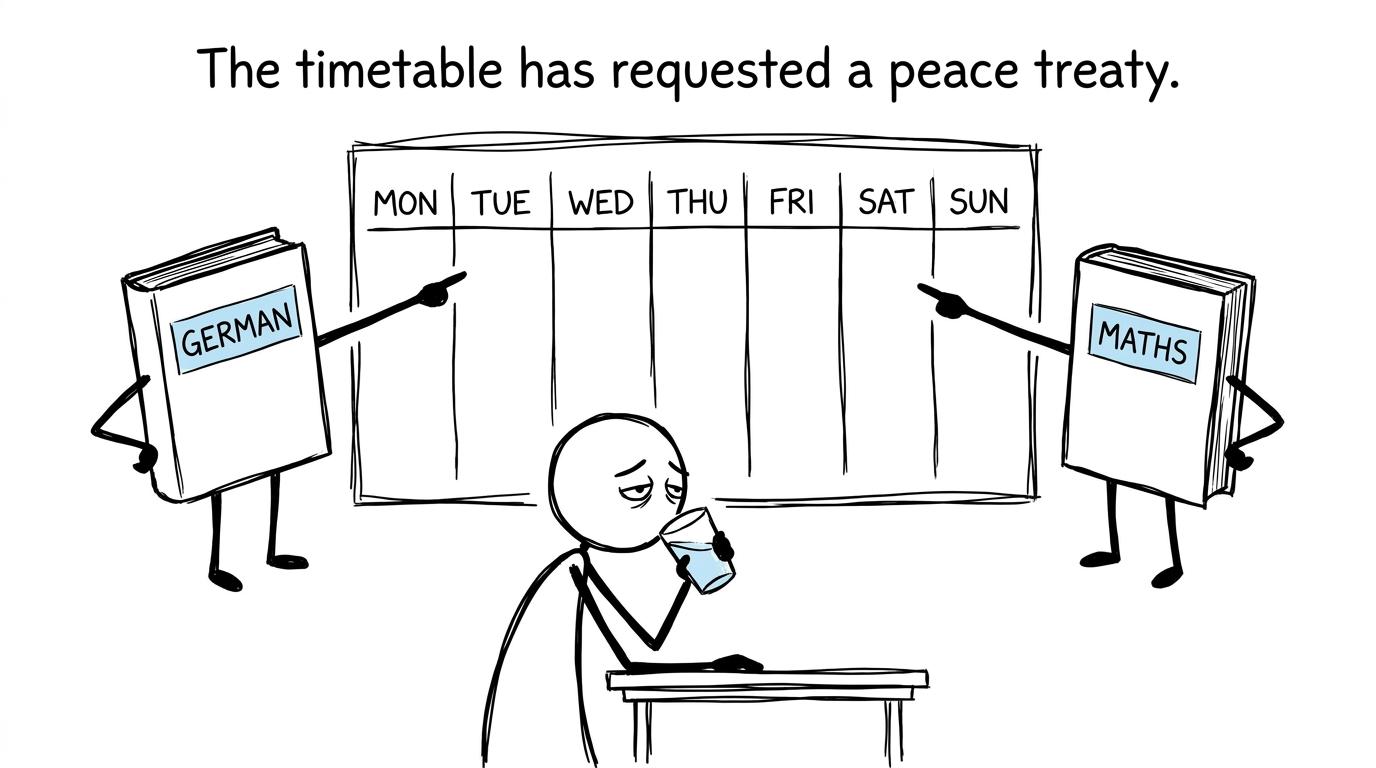 German and maths books negotiating over a revision timetable
Common mistakes when choosing GCSE German
Choosing it only because friends are taking it
Classes and timetables can change. Your friend will not complete your vocabulary practice or speaking assessment. Friendship is a pleasant bonus, not a selection criterion.
Assuming it guarantees university admission
German may strengthen a broad academic programme and is essential for some language pathways, but requirements vary by institution and course. Check current entry requirements when the time comes rather than relying on general claims.
Believing you must already be fluent
GCSE German is designed for learners. You are assessed on the course content, not against native speakers. A strong foundation helps, but fluency is not an entry condition.
Ignoring the speaking component
Students sometimes choose a language because they enjoy written exercises, then postpone speaking practice. Treat speaking as a weekly skill from the beginning rather than a performance to prepare at the last moment.
Letting German crowd out compulsory subjects
German should sit within a balanced plan. If maths is slipping, use focused Edexcel GCSE maths past papers when that is your board, or select the correct board and tier through the main revision hub. Mark work promptly and repair only the topics that cost you marks.
So, is GCSE German worth taking?
GCSE German is worth taking if you have some interest in the language, accept the need for steady practice and value the options it may keep open. It is especially suitable for students who enjoy communication, patterns and learning through repetition.
It may not be worth it if you are choosing it solely for appearances, strongly dislike every form of language practice or cannot fit the workload into a healthy timetable. That is not failure. Good option choices are personal, and honesty now is more useful than resentment later.
Once you have chosen, make the rest of your GCSE workload easier to organise. Start with MathsGenie's free GCSE maths revision resources, then move from revision lessons and practice questions to mini tests, past papers and predicted papers. Use mark schemes and video solutions to correct mistakes while they are still small. German may broaden your future, but a calm, repeatable revision system is what helps you reach it.










