

Is GCSE Geography Hard? What Students Really Say
Is GCSE Geography hard? Discover what students find difficult, how exams and fieldwork work, and the revision habits that make it manageable.
A thick case-study folder can make GCSE Geography look less like one subject and more like an entire planet you have somehow agreed to memorise. Rivers, cities, tectonic hazards, ecosystems, fieldwork methods and unfamiliar maps all seem to arrive at once.
So, is GCSE Geography hard? The straight answer is that it is demanding, but usually manageable. Students commonly describe the content itself as understandable. The greater difficulty is remembering case-study evidence, applying knowledge to unfamiliar resources, writing extended answers quickly and revising a broad specification without leaving gaps.
Online student discussions are not representative surveys, so they cannot tell you how every student feels. Still, recent discussions show a consistent split: some students find Geography straightforward and enjoyable, while others feel overwhelmed by case studies, fieldwork and time pressure. That difference often comes down to interest, teaching, exam board and revision method rather than raw ability.
GCSE Geography difficulty at a glance
Before looking more closely, here is the practical verdict:
- The ideas are usually accessible: most topics build from understandable physical or human processes.
- The volume can feel heavy: several topics, named examples and fieldwork enquiries must remain available in your memory.
- Questions require application: knowing a fact is not enough if you cannot use it to interpret a map, graph or unfamiliar place.
- Extended writing matters: longer responses need a supported argument, not disconnected facts.
- There is genuine maths: specifications include numerical, graphical and statistical techniques.
- It becomes easier with question practice: retrieval and exam-style practice are more effective than repeatedly reading notes.
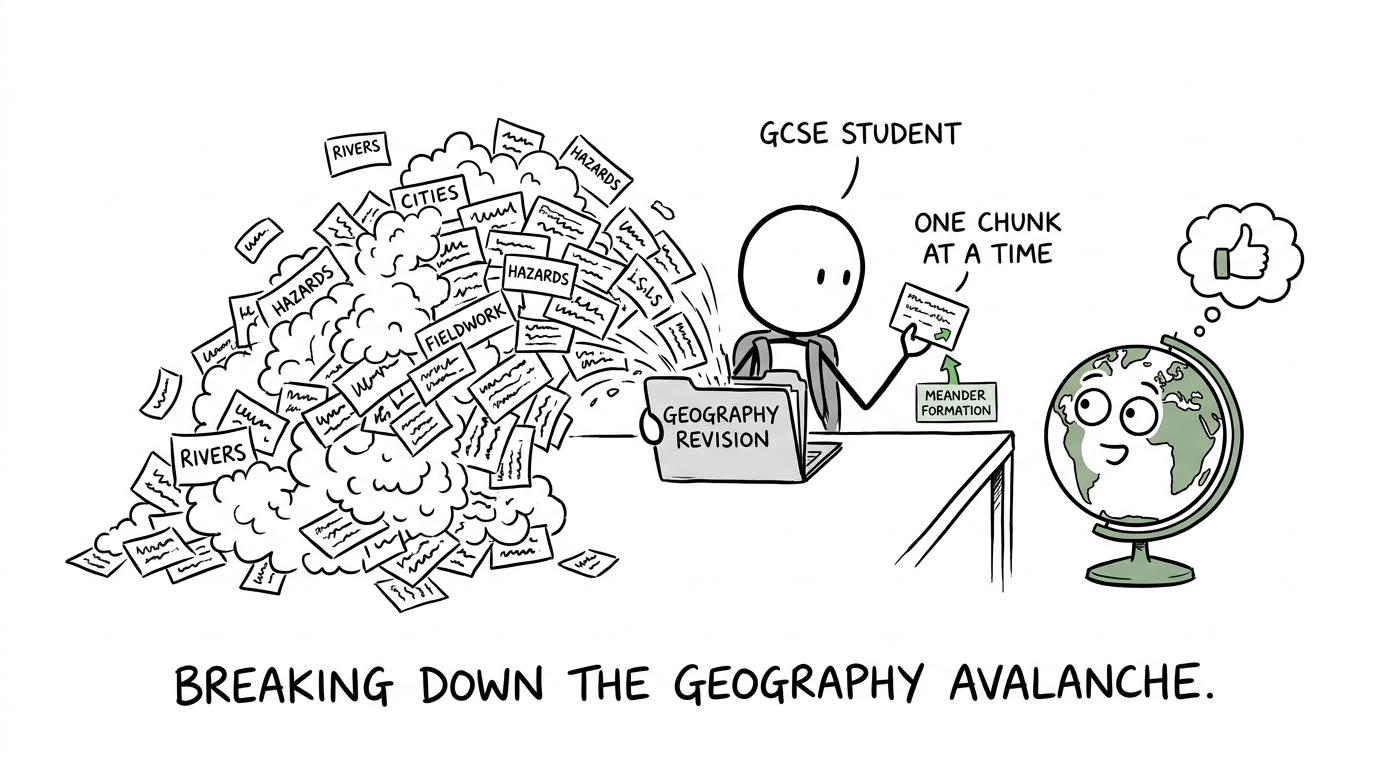 A student calmly handles one Geography topic while a revision folder releases an avalanche of topic cards
What students really find difficult
Student comments about GCSE Geography vary dramatically. That is useful in itself. A subject can feel easy to one student and exhausting to another because its difficulty is not concentrated in one skill.
Remembering a broad course
The most frequent concern in student discussions is the amount to remember, particularly named examples and case studies. Geography moves between physical processes, human decisions and real places. Students may understand coastal erosion perfectly in class but struggle to retrieve precise evidence from the correct example months later.
The solution is not to memorise every sentence in a textbook. For each required example, create a compact record containing:
- its location and geographical context;
- a few precise facts or figures;
- causes or processes;
- immediate and longer-term effects;
- responses, management or competing viewpoints;
- the questions for which the example is useful.
The final point is crucial. A remembered fact has limited value until you know where it belongs.
Applying knowledge instead of repeating it
Geography papers frequently provide maps, photographs, graphs, extracts and data. The place may be unfamiliar, but the processes are not. You are expected to combine the resource with what you know.
This is where some students say an apparently easy subject becomes less predictable. A prepared paragraph copied from memory may not answer the precise question. Strong answers select relevant knowledge, quote evidence from the resource and explain the connection.
That skill is learnable. When practising, ask three things:
- What does the command word require?
- What evidence can I extract from the resource?
- Which geographical process explains that evidence?
Writing enough, but not too much
Longer questions can create time pressure. Students sometimes know the topic but spend too long on an early response, leaving a later high-mark question unfinished.
Good extended writing is selective. Make a clear point, support it with evidence, explain why it matters and return to the judgement in the question. For an assess, evaluate or justify question, consider more than one side before reaching a supported conclusion.
Writing more does not automatically earn more marks. Relevant reasoning does.
Fieldwork and unfamiliar methods
Fieldwork is not simply a trip away from school. Official specifications assess the enquiry process: asking questions, selecting sampling methods, collecting and presenting data, reaching conclusions, and evaluating reliability.
Students often find this section difficult when they remember the location but forget why a method was chosen. Revise fieldwork as a chain of decisions rather than a travel diary. MathsGenie's AQA GCSE Geography fieldwork guide shows how an enquiry moves from its question to an evidence-based evaluation. Students following OCR can use the OCR A fieldwork skills guide.
Why some students find GCSE Geography easier
The students who describe Geography as manageable often mention that the underlying material makes sense once the main processes are understood. A river landscape is not a list of unrelated words. It is a connected system. Urban change is not merely a collection of case-study statistics. It is a story about people, investment, inequality and decisions.
Interest also matters. If you naturally notice weather, landscapes, cities or global issues, the course gives existing curiosity a structure. That does not remove revision, but it gives facts somewhere meaningful to attach.
Geography can also reward students with balanced strengths. You do not need to be purely an essay writer or purely numerical. Short responses, source interpretation, extended arguments, maps and calculations all provide different routes to marks.
How much maths is in GCSE Geography?
GCSE Geography is not an alternative maths course, but maths is part of the subject. Current specifications require geographical skills including numerical and statistical techniques, and at least 10%10\%10% of qualification marks are directed towards mathematical and statistical skills.
Depending on the specification and question, these can include:
- percentages and percentage change;
- ratio, proportion, scale and distance;
- mean, median, mode and range;
- quartiles and interquartile range;
- interpreting tables and graphs;
- scatter graphs, relationships and lines of best fit;
- population density, area and unit conversions;
- sampling, accuracy and reliability.
For example, percentage change uses:
Percentage change=new value−original valueoriginal value×100\text{Percentage change}=\frac{\text{new value}-\text{original value}}{\text{original value}}\times 100Percentage change=original valuenew value−original value×100The interquartile range is:
IQR=Q3−Q1\text{IQR}=Q_3-Q_1IQR=Q3−Q1These are not worked examples to memorise in isolation. They are tools for interpreting geographical evidence. MathsGenie's AQA numerical skills resources and statistical skills revision guide connect the calculations directly to Geography.
If the fundamentals feel uncertain, strengthen them through fractions, decimals and percentages revision. The scatter graphs revision guide is also valuable because fieldwork and geographical data questions often ask you to describe relationships, identify anomalies or make sensible estimates.
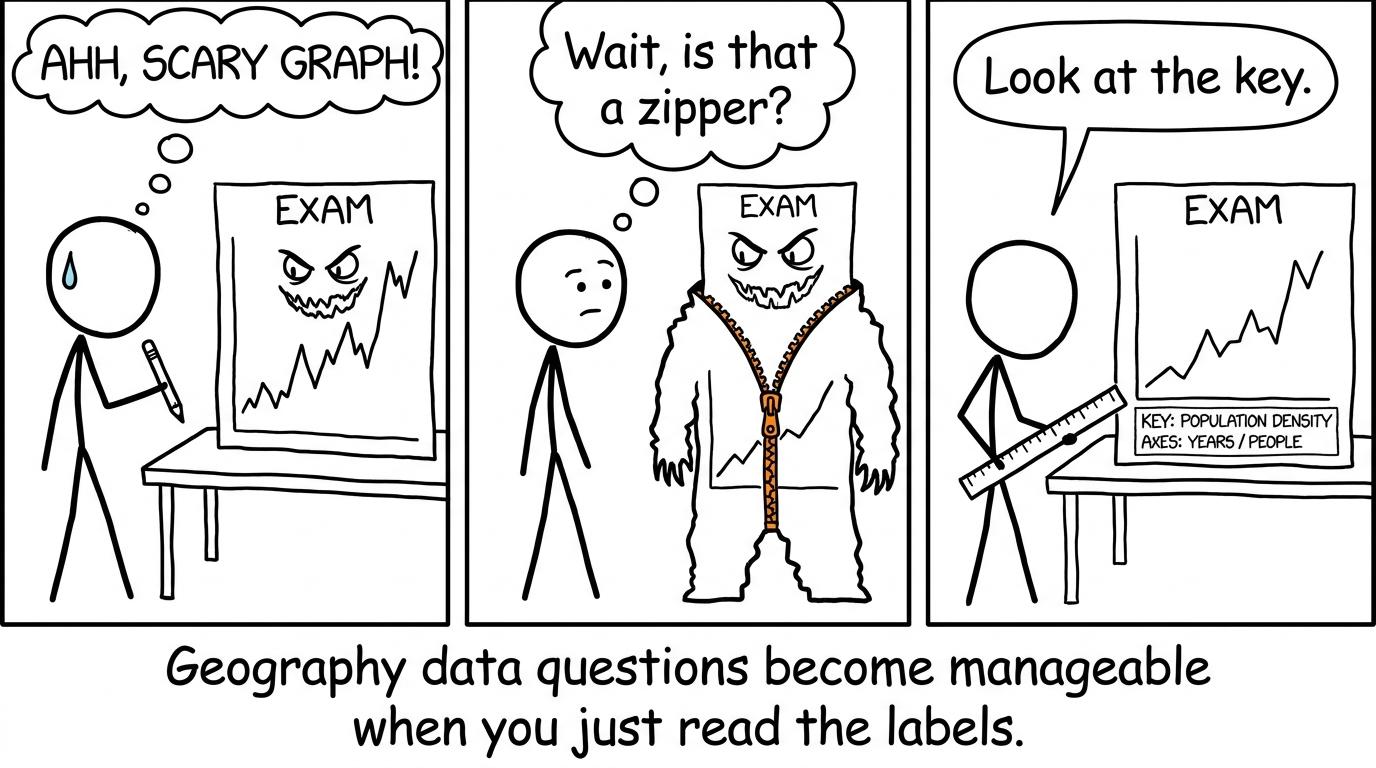 A supposedly frightening graph is revealed to be wearing a cheap monster costume
Is GCSE Geography harder than GCSE Maths?
There is no universal ranking. The subjects ask for different kinds of control.
GCSE Maths is cumulative: an insecure earlier skill can affect several later topics. Geography is broad: you may understand one unit well while having a separate gap elsewhere. Maths often asks you to choose and execute a method. Geography often asks you to select evidence, apply understanding and communicate a judgement.
For students preparing for maths exams, Geography can create an unexpected advantage. Map scale, percentages, averages, graphs and data interpretation reinforce useful mathematical habits. Equally, accurate maths can protect accessible marks in a Geography paper.
The best comparison is therefore personal. Which costs you more marks: missing knowledge, weak calculations, vague explanations or slow timing? Difficulty becomes useful once you describe it precisely.
How to make GCSE Geography feel manageable
Build revision around the specification
First confirm whether you take AQA, Edexcel, OCR or Eduqas and identify the exact specification. Paper structures, optional topics and fieldwork arrangements vary, and specifications can change. Do not rely on a friend's revision list from another board.
Turn each specification statement into a question. This changes a passive checklist into a retrieval tool. If you cannot answer without notes, the topic remains unfinished.
Compress case studies
Reduce each case study to one page or a small set of flashcards. Separate facts by purpose rather than writing one long narrative. A statistic attached to a cause, effect or response is easier to deploy accurately.
Then practise recalling the case study from a blank page. Recognition feels comfortable, but recall is what the exam requires.
Practise maps, graphs and resources
Skills improve through use. Work on grid references, scale, relief, graph interpretation and data evidence little and often. The AQA cartographic skills revision guide develops map-reading and inference, while the graphical skills guide helps you choose and interpret appropriate presentations.
Use mark schemes as feedback
After answering a question, do more than total the marks. Identify why marks were lost:
- missing knowledge;
- insufficient place-specific evidence;
- misunderstanding the command word;
- weak use of the resource;
- an unsupported judgement;
- calculation or unit error;
- poor timing.
That list gives your next revision session a job. A mark scheme is not a verdict on ability. It is a map of where your answer stopped earning credit.
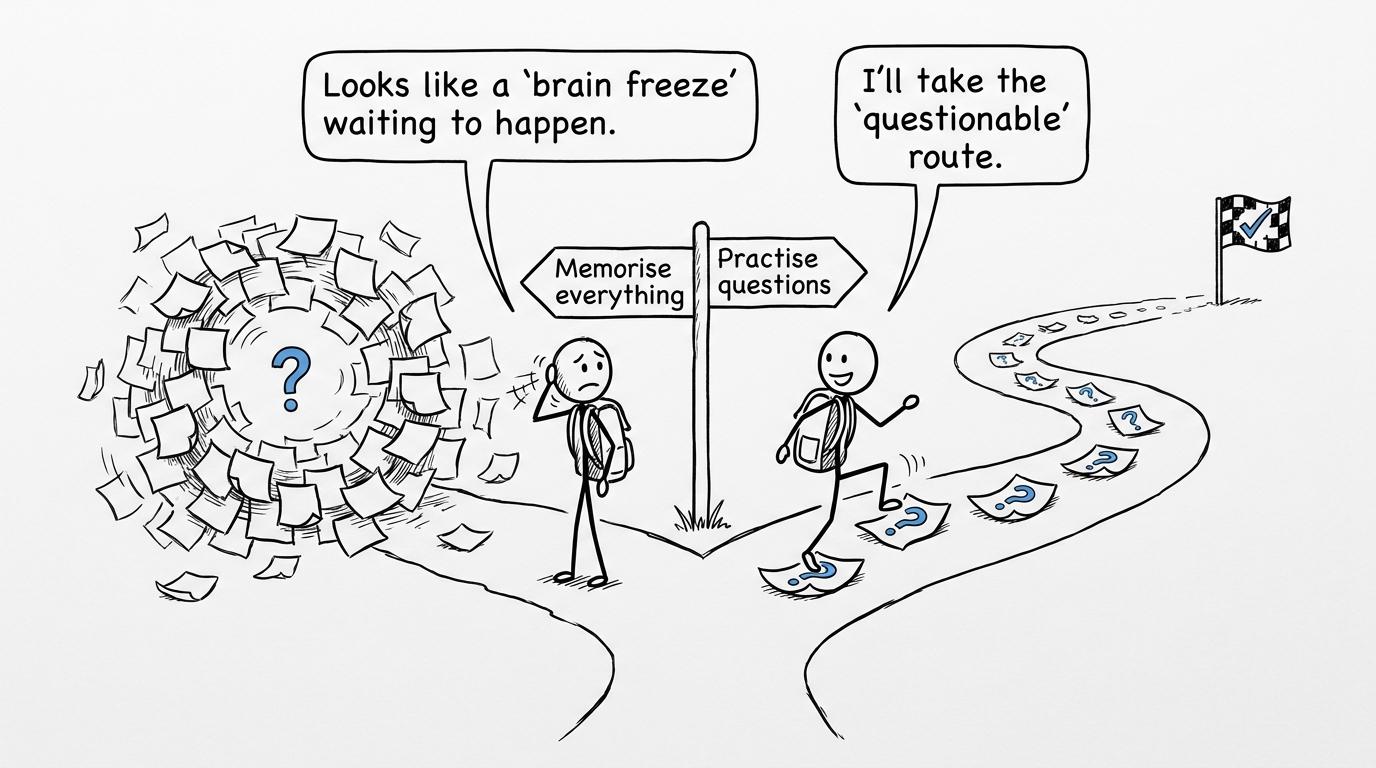 Students choose between a foggy path of endless memorising and stepping stones made from practice papers
Common mistakes that make Geography seem harder
Rereading instead of retrieving
Highlighting and rereading can create familiarity without reliable recall. Close the book and write what you remember, then check the gaps.
Memorising full essays
A memorised essay rarely fits an exam question perfectly. Learn adaptable evidence and arguments, then respond to the wording in front of you.
Ignoring command words
Describe, explain, assess, evaluate and justify require different responses. Underline the command word and the precise geographical focus before writing.
Giving vague data evidence
Writing that a value is “much higher” wastes an opportunity. Quote an accurate figure, unit, date or comparison from the resource when available.
Treating fieldwork as a list of facts
You need to understand why a sampling method was suitable, how data supported a conclusion and what would make the enquiry more reliable.
Avoiding timed practice
Knowing Geography in a quiet bedroom is different from selecting and writing it under time pressure. Build from individual questions to timed sections before attempting complete papers.
The honest verdict
GCSE Geography is hard when it is treated as a mountain of facts to cram. It becomes much more manageable when it is organised into processes, examples, skills and recurring question types.
What students say reflects that divide. Some find the breadth and case-study load tiring. Others find the concepts clear and the papers approachable. Both experiences can be genuine. Your aim is not to decide whether the subject is officially “easy” or “hard”, but to identify which part is costing you marks and train it directly.
Start with one weak area today. Use MathsGenie's free revision lessons and practice questions to strengthen geographical and numerical skills, then mark your work carefully. For broader maths preparation, move on to GCSE predicted papers, past papers, mini tests, mark schemes and video solutions. A large course becomes less intimidating when every revision session produces one visible improvement.










