

Is GCSE Further Maths Hard? An Honest Student View
Is GCSE Further Maths hard? Get an honest answer based on student experiences, challenging topics and practical ways to prepare with confidence.
A difficult-looking question can create more anxiety than a genuinely difficult one. GCSE Further Maths has that effect. Students hear words such as calculus, matrices and functions, then assume they are about to begin a miniature university degree.
So, is GCSE Further Maths hard? The straight answer is yes: it is harder than GCSE Higher Maths. It introduces unfamiliar ideas, expects confident algebra and is often taught quickly. But students who are comfortable with higher-tier algebra commonly describe it as challenging rather than impossible. The jump tends to feel much smaller when your GCSE foundations are secure and you practise the new notation regularly.
There is an important qualification to that answer. Public student discussions are not a representative survey, and experiences vary between schools. Some students receive weekly lessons; others cover the course in a short after-school programme. The teaching time, qualification and strength of your existing maths can change the experience considerably.
The quick difficulty checklist
Further Maths is likely to feel manageable if you can:
- rearrange complicated formulae without losing signs;
- factorise and solve quadratic equations confidently;
- work accurately with indices, surds and algebraic fractions;
- interpret functions and graphs;
- keep practising when notation initially looks unfamiliar;
- make time for an additional qualification alongside your GCSE subjects.
It is likely to feel difficult if ordinary higher-tier algebra is still uncertain. That is not a verdict on your ability. It simply identifies the best next step: strengthen the foundation before adding another floor.
MathsGenie's GCSE Maths revision resources let you revisit those foundations by topic, with videos and exam-style questions.
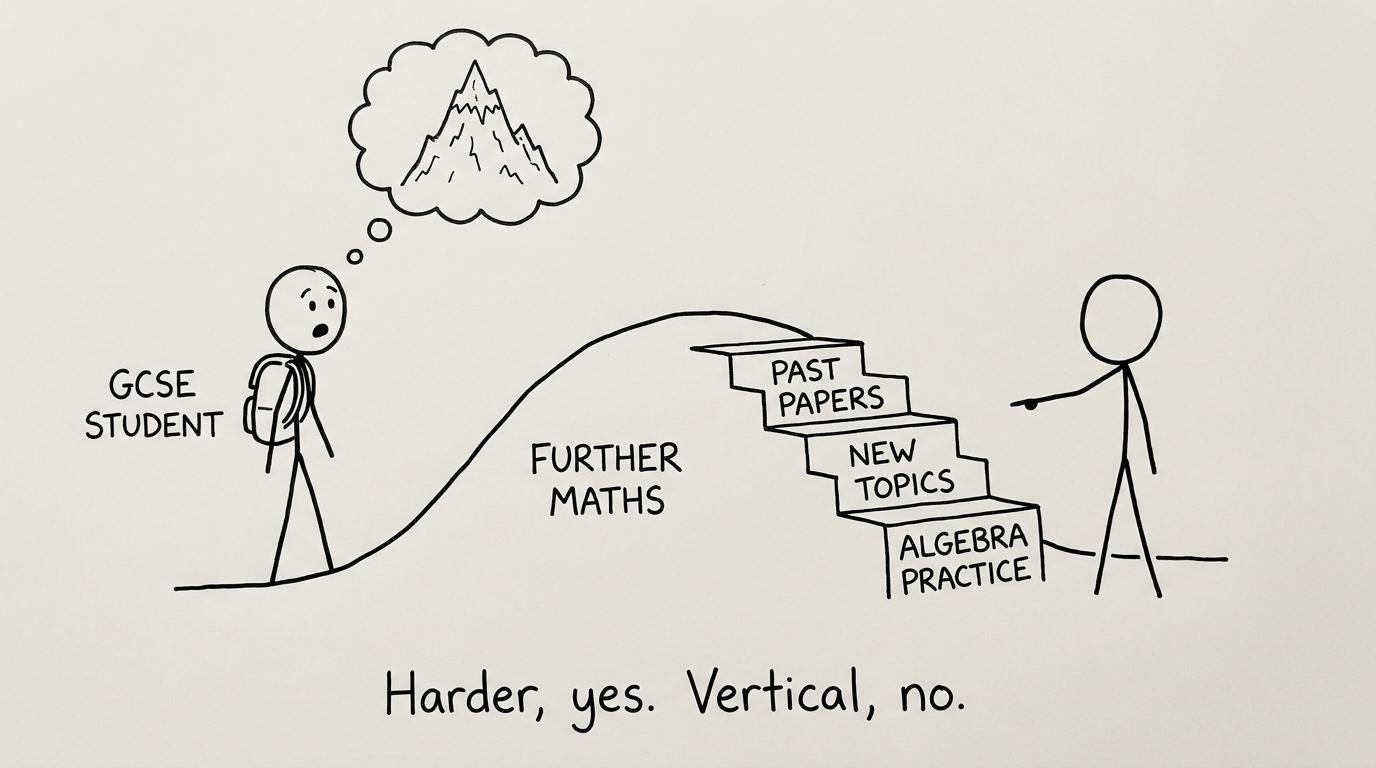 A student discovers that Further Maths is a climb rather than a vertical wall
What does GCSE Further Maths actually mean?
The name can be slightly misleading. What schools casually call “GCSE Further Maths” is often a separate Level 2 qualification rather than another GCSE.
One common route is the AQA Level 2 Certificate in Further Mathematics. Its current assessment consists of two written papers, each lasting 111 hour 454545 minutes and carrying 808080 marks. Paper 1 is non-calculator and Paper 2 permits a calculator. The qualification uses grades 555 to 999 and is designed to stretch students who are already working towards strong GCSE Maths grades.
Other schools may offer a different qualification, such as OCR's Level 3 FSMQ in Additional Mathematics. That is not interchangeable with AQA's Level 2 certificate. Content, assessment and grading can differ, so ask your teacher for the exact qualification title and specification before downloading resources.
Edexcel, AQA, OCR and Eduqas also structure their ordinary GCSE Maths courses differently. Further Maths is therefore not simply a universal “fourth GCSE paper”. It is an additional course selected by the school.
Why GCSE Further Maths feels hard
The course assumes algebraic fluency
In ordinary GCSE questions, algebra may be the main topic being tested. In Further Maths, algebra is often the language used to access something else.
You might meet expressions involving functions such as f(x)f(x)f(x), algebraic division, factor and remainder ideas, or equations containing several connected steps. Manipulating an expression like
ax2+bx+cax^2+bx+cax2+bx+cneeds to feel reasonably familiar before a new technique can receive your full attention.
This is why two equally motivated students can experience the course differently. One is learning a new idea. The other is learning that idea while also trying to remember how factorisation works.
If algebra is the main obstacle, begin with grade 7 GCSE topics, then move through the grade 8 revision resources and grade 9 GCSE Maths topics. That sequence is often more useful than repeatedly attempting a Further Maths paper before you are ready.
Some topics are completely new
Depending on the qualification, students may encounter matrices, calculus, advanced functions, coordinate geometry and more demanding trigonometry.
A matrix such as
(2103)\begin{pmatrix} 2 & 1\\ 0 & 3 \end{pmatrix}(2013)looks strange because GCSE Maths gives most students little reason to use one. Differentiation introduces notation such as
dydx,\frac{\mathrm{d}y}{\mathrm{d}x},dxdy,which can look more intimidating than the underlying process eventually feels.
This leads to a recurring theme in student discussions: the first encounter is often the worst part. Once the notation has a meaning and the question types become recognisable, the course feels less mysterious. New does not always mean exceptionally difficult. Sometimes it simply means you have not yet had enough introductions.
The pace can be the real difficulty
Further Maths is frequently offered to a selected group alongside a full GCSE timetable. A school might teach it during additional lessons, lunchtime sessions or a compressed period after substantial GCSE content has been completed.
Students therefore describe very different workloads. Someone with regular teaching and organised practice may find the course enjoyable. Someone covering the same material quickly, while preparing for several other exams, may find it exhausting.
The specification is only half the story. Time matters too.
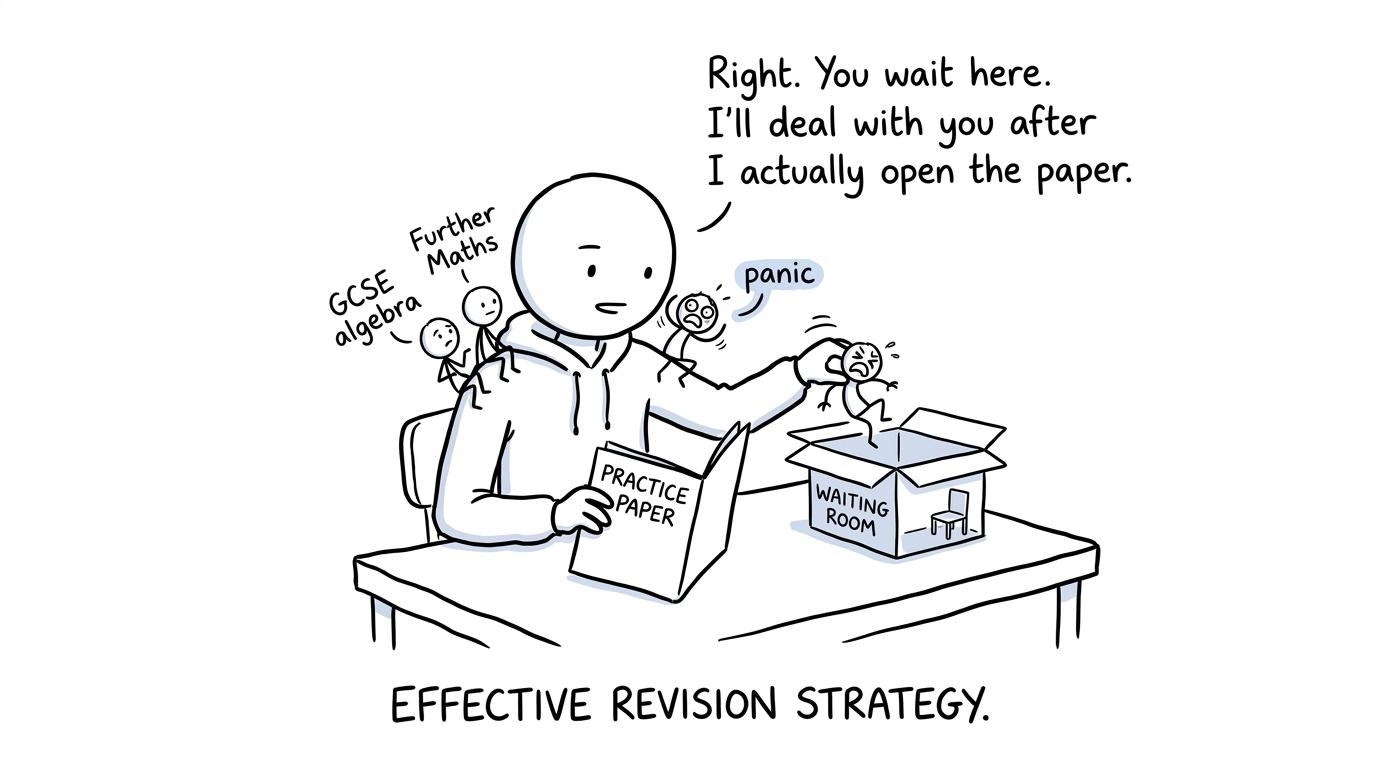 A student sends panic to the waiting room before opening a practice paper
What students tend to say after taking it
Public forum posts and student discussions cannot tell us what every candidate thinks. They can, however, reveal recurring themes when treated cautiously rather than as statistics.
“It depends on how strong your algebra is”
This is perhaps the most consistent message. Students already performing confidently at the top of higher tier often find the extension logical. Those with gaps in rearranging, quadratics or indices may feel that every question contains two challenges at once.
Your current GCSE grade is useful evidence, but it is not the whole answer. Look at how you earn that grade. If algebra questions are usually a strength, Further Maths may suit you particularly well.
“The topics become easier with repetition”
Students often distinguish between initial confusion and long-term difficulty. Matrices or differentiation can feel alien in the first lesson, then routine after several carefully spaced practice sessions.
That change is important. Confidence is sometimes treated as a personality trait, but in maths it is often stored evidence. Each completed question tells your brain, quietly, that this type of problem has been seen before.
“The exam can be demanding even when lessons feel fine”
Understanding a teacher's explanation is not the same as selecting a method independently under timed conditions. Further Maths papers can combine topics and require precise algebra across several stages.
That is why GCSE Maths past papers remain valuable preparation. They improve the core fluency that the additional qualification assumes. Closer to the exam, MathsGenie predicted papers can provide further structured practice, although no predicted paper can guarantee the content of a live examination.
Is Further Maths worth taking?
For a student considering A Level Maths, it can be extremely useful preparation. Functions, algebraic reasoning and introductory calculus reduce the shock of moving beyond GCSE. You can also explore the A Level Maths revision section to see how these ideas develop later.
It may be worth taking if:
- you enjoy algebra and problem-solving;
- you are secure with higher-tier GCSE content;
- you are considering A Level Maths or Further Maths;
- your school provides enough teaching and feedback;
- the extra revision will not damage your other subjects.
It may not be the right priority if core GCSE Maths still requires substantial attention or your timetable is already unmanageable. An additional qualification should stretch you, not quietly undermine the subjects you need most.
You also do not need Further Maths to begin A Level Maths unless a particular school or college sets its own entry requirement. Institutions decide their requirements, so check directly rather than relying on a general assumption.
How to make Further Maths feel easier
Secure the GCSE foundation first
Do not use advanced content to avoid a weakness in ordinary algebra. Repair the weakness. Practise rearranging, factorising, quadratics, indices, surds, graphs and trigonometry until the basic operations demand less attention.
Revise little and often
A short session several times a week is usually more useful than leaving every unfamiliar topic until one long weekend. The aim is not merely to remember a procedure. It is to make the notation normal.
Separate learning from testing
Use a revision lesson or video solution when learning. Then close the explanation and attempt practice questions independently. Later, use mini tests and timed papers to check whether the method can be retrieved without a prompt.
Review mistakes by cause
Do not record only that an answer was wrong. Decide why:
- Was the concept misunderstood?
- Was a GCSE algebra skill missing?
- Was there a sign or notation error?
- Was the correct method chosen too slowly?
Those causes require different fixes. A concept gap needs teaching; an accuracy problem needs deliberate practice.
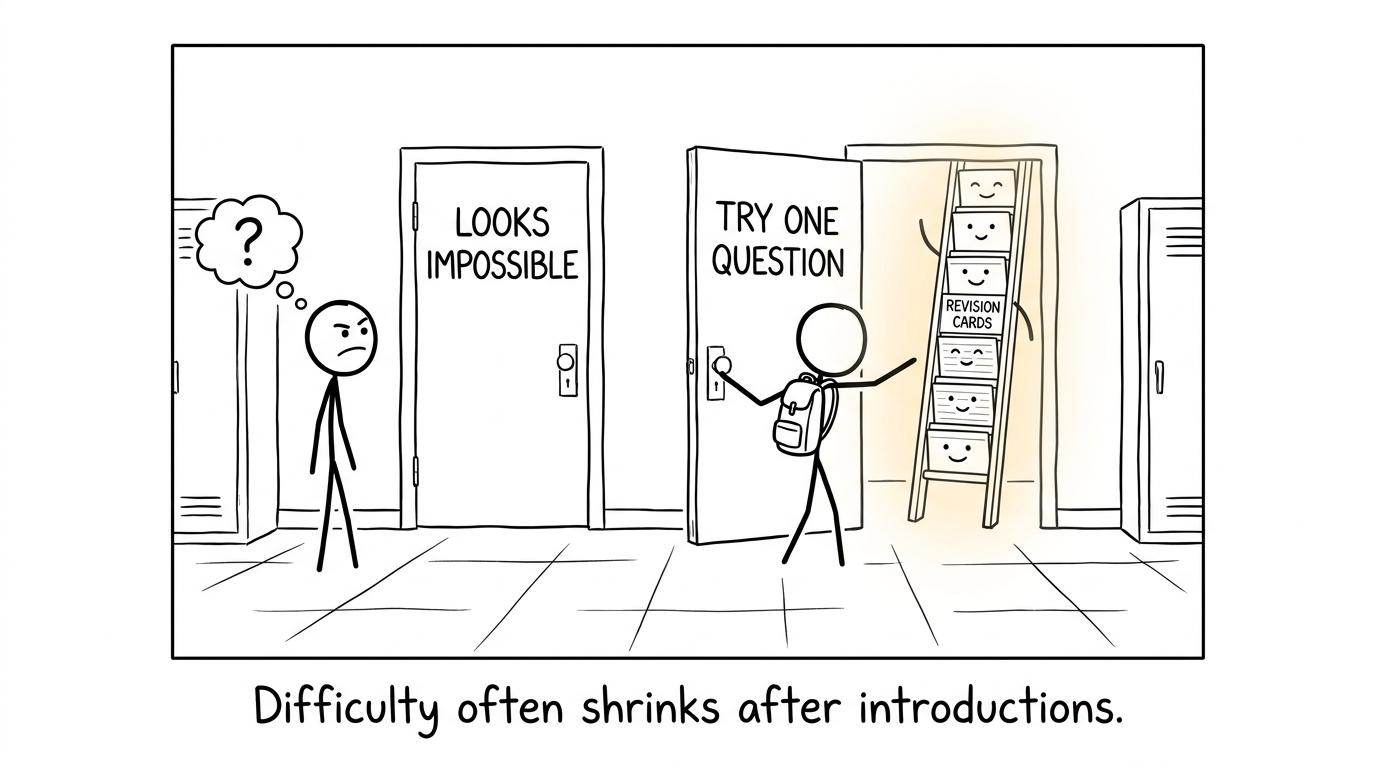 A student chooses one question instead of the door marked looks impossible
Common Further Maths mistakes
Assuming a high GCSE grade removes the need to practise
A strong grade makes the course more accessible, but unfamiliar methods still need repetition. Natural fluency in GCSE Maths does not automatically create familiarity with matrices or calculus.
Ignoring non-calculator skills
For qualifications with a non-calculator paper, exact arithmetic and algebraic manipulation matter. Depending too heavily on a calculator can hide uncertainty with fractions, surds and symbolic work.
Jumping straight into full papers
Full papers are diagnostic tools, not always the best teaching tools. If several topics are new, revise them individually before using a complete paper to test selection, timing and stamina.
Treating every error as carelessness
“Careless” is too vague to improve. Name the error precisely: an expanded bracket changed sign, a power rule was misapplied, or a function was interpreted incorrectly. Specific mistakes create specific revision tasks.
Comparing timetables with other students
One student may have studied the course for a year; another may have started recently. Their reaction does not measure your potential. Compare your current work with your own earlier attempts.
The honest verdict
GCSE Further Maths is hard enough to deserve respect, but not fear. Its reputation comes from a combination of new topics, demanding algebra and limited teaching time. Students with secure higher-tier foundations often find that the apparent difficulty falls sharply once the notation becomes familiar.
Start by identifying whether your obstacle is knowledge, algebra or time. Then use MathsGenie's free revision lessons, practice questions, video solutions, mini tests and revision planner to turn that obstacle into a sequence of manageable tasks. Follow topic practice with past papers and predicted papers when you are ready.
Further Maths rarely becomes easy all at once. It becomes familiar one question at a time, and familiarity is often what confidence was waiting for.










