Is GCSE English Language and Literature EBacc?
Is GCSE English Language and Literature EBacc? Learn what counts for the English element, how options work and how to plan balanced GCSE revision.
The phrase English Baccalaureate sounds like a qualification you collect on results day. That is why students often ask, “is GCSE English Language and Literature EBacc?” The short answer is yes: in England, both GCSE English Language and GCSE English Literature form the English element of the EBacc. To enter that element, a student must normally be entered for both qualifications. To achieve it, they need a grade 444 or above in at least one of them.
But the EBacc is not a separate GCSE, certificate or exam. It is a school performance measure built from a particular combination of GCSE subjects. Understanding that difference can make your options form and your revision timetable feel much less mysterious.
The answer at a glance
Here is the essential checklist:
- GCSE English Language and GCSE English Literature make up the English part of the EBacc.
- Students normally need to sit both subjects for the English element to count as an EBacc entry.
- A grade 444 or above in at least one of the two is needed to achieve the English element.
- English is only one part of the EBacc subject combination.
- The EBacc is a performance measure used in England, not an additional qualification awarded to students.
- Your individual GCSE grades still appear separately on your results statement and certificates.
- Your school's options process may shape how EBacc subjects fit into your timetable.
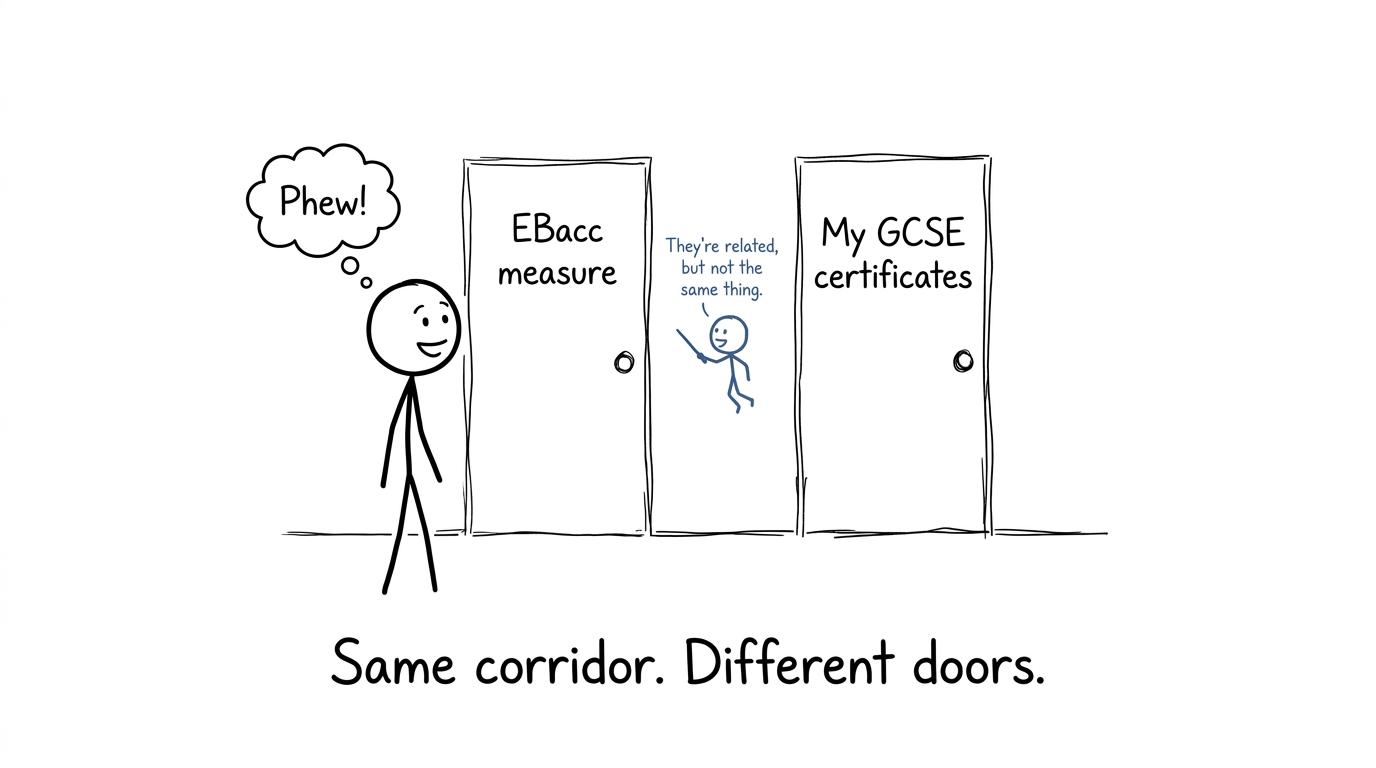 A student discovers that the EBacc measure and GCSE certificates are related but different
How English Language and Literature count towards the EBacc
The English element is slightly unusual because it involves two GCSE courses. Under current Department for Education guidance, a pupil must generally be entered for both English Language and English Literature for the English part of the EBacc entry measure.
For EBacc achievement, the pupil must gain at least a grade 444 in one of those qualifications. This does not mean the other result is unimportant. Both remain separate GCSEs, and schools, colleges, sixth forms and employers can consider the individual grades when applying their own entry requirements.
Imagine a student receives a grade 555 in English Language and a grade 333 in English Literature. Provided the other entry conditions are satisfied, the English element has been achieved because one of the two grades is at least 444. A student entered only for English Language would not normally meet the entry requirement for that element, even with a strong grade.
That distinction between entry and achievement matters. Entry concerns whether the correct subjects were taken. Achievement concerns whether the required grades were obtained.
What is included in the full EBacc?
The EBacc brings together subjects in five broad areas:
- English Language and English Literature
- mathematics
- sciences
- either history or geography
- an eligible ancient or modern foreign language
The science element can be met through approved routes, including Combined Science or an appropriate combination of separate sciences. Your school should explain which science route its curriculum provides and how this affects EBacc entry.
A student has not completed the full EBacc merely by taking English and maths. They need the required combination across all five areas. Similarly, choosing history but not a language would leave one element incomplete.
Subject eligibility and accountability rules can change, so your school's options booklet and the latest Department for Education guidance should be treated as the final references for your year group. Exam boards such as Edexcel, AQA, OCR and Eduqas provide GCSE specifications, but the Department for Education determines which qualifications count in England's performance measures.
The EBacc is not another qualification
This is the point that clears up most confusion: there is no separate EBacc examination.
You do not receive one question paper covering English, maths, science, humanities and languages. You sit the normal GCSE examinations for the subjects you study. Those results may then satisfy the EBacc combination.
Nor is there usually a separate grade called “EBacc” printed beside your GCSE results. The individual grades matter. Your English Language grade remains your English Language grade; your maths grade remains your maths grade.
The measure is mainly used to describe subject entry and attainment across schools in England. It may influence how a school constructs its option blocks, but it does not erase the importance of other subjects such as art, music, drama, design and technology, business, religious studies or physical education.
A performance measure is a way of looking at a curriculum. It is not a complete description of a student.
What does the EBacc mean for your GCSE options?
When schools say they offer an “EBacc pathway”, they usually mean that the student's timetable includes the subjects needed for the complete combination. English, maths and science are commonly built into the core curriculum, leaving the most visible decisions around languages, history and geography.
However, option systems differ between schools. Some strongly encourage the EBacc combination, while others offer more flexibility. The number of option blocks, available teachers and timetable clashes can all affect what is possible.
Before submitting your choices, ask:
- Will I be entered for both English Language and English Literature?
- Which science route will I follow?
- Must I choose history or geography, or may I choose both?
- Which language qualifications offered by the school are eligible?
- Is the EBacc pathway expected, recommended or optional here?
- Could any option combination create a timetable clash?
These are practical questions, not signs that you are behind. A ten-minute conversation with an options adviser can prevent months of uncertainty.
The EBacc applies specifically to school accountability arrangements in England. Wales, Scotland and Northern Ireland have different qualification structures and performance systems, so students there should follow guidance from their school and relevant national education body.
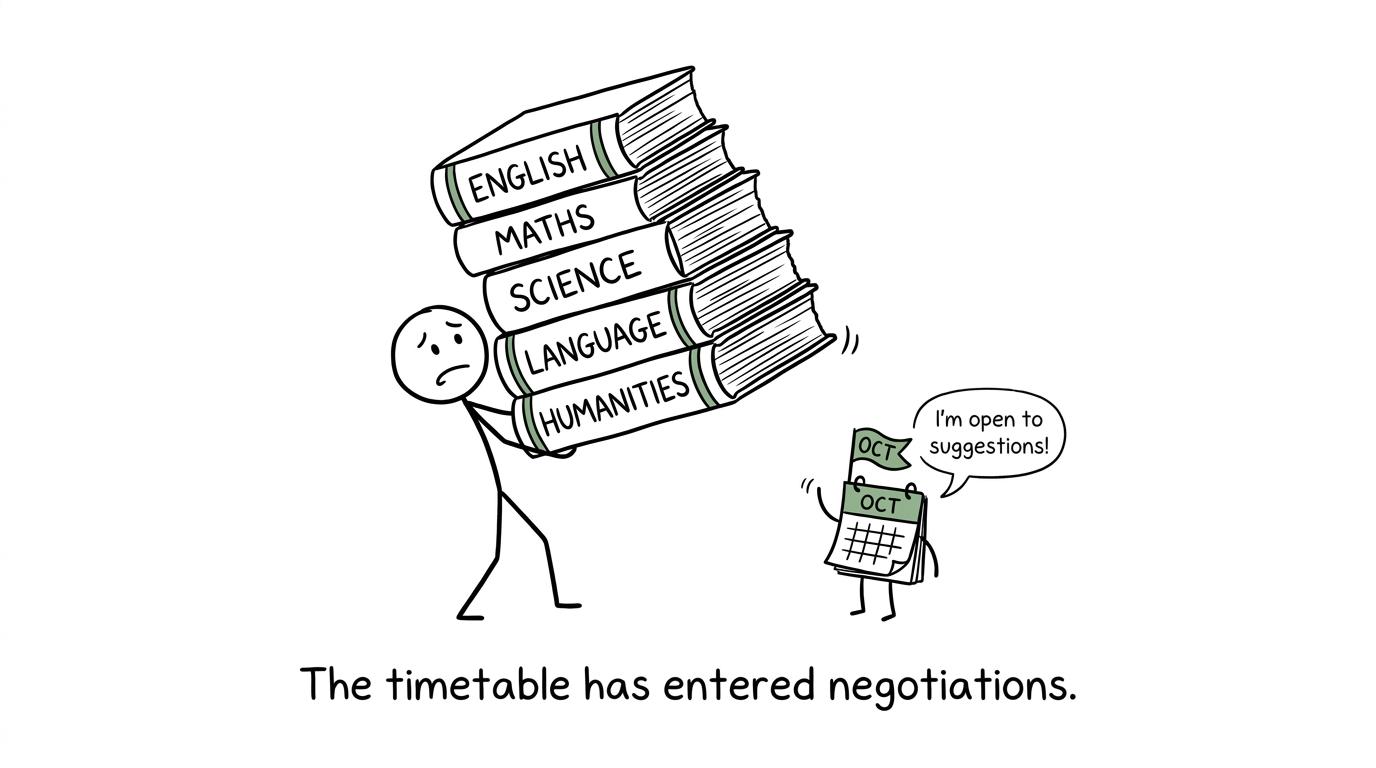 A student negotiates with a crowded GCSE revision timetable
Why this matters when you are revising maths
English may have prompted the question, but the EBacc also includes GCSE maths. A balanced subject combination creates a balanced revision problem: several important exams compete for the same limited evenings.
The answer is not to revise everything every day. It is to make the next action small and visible.
Start by identifying your current maths level through the free GCSE maths revision resources. Then organise topics by confidence rather than simply following the order of a textbook. A topic you cannot begin deserves more attention than one where you only make an occasional arithmetic slip.
MathsGenie's grade-based resources can help you move through that process deliberately:
- Grade 444 GCSE maths topics help secure essential foundation and crossover skills.
- Grade 555 GCSE maths topics support students working towards a strong pass.
- Grade 666 GCSE maths topics build confidence with increasingly demanding higher-tier content.
- Grade 777 GCSE maths topics develop the reasoning needed for more complex questions.
- Grade 999 GCSE maths topics provide challenge for students aiming at the top of the higher tier.
Use revision lessons and practice questions while learning a topic. Save full GCSE maths past papers for checking how well you can select methods without being told which topic is being tested.
Closer to the examinations, MathsGenie predicted papers can add fresh exam-style practice. They should complement, rather than replace, official past papers and the specification for your exam board.
Build a revision plan around evidence
Students often allocate time according to emotion. The subject that feels worrying receives an entire evening; the subject that feels comfortable is ignored for a fortnight. A calmer method is to let evidence decide.
After completing practice questions, a mini test or part of a paper, record three things:
- the topic involved;
- why marks were lost;
- the next task that would fix the problem.
“Revise algebra” is too broad. “Practise rearranging formulae, then complete a mini test without notes” is actionable. The same principle works in English: “revise Literature” is vague, while “plan two responses on how a character changes” gives the session a clear finish line.
Use mark schemes to understand what earns marks, and use video solutions when the written method does not reveal why a step works. A revision planner can then distribute those next actions across the week without allowing one EBacc subject to consume all available time.
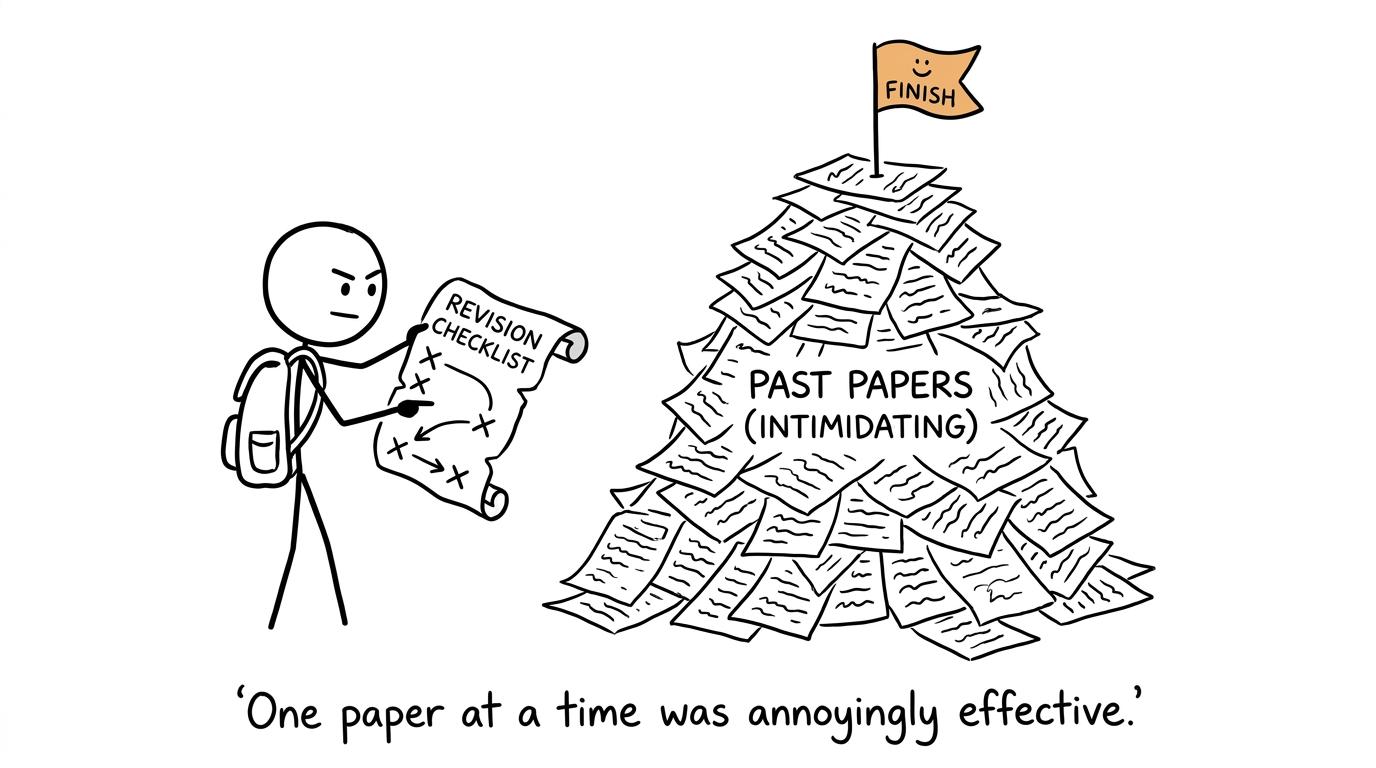 A revision checklist turns a pile of papers into a manageable route
Common mistakes about English and the EBacc
Thinking English Language alone completes the English element
A strong English Language grade does not normally create an EBacc entry if the student was not also entered for English Literature. Both qualifications are part of the entry requirement.
Believing both English subjects require a grade 444
For the English achievement element, a grade 444 or above is required in at least one of English Language or English Literature, provided the student has been entered for both. Individual sixth forms or courses may set different admissions requirements.
Treating the EBacc as a compulsory extra GCSE
It is a combination of existing subjects and a performance measure, not an additional course with its own lessons, paper and certificate.
Assuming the rules are identical across the UK
The EBacc discussed here is an English accountability measure. Students elsewhere in the UK follow different national systems.
Letting the label replace careful option research
Knowing that a subject sits within the EBacc does not tell you whether it fits your ambitions, timetable or school's rules. Read the options booklet, attend information events and ask how each choice affects later courses.
Make the label useful, then return to the work
The answer is reassuringly simple: GCSE English Language and English Literature both contribute to the English part of the EBacc. Students normally take both, while a grade 444 or above in at least one is required to achieve that element. The full EBacc also depends on mathematics, science, a humanities subject and a language.
Once you understand the label, the more valuable question is what to do next. Confirm your subject combination with your school. Check the requirements of any sixth form or course you may consider. Then turn attention back to the habits that improve actual grades.
MathsGenie makes that next step free and practical. Choose a revision lesson, answer the linked practice questions, check the mark scheme, watch the video solution where needed and test the skill again. As examinations approach, add past papers and predicted papers to your revision planner. The EBacc describes a set of subjects; consistent, well-chosen practice is what changes the results within it.