

Is GCSE Business EBacc? Options Explained
Is GCSE Business EBacc? No. Learn which subjects count, what the EBacc means in England, and how to choose options while protecting maths revision time.
Choosing GCSE options can feel oddly permanent. A subject sits in one column of a form, yet selecting it can seem like a decision about university, work and the person you might become. Then someone mentions the EBacc, and an already difficult choice acquires another layer.
So, is GCSE Business EBacc? The clear answer is no. GCSE Business does not belong to one of the five EBacc subject areas. It can still be a valuable GCSE, may fit alongside an EBacc combination and does not become less worthwhile simply because it is absent from that particular list.
The distinction matters: the EBacc is a combination of subjects used in England, not a separate qualification that appears on your certificate. Your school’s option rules, your interests and your likely next steps all deserve consideration too.
The answer at a glance
Here is the essential checklist:
- GCSE Business is not an EBacc subject.
- The EBacc subject areas are English, maths, science, a language, and history or geography.
- The EBacc is a subject combination and school performance measure, not an additional GCSE.
- You can often take Business alongside the subjects needed for the EBacc, depending on your school’s option blocks.
- Business may still contribute to broader school performance calculations under the applicable rules, but that does not make it an EBacc subject.
- EBacc policy applies to schools in England; arrangements elsewhere in the UK differ.
- Your school should confirm which combinations are available before you submit your options.
Which GCSE subjects count towards the EBacc?
The Department for Education defines the EBacc through five subject areas, sometimes called pillars.
English
Students normally take both GCSE English Language and GCSE English Literature. The detailed rules governing entry and attainment are part of the school performance framework, but Business cannot replace either English subject.
Maths
GCSE Maths forms its own EBacc pillar. It is also a core subject for every student and remains especially important for progression after Year 111111.
Your exam board might be Edexcel, AQA, OCR or Eduqas, and you will sit either foundation or higher tier. You can select the correct board and tier through the GCSE Maths revision hub, where MathsGenie brings together revision lessons, questions and papers.
Science
The science pillar can be met through approved science combinations. These may involve combined science or an eligible group of separate sciences. Computer Science can count within the relevant separate-science route, but it is important to follow the complete entry rules rather than assuming that one Computer Science GCSE fills the pillar by itself.
History or geography
At least one eligible qualification in history or geography is needed for the humanities pillar. GCSE Business does not replace either subject here, even though businesses frequently make decisions involving places, populations and historical conditions.
A language
An approved ancient or modern language completes the language pillar. The precise language offered depends on the school, but Business does not count as a language qualification.
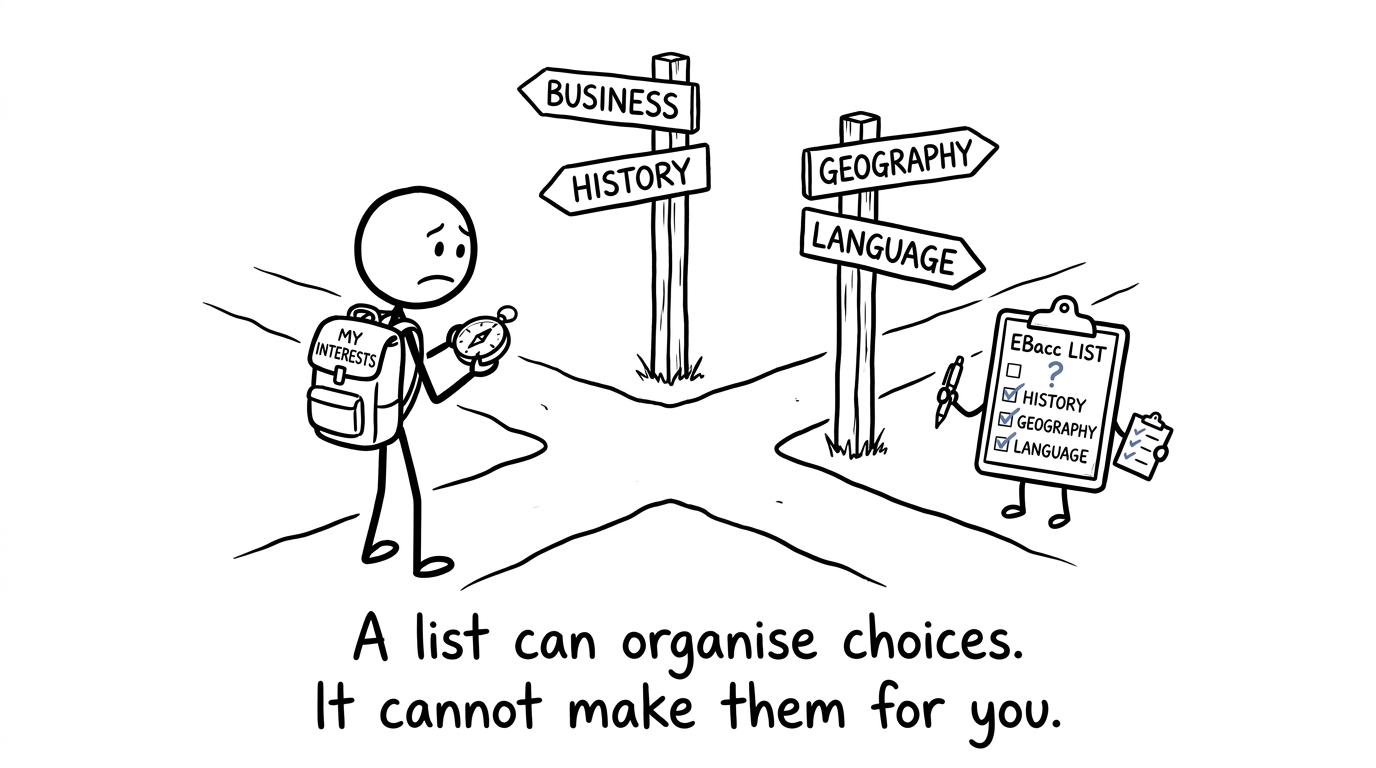 A student choosing between school option paths while an EBacc clipboard checks the official list
Why GCSE Business does not count
GCSE Business has recognised subject content and is offered by major exam boards, including Edexcel, AQA and OCR. However, being an established GCSE is not the same as being included in the EBacc.
The EBacc is deliberately limited to a defined combination of academic subject areas. Business sits outside those five pillars, alongside subjects such as art, drama, music, physical education, religious studies, media studies and economics.
This creates three different questions that students sometimes treat as one:
- Is Business a GCSE? Yes, when you take an accredited GCSE Business qualification.
- Is Business an EBacc subject? No.
- Can Business still be one of my GCSE options? Often yes, subject to your school’s timetable and option policy.
That final question is usually the most practical. A school might require some students to choose history or geography and a language, then leave another option block available for Business. Another school may arrange its blocks differently. The national EBacc list does not tell you whether two lessons clash on your particular timetable.
What the EBacc actually means for students
The EBacc is not an examination, a grade or an extra certificate. You do not sit an “EBacc paper”. Instead, it describes entry and attainment across a combination of GCSE subjects.
Historically, EBacc measures have been used prominently in England’s secondary school performance information. The government has since announced the removal of EBacc headline and additional performance measures for the academic year 202520252025 to 202620262026, with those reporting changes taking effect in autumn 202620262026.
That policy change should not be misread. It does not turn GCSE Business into an EBacc subject. Nor does it automatically change the options your school has already arranged. It means the accountability framework is changing, so current Year 999 students should rely on their school’s latest options booklet and guidance rather than an older leaflet or online discussion.
The safest questions to ask your options adviser are:
- Does my school expect me to follow an EBacc pathway?
- Can I take Business alongside that pathway?
- Which language, history and geography combinations fit the timetable?
- Will my choices support the sixth-form, college or apprenticeship routes I am considering?
- When is the final deadline for changing an option?
Is GCSE Business still a useful choice?
A subject does not need the EBacc label to be useful. GCSE Business typically develops understanding of areas such as enterprise, finance, marketing, operations, human resources and external influences on organisations. Exact wording and assessment structure vary between exam boards, so read your school’s specification information carefully.
Business also involves skills that connect naturally with maths. You may need to interpret numerical information, work with percentages, compare costs and revenue, read graphs or justify a decision using data. Taking Business is not a substitute for learning GCSE Maths, but secure number and ratio skills can make its quantitative content more manageable.
The better question is not simply, “Does this subject appear on a list?” It is, “Does this combination leave me with a broad education, realistic progression routes and enough motivation to work consistently?”
Consider Business if:
- you are genuinely interested in how organisations make decisions;
- you understand how the course is assessed;
- it fits alongside your compulsory and preferred subjects;
- you are prepared for written explanations as well as numerical work;
- it supports, or at least does not close, routes you may want later.
Do not choose it solely because it sounds easy, practical or profitable. Course difficulty depends on your strengths, and Business requires accurate terminology, application to unfamiliar situations and reasoned judgement.
How GCSE options affect maths revision
Students often focus on whether a subject “counts” and overlook a quieter constraint: time. Every GCSE creates lessons, homework, assessments and revision demands. A sensible options decision therefore includes a plan for protecting your core subjects.
Start by checking your maths board and tier. MathsGenie’s GCSE Maths topics by exam board and tier can help you understand the content ahead. Then build a routine that is small enough to survive busy weeks.
A useful revision cycle is:
- learn or revisit one method;
- complete focused practice questions;
- check the mark scheme or video solution;
- record the precise reason for each lost mark;
- retest the same skill later;
- move into mixed questions and full papers when ready.
If your timetable already feels crowded, the twenty-minute GCSE maths revision routine provides a manageable structure. For longer-term organisation, use the GCSE maths revision timetable guide or the one-month maths revision plan.
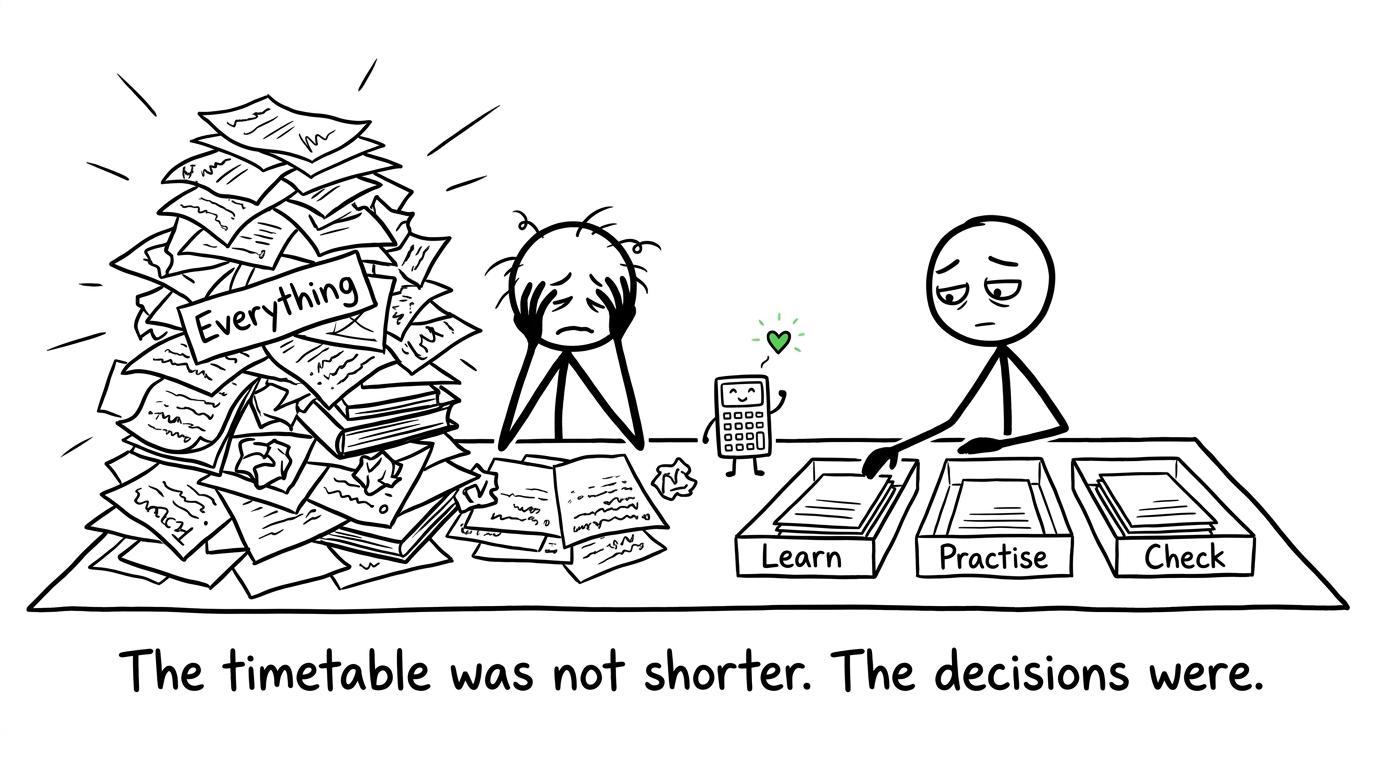 One student faces a chaotic revision pile while another uses three calm trays labelled Learn, Practise and Check
The aim is not to revise every subject every evening. It is to remove repeated decisions. A clear weekly pattern leaves more attention for the work itself.
Common mistakes when thinking about Business and the EBacc
Assuming every academic GCSE is an EBacc subject
Business is a legitimate GCSE, but the EBacc contains only specified subject categories. Economics and Religious Studies are not replacements for history or geography either.
Believing the EBacc is a separate qualification
There is no additional EBacc course or examination. The term describes a combination of entries and results across existing qualifications.
Thinking Business cannot be taken with the EBacc
Business does not count towards the combination, but it may be taken alongside it. Whether this is possible depends on your school’s option blocks and curriculum.
Using outdated school-performance information
The accountability framework is changing from the 202520252025 to 202620262026 academic year. Always check the date of an options booklet and ask your school how current national changes affect its policy.
Choosing subjects without checking future requirements
Different sixth forms, colleges and courses set their own entry requirements. Check the routes that interest you. Strong results across a suitable combination usually matter more than an assumption based on the name of one subject.
Letting option anxiety replace current revision
Your choices matter, but so do the grades you are working towards now. Once you have gathered the necessary information, return to concrete action. Edexcel students can begin with the Edexcel GCSE Maths revision area, while AQA students can practise using AQA GCSE Maths past papers.
Make the choice, then build the routine
GCSE Business is not part of the EBacc. That is the factual answer. What it means for you depends on a more local question: can Business fit beside your compulsory subjects, any EBacc pathway your school expects, and the other options you value?
Read the current options booklet. Speak to your teachers and options adviser. Check likely entry requirements for future courses without pretending you must know your entire career at fourteen. Then choose a balanced set of subjects you are willing to work at consistently.
Once the form is submitted, attention becomes more valuable than further speculation. Use MathsGenie as your free maths revision base: work through revision lessons and practice questions, check mark schemes and video solutions, use mini tests to find gaps, and develop exam stamina with predicted papers and past papers. The guide to using GCSE maths past papers properly gives you a repeatable paper, mark, repair and retest process.
An options list can shape the road ahead. It does not walk the road for you. Regular, honest practice still does most of that work.











