

Is GCSE Astronomy Part of the EBacc?
Is GCSE Astronomy EBacc? Learn why Astronomy does not fill an EBacc science slot and what that means when choosing your GCSE subjects at school.
Choosing GCSE options can feel like trying to solve a puzzle before anyone has shown you the finished picture. You may enjoy astronomy, recognise its scientific value and then encounter one awkward question: is GCSE Astronomy EBacc?
The short answer is no. Under the current Department for Education rules in England, GCSE Astronomy does not count towards the science component of the English Baccalaureate. It can still be a worthwhile GCSE, but it cannot replace combined science or the required combination of eligible individual sciences.
That distinction matters when you select your options. It does not mean Astronomy is an inferior subject. It simply means that the EBacc uses a specific list of subjects rather than including every academic GCSE.
The answer at a glance
Here is the practical position:
- The EBacc is a school performance measure in England, not a separate qualification or certificate.
- GCSE Astronomy is not one of its recognised science subjects.
- Combined science can satisfy the science component.
- Alternatively, students must enter three eligible individual sciences from Biology, Chemistry, Physics and Computer Science.
- Astronomy may sometimes be taken as an additional GCSE, depending on your school's timetable and options policy.
- Your school may encourage or require an EBacc combination even though the EBacc itself is not a qualification.
- Choosing Astronomy does not remove the need to plan carefully for English, maths, science, a humanity and a language.
Your school should confirm how Astronomy fits into its particular options blocks. Availability, staffing and timetable arrangements vary between schools.
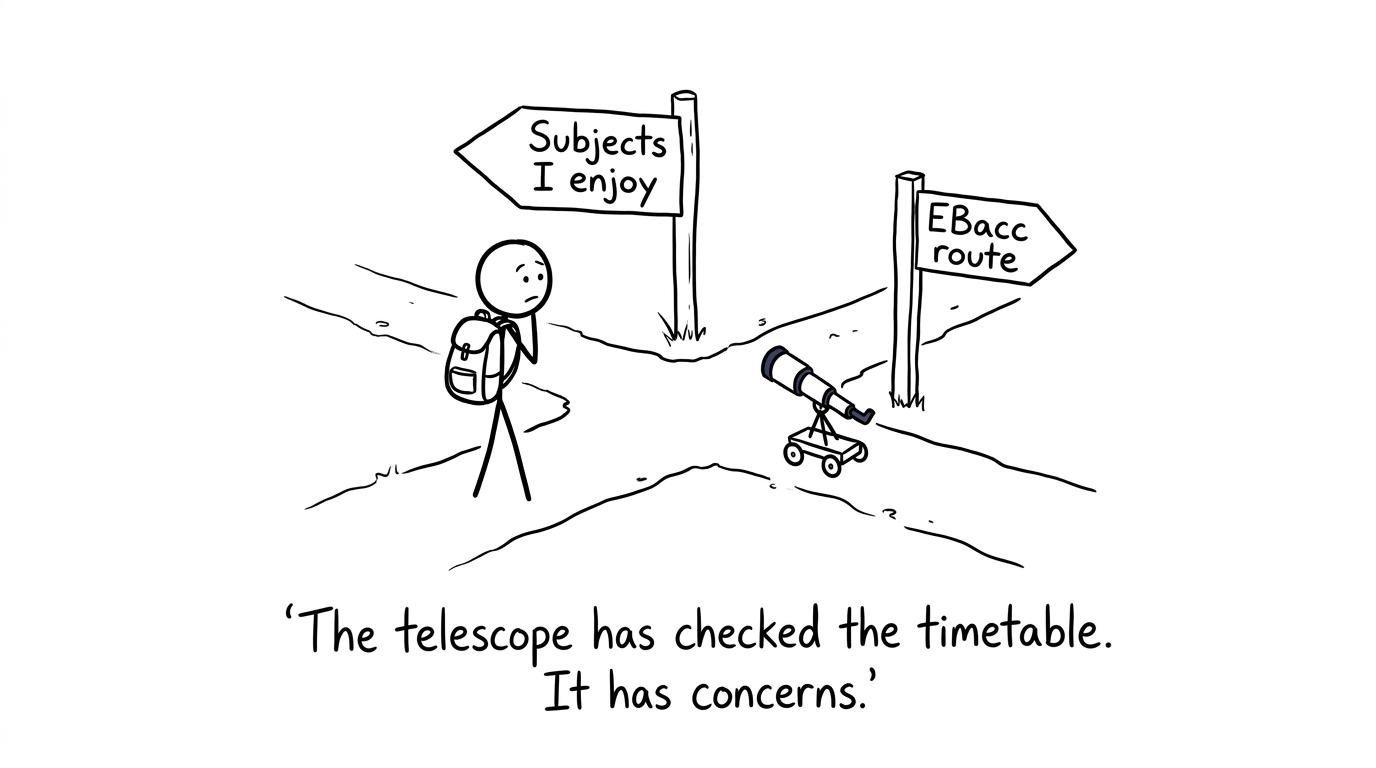 A student, an EBacc signpost and a concerned telescope at an options crossroads
What is the EBacc?
The English Baccalaureate, usually shortened to EBacc, measures whether pupils enter a defined group of academic GCSE subjects. It applies to schools in England and should not be confused with the Welsh Baccalaureate.
The EBacc subject areas are:
- English language and English literature
- Maths
- Science
- Geography or history
- A language
There is no single EBacc examination. Nor do students receive a separate GCSE called the EBacc. Instead, the measure is created from the qualifications entered and the grades achieved in its different subject areas.
This explains why the phrase “taking the EBacc” can be misleading. In practice, you take GCSEs that together meet the EBacc requirements.
The EBacc is also different from Progress 8 and Attainment 8. Those accountability measures can include a broader range of approved qualifications in different slots. A subject potentially contributing elsewhere in school performance data does not automatically make it an EBacc subject.
Why GCSE Astronomy does not count as an EBacc science
Astronomy is clearly scientific. It studies objects and processes beyond Earth, drawing on observation, physics, data and mathematical models. But the EBacc definition is administrative as well as academic.
For the science component, the recognised routes are:
- GCSE combined science, or
- three eligible individual sciences chosen from Biology, Chemistry, Physics and Computer Science.
Astronomy is not on that list. Consequently, it cannot substitute for Physics, Computer Science or another required science.
Suppose a school's EBacc pathway includes separate sciences. Taking Biology, Chemistry and Astronomy would not complete the science component because Astronomy is not an eligible replacement for Physics or Computer Science. A student taking combined science may still be able to choose Astronomy as an additional option, but that depends on what the school offers.
The key principle is simple: a subject can be a rigorous, recognised GCSE without belonging to the EBacc selection.
What this means for your GCSE options
The question is not only whether Astronomy counts. It is whether you can fit it beside the subjects your school expects you to take.
If you take combined science
Combined science is designed to cover Biology, Chemistry and Physics and normally leads to two GCSE grades. Under current rules, it can satisfy the EBacc science component.
Astronomy could therefore sit alongside combined science as an extra option if your school offers it. It would not be completing the EBacc requirement itself; combined science would be doing that job.
If you take separate sciences
For the individual-science route, the EBacc requires entry in three eligible sciences from Biology, Chemistry, Physics and Computer Science. Astronomy cannot occupy one of those three places.
You might still take Astronomy in addition to the eligible combination, but this creates a wider workload. Look beyond the number of subjects and consider lesson time, observational work, homework and revision demands.
If your school has a fixed EBacc pathway
Some schools arrange options so that most pupils take history or geography and a language alongside the core subjects. Astronomy may appear in another option block or may not be available at all.
Ask your options lead three precise questions:
- Is Astronomy taught as a full GCSE at this school?
- Is it taken during normal timetable hours or outside them?
- Which subjects would I be unable to choose because of the options blocks?
Clear questions usually produce more useful answers than simply asking whether Astronomy is “allowed”.
Is GCSE Astronomy still worth taking?
EBacc status should be one factor in your decision, not the entire decision.
GCSE Astronomy can suit students who are genuinely interested in space, observation and the use of scientific evidence. Pearson Edexcel currently offers the GCSE qualification, but you should use the specification and assessment information supplied by your school for your examination year.
Before choosing it, consider:
- whether you enjoy the subject enough to revise it consistently;
- whether your school has specialist teaching and suitable resources;
- how it fits around your required GCSEs;
- whether it supports your longer-term interests;
- whether the total workload remains manageable.
Do not choose Astronomy merely because it sounds impressive. Equally, do not reject it simply because it is outside the EBacc. A good options decision balances requirements, interest and the realistic use of your time.
How Astronomy connects with GCSE maths
Astronomy and maths often reward the same habits: reading scales carefully, handling units, interpreting graphs and deciding whether an answer is reasonable.
Relevant mathematical skills can include:
- standard form for extremely large or small quantities;
- ratios and proportional reasoning;
- rearranging formulae;
- angles and scale drawings;
- interpreting tables, charts and graphs;
- averages and the analysis of observational data;
- recognising relationships between variables.
This does not mean that Astronomy revision can replace maths practice. It means that secure maths skills reduce the amount of attention consumed by calculations, leaving more room to think about the scientific ideas.
Start with the MathsGenie GCSE maths revision programme, where topics are organised by grade and supported by videos and exam-style questions. If your foundations need strengthening, the grade 333 revision topics and grade 444 revision resources provide a sensible starting point.
Students working towards stronger higher-tier results can progress through grade 555 maths revision, grade 666 topics and grade 777 practice. The aim is not to rush through a list. It is to find the first skill you cannot yet complete confidently, practise it and then test it again later.
 A telescope discovers that starting revision on time is a rare celestial event
Building a manageable revision plan
An additional GCSE only helps if you can prepare for it without neglecting core subjects. Time is often the hidden cost of an options decision.
Begin by mapping your weekly commitments. Protect regular sessions for English, maths and science, then allocate time to your options according to upcoming assessments and weaker topics. Short, repeated practice is usually more manageable than leaving several subjects until the final weeks.
For maths, combine three types of work:
- Learn: use a focused revision lesson to understand one method.
- Practise: answer questions without immediately checking the solution.
- Test: complete mixed questions or a timed paper, then use the mark scheme honestly.
MathsGenie GCSE past papers help you move from isolated skills to full-paper decision-making. MathsGenie predicted papers can provide further exam-style practice, but they should supplement rather than replace specification coverage and past papers.
A useful plan also includes correction time. A paper is not finished when the timer stops. Revisit lost marks, identify the topic behind each error and return to the relevant revision lesson or practice questions. That process turns a score into information.
Common mistakes when thinking about Astronomy and the EBacc
Assuming every science GCSE counts
The word “science” in a qualification title does not decide EBacc eligibility. The Department for Education specifies which subjects can fill the science component, and Astronomy is not currently one of them.
Treating the EBacc as a qualification
You do not receive an EBacc GCSE or sit an EBacc paper. It is a combination of GCSE subjects used as a performance measure.
Thinking Astronomy can replace Physics
Astronomy contains ideas related to physics, but the qualifications are not interchangeable for EBacc purposes. If your route requires Physics as one of three eligible sciences, Astronomy cannot take its place.
Ignoring your school's timetable
A theoretically possible combination may be impossible within your school's option blocks. Confirm the actual timetable before making plans around an additional GCSE.
Choosing subjects for the label alone
EBacc requirements deserve attention, but so do your interests, future plans and capacity to manage the work. The strongest combination is one that meets necessary requirements and can be completed well.
Letting an extra subject weaken core maths preparation
Maths is itself an EBacc pillar and is important for many post-161616 routes. If an additional option leaves too little time for regular maths practice, reconsider the balance rather than relying on last-minute revision.
Make the decision, then build the routine
So, is GCSE Astronomy part of the EBacc? No. It does not count towards the EBacc science component, although it remains a genuine GCSE that may be available as an additional subject. Combined science, or three eligible individual sciences from Biology, Chemistry, Physics and Computer Science, must satisfy the science requirement.
Once you have confirmed your school's option rules, shift your attention from labels to habits. Subject choices shape the timetable, but regular practice shapes the result.
Use MathsGenie's free GCSE revision resources to identify weaker topics, learn from video solutions and complete targeted practice questions. Then test your progress with past papers and mark schemes, mini tests and predicted papers. A calm plan, followed consistently, is more valuable than an ambitious plan that exists only on paper.











