

Is GCSE Arabic Worth It? Honest Pros and Cons
Is GCSE Arabic worth it? Compare the workload, exam structure, honest benefits and drawbacks, then decide whether it fits your wider GCSE revision plans.
Choosing a GCSE can feel oddly permanent. You are asked to predict what your future self will enjoy, what universities might value and how much revision you will manage alongside maths, English and science.
So, is GCSE Arabic worth it? For a student with genuine interest, existing Arabic knowledge or regular access to teaching and speaking practice, it can be an excellent choice. It develops a recognised language skill, can contribute to the English Baccalaureate subject combination and may support later language study. But it is not an effortless extra GCSE. You are assessed in listening, speaking, reading and writing, so conversational confidence alone is not enough.
The right question is not simply whether Arabic is valuable. It is whether the course fits your ability, support and available revision time.
GCSE Arabic decision checklist
Before choosing the subject, ask yourself:
- Can I understand Modern Standard Arabic, not only a regional dialect?
- Can I read and write Arabic accurately enough to develop exam technique?
- Will I have a teacher, tutor or organised course?
- Can I practise speaking and listening regularly?
- Does my school or examination centre offer the qualification in my exam year?
- Will the workload leave enough time for core subjects, especially maths and English?
- Am I interested in improving, rather than merely collecting another GCSE?
Several confident yes answers suggest GCSE Arabic may be worthwhile. If most answers are uncertain, investigate the course before committing.
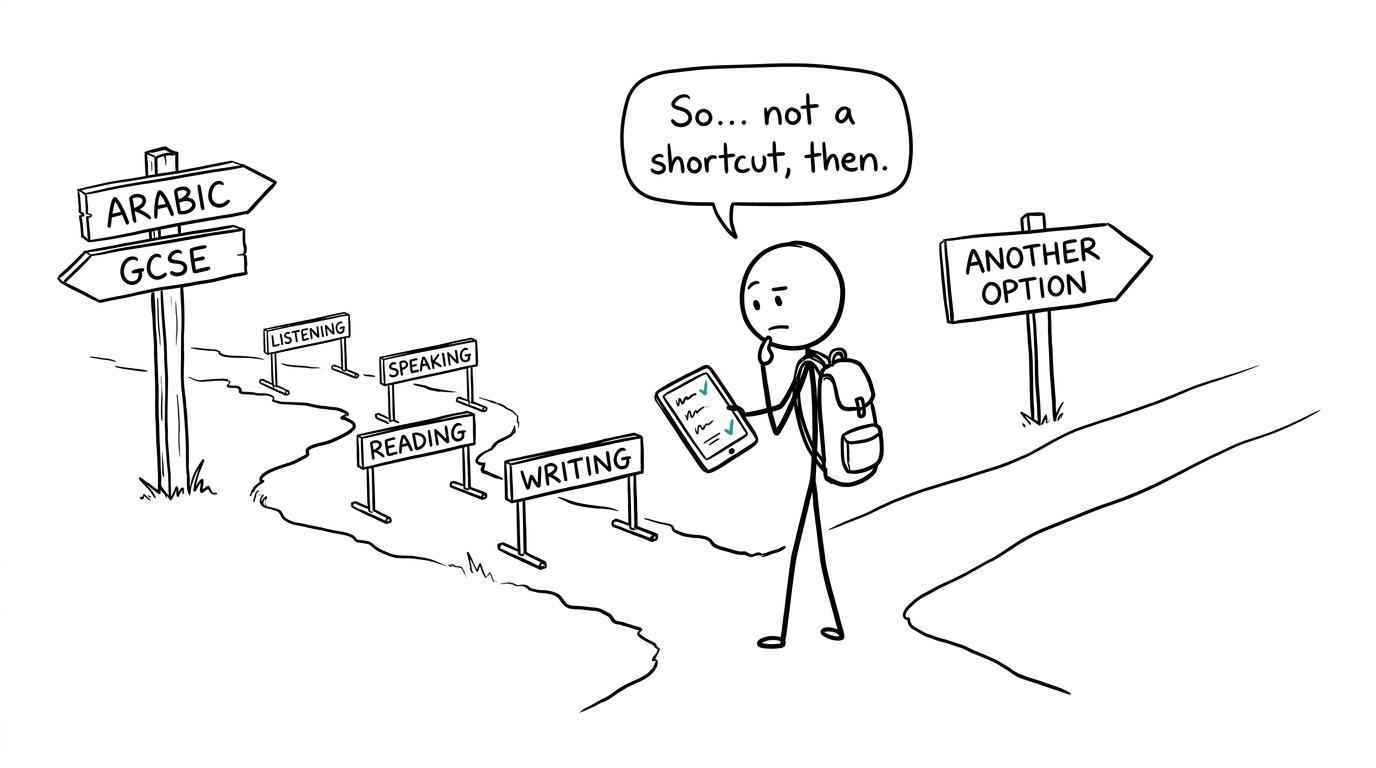 A student discovers that GCSE Arabic has four skill hurdles rather than offering a shortcut
What does GCSE Arabic actually involve?
For students taking Pearson Edexcel GCSE Arabic in summer 2026, the qualification has four compulsory assessments: listening, speaking, reading and writing. Each skill contributes 25%25\%25% of the qualification.
| Skill | What it tests | Weighting |
|---|---|---|
| Listening | Understanding spoken Arabic in public and social contexts | 25%25\%25% |
| Speaking | Communicating through a role play, picture task and conversation | 25%25\%25% |
| Reading | Understanding different written texts and translating into English | 25%25\%25% |
| Writing | Producing written responses and translating into Arabic | 25%25\%25% |
Foundation and higher tiers are available, but candidates must take the same tier across all four papers. Foundation targets grades 1-5 and higher targets grades 4-9. Dictionaries are not permitted in the assessments.
The content is organised around identity and culture; local area, holidays and travel; school; future aspirations, study and work; and international and global issues. These themes are studied in both home and Arabic-speaking contexts.
Qualification availability and specifications can change. Before planning around GCSE Arabic, ask your school or examination centre to confirm the board, specification, tier, teaching arrangements and examination series. Do not assume that every school offers it or accepts private entries.
The honest advantages of taking GCSE Arabic
It turns language knowledge into a recognised qualification
If you already speak some Arabic at home, GCSE study can give formal structure to that knowledge. Instead of relying only on informal conversation, you develop reading, writing, translation and understanding of Modern Standard Arabic.
That distinction matters. A student may communicate fluently with relatives yet find formal texts, unfamiliar vocabulary or extended writing difficult. Preparing for the GCSE can strengthen those weaker areas and provide a nationally recognised record of achievement.
It can support a broad GCSE programme
Arabic can count as the language component of the English Baccalaureate when the relevant approved qualification is taken alongside English, maths, sciences, history or geography, and a language. The EBacc is a performance measure and combination of subjects, not a separate certificate.
A language GCSE may also demonstrate breadth beside analytical subjects. However, it should not be treated as a guaranteed admissions advantage. Universities and sixth forms set their own requirements, and most will care far more about whether you meet the stated grades and subjects for your chosen course.
It may create a route into further language study
GCSE Arabic can provide a foundation for more advanced language learning where suitable courses are available. It may also complement later interests involving languages, linguistics, history, international relations or regional studies.
That does not mean one GCSE fixes your career direction. Few subjects work like that. Its value is more gradual: you build a skill that may become useful when combined with stronger fluency, further qualifications and subject-specific knowledge.
Existing knowledge can make progress more realistic
Students who already hear or use Arabic may begin with useful vocabulary, pronunciation and listening experience. That can reduce the distance between their starting point and the exam standard.
But prior exposure is an advantage, not a free pass. Regional dialects and Modern Standard Arabic are not interchangeable in every context. Formal reading, accurate writing and examination-style translation may still require substantial practice.
The drawbacks you should consider
Four skills create four different revision demands
Arabic is not revised through one method. Vocabulary lists may support reading and writing, but they do not automatically produce fluent speaking or reliable listening.
You need repeated contact with the language: reading unfamiliar material, hearing different voices, rehearsing spoken answers and writing under time pressure. If one skill is neglected, it still accounts for a quarter of the qualification.
Speaking can be difficult to practise independently
A textbook can help with vocabulary. It cannot fully reproduce a live conversation in which you must understand a question, select language and respond clearly.
Students without a teacher, tutor or confident speaking partner may find this part especially demanding. Before entering independently, establish how speaking practice will be conducted and how the formal assessment will be arranged.
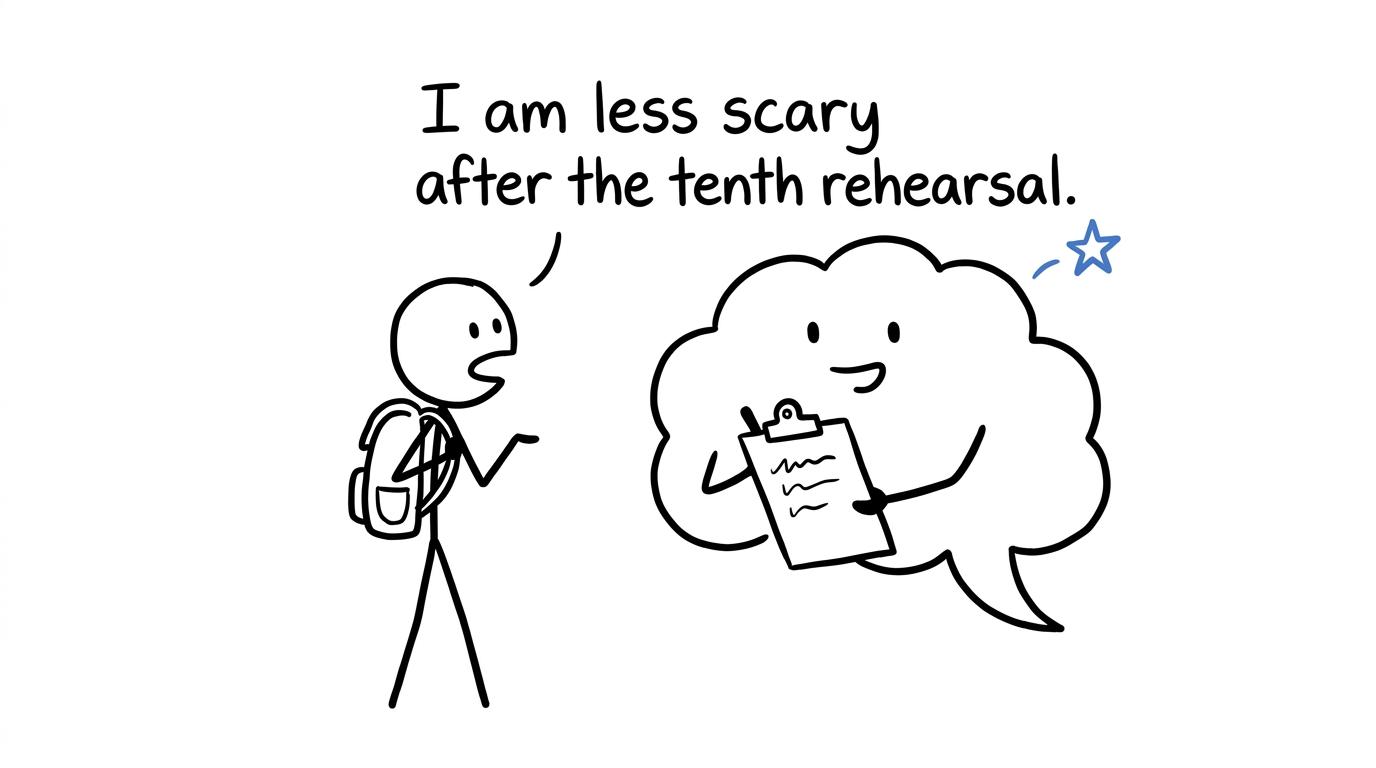 A speech bubble explains why repeated rehearsal makes a speaking assessment less intimidating
It can compete with essential revision time
Another GCSE is not merely another line on a timetable. It creates lessons, homework, vocabulary review, mock assessments and examination preparation.
That opportunity cost matters if you are struggling with compulsory subjects. A strong extra qualification is useful, but not if preparing for it repeatedly displaces the work needed to secure important maths and English grades.
Use the GCSE Maths Revision hub to check how much mathematics you still need to cover. The GCSE maths topics by exam board and tier guide can make the remaining workload more visible before you commit.
Heritage speakers can underestimate the formal course
Being able to speak Arabic socially does not guarantee high marks. Examinations reward evidence demonstrated through specific tasks. Formal vocabulary, reading speed, spelling, grammar and written development can expose gaps that ordinary conversation does not reveal.
This is not a reason to avoid the subject. It is a reason to begin with an honest assessment rather than an assumption.
How much work does GCSE Arabic take?
There is no reliable universal number of hours. The workload depends on your starting point, literacy, access to teaching and intended grade.
A fluent reader and writer may mainly need specification coverage and exam practice. A confident speaker who rarely reads Arabic may require far more time. A complete beginner usually faces the largest commitment because the script, vocabulary, grammar and four assessed skills must all develop together.
A realistic weekly routine should include:
- vocabulary recall across the specification themes;
- listening practice without relying immediately on a transcript;
- regular reading of unfamiliar passages;
- short writing tasks followed by correction;
- speaking rehearsal with feedback;
- periodic timed practice in the correct paper format.
The important word is regular. Languages respond poorly to occasional revision marathons because recall and fluency need repeated use.
Balancing Arabic with GCSE maths revision
Arabic and maths demand different kinds of attention, but both improve through short cycles of retrieval, practice and correction. The danger is allowing the subject you enjoy most to absorb all your revision time.
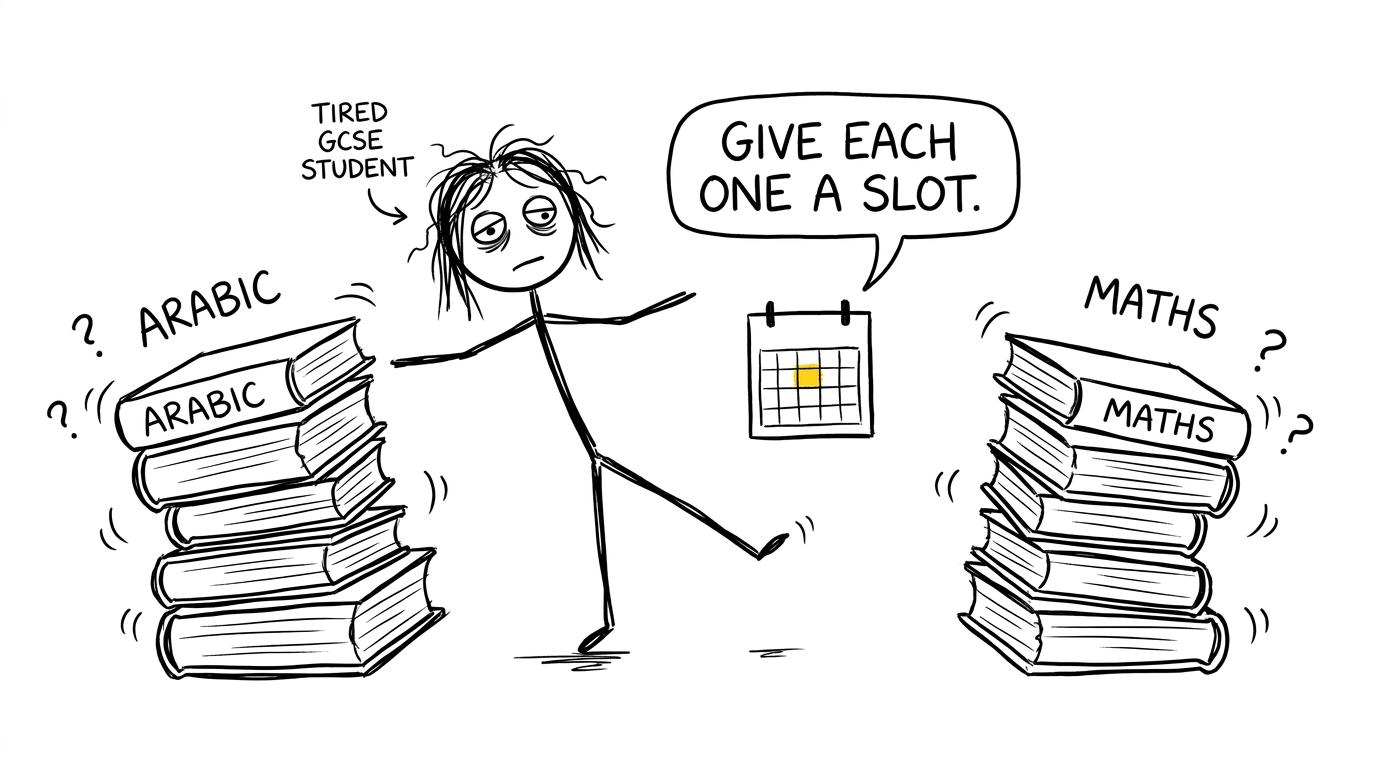 A student balances Arabic and maths books while a calendar calmly suggests giving each subject a slot
Start by giving each subject protected sessions. Arabic might need frequent shorter practice, while maths sessions can focus on one weak topic followed by exam questions. The 20-minute GCSE maths revision routine is useful on days when language homework is heavy.
For maths, use a simple sequence: learn, practise, mark, fix and retest. Once your topic knowledge is secure, move into Edexcel GCSE Maths past papers or the appropriate resources for your own board. The guide to using GCSE past papers properly explains how to turn lost marks into targeted revision rather than simply collecting scores.
Near the examination period, Edexcel GCSE Maths predicted papers can provide additional unseen practice. They should supplement official past papers, not replace them. If time is already tight, the one-week GCSE maths revision plan also shows how quickly competing commitments can fill a calendar.
Who is GCSE Arabic most likely to suit?
GCSE Arabic is a particularly sensible option if you:
- already have some speaking, reading or writing ability;
- enjoy languages and want to improve formal Arabic;
- can access consistent teaching and feedback;
- are prepared to work on all four skills;
- have enough capacity alongside compulsory GCSE subjects;
- may want to continue with languages later.
Think more carefully if you have no reliable teacher, expect home conversation alone to secure a high grade, dislike speaking assessments or are already overwhelmed by core subjects.
You do not need to be fluent before starting. But you do need a credible route from your current level to the specification requirements.
Common mistakes when deciding whether to take GCSE Arabic
Choosing it because it sounds like an easy extra GCSE
Existing knowledge helps, but the qualification still tests formal skills across four assessments. Look at the specification and sample materials before deciding.
Ignoring the difference between dialect and formal Arabic
A regional dialect can support communication and listening confidence, but the course requires Modern Standard Arabic. Identify your reading and writing gaps early.
Focusing only on a possible future benefit
A subject should fit your present workload as well as your future ambitions. Do not sacrifice secure progress in maths, English or science for a vague belief that any additional GCSE automatically impresses universities.
Entering without confirming assessment arrangements
Speaking assessments require proper organisation, and not every centre accepts external candidates. Confirm the board, tier, fees if applicable, deadlines and assessment arrangements before investing months of preparation.
Revising passively
Reading notes feels productive but does not test listening, spontaneous speaking or independent writing. Revision must reproduce the skill you will be assessed on.
So, is GCSE Arabic worth taking?
Yes, GCSE Arabic can be worth taking when it formalises genuine language ability, reflects a real interest and fits comfortably beside your core GCSEs. It is less worthwhile when chosen as a supposedly easy grade, attempted without teaching support or allowed to weaken essential revision elsewhere.
Make the decision using evidence: inspect the specification, test all four skills, confirm that a centre can enter you and map the weekly commitment against your other subjects. A good option choice should expand your future without quietly damaging your present.
Then protect the rest of your timetable. Use MathsGenie as your free maths revision base, with revision lessons, practice questions, mini tests, past papers, predicted papers, mark schemes and video solutions. Start at the MathsGenie GCSE Maths Revision hub, choose your exam board and turn each session into a clear next step.










