

Is GCSE Arabic Part of the EBacc? Your Options
Is GCSE Arabic EBacc eligible? Yes. Learn how Arabic fills the language pillar, what else you must study and what to confirm before choosing options.
Choosing GCSE options can feel strangely permanent. A subject sits in one column on a form, yet the decision seems to stretch years into the future. Students often ask “is GCSE Arabic EBacc?” because they want to know whether a language they speak, enjoy or hope to learn will count.
The short answer is yes. In England, an eligible GCSE in Arabic can count towards the language component of the English Baccalaureate. However, Arabic alone does not give you the EBacc. You must take the complete combination of English, maths, science, a language, and either history or geography.
There is another important detail: the EBacc is not a separate qualification or certificate. It is a combination of academic subjects used in school performance measures. Your school must also offer or approve the relevant Arabic qualification and enter you for it correctly.
GCSE Arabic and the EBacc: the quick checklist
Current Department for Education guidance confirms that ancient or modern foreign language GCSEs can satisfy the EBacc language requirement. Arabic is recognised as a modern foreign language for this purpose.
Before choosing your subjects, check the following:
- You are taking an eligible GCSE Arabic qualification, rather than a course with a similar name.
- Your school offers Arabic or permits an approved external entry.
- You are also entered for the other EBacc subject areas.
- Your school confirms how the entry will be recorded.
- You understand that the EBacc framework applies to schools in England.
A current example is Pearson Edexcel GCSE Arabic. Its specification assesses listening, speaking, reading and writing, with students entered at either foundation or higher tier. Qualification availability and performance-table eligibility can change, so your school’s examinations officer should confirm the exact specification and qualification number before you rely on it.
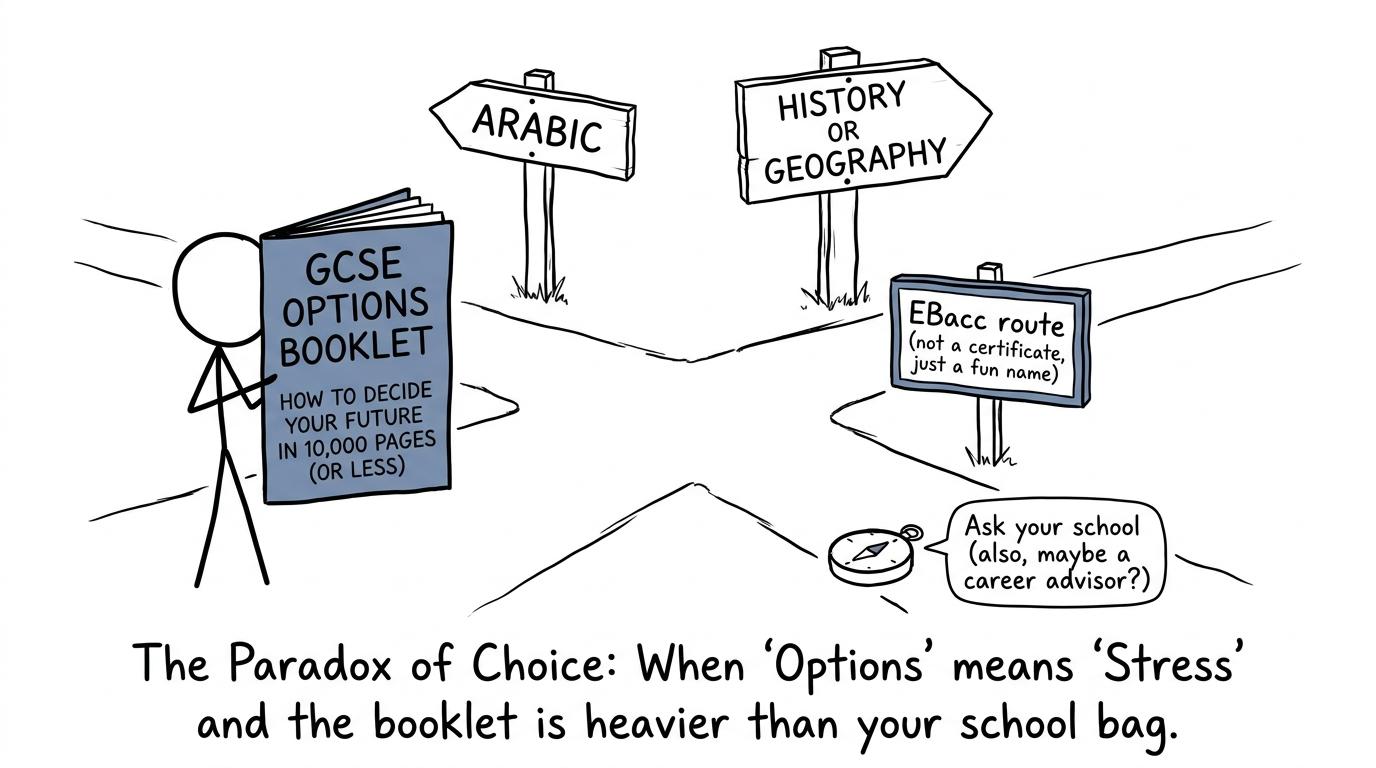 A student navigating GCSE options with signs for Arabic and the EBacc route
What subjects make up the EBacc?
The English Baccalaureate is organised into five subject areas, often called pillars.
| EBacc area | Subjects normally required |
|---|---|
| English | GCSE English language and GCSE English literature |
| Maths | GCSE mathematics |
| Science | An approved combination of science qualifications |
| Humanities | GCSE history or GCSE geography |
| Language | An eligible ancient or modern foreign language, including Arabic |
Depending on your science route, completing the full combination can involve up to 888 GCSE entries. That is why the EBacc is better understood as a subject pattern than as one extra course.
Arabic fills the language pillar. It does not replace history or geography, and it does not replace English. If you take English, maths, the required sciences and Arabic but choose neither history nor geography, you have not entered the full EBacc combination.
Likewise, taking Arabic does not turn an otherwise incomplete set of options into the EBacc. Every pillar matters.
What does “counts towards the EBacc” actually mean?
This phrase causes much of the confusion.
When an eligible Arabic GCSE counts towards the EBacc, it means the result can be used within the language component of the government’s Key Stage 444 accountability measures. It does not mean that “EBacc” will replace “Arabic” on your GCSE certificate. Your certificate records the individual qualification and grade.
The EBacc is also not an exam board. You do not sit an “EBacc paper”, and there is no separate EBacc mark scheme. Instead, results from the relevant GCSE subjects are brought together when entry and attainment measures are calculated.
For students, the practical meaning is simple: Arabic can be the language in your EBacc subject combination, provided the precise qualification is eligible and all the other requirements are met.
Does Arabic have to be taught by your school?
Your school controls its timetable, option blocks and examination entries. Although Arabic can count, that does not force every school to offer it as a classroom subject.
A school might:
- teach GCSE Arabic as a normal timetabled course;
- arrange lessons through another school or provider;
- allow a student with suitable preparation to enter the examination;
- decide that it cannot support the entry in a particular year.
If Arabic is not printed in your options booklet, ask rather than assume. Speak to your options lead, languages department and examinations officer. Useful questions include:
- Which GCSE Arabic specification would I take?
- Is it an eligible domestic GCSE for the EBacc?
- Who would prepare me for speaking and listening assessments?
- Would the lessons fit around my existing timetable?
- Would the school make the examination entry?
This is especially important if you are considering private tuition or an external examination centre. Being able to speak Arabic does not automatically create a GCSE result. You still need the correct qualification, preparation across every assessed skill and a valid examination entry.
GCSE Arabic is not automatically the same as International GCSE Arabic
Similar titles can hide important differences. A UK-regulated GCSE Arabic qualification and an International GCSE Arabic qualification are not necessarily interchangeable for English school performance measures.
Do not make the decision from the subject name alone. Ask your school to verify the exact qualification against the current Department for Education eligibility list. This small administrative check can prevent a large misunderstanding later.
How Arabic affects your GCSE options
Choosing Arabic may help you complete the EBacc while studying a language that is meaningful to you. But “it counts” should not be the only reason to choose it.
Think about three separate questions.
Is the qualification right for your language level?
GCSE language assessment covers more than informal conversation. You may need to understand different registers, read unfamiliar material, write accurately, translate and respond under timed conditions. A student who speaks Arabic at home may have strong listening and speaking skills but still need focused practice in formal reading, spelling or extended writing.
Equally, Arabic does not have to be your home language. What matters is whether the course, teaching and expected starting point suit you.
Does it fit your complete options pattern?
Check the whole timetable. To follow the EBacc route, you still need history or geography alongside the other core areas. Arabic may occupy an option block that affects which creative, technical or vocational subjects remain available.
There is no universal best combination. Schools organise choices differently, and your interests, future plans and workload matter. The value of keeping options open should be balanced against choosing courses you can engage with seriously.
Can you prepare for every assessment component?
Confidence in one skill can disguise gaps in another. Before entering, look at the official specification and sample assessment materials with a teacher. Find out how speaking practice will be organised and who can give reliable feedback on written responses.
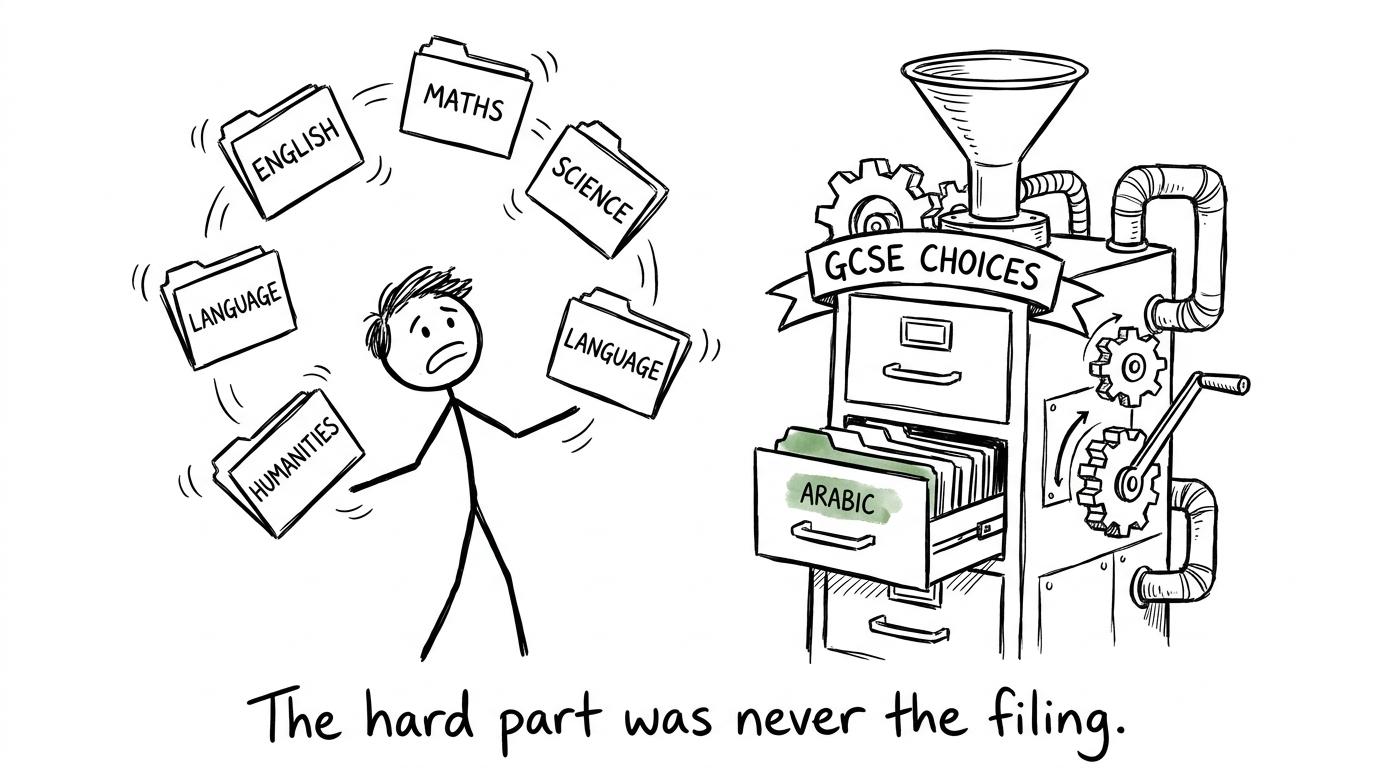 A student juggling the five EBacc subject folders
What this means for your maths revision
Maths is a compulsory EBacc pillar, regardless of which language you choose. Arabic may complete one part of your subject combination, but your GCSE maths result still depends on steady preparation at the correct tier and for the correct exam board.
Begin with the GCSE Maths Revision hub, where you can select resources for boards including Edexcel, AQA, OCR and Eduqas. Check your board and whether you are taking foundation or higher tier before downloading papers.
A manageable revision loop is:
- identify one weak topic;
- use a revision lesson to rebuild the method;
- complete practice questions without copying;
- mark the work carefully;
- record the exact reason for each lost mark;
- retest the topic later.
The MathsGenie resources collection brings together paper-based revision materials, while Edexcel GCSE maths mini tests provide shorter timed checks for students on that board.
If your timetable feels crowded, build a repeatable plan rather than waiting for a free weekend that may never arrive. The GCSE maths revision timetable guide explains how to combine topic work with timed practice. For a shorter runway, use the one-month GCSE maths revision plan.
Past papers become most useful when you learn from them. Follow the process in how to use GCSE past papers properly: complete, mark, diagnose, repair and retest. Predicted papers can provide fresh practice near the examinations, but they should supplement official past papers rather than replace them. The guide to GCSE predicted topics explains how to use predictions without gambling your revision on guesses.
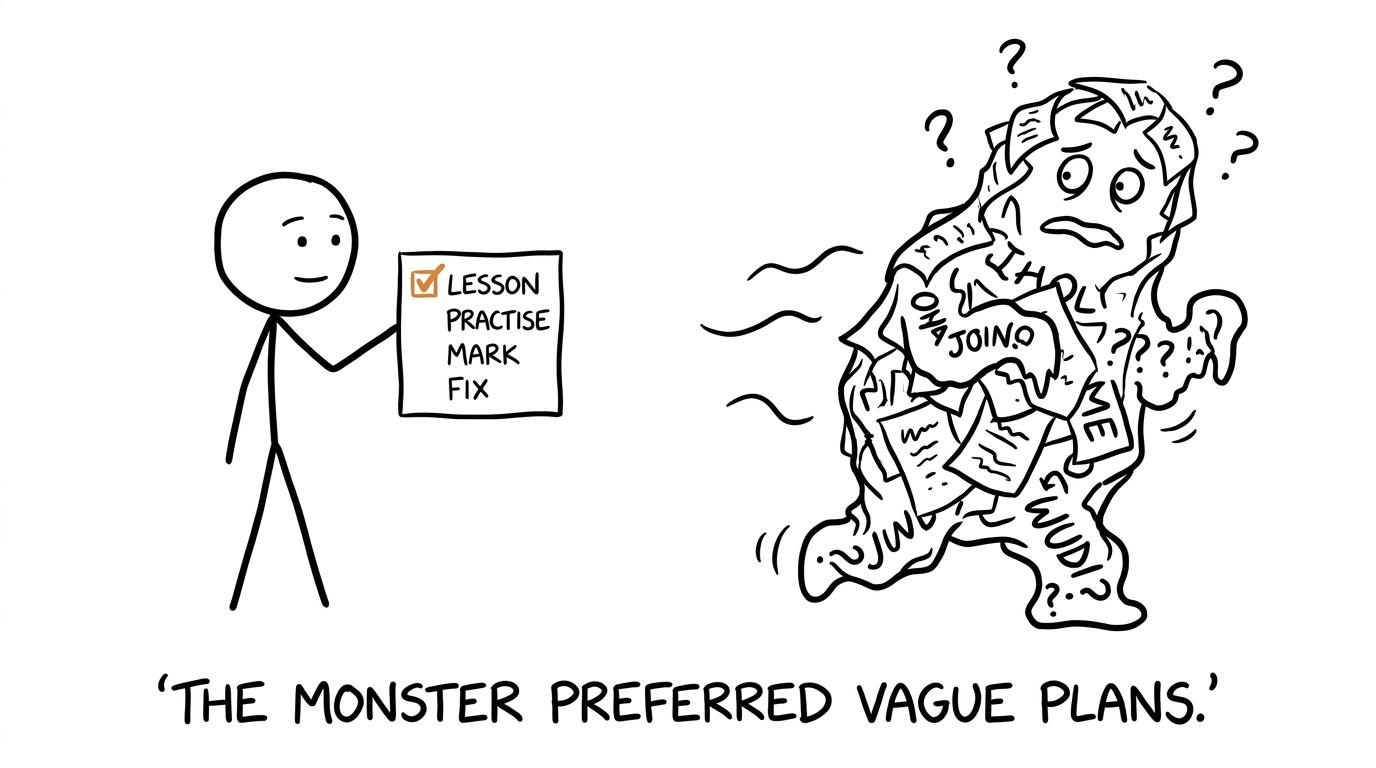 A revision checklist defeating a monster made from scattered notes
Common mistakes when thinking about Arabic and the EBacc
Assuming the EBacc is a separate qualification
It is a combination of subjects and an accountability measure, not another GCSE. There is no standalone EBacc examination or certificate.
Thinking Arabic replaces any EBacc subject
Arabic satisfies the language component only. You still need the required English, maths and science qualifications plus history or geography.
Assuming every course called Arabic is eligible
GCSE, International GCSE and other language qualifications may be treated differently. Confirm the exact title and qualification number with your school.
Believing home fluency guarantees an easy high grade
Speaking confidently is valuable, but the assessment also tests listening, reading and writing. Formal accuracy and examination technique still require preparation.
Forgetting that school arrangements matter
A qualification may be nationally eligible while remaining unavailable through your school. Confirm teaching, speaking arrangements, timetable compatibility, fees where applicable and examination entry before making plans.
Letting option uncertainty interrupt core revision
Subject choices deserve careful thought, but they should not consume every revision session. If you are unsure where maths marks are being lost, use MathsGenie’s guide to finding your weakest GCSE topics and turn the result into a short priority list.
Make the choice, then build the routine
So, is GCSE Arabic part of the EBacc? Yes, an eligible GCSE Arabic qualification can satisfy the language pillar in England. You must still complete the other required subject areas, and your school should verify the precise qualification and entry arrangements.
The decision is important, but it is only the beginning. Grades are usually built through smaller choices repeated over time: opening the lesson, attempting the questions, reading the mark scheme and returning to the mistake.
Once your options are clear, make MathsGenie your free maths revision base. Start with revision lessons and practice questions, use mini tests to check recall, then progress to past papers and predicted papers with mark schemes and video solutions. A clear subject plan keeps your route open. A consistent revision plan helps you travel it.










