

International Students: A-Level Results Day
International students A-Level results day guide: plan for time zones, remote results, UCAS decisions, Clearing, university contact and visa next steps.
Results day can feel strangely distant when your school is thousands of miles away. The building may be opening for collection while your city is asleep, and a simple phone call can become complicated by time zones. For international students, A-Level results day preparation is mostly about removing that uncertainty early: confirm how you will receive your grades, translate every important time into your local time zone, and know whom to contact if your university decision is unclear.
For 2026, A level results in England, Wales and Northern Ireland are released on Thursday 13 August. Centres may give results to candidates from 08:00 UK time, but your school or college decides its own collection and remote-access arrangements.
Your overseas results day checklist
Before travelling or switching off for the summer, make sure you have:
- written confirmation of how your school will send your results;
- the release time converted into your local time zone;
- working school portal and UCAS sign-in details;
- current email addresses and telephone numbers in your UCAS application;
- your UCAS Personal ID and university applicant numbers;
- contact details for your school, firm choice and insurance choice;
- digital copies of your passport, offer information and previous qualifications;
- a quiet place, charged phone and reliable internet connection;
- a short list of alternative courses in case you need Clearing.
Save these details somewhere available offline. A plan stored only in an email account is not much help if that account suddenly asks for a verification code sent to an old UK number.
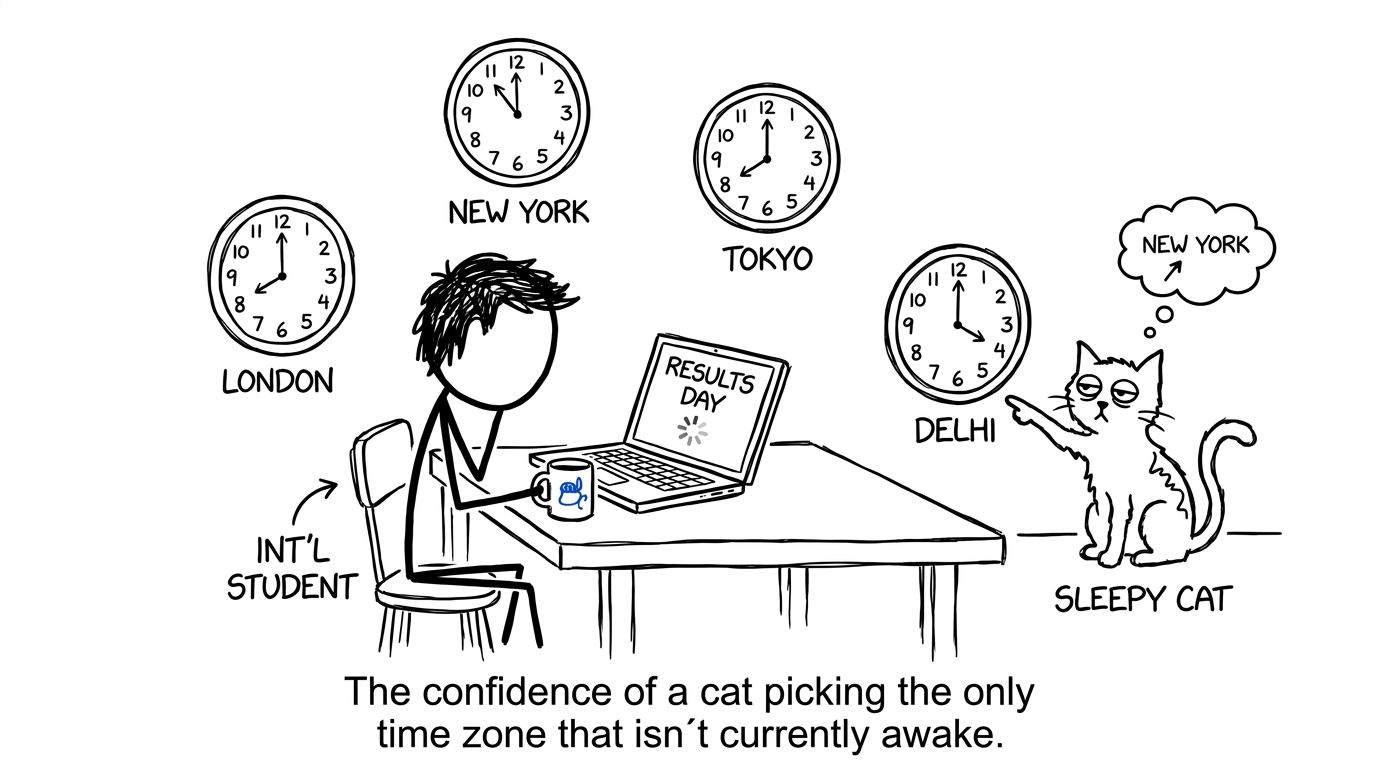 A sleepy international student checks several clocks while a cat chooses the wrong one
Confirm how you will receive your A level results
Do not assume that UCAS will show your grades. UCAS displays the status of your university application, while your school or college provides your results. Ask the exams officer whether you will receive a secure portal login, an encrypted email, a telephone appointment or another approved form of remote access.
Make this arrangement before the school closes for summer. Confirm:
- which email address will be used;
- whether identification is required;
- when the portal or message becomes available;
- whether somebody else may collect results for you;
- whom to contact if the message does not arrive.
If a parent or trusted adult may need to speak to UCAS for you, arrange nominated access in advance. This does not automatically give them permission to collect school results, so check the centre's separate policy too.
Plan around UK time, not your local date
Students often remember the date but overlook the clock. Write 08:00 UK time on 13 August 2026 beside the equivalent local time and date where you will be staying. Use a reliable time-zone converter close to results day because daylight-saving rules differ between countries.
Be available when your school and universities are open in the UK. If results arrive during your night, decide whether to wake for them or wait until morning. The sensible choice depends on your offer and whether you may need rapid contact with a university. Build in time for busy telephone lines and delayed application updates.
Understand the school, UCAS and university roles
Three systems are involved, and they do different jobs:
- Your school or college receives your provisional grades and releases them to you.
- UCAS matches many UK qualification results to applications and displays university decisions.
- Your university decides whether to confirm your place when it receives the required evidence.
Most UK GCE AS and A level results reach UCAS automatically. However, UCAS advises that students with many international qualifications must send their evidence to universities themselves. Check how every qualification listed in your offer will be delivered, particularly International A levels, English-language qualifications and any required GCSE results.
If you are currently preparing for GCSEs, this is worth remembering now. Universities may ask for particular GCSE grades, especially in maths and English, alongside A levels. Keep certificates and accurate digital copies rather than assuming every result will transfer automatically.
Prepare for each possible decision
If your place is confirmed
Read the university's instructions rather than rushing straight to travel bookings. International students may need to complete financial, accommodation or immigration steps. A UK Student visa application requires a Confirmation of Acceptance for Studies, known as a CAS, from a licensed student sponsor. The university controls when it assigns this, so follow its international admissions guidance and never treat a UCAS update as the CAS itself.
If your application is still conditional
A pending decision does not necessarily mean rejection. The university may be waiting for a result, checking whether it can accept a near miss or processing a large volume of decisions. Check your email and application first, then contact admissions with your applicant number and complete grades ready.
If you enter Clearing
International applicants can use Clearing in the same way as UK applicants, but visa timing, English-language evidence and course start dates need particular attention. Research alternatives before results day, record the course codes and check whether each university can sponsor international students.
Speak to a university before adding a Clearing choice. Ask about academic entry requirements, fees, deposits, accommodation, the CAS process and the latest realistic arrival date.
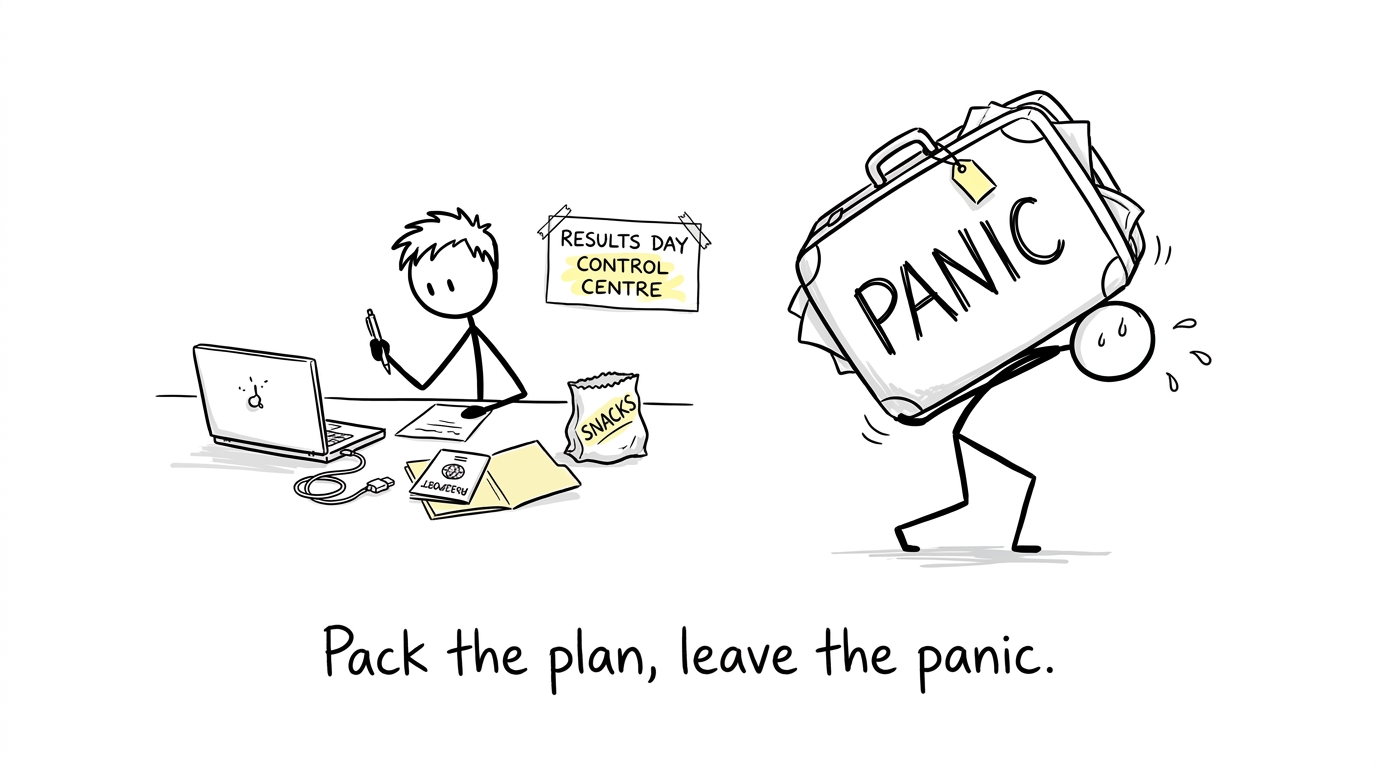 A student packs a calm results-day control centre while someone carries a suitcase labelled panic
Keep revision and results preparation separate
Results-day logistics matter, but they cannot replace the work that produces the grades. GCSE students can start with the GCSE Maths Revision hub, while A level students can use the A Level Maths Revision hub.
Choose resources matching your board and specification. MathsGenie provides dedicated support for Edexcel GCSE Maths, AQA GCSE Maths and Edexcel A Level Maths. Use the revision planner to organise lessons and practice, then test your progress with GCSE predicted papers or A Level predicted papers.
Common mistakes overseas students should avoid
- Assuming UCAS supplies the grades: obtain the actual results from your school or college.
- Converting the time zone from memory: check the UK release time against your location.
- Waiting until results day to test logins: reset passwords and update telephone numbers early.
- Sending only part of the evidence: read every condition attached to the offer.
- Treating a pending decision as a rejection: check messages and contact admissions calmly.
- Making immediate travel purchases: wait for confirmation and review the university's visa and arrival instructions.
- Having no communication backup: keep alternative email, internet and telephone options available.
A calm plan travels well
Being overseas changes the logistics, not the value of preparation. Confirm the delivery method, convert the time, gather your documents and write down the next action for every possible outcome. Then return your attention to what you can still influence.
MathsGenie can support that quieter part of the journey with free revision lessons, practice questions, past papers, predicted papers, mini tests, mark schemes and video solutions. Build a manageable plan now, and let results day become a sequence of informed decisions rather than a scramble for information.











