Imposter Syndrome: Top Set GCSE Statistics
Imposter syndrome top set GCSE Statistics explained: why capable students feel behind, how to challenge that feeling, and build a calm revision plan.
A top-set classroom can create a strange illusion. You see the student who answers quickly, the one who remembers every sampling method and the one who finishes the histogram before you have labelled the axes. You do not see their crossed-out working, private doubts or revision at home.
So, is imposter syndrome in top set GCSE Statistics common? Imposter feelings appear to be common among students and high achievers generally, but there is no reliable research giving a precise figure for top-set GCSE Statistics students. What we can say is that feeling out of place does not prove that you are out of place. It often reflects comparison, perfectionism and pressure rather than ability.
The practical answer is not to wait until you feel confident. It is to collect better evidence about what you know, improve specific weaknesses and ask for support when the pressure becomes difficult to manage.
A quick checklist
If top set has started to feel uncomfortable, remember:
- a set is a teaching arrangement, not a verdict on your intelligence;
- fast answers are not the same as deep understanding;
- GCSE Statistics includes interpretation as well as calculation;
- mistakes identify skills to practise, not whether you belong;
- confidence often follows repeated evidence of progress;
- persistent anxiety deserves support from a trusted adult.
You can begin by opening the GCSE Statistics revision hub and checking the resources for your exam board and tier.
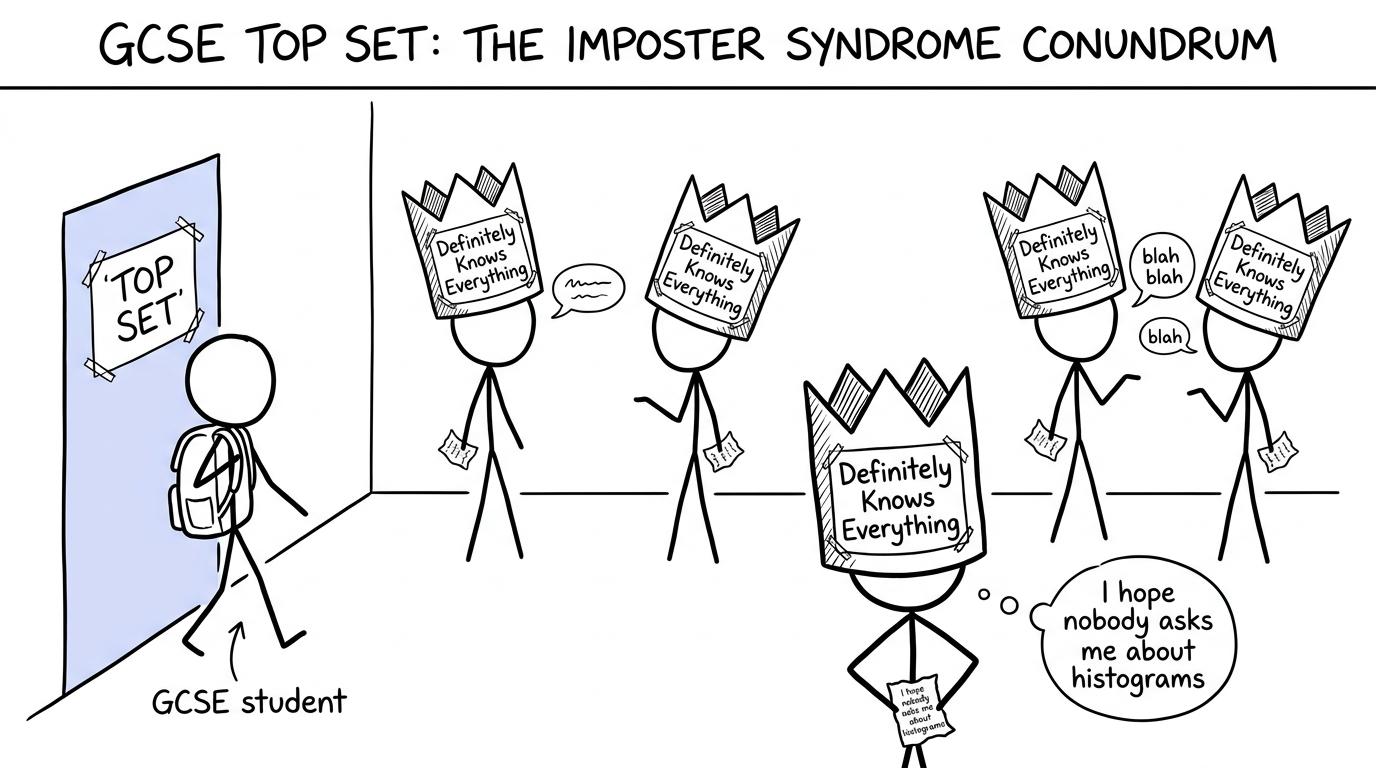 Top-set students wearing confident crowns while privately worrying about histograms
What imposter syndrome actually means
The term describes a pattern in which someone doubts their competence despite evidence that they are capable. Success may be dismissed as luck, an easy test or help from somebody else. A difficult lesson, meanwhile, is treated as proof that everyone has finally discovered the truth.
Researchers often prefer the term impostor phenomenon or impostor feelings. It is not, by itself, a formal clinical diagnosis. That distinction matters: an article can help you recognise an unhelpful pattern, but it cannot diagnose what you are experiencing.
Research reviews have found these feelings across different ages and academic settings. However, reported prevalence varies greatly because studies use different populations, questionnaires and thresholds. Most research also concerns university students or professionals rather than pupils in a particular GCSE class. Any exact claim such as “half of top-set Statistics students feel this way” would therefore be invented precision.
The honest conclusion is simpler. You are unlikely to be the only person experiencing it, even if nobody else says so.
Why top set can make capable students feel behind
Your comparison group has changed
A student who previously felt comfortably strong at maths may enter top set and suddenly be surrounded by other strong students. Their ability has not disappeared. The reference group has changed.
Statistics offers a useful way to think about this. A value can appear high or low depending on the distribution against which it is compared. In the same way, being slower than several fast classmates does not mean your understanding is weak across the whole GCSE cohort.
Top set concentrates visible strengths in one room. It also hides how uneven those strengths can be. One student may be excellent at probability but uncertain about sampling. Another may calculate accurately but struggle to interpret conclusions in context.
Speed is unusually visible
Classroom speed is easy to notice. Understanding is harder to observe.
The first raised hand may belong to somebody who has seen a similar question before. A quieter student may take longer, check assumptions and produce a better explanation. GCSE mark schemes reward correct reasoning and communication, not winning an unofficial race to finish first.
When revising, separate fluency from knowledge. If you can answer accurately without a time limit, you probably need timed practice. If you cannot choose a method, you need to revisit the topic. These are different problems and deserve different solutions.
Statistics contains genuine uncertainty
Statistics is not merely a collection of formulas. You may need to assess bias, choose a suitable graph, compare distributions or decide whether evidence supports a hypothesis. Sometimes more than one observation is relevant, provided it is justified clearly.
That can feel unsettling to a student who expects every question to have one obvious route. Yet uncertainty is part of the subject. Finding an interpretation question difficult does not mean you lack mathematical ability. It means you are learning how to make a defensible judgement from data.
Official GCSE Statistics content includes data collection, processing and representation, analysis and probability. AQA and Edexcel offer foundation and higher tiers, although your school’s internal set name does not itself determine the tier you will sit. Check with your teacher if you are unsure about your entry.
How to test the feeling against evidence
Imposter thinking makes a broad claim: “I cannot do Statistics.” A useful response is to demand better data.
After a test or practice session, divide lost marks into categories:
- missing knowledge;
- incorrect method;
- weak interpretation;
- inaccurate calculation;
- misreading the question;
- incomplete working or wording.
This turns a judgement about your identity into information about your next action. “I am not a top-set student” cannot be revised. “I confuse correlation with causation” can.
Use the mark scheme carefully. Record what earned marks as well as what lost them. Otherwise, your revision log becomes a biased sample containing only failures.
For exam-board practice, the Edexcel GCSE Statistics revision page brings together lessons, worksheets and exam questions. When you are ready for mixed practice, use Edexcel GCSE Statistics past papers under realistic conditions and check how each mark is awarded.
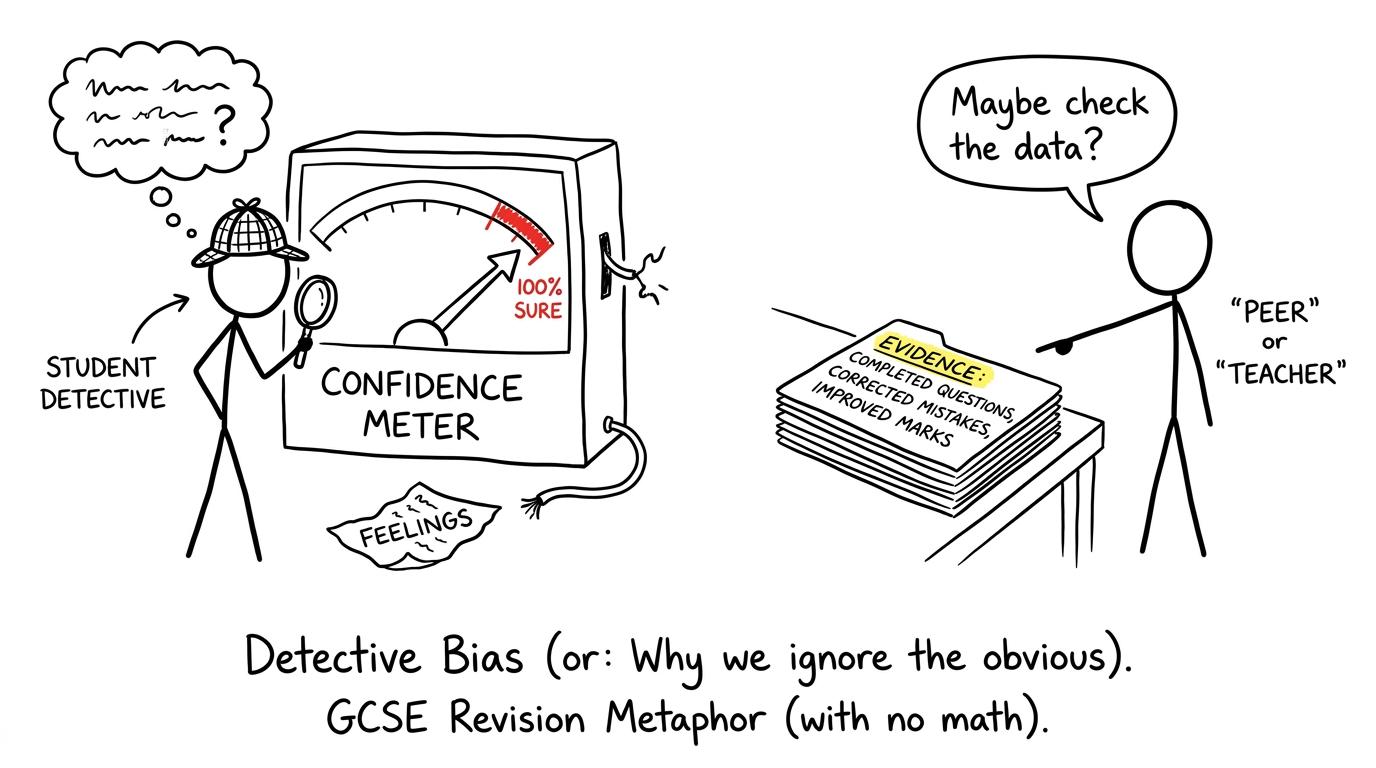 A student detective ignoring a folder of evidence while inspecting a confidence meter
What actually helps with confidence and marks
Build confidence topic by topic
Trying to “become good at Statistics” is too vague. Choose one defined skill instead.
You might revise how area represents frequency using the histograms revision resources, then answer questions without copying a method. On another day, use the cumulative frequency revision guide to secure quartiles, medians and box plots.
A dependable revision cycle is:
- learn or review one idea;
- answer focused questions independently;
- mark them precisely;
- write one correction for each lost mark;
- reattempt the skill after a short gap;
- test it later in a mixed paper.
Confidence built this way is less dramatic than a motivational speech. It is also more reliable.
Practise explanation, not just calculation
Top-set students sometimes spend most of their time on technically difficult calculations because those questions feel suitably challenging. Yet marks can also disappear through vague statistical language.
Practise explaining comparisons using measures of location and spread. Distinguish association from causation. Refer to the context, units, sample and possible bias where relevant. A sentence should say what the data suggest and why, rather than merely naming a feature.
The scatter graphs revision resources can help you practise correlation, lines of best fit and sensible estimates. For chance topics, the probability revision section provides lessons, questions and self-testing resources.
Use papers as diagnosis, not judgement
A disappointing raw mark can feel like a final ruling. It is actually a snapshot taken under particular conditions.
Before interpreting it, ask whether you had revised the full content, used the correct timing and marked against the right paper and tier. Then inspect where the marks went. A paper becomes valuable when it changes what you practise next.
Do not repeatedly complete papers without repairing the gaps they reveal. Alternate mixed papers with focused topic work. MathsGenie’s guide to revising GCSE maths efficiently explains a similar learn, practise, mark and re-test loop.
Speak before the problem grows
Tell your teacher if you consistently feel lost. Use a specific question: “Which three topics should I prioritise?” is easier to answer than “Am I bad at Statistics?”
You might also ask whether the difficulty is knowledge, exam technique or timing. A teacher can compare your perception with classroom evidence you may be overlooking.
If stress is persistent, affects sleep or makes ordinary life difficult, speak to a parent, carer, teacher, school pastoral lead or GP. NHS guidance recommends breaking revision into manageable chunks, planning time, sleeping properly and talking to somebody you trust. Seeking help is not an admission that you do not belong in top set.
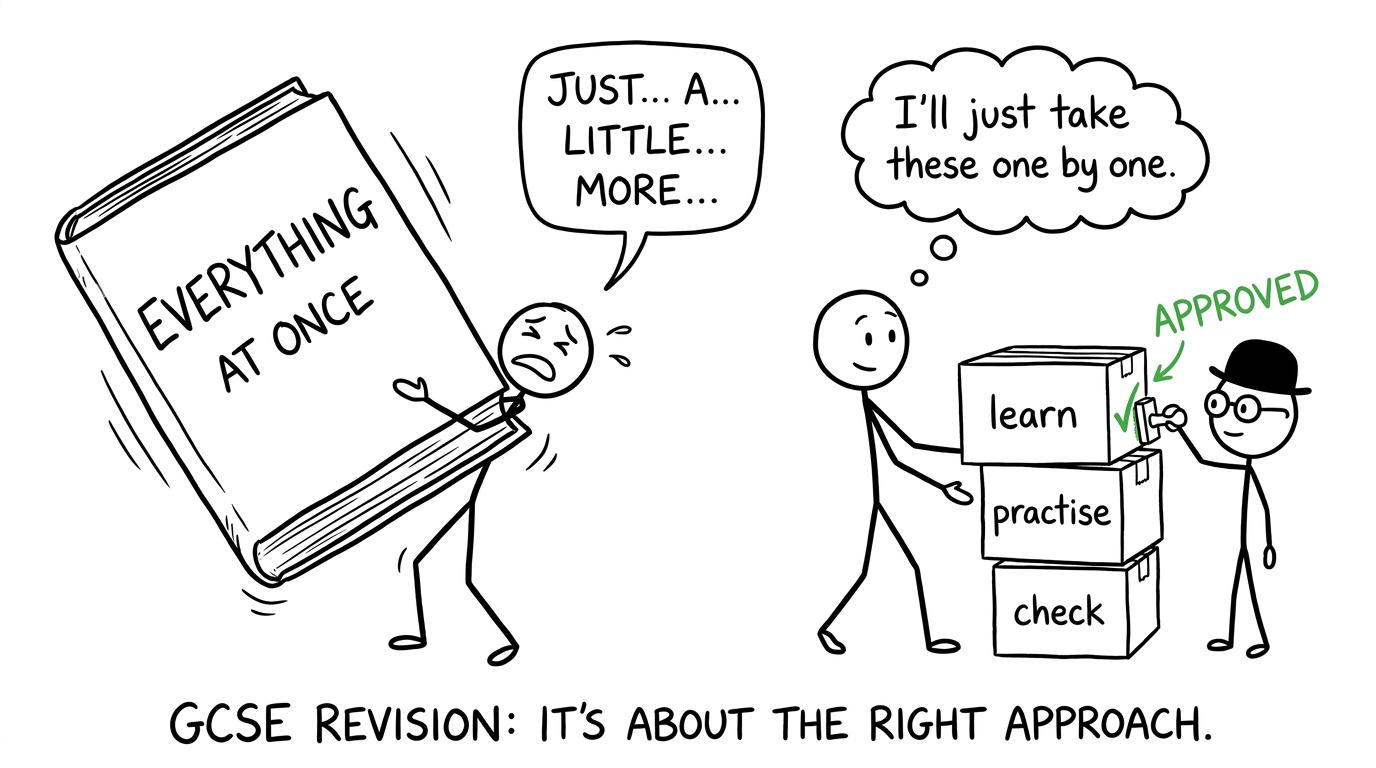 One student lifting everything at once while another carries small learn, practise and check boxes
Common mistakes when trying to overcome imposter feelings
Revising only your strongest topics
Familiar questions provide quick reassurance, but they may not repair the gaps causing anxiety. Keep some confidence-building work, then spend most of the session on one clearly identified weakness.
Treating every mistake as evidence
A dropped mark might reveal a misunderstood concept, but it could also come from rounding, units, wording or reading the wrong value from a graph. Classify the error before deciding what it means.
Comparing hours instead of outcomes
Another student’s revision time tells you little about its quality. Track completed questions, corrected misconceptions and performance on later attempts. Evidence of learning is more useful than hours at a desk.
Jumping straight to the hardest questions
Difficulty is not proof of productive revision. Secure the underlying method first, then increase complexity. Starting beyond your current level can create unnecessary evidence for an inaccurate belief that you cannot cope.
Using predicted papers as guarantees
Predicted papers can provide useful practice, but they cannot promise which questions will appear. Cover the specification, use past papers and treat predictions as an additional resource rather than a substitute for broad revision.
Your next step with MathsGenie
Belonging in top set does not require you to know everything immediately. It means you are in a class where you are expected to encounter demanding ideas and learn from them. Confusion is sometimes evidence that the work is stretching you, not that a mistake has been made.
Begin with one honest diagnostic task. Mark it, name the weakest skill and choose the matching MathsGenie revision lesson or practice questions. Then return to that skill until the evidence changes.
MathsGenie gives you free revision lessons, past papers, predicted papers, practice questions, mark schemes, video solutions, mini tests and planning tools in one place. Start at the GCSE Statistics revision hub, select your board and tier, and make your next revision session small enough to begin today.