

How to Use Timed Practice for GCSE Maths
Learn how to use timed practice for GCSE Maths with research-informed advice, a sample revision week and practical ways to review mistakes and plan ahead.
You can recognise every line in your revision notes and still freeze when an exam question asks you to choose a method. Knowing how to use timed practice for GCSE Maths means closing those notes, attempting suitable questions within a manageable time limit, marking them carefully and returning to mistakes later. The clock helps you practise pacing. The questions and feedback do the learning.
Imagine a hypothetical student called Sam, who rereads algebra notes because they feel reassuringly familiar. A short question set reveals the gap between recognising a method and choosing it independently.
Your timed practice checklist
Before starting, have these ready:
- Questions matched to your exam board and foundation or higher tier.
- A topic you have already learnt.
- A manageable time limit and separate marking slot.
- The correct calculator conditions and permitted resources.
- Somewhere to record mistakes and schedule another attempt.
The GCSE Maths revision timetable guide explains how to fit topic revision and paper practice together.
What the research actually supports
A review by John Dunlosky and colleagues, published in Psychological Science in the Public Interest in 2013, rated practice testing and distributed practice highly. Rereading received a low overall utility rating. This supports attempting questions from memory and spreading revision across separate sessions.
It does not establish that adding a countdown improves every session. Retrieval practice and time pressure are separate ingredients.
Research titled Distributed Practice and Time Pressure Interact to Affect Learning and Retention of Arithmetic Facts, published in the Journal of Numerical Cognition, found that timing increased perceived stress and had effects that depended on practice spacing. Its arithmetic tasks were narrower than GCSE problem solving, so the findings cannot establish an ideal GCSE routine.
The practical judgement: retrieve methods regularly, use feedback, and introduce timing to rehearse exam decisions. No particular session length guarantees better grades.
Apply timed practice to maths
Sam replaces one rereading session with questions, marking and a later retry. Each stage has a purpose.
Choose questions you are ready to attempt
Start with a method you understand but cannot yet use reliably. MathsGenie's GCSE Maths revision resources provide a starting point.
If you cannot begin without copying a solution, pause the timer. Use a revision lesson to repair the gap, explain the method in your own words, then attempt a fresh question independently.
Set a limit that reveals your habits
Begin with a short set, perhaps ten minutes. This is a starting suggestion, not a research-backed optimum. Choose enough questions to keep working without cramming a whole topic into the slot.
For exam rehearsal, check the paper's duration and instructions. Formats vary between qualifications and boards. If you receive approved access arrangements, rehearse using your applicable conditions.
Edexcel students can use GCSE Maths mini tests. Choose resources matching your board and specification.
Work independently, then review slowly
Keep notes and solutions closed. Write clear working. If you become stuck, record what you tried, move on and return if time remains.
When time ends, draw a line. Continue in a different colour if helpful, distinguishing what you completed within the limit from what you could solve with longer.
Mark carefully. Did each lost mark come from missing knowledge, choosing the wrong method, inaccurate calculation, misreading or running out of time? These causes need different responses.
Return after a gap
Sam records “could not choose the method” rather than “bad at algebra”. A few days later, Sam attempts a fresh question requiring the same skill, with the solution hidden.
Copying a correction immediately can feel successful because the answer remains in memory. A later independent attempt provides stronger evidence of learning.
Schedule attempts, marking and retries in the Revision Planner.
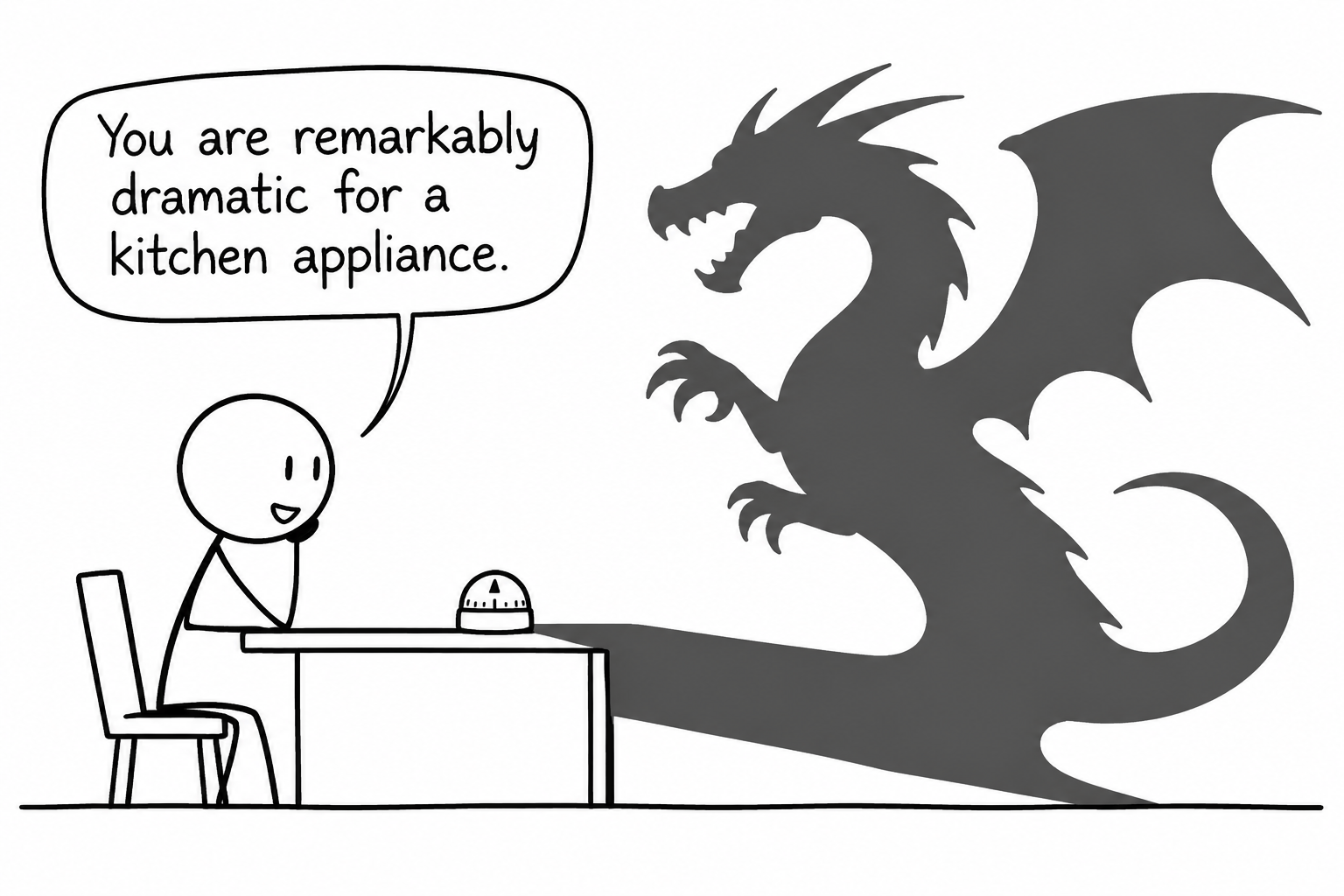 A stick-figure student calmly addresses a kitchen timer whose shadow resembles an enormous dragon.
A sample week of timed practice revision
Adapt this suggested week around lessons, homework and other subjects. Protect review time when making adjustments.
| Day | Session | Purpose |
|---|---|---|
| Monday | Ten minutes of familiar questions, then ten minutes marking | Identify one weakness |
| Tuesday | Fifteen minutes of untimed revision | Repair that weakness |
| Wednesday | Ten minutes of fresh questions, then ten minutes reviewing | Check recall after a gap |
| Thursday | Planned homework only | Keep the schedule realistic |
| Friday | Fifteen minutes of mixed questions, then fifteen minutes marking | Practise choosing methods |
| Saturday | Twenty minutes reviewing Friday's hardest questions | Explain errors and attempt corrections |
| Sunday | Ten minutes checking errors and planning | Choose next week's priority |
Once shorter attempts feel manageable, replace one with a longer paper section. Full papers help rehearse stamina and pacing. Read when to start GCSE past papers for guidance on introducing them.
Common mistakes that make timing less useful
Chasing speed before accuracy. Finishing faster means little if you omit working or repeat errors. Compare questions of similar difficulty and check that your reasoning remains clear.
Treating every question equally. A reasoning problem may deserve longer than a short calculation. Use marks and difficulty as rough guides, while remaining willing to move on.
Skipping feedback. Another timed set will not explain yesterday's mistake. MathsGenie's GCSE paper resources include past papers, predicted papers and mini tests. Use mark schemes and available video solutions after attempting questions. Predicted papers cannot promise exam content.
Ignoring distress. If timing repeatedly stops you thinking clearly, shorten the set or practise untimed first. Discuss persistent difficulties with your teacher.
Turn the method into your weekly routine
Sam's useful change is a repeatable sequence: attempt, review, repair and revisit. Start with one manageable session, then let your mistakes guide the next. Build your schedule in MathsGenie's Revision Planner and give feedback as much attention as the clock.















