

How to Use Self-Explanation for GCSE Maths
How to use self-explanation for GCSE Maths: replace passive rereading with clear prompts, worked examples and a practical weekly revision plan.
A student can spend an hour rereading algebra notes and finish with a comforting sense of recognition. Then the first independent question appears, and the method vanishes.
Learning how to use self-explanation for GCSE Maths helps close that gap. Instead of merely reading a solution, you explain why each step works, how it connects to what you know and when you could use it again. The short answer is simple: study a method, hide the explanation, reconstruct it in your own words, answer a related question and check your reasoning.
Imagine a student called Sam. Sam's old routine was to read notes, highlight formulas and watch solutions without pausing. The pages became familiar, but the decisions behind the maths did not. Self-explanation changed the question from “Have I seen this?” to “Could I justify this?”
The self-explanation checklist
For each topic, use this cycle:
- Choose one method or worked solution.
- Pause after every meaningful step.
- Ask what changed and why it was valid.
- Connect the step to a rule, definition or earlier topic.
- Hide the solution and reconstruct it.
- Complete a similar question independently.
- Check against the answer or mark scheme.
- Record any explanation you could not give clearly.
That is self-explanation revision in practice. It is active, specific and testable.
What self-explanation means
Self-explanation is the act of generating links and inferences while learning. In maths, it means explaining the reasoning that joins one line of working to the next, rather than narrating the symbols mechanically.
Suppose a solution contains:
3x+7=22 3x+7=22 3x+7=22 3x=15 3x=15 3x=15 x=5 x=5 x=5A weak explanation says, “Then it becomes 3x=153x=153x=15, and the answer is 555.” A useful explanation says, “I subtract 777 from both sides to preserve equality. I then divide both sides by 333 to isolate xxx.”
The second version identifies the mathematical principles. It is more likely to transfer when the numbers, signs or layout change.
Self-explanation is not the same as making beautiful notes. It may be spoken, written in brief annotations or completed mentally. What matters is that you generate the reasoning instead of copying it.
What the research says
A 2018 meta-analysis by Bisra and colleagues examined self-explanation prompts across different learning tasks and subjects. It reported an overall positive effect on learning, suggesting that prompting learners to explain can be useful across a range of conditions.
There are sensible reasons for this. Explaining a step can expose a missing connection that rereading conceals. It also makes the learner select relevant knowledge, connect new information to prior knowledge and notice when a procedure has been followed without being understood.
The evidence does not mean that talking through anything automatically improves attainment. The quality of the prompt and explanation matters. “I did this because that is the method” adds little. A focused prompt such as “Which property allows this step?” demands more thought.
Nor should self-explanation replace question practice, feedback or instruction. It works best as a layer within those activities. Sam still needs to solve unfamiliar questions and use mark schemes. Explaining an incorrect idea repeatedly would only make the error more fluent.
How to use self-explanation for GCSE Maths
Start with a focused resource
Choose one topic from the GCSE Maths revision resources, rather than opening several chapters at once. Use a revision lesson or worked solution that matches your exam board and tier where relevant.
Watch or read only enough to reach one important step. Then pause. Self-explanation becomes weaker when an entire solution is consumed before any thinking happens.
Ask mathematical questions
Use a small set of prompts repeatedly:
- What is the goal of this step?
- Which fact, definition or rule justifies it?
- Why is this operation allowed?
- What would change if a value were negative or fractional?
- How could I check the result?
- What clue in the question suggested this method?
- How is this different from a similar topic?
For geometry, name the theorem and check its conditions. For algebra, explain how equality is maintained. For probability, identify the sample space and whether outcomes overlap. For graphs, connect a feature of the equation to a feature of the graph.
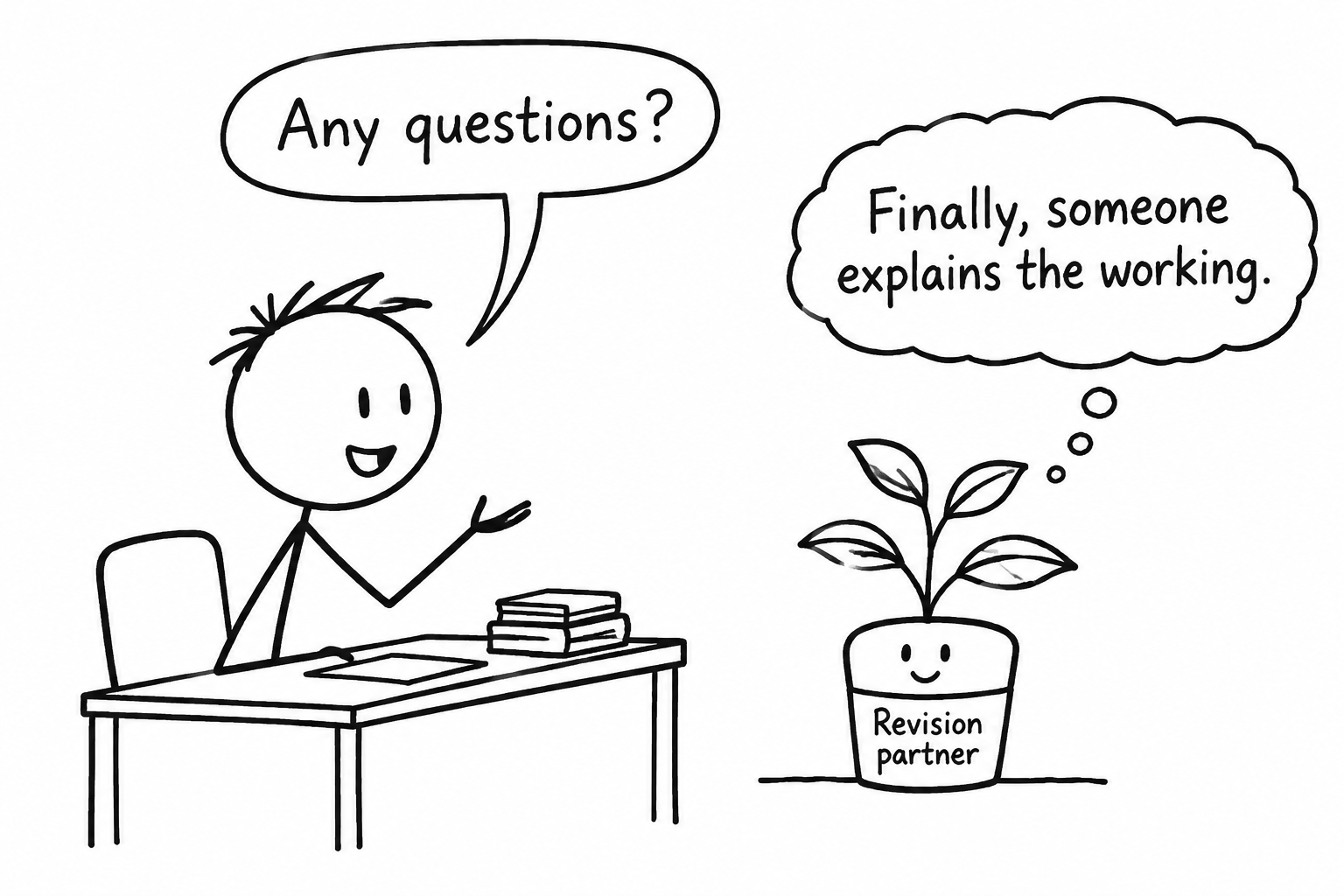 A GCSE student explains revision to an unexpectedly demanding houseplant
Reconstruct before practising
After studying a solution, cover it and reproduce the method. Explain the decisions aloud or add short notes beside your working. If you become stuck, reveal only the next step, then explain why it follows.
Next, complete a related question without support. This distinction matters. Reconstructing a known solution tests whether you understood the example; answering a fresh question tests whether you can select and apply the method.
Check the explanation as well as the answer
An answer can be correct for the wrong reason. Compare your working with a reliable solution or mark scheme and ask:
- Did I use a valid method?
- Did I communicate enough working for the available marks?
- Was my explanation precise?
- Could the method work on a less familiar question?
When you find an error, do not merely cross it out. Write one corrective sentence, such as “I cannot cancel terms across addition; cancellation applies to common factors.” That sentence becomes a useful prompt for the next session.
Once this method feels manageable, you can place the sessions into a GCSE Maths revision timetable, or let the Revision Planner organise when you will return to them.
A sample week of self-explanation revision
Sam replaces five rereading sessions with this plan. Each session has a clear purpose, and the topics are examples rather than a compulsory order.
| Day | Activity | Self-explanation focus |
|---|---|---|
| Monday | Learn one algebra method, then reconstruct an example | Explain why each operation preserves equality |
| Tuesday | Answer targeted algebra questions | Explain how each question signals the required method |
| Wednesday | Review a geometry lesson and two examples | State the theorem and verify that its conditions apply |
| Thursday | Complete mixed algebra and geometry questions | Explain why one method fits and a tempting alternative does not |
| Friday | Attempt a short mini test | Mark it, then explain every error or uncertain answer |
| Saturday | Complete part of a past paper under timed conditions | Add explanations only after the timed attempt |
| Sunday | Review the week's error notes | Re-answer two weak questions without looking at the solution |
The structure alternates learning, retrieval, mixed practice and checking. For a longer runway to the exams, use the one-month GCSE Maths revision plan as a broader framework.
Common mistakes to avoid
Narrating instead of explaining
Saying “I moved the 444 over” describes an appearance, not a mathematical operation. Say what operation was applied to both sides and why equality remains true.
Explaining with the solution visible
A visible answer creates recognition. Covering it forces reconstruction. Use both stages, but do not confuse the first with independent recall.
Spending too long talking
Self-explanation should support problem-solving, not consume the whole session. Explain pivotal decisions, unfamiliar steps and errors. Routine arithmetic does not need a speech every time.
Trusting your own explanation without checking
A confident explanation can still be wrong. Verify it with MathsGenie video solutions, mark schemes or teacher feedback, then correct misconceptions promptly.
Using it instead of exam practice
GCSE Maths rewards choosing methods and applying them under time pressure. Self-explanation develops understanding, while practice questions and past papers test performance. You need both.
When self-explanation is less useful
This GCSE maths study technique has limits. A beginner may lack enough knowledge to produce an accurate explanation. In that case, learn from a clear model first and use narrower prompts. If a topic is already secure, lengthy explanations can waste time; a brief justification and harder question may be better.
It can also slow you down, which is helpful during learning but unsuitable for every timed session. Practise explanations during untimed revision, then gradually shorten them into efficient internal checks. Use full timed papers to rehearse exam pace.
The aim is not to explain everything forever. It is to build reasoning strong enough that the right decisions become available when the question changes.
Turn the method into a schedule
Sam's improvement begins not with a miraculous result, but with a more honest routine: fewer familiar pages, more justified decisions and regular checks. Knowing the cycle is the first step; fitting it around school, other subjects and fixed exam dates is the next.
You have seen how a self-explanation week works. Now build your day-by-day schedule in the Revision Planner.















