How to Revise for Level 2 Further Maths
How to revise for Level 2 Further Maths with focused topic practice, retrieval, marking and timed papers alongside your GCSE revision each week.

A student opens a Further Maths paper and recognises almost every topic. Yet the first question involving an unfamiliar function still stops them. A parent watching from the other side of the table may assume that more revision hours are the answer. Often, the real problem is not effort. It is that the hours have no clear job.
The practical answer to how to revise for Level 2 Further Maths is to follow a repeating cycle: identify weak topics, relearn one method, answer questions without notes, mark the work carefully, and return to the topic several days later. Add timed papers only after the underlying techniques are becoming reliable.
This guide shows you how to build that cycle around your existing GCSE revision rather than creating an unmanageable second timetable.
Your Level 2 Further Maths revision checklist
A useful plan should include:
- the exact specification and paper format for your qualification
- an honest topic audit based on questions, not confidence alone
- short sessions combining retrieval and exam practice
- regular review of previous mistakes
- gradual movement from topic questions to mixed and timed papers
- protected time for your other GCSE subjects
If you are taking AQA Certificate Level 2 Further Mathematics, the qualification extends GCSE work through areas including algebra, functions, coordinate geometry, calculus, matrices and geometry. It is assessed through two written papers, each lasting one hour and forty-five minutes and carrying 808080 marks. Other Level 2 qualifications can differ, so confirm your awarding body and specification before planning.
Begin with evidence, not a favourite topic
Imagine a student who says, “I need to revise matrices.” That may be true, but it is not yet a plan. Which matrix skill is weak? Is the student forgetting the method, making arithmetic errors, or misunderstanding what a transformation represents?
Start with a short sample from several areas of the course. Use topic questions or part of an AQA Further Maths past paper, then mark every answer. Sort the results into three groups:
- Secure: you can answer unfamiliar questions without help.
- Unsteady: you understand the idea but make errors or need prompts.
- Not secure: you cannot yet choose or complete the method.
This audit is more useful than highlighting a specification. Recognition can feel like knowledge, but an exam asks you to produce a method independently.
Your first revision sessions should focus mainly on the unsteady group. These topics are often close enough to understanding that careful practice produces meaningful progress. Keep some time for insecure areas and revisit secure material through mixed questions.
Use a three-stage study technique
Each topic session should have three distinct stages: retrieve, practise and check.
Retrieve the method
Close your notes and write down what you remember. For differentiation, for example, you might recall that:
ddx(axn)=anxn−1.\frac{d}{dx}(ax^n)=anx^{n-1}.dxd(axn)=anxn−1.Then ask what each part means and when the rule applies. This is stronger than copying a worked solution because it exposes missing knowledge immediately.
If recall fails, use a short revision lesson or video solution to rebuild the method. Keep this phase brief. Watching feels productive, but Further Maths improves when you make decisions yourself.
Practise without support
Answer a small set of questions with notes closed. Begin with direct applications, then include at least one question where the required method is not announced.
This matters because exam questions may connect topics. A coordinate geometry problem could require algebraic manipulation; a function question may depend on solving an equation accurately. Topic practice builds the tool, while mixed practice teaches you when to use it.
Check and record the cause
Use the mark scheme after completing the questions, not during them. Record why each mark was lost:
- missing knowledge
- wrong method
- algebraic or arithmetic error
- incomplete reasoning
- misreading the question
- poor use of time
The category determines the next action. Missing knowledge requires relearning. A recurring algebraic slip needs slower written working. Misreading needs deliberate annotation of command words and given information.
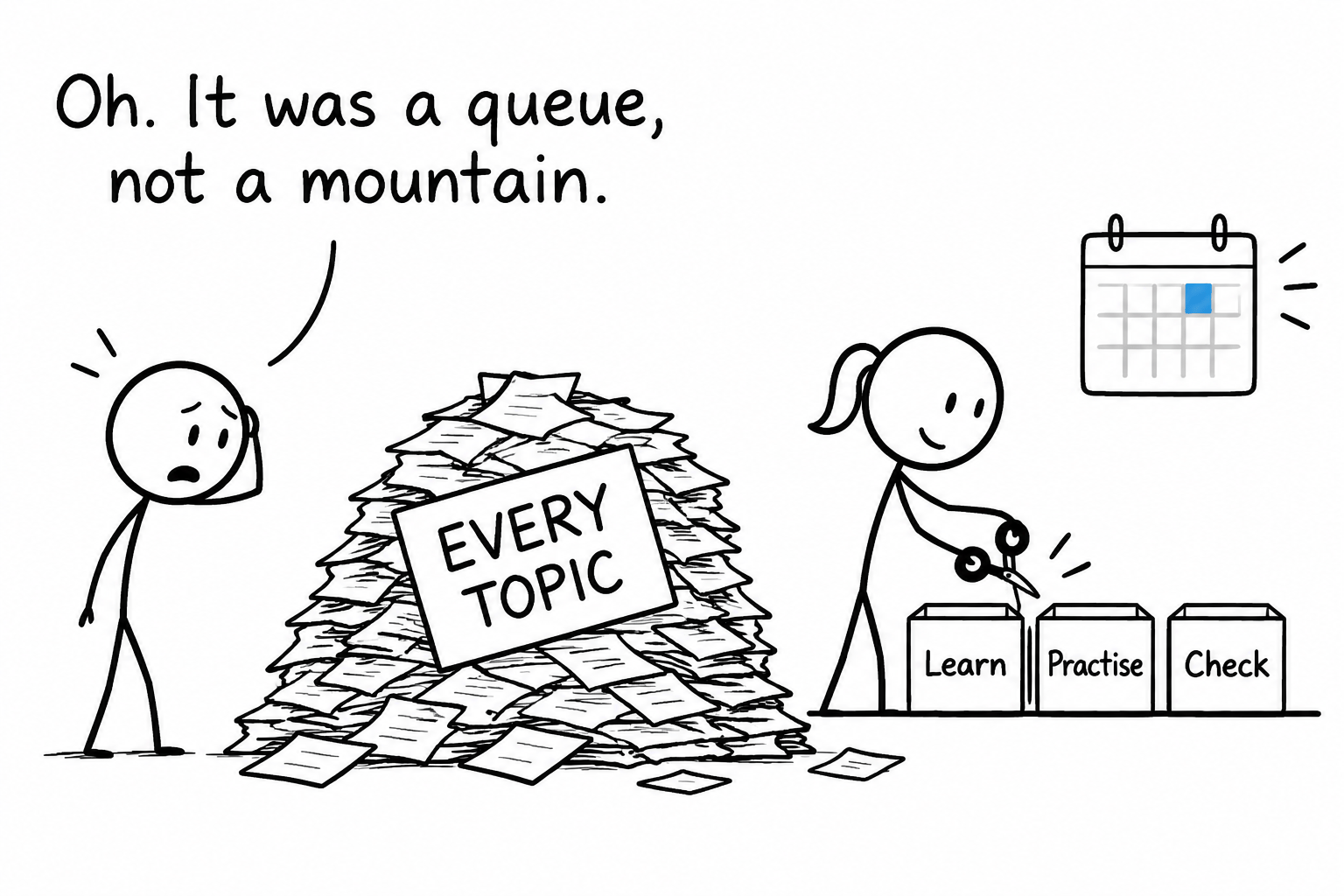 A student and parent turn an intimidating revision mountain into a manageable queue
Build a weekly revision plan
Further Maths should not consume every available evening. It sits alongside GCSE Maths and your other subjects, so consistency matters more than occasional exhausting sessions. The GCSE revision timetable guide can help you organise the wider week, while the guide to daily GCSE revision hours explains why workload must remain realistic.
A balanced Further Maths week might contain:
- one session for an insecure topic
- one session for an unsteady topic
- one mixed-question session
- one short review of previous errors
- a paper or longer timed section when the exam is approaching
A session does not need to be long to be useful. A focused block of roughly 303030-454545 minutes can contain retrieval, several questions and proper marking. The right duration depends on your concentration, current workload and distance from the exam.
Space repeated topics across the week. If you revise matrices on Monday, check them again briefly on Thursday or Friday. That delayed return is important because successful revision is not proving that you can do something immediately after seeing it. It is proving that you can still do it later.
Once this weekly structure is clear, you can build it in the MathsGenie Revision Planner rather than repeatedly redrawing it around every homework deadline.
Coordinate Further Maths with GCSE Maths
There is considerable overlap in the underlying skills. Strong algebra, graphs, trigonometry and coordinate geometry support Further Maths, so avoid treating the courses as unrelated.
If rearranging expressions causes mistakes in Further Maths calculus, the sensible response may be a short GCSE algebra repair session. This is not stepping backwards. Advanced questions often reveal small weaknesses in foundational techniques.
However, do not let ordinary GCSE revision replace qualification-specific practice. Matrices and introductory calculus, for example, need dedicated attention where they appear in your specification. Your plan should therefore contain both foundational repair and genuine Level 2 Further Maths questions.
Parents can help without becoming the teacher. Ask the student what the session is meant to achieve, whether it was completed, and what the marking revealed. “What will you revisit?” is usually more useful than “How many hours did you do?”
Move from topics to timed papers
Past papers are most valuable after you have repaired several major gaps. Used too early, a full paper may simply confirm that many topics have not been learnt. Used too late, it leaves no time to improve exam technique.
Progress through three phases:
Untimed paper sections
Choose groups of questions and concentrate on selecting methods and showing complete working. Mark them immediately and add useful errors to your log.
Timed sections
Complete a defined portion under exam conditions. This helps you judge when to move on and whether slow algebra is consuming too much time.
Full papers
Complete full papers in the correct conditions for your qualification. For AQA, that means preparing for both the non-calculator and calculator papers. Review the mark scheme carefully, then revise the topics responsible for lost marks before attempting another paper.
If the exam is already very close, use the three-day Further Maths revision plan to prioritise rather than attempting to compress months of work into every remaining hour.
Common Level 2 Further Maths revision mistakes
Spending too long making notes
Neat notes can organise ideas, but they do not demonstrate independent problem-solving. Use notes to clarify a method, then close them and answer questions.
Practising only comfortable algebra
Further Maths often attracts students who already enjoy algebra. That strength can become a hiding place. Allocate time according to evidence from marked work, not preference.
Treating every mistake equally
A forgotten formula and a copied sign error need different responses. Label the cause so that your next session fixes the real problem.
Starting a new paper without reviewing the last one
The value of a past paper lies in the feedback loop. If you do not correct and revisit mistakes, completing more papers can merely rehearse the same weaknesses.
Building an impossible timetable
A plan containing several hours every evening may look ambitious, but missed sessions quickly make it feel like failure. Build around school, sleep, other subjects and fixed commitments. If workload is your concern, the GCSE Maths revision timetable guide offers a broader framework for lessons, questions, marking and papers.
Turn the plan into a schedule
The student at the kitchen table does not need a heroic number of hours. They need to know which topic comes next, when an old topic will return, and when paper practice begins. Knowing that structure is the first step; following it consistently until a fixed exam date is the harder part.
You have seen how to combine diagnosis, retrieval, spaced practice and timed papers. Now build your Level 2 Further Maths schedule in the Revision Planner.