GCSE Further Maths Last-Minute Revision Plan: 3 Days
GCSE further maths last minute revision plan: use three calm days to diagnose gaps, practise key topics, mark papers and prepare for exam day.
The exam is three days away. Your notes seem larger than they did last week, matrices have quietly disappeared from memory, and every untouched past paper feels like evidence that you started too late.
Pause. Three days cannot rebuild an entire course, but they can still improve what happens in the exam. This GCSE further maths last minute revision plan gives each day one job: diagnose, repair and rehearse. You will prioritise questions over rereading, learn from mark schemes and protect enough energy to think clearly when the paper arrives.
Start at the AQA GCSE Further Maths revision hub, where MathsGenie brings together lessons, questions, past papers and mark schemes.
Your calm three-day checklist
Keep the plan visible and simple:
- Day one: diagnose: establish the paper you are taking, complete a mixed assessment and identify your three biggest marks leaks.
- Day two: repair: relearn those weak skills, practise them immediately and test whether the repair has worked.
- Day three: rehearse: complete controlled exam practice, review recurring errors and finish early enough to rest.
- Use active question practice in every substantial session.
- Mark work on the same day and record specific corrections.
- Keep ordinary GCSE Higher skills warm because Further Maths builds upon them.
- Confirm calculator rules, equipment, start time and location.
- Do not attempt to cover everything equally.
Panic usually asks an enormous question: “How can I learn the whole course?” A useful plan asks a smaller one: “Which action is most likely to protect my next mark?”
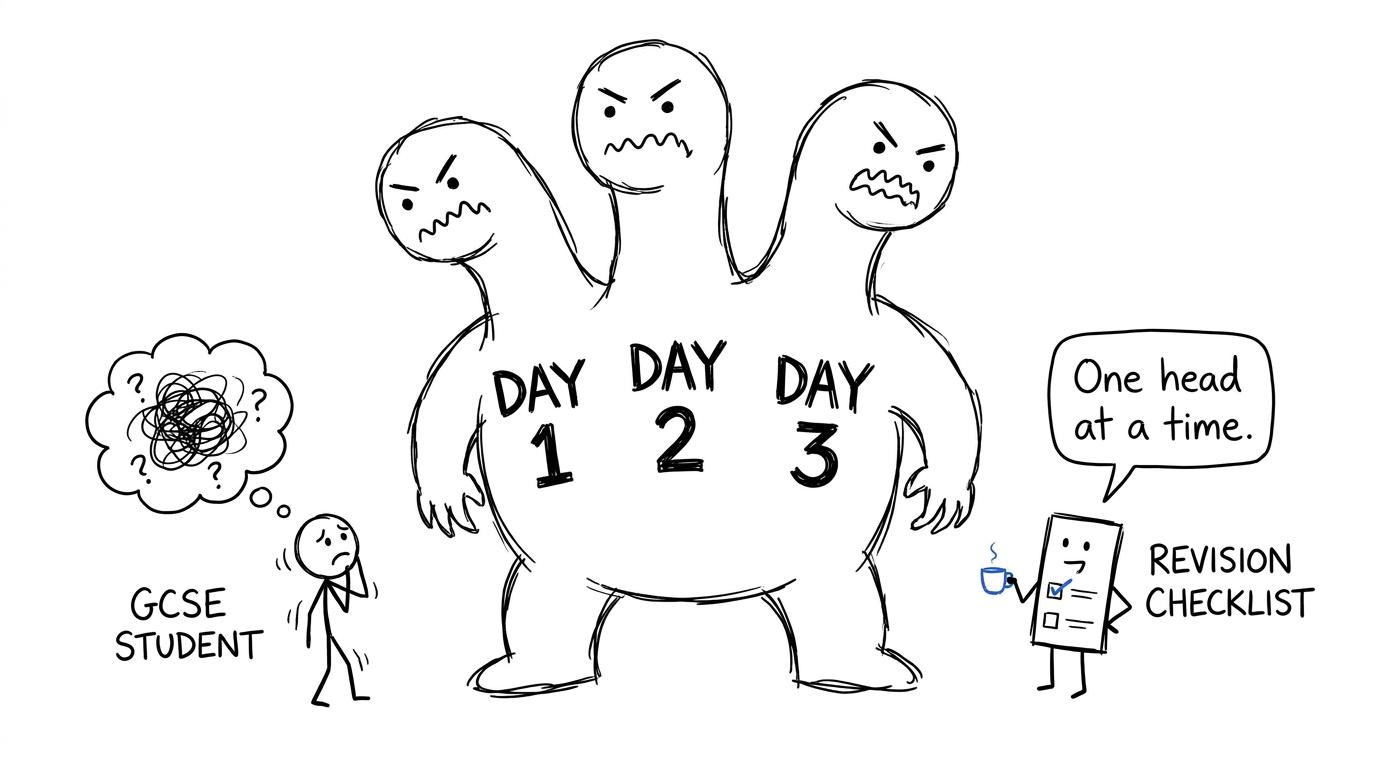 A calm checklist faces the three-day revision monster
Before revising, confirm your qualification
“GCSE Further Maths” can describe different qualifications informally, so check the front of a school paper, your exam timetable or ask your teacher. Do not assume that a resource matches simply because its title says Further Maths.
For AQA Level 2 Certificate in Further Mathematics, the specification contains number, algebra, coordinate geometry, calculus, matrix transformations and geometry. It is a linear qualification with two papers. Paper 1 is a non-calculator paper and Paper 2 allows a calculator; each lasts 111 hour 454545 minutes, carries 808080 marks and can assess content from across the specification.
There is no foundation or higher tier for this AQA qualification. That differs from ordinary GCSE Maths, where your tier matters.
OCR Additional Mathematics is a Level 3 FSMQ rather than the same AQA Level 2 course. Its content and assessment structure differ, so an OCR student should follow the precise specification and instructions supplied by their school. The same principle applies to any other Further or Additional Maths qualification.
Spend five minutes confirming:
- the awarding body and qualification name;
- the paper number;
- whether it is calculator or non-calculator;
- the duration and start time;
- which resources match your specification.
Five careful minutes here can prevent three days of practising for the wrong paper.
Day one: diagnose where the marks are going
Day one is not for producing beautiful notes. It is for replacing vague fear with evidence.
Set up a short diagnostic
Choose a recent paper or a substantial mixed section from the AQA Further Maths resources. Work for approximately 606060 to 757575 minutes under the correct calculator conditions. If a question stops you completely, circle it and continue rather than opening your notes.
Then mark the work strictly. For each lost mark, assign one cause:
- knowledge: you did not know the required fact or method;
- recognition: you knew the method but did not identify when to use it;
- execution: algebra, signs, arithmetic or notation went wrong;
- exam technique: working was missing, the question was misread or time was poorly allocated.
The distinction matters. Watching another lesson may help a knowledge gap, but it will not cure omitted working or careless matrix order.
If you need a sharper diagnostic method, use MathsGenie’s guide to finding your weakest GCSE topics quickly.
Build a three-topic priority list
Select no more than three areas for intensive repair. For an AQA student, your shortlist might come from:
- algebraic manipulation, equations and inequalities;
- functions, graphs and coordinate geometry;
- differentiation and its applications;
- matrices and matrix transformations;
- geometry, trigonometry and algebraic proof.
Choose according to your marked evidence, not somebody else’s predicted topic list. Predictions may help organise fresh practice, but they cannot guarantee what will appear. MathsGenie’s guide to using predicted GCSE topics without guessing explains that distinction.
Finish day one with one short repair session on the largest weakness. Use this loop:
- review one focused revision lesson;
- close the explanation;
- complete a small set of questions;
- mark immediately;
- write one sentence describing the correction;
- retry a similar question without support.
Day two: repair the weaknesses that matter
Day two carries most of the deliberate practice. Divide it into three focused blocks of roughly 505050 minutes, with proper breaks between them. More time is not automatically better; the goal is accurate practice followed by feedback.
Block one: algebra and functions
Algebra supports much of the course, including coordinate geometry and calculus. Check whether you can confidently manipulate expressions, solve equations and inequalities, work with functions and communicate proof.
Keep essential structures visible in memory. For example, differentiation of powers relies on
ddx(xn)=nxn−1.\frac{d}{dx}\left(x^n\right)=nx^{n-1}.dxd(xn)=nxn−1.This is not enough by itself. You must also recognise when a gradient, tangent or stationary-point question requires differentiation. Practise identifying the first step before completing the method.
If an ordinary Higher GCSE skill is causing the difficulty, return briefly to the GCSE Maths revision hub. Repairing factorisation or rearrangement can unlock several Further Maths topics at once.
Block two: matrices, graphs or geometry
Choose the weakest major area from day one. With matrices, pay particular attention to order, dimensions and the direction of transformations. Matrix multiplication is not generally commutative:
AB≠BA.AB \ne BA.AB=BA.With coordinate geometry, connect gradients, equations, intersections and curves rather than treating them as separate lists. In geometry, draw and label a diagram before manipulating algebra. These habits reduce working-memory pressure and leave a clearer trail for the examiner.
Block three: mixed timed practice
Complete a timed paper section containing both comfortable and difficult questions. Use a simple three-pass approach:
- bank questions you can begin immediately;
- return to questions where you can identify a plausible method;
- use the remaining time to search for method marks on the hardest questions.
Mark the section before the day ends. The mark scheme is not merely a score counter; it reveals which intermediate statements and methods earn credit. If a written solution is unclear, compare it with available video solutions or revision lessons.
The wider AQA GCSE Maths past-paper collection can also help if your difficulties come from underlying Higher GCSE algebra, graphs or geometry. Keep most of your time, however, on material matching the Further Maths specification.
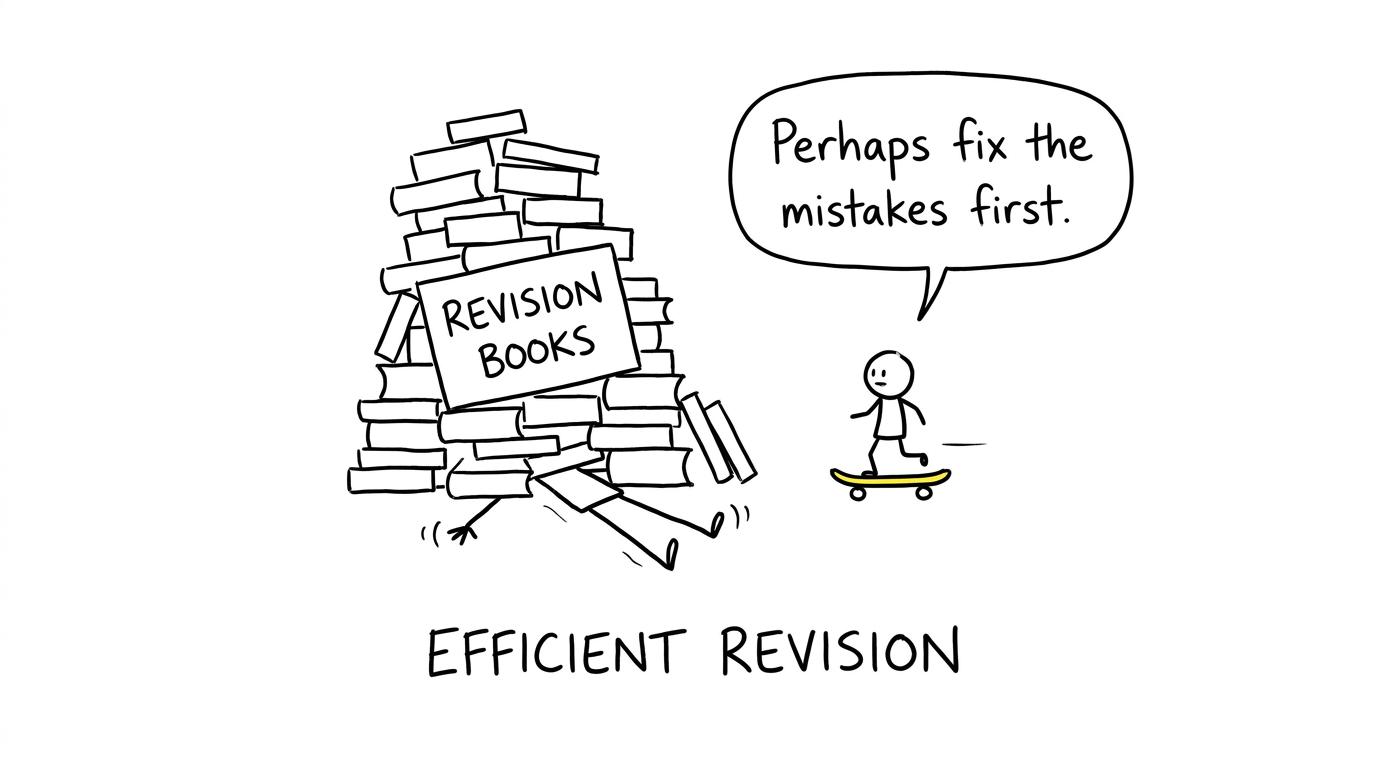 A mark scheme glides past an unnecessary mountain of books
Day three: rehearse, review and then stop
The final day should make the exam feel familiar, not leave you exhausted.
Complete one realistic rehearsal
Use either a full paper or a carefully chosen long section. Match the real conditions: calculator status, timing, no notes and no pauses. If your next AQA paper is Paper 1, practising with a calculator would hide precisely the fluency you need to test.
When marking, focus on patterns rather than chasing a comforting total. Ask:
- Which question types did I fail to start?
- Where did I lose signs or mishandle algebra?
- Did I state conclusions clearly in proof or geometry?
- Did I show enough intermediate working?
- Which two reminders belong at the top of my final checklist?
For more guidance on making papers useful, read when and how to use GCSE past papers. Even at this late stage, reviewing one paper properly is more valuable than rushing through several without correction.
Use the afternoon for light consolidation
Redo a small number of questions from your error log without looking at the previous solution. Refresh definitions, notation and formulae that your specification expects you to use. Do not begin an enormous new topic unless your diagnostic evidence shows it offers unusually accessible marks.
You can place these final sessions into the free MathsGenie revision planner, but keep the schedule realistic. A plan should remove decisions, not create another task to perfect.
Prepare for the room, not just the questions
Check the instructions on your paper and follow your school’s exam guidance. For a calculator paper, make sure your permitted calculator works, clear stored information as required and remove any cover containing printed instructions or formulae. Phones and internet-connected devices are not calculators for exam purposes.
Pack pens and any required geometrical equipment. Confirm the time and location, set an alarm and finish revision at a sensible point. The final hour of frantic rereading can feel productive because it is intense. Intensity and usefulness are not the same thing.
 A well-rested calculator prepares for exam day
Common last-minute Further Maths mistakes
Revising the wrong specification
AQA Level 2 Further Mathematics and OCR Level 3 FSMQ Additional Mathematics are not interchangeable. Confirm the qualification before selecting papers or topic lists.
Watching without practising
A clear video can create recognition without independent recall. Close it and answer questions. If you cannot reproduce the method, the topic is not yet secure.
Completing papers without reviewing them
A paper diagnoses weaknesses; the review repairs them. Always reserve time for the mark scheme, corrections and at least one retry.
Giving every topic equal time
Three days demands triage. Prioritise recurring weaknesses and methods that support several topics. Maintain stronger areas briefly rather than repeatedly proving that you can already do them.
Hiding working
An incorrect final answer may still contain valid method. Write substitutions, algebraic steps, matrix operations and logical conclusions clearly enough to be assessed.
Letting one question consume the paper
Difficulty is not an instruction to remain still. Leave space, move on and return. A calm first pass protects accessible marks.
Three days can still be used well
The purpose of this plan is not to pretend that time is unlimited. It is to make limited time behave better.
Diagnose on day one. Repair on day two. Rehearse and recover on day three. Keep your error log short, your practice active and your resources matched to the exact qualification.
Begin now with MathsGenie’s free AQA GCSE Further Maths revision resources. Use the revision lessons to refresh methods, practise with exam questions, learn from mark schemes and video solutions, and test yourself with past papers. Where suitable resources are available, predicted papers and mini tests can provide additional practice, but official papers and your own marked mistakes should guide the plan.
You do not need to feel completely ready before taking the next useful step. Open one paper, set the timer and find the first mark you can protect.