

How to Get Grade 9 GCSE Arabic
How to get grade 9 GCSE Arabic: improve listening, speaking, reading and writing through focused revision, feedback and realistic exam practice.
A student can know a great deal of Arabic and still leave marks behind. Sometimes the listening recording moves too quickly. Sometimes a carefully memorised speaking answer does not fit the question. Sometimes an ambitious piece of writing is weakened by avoidable errors.
The answer to how to get grade 9 GCSE Arabic is not simply to learn more words. You need to perform strongly across listening, speaking, reading and writing, practise at Higher tier, understand what the mark schemes reward and repair recurring weaknesses. Grade 9 preparation is less about occasional heroic revision and more about a calm cycle: attempt, mark, diagnose, improve and repeat.
This guide focuses on the habits and revision changes most likely to move a capable student towards the top grade.
Your grade 9 GCSE Arabic checklist
Use this as a quick overview of the strategy:
- Confirm your exact qualification, specification and tier.
- Revise all four skills every week.
- Build vocabulary by theme and retrieve it from memory.
- Practise manipulating grammar rather than memorising whole scripts.
- Record speaking answers and respond to unpredictable questions.
- Complete Higher-tier tasks under timed, closed-book conditions.
- Mark work against the official assessment criteria.
- Keep an error log and revisit mistakes within a few days.
- Protect sleep and consistency instead of relying on last-minute cramming.
A grade 9 is only available through Higher tier in the current Pearson Edexcel GCSE Arabic qualification. If you are unsure about your entry, ask your teacher before building your revision plan.
Know the GCSE Arabic exam you are preparing for
In England, the current GCSE Arabic qualification is offered by Pearson Edexcel under specification 1AA01\text{AA}01AA0. Do not assume that an AQA, OCR or Eduqas language format applies to Arabic. You should also check that you are taking GCSE Arabic rather than International GCSE Arabic, because the assessments are different.
Pearson Edexcel GCSE Arabic has four compulsory papers:
- listening and understanding;
- speaking;
- reading and understanding;
- writing.
Each skill contributes 25%25\%25% of the qualification. Students must enter the same tier for every paper, and dictionaries are not permitted. At Higher tier, listening lasts 454545 minutes including reading time, speaking lasts between 101010 and 121212 minutes after 121212 minutes of preparation, reading lasts 111 hour 555 minutes, and writing lasts 111 hour 252525 minutes.
The equal weighting matters. A student who enjoys writing cannot afford to neglect listening, while a fluent speaker still needs accurate reading and translation skills. Grade 9 preparation must be balanced.
Published boundaries can provide context, but they are not permanent targets. For example, the June 202520252025 Higher-tier grade 9 boundary was 237237237 out of 280280280. Boundaries change between exam series, so use the GCSE Arabic grade boundaries to understand previous outcomes rather than trying to predict the mark required in your own year.
Build a revision system, not a collection of notes
The difference between passive and active revision can look small from the outside. In both cases, a student may sit at a desk for an hour. But one student rereads vocabulary; the other closes the book and tries to retrieve it. One highlights a model answer; the other writes an answer, checks it and rewrites the weakest section.
Only the second approach produces useful evidence.
A productive weekly cycle is:
- Learn: review one grammar feature or vocabulary group.
- Retrieve: recall it without notes.
- Apply: use it in listening, speaking, reading or writing.
- Check: compare your response with a mark scheme or teacher feedback.
- Repair: correct the precise weakness.
- Retest: attempt a similar task later without support.
The same disciplined pattern underpins MathsGenie's short GCSE revision routine. Although the questions there are mathematical, the habit transfers directly: choose one narrow target, practise actively and finish by recording what needs attention next.
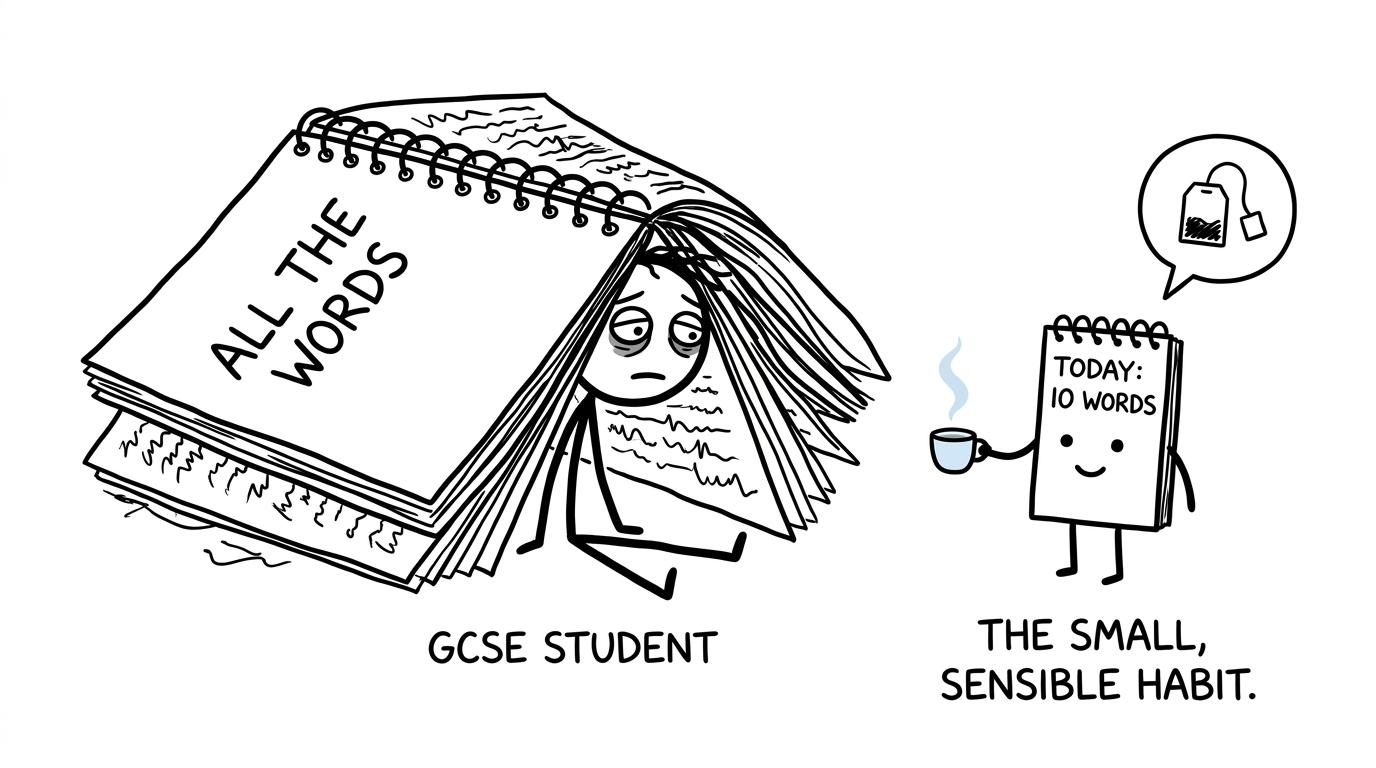 A small daily vocabulary notebook calmly defeats an enormous pile of unfocused revision
Use the free MathsGenie revision planner to protect regular revision slots across your subjects. Arabic benefits from frequent contact, so four shorter sessions are usually more useful than leaving all your work until one long weekend block.
Change how you learn Arabic vocabulary
Vocabulary lists are necessary, but recognising a word on a page is not the same as recalling it during an exam.
Organise vocabulary around the specification themes, including identity and culture, local area and travel, school, future study and work, and international or global issues. Within each theme, learn useful language in connected groups:
- nouns with relevant adjectives;
- verbs with common subjects and time frames;
- opinion phrases with reasons;
- connectives that extend an answer;
- contrasting language for balanced arguments.
Test both directions. Seeing an Arabic word and remembering its English meaning supports comprehension, but writing or saying Arabic from an English prompt develops productive recall. Grade 9 performance needs both.
Do not remove difficult words from your practice because they feel uncomfortable. Give them more frequent retrieval. A word that repeatedly escapes is showing you exactly where revision is needed.
Improve listening through deliberate replay
Listening does not improve much when Arabic merely plays in the background. Effective listening practice is deliberate.
First, attempt an exam extract without pausing and answer under normal conditions. Then replay it to identify why marks were lost. Was the problem unknown vocabulary, speed, a negative expression, a change of opinion or confusion over who performed an action?
Create a short listening log with three details:
- the phrase you misheard;
- what you thought it meant;
- the clue that reveals the correct meaning.
Listen for meaning rather than trying to translate every word. Before the recording starts, use the reading time to inspect the questions and predict the information required, such as a reason, place, opinion or time reference. This gives your attention somewhere useful to go.
Make speaking flexible rather than memorised
A polished script can feel safe. The problem is that the speaking assessment rewards communication, interaction, spontaneity and linguistic accuracy. An answer that only works when the expected question appears is fragile.
Build adaptable response frameworks instead. Practise giving:
- an opinion;
- a developed reason;
- a past or future reference;
- a comparison;
- a response to an unexpected follow-up.
Record yourself regularly. Listen for clarity, hesitation, pronunciation, agreement and whether your answer actually addresses the question. Then answer the same prompt again without reading.
Ask a teacher, classmate or family member to vary the order and wording of familiar questions. The aim is not to sound rehearsed. It is to remain accurate when the conversation stops following your plan.
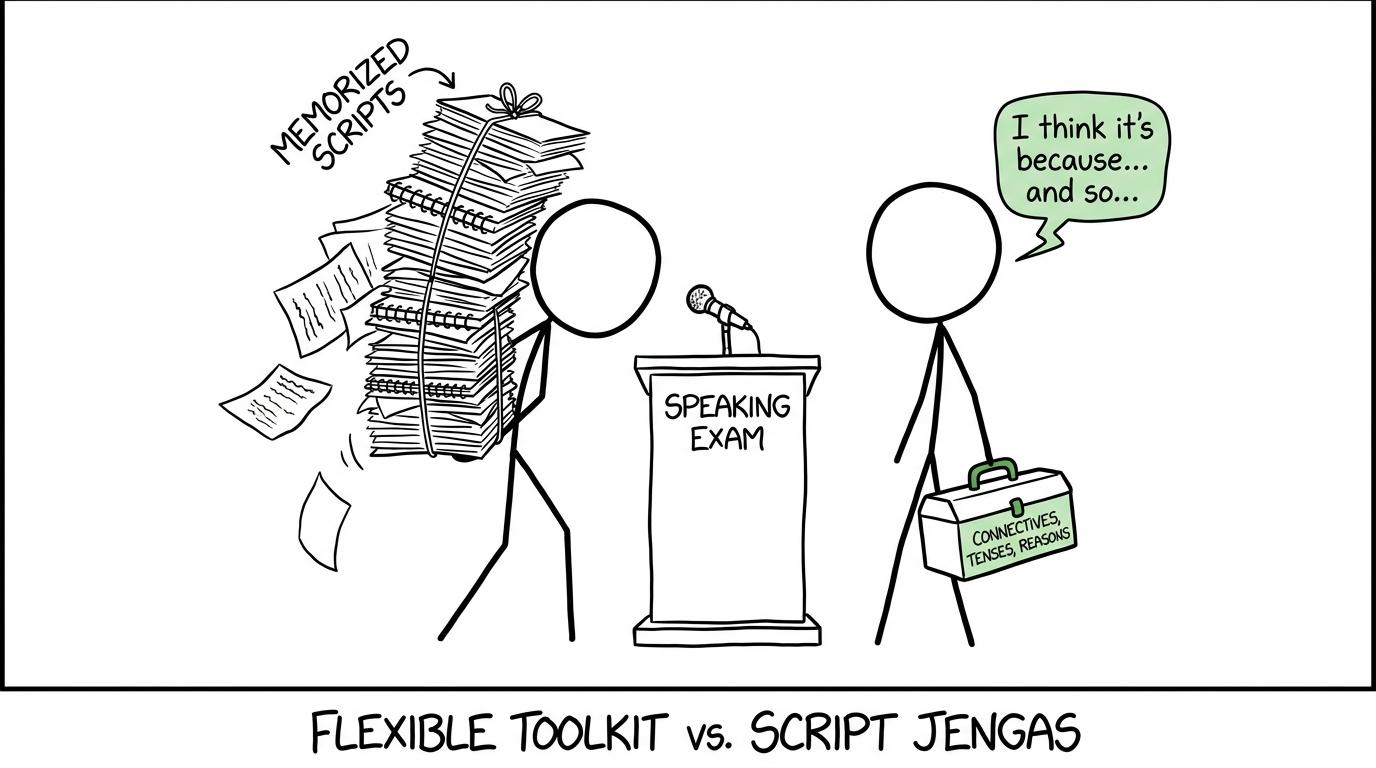 A flexible speaking toolkit proves more useful than a collapsing tower of memorised scripts
Turn reading into an evidence-finding skill
Higher-tier reading texts may include opinions, implicit meaning and unfamiliar language. You do not need to understand every word to earn the marks.
Read the question carefully before searching the passage. Identify whether it asks for a fact, reason, attitude or conclusion. Then locate evidence and check details such as negatives, pronouns, time markers and contrasting connectives.
When an unfamiliar word appears, use its surrounding sentence, word family and grammatical role. Do not let one missing word persuade you that the entire paragraph is inaccessible.
Translation into English should preserve meaning rather than copy Arabic structures mechanically. After translating, read the English sentence naturally and ask whether any idea, tense or negative has disappeared.
Write for the task and the mark scheme
Grade 9 writing is not a competition to include the longest words. It is controlled communication using varied vocabulary and grammar with a high level of accuracy.
Before writing, turn every bullet point into a small checklist. Missing part of the task can limit the value of an otherwise impressive response. Plan which time frames, opinions, reasons and complex structures fit naturally, then leave time to check.
Your final review should focus on recurring risks:
- agreement;
- verb forms and tense consistency;
- spelling and letter formation;
- pronouns;
- connectives;
- omitted bullet points;
- sentences copied from a memorised answer that do not fit the question.
Mark schemes should become part of revision, not something seen after a mock. The process described in MathsGenie's guide to using GCSE mark schemes effectively is valuable across subjects: identify the assessment criterion, locate evidence in your response and rewrite what failed to meet it.
Use past papers as diagnostic tests
Past papers reveal whether your knowledge survives timing, unfamiliar wording and exam pressure. But completing many papers without reviewing them can simply rehearse the same mistakes.
Use this cycle:
- attempt the correct Higher-tier paper under realistic conditions;
- mark it strictly using the official mark scheme;
- classify every lost mark;
- select the three most costly weaknesses;
- complete targeted practice;
- retry the relevant questions without notes.
The principle is explored further in MathsGenie's guide to using past papers properly. For Arabic, obtain the official papers and audio from your school or Pearson's qualification materials. Save some unseen material for genuine timed practice near the examination.
Keep a precise grade 9 error log
An error log should not say, “I am bad at listening” or “careless mistake”. Those labels do not tell you what to do next.
Write specific diagnoses such as:
- missed a negative expression;
- confused past and present reference;
- answered a different speaking question;
- omitted one writing bullet point;
- translated the general idea but lost a key detail;
- used ambitious grammar inaccurately.
Add a repair action beside each entry. Then revisit the same skill after a short delay. An error is useful only if it changes your next attempt.
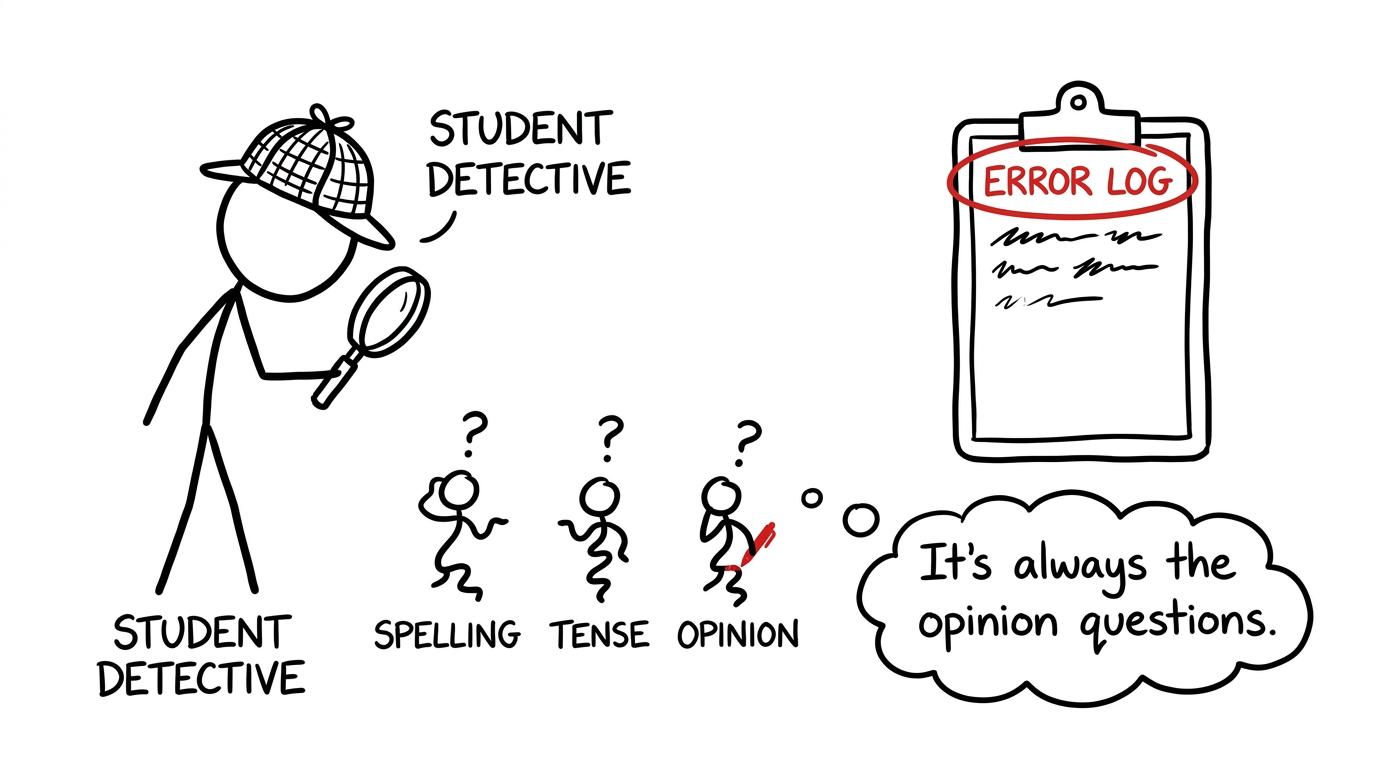 A revision detective tracks down escaped marks using a precise error log
Common mistakes that block a grade 9
Revising only the strongest skill
Because each paper contributes 25%25\%25%, avoiding a weaker skill creates a serious ceiling. Give extra sessions to the weakest area while maintaining the others.
Memorising answers word for word
Memorised material can support vocabulary and structure, but complete scripts often fail when the question changes. Practise recombining language in unfamiliar contexts.
Using difficult grammar without control
Complexity helps only when meaning remains clear. Build from accurate core structures, then add variety deliberately.
Counting papers instead of fixing them
A completed paper is not automatically progress. The improvement happens during marking, diagnosis and reattempting.
Treating previous boundaries as promises
Grade boundaries vary. Aim to maximise marks across the complete specification rather than revising towards one historic threshold.
Neglecting other GCSE subjects
Arabic revision has to fit inside a wider timetable. MathsGenie can take much of the friction out of your maths preparation through the free GCSE Maths revision hub, while Edexcel predicted maths papers and mark schemes provide structured exam practice. That leaves you with a clearer plan for balancing Arabic, maths and your remaining subjects.
Make consistency your final advantage
Grade 9 GCSE Arabic is built in ordinary sessions: retrieving vocabulary when you would rather reread it, recording one more spontaneous answer, examining why a listening mark disappeared and rewriting a response after feedback.
Start with one honest Higher-tier task. Mark it, identify three marks leaks and schedule the repairs. Then repeat the process across all four skills.
For the rest of your GCSE timetable, use MathsGenie's free revision lessons, practice questions, mini tests, past papers, predicted papers, mark schemes and video solutions. A strong grade does not come from doing everything at once. It comes from knowing what needs to improve next, and returning to do it.










