

How to Get Grade 8 GCSE Economics
How to get grade 8 GCSE Economics with active recall, sharper evaluation, data skills, past-paper practice and a practical revision routine that works.
A student can know every definition in the textbook and still feel strangely exposed when an extended-response question appears. The problem is rarely effort. It is that GCSE Economics rewards more than remembering content.
If you are wondering how to get grade 8 GCSE Economics, the short answer is this: master the specification, retrieve knowledge without notes, apply it precisely to the context, build connected analysis and make supported judgements. Then practise those skills under timed conditions.
A grade 888 is not secured by chasing a fixed percentage. Grade boundaries change each year to reflect the difficulty of the papers. What you can control is the quality and consistency of your answers.
Your grade 8 checklist
A strong revision system should help you:
- know exactly what your exam board assesses
- recall accurate definitions without prompts
- connect causes, consequences and stakeholders
- use the question's context throughout an answer
- interpret calculations, graphs and economic data
- evaluate by weighing factors rather than listing drawbacks
- complete timed past-paper questions
- record, correct and revisit lost marks
The important shift is from measuring revision in hours to measuring it in improved decisions. Did you identify the right concept? Did you use the data? Did your conclusion answer the precise question? Those are the habits that move marks.
Start with your specification, not your textbook
Revision becomes much easier when the boundary of the course is clear. Find your exam board and turn every specification statement into a checklist. MathsGenie provides topic-by-topic AQA GCSE Economics revision guides and OCR GCSE Economics revision guides, so you can revise content that matches the qualification rather than collecting disconnected notes.
Paper structures differ between boards. Under the current specifications, AQA assesses two 808080-mark papers lasting 111 hour 454545 minutes each, while OCR uses two 808080-mark papers lasting 111 hour 303030 minutes each. Always check the specification and instructions for the qualification you are actually taking.
For both AQA and OCR, the overall assessment-objective weighting is:
| Skill | Overall weighting |
|---|---|
| Knowledge and understanding | 35%35\%35% |
| Application to context | 35%35\%35% |
| Analysis and evaluation | 30%30\%30% |
That balance explains why memorising definitions is necessary but insufficient. Almost two-thirds of the marks reward what you do with your knowledge.
Replace rereading with active recall
Rereading often feels productive because familiar sentences become easier to recognise. Recognition, however, is not the same as recall. In an exam, the page is gone.
After revising a topic, close your notes and retrieve:
- the central definitions
- the relevant diagram and its labels
- two causes and two consequences
- affected stakeholders
- one limitation or condition affecting the outcome
- any required formulae
Then compare your attempt with the revision guide. Gaps discovered during retrieval are useful. They show you what to fix before the exam does.
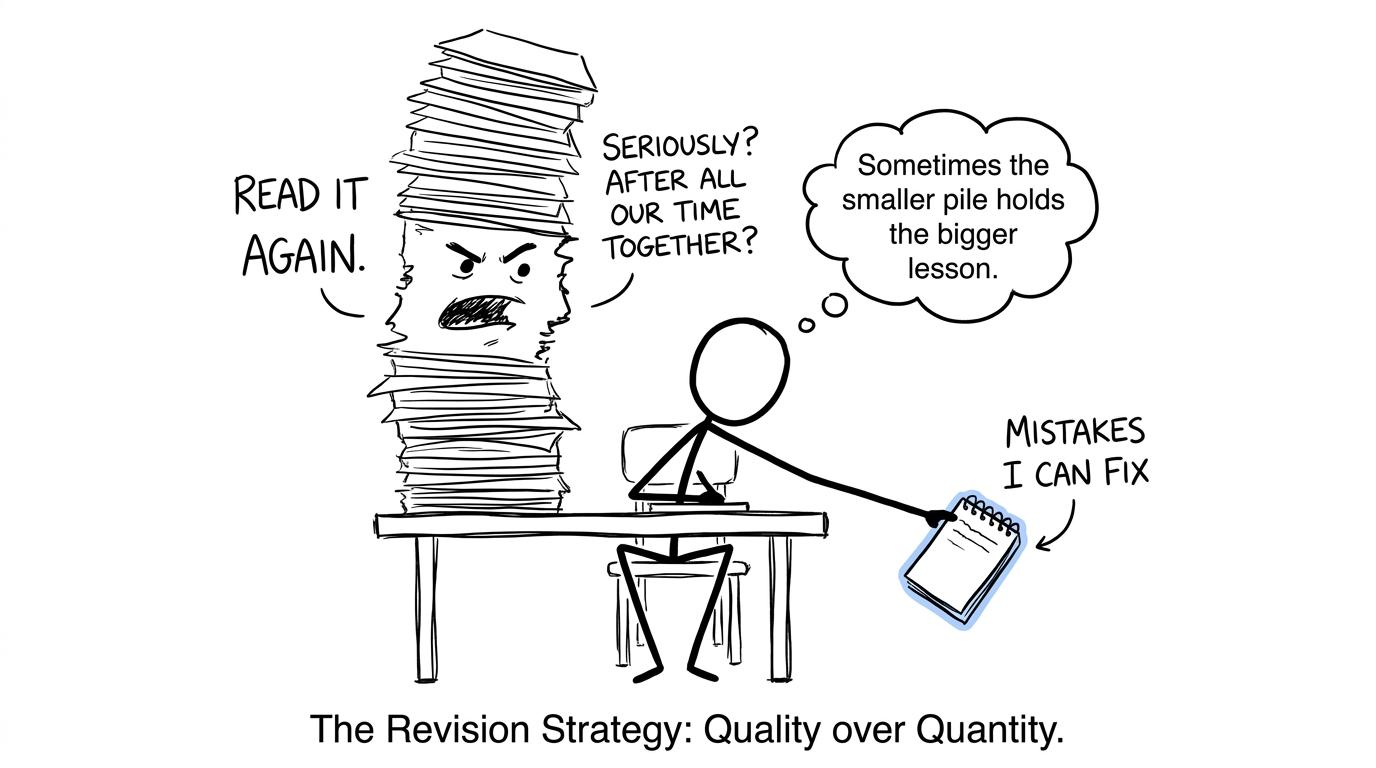 A student chooses a useful mistake notebook instead of another mountain of rereading
Keep retrieval sessions short and repeated. Revisiting a topic after a gap forces the brain to reconstruct it. That effort is the point. A neat page produced once may look impressive; knowledge retrieved repeatedly is more likely to remain available under pressure.
Build answers around the assessment objectives
Grade 888 answers tend to combine knowledge, application, analysis and evaluation rather than treating them as separate boxes.
Make definitions exact
Economic language is precise. Demand is not simply wanting something; it concerns consumers being willing and able to buy at different prices over a period. Supply and quantity supplied are not interchangeable. Inflation is not merely a high price; it is a sustained rise in the general price level.
Use your specification's wording, then explain it naturally. The AQA supply revision guide is useful for separating a movement along a curve from a shift of the curve, a distinction that often changes the whole argument.
Apply every argument to the context
Application means more than copying the name of a business or country from the extract. Use a contextual detail to change or support your reasoning.
Ask:
- What type of market, consumer or producer is involved?
- Which figure from the data is relevant?
- Is the change large, small, temporary or persistent?
- Which stakeholder is most exposed?
A sentence becomes applied when the context does real work. Specific evidence should help explain why an effect is likely, not sit inside brackets as decoration.
Develop chains of analysis
An analytical chain links an initial change to its likely consequences. A useful internal structure is:
change →\rightarrow→ incentive or behaviour →\rightarrow→ economic outcome →\rightarrow→ stakeholder effect
Each arrow needs an explanation. Do not leap from a tax change directly to economic growth without explaining spending, costs, demand, investment or incentives in between.
The role of money and financial markets guide shows how interest rates connect to saving, borrowing, consumption and investment. Revision should focus on those relationships, not isolated vocabulary.
Evaluate by identifying what the answer depends on
Evaluation is not adding “however” to the final paragraph. It means testing the strength of an argument.
Useful evaluative questions include:
- How large is the change?
- How quickly will people respond?
- Is the effect different in the short run and long run?
- Which stakeholder gains and which loses?
- Does the policy create an unintended consequence?
- Is another factor more important?
- Is the evidence sufficient to justify the conclusion?
For policy questions, the misallocation of resources revision guide can help you compare market outcomes with the possible benefits and limitations of government intervention.
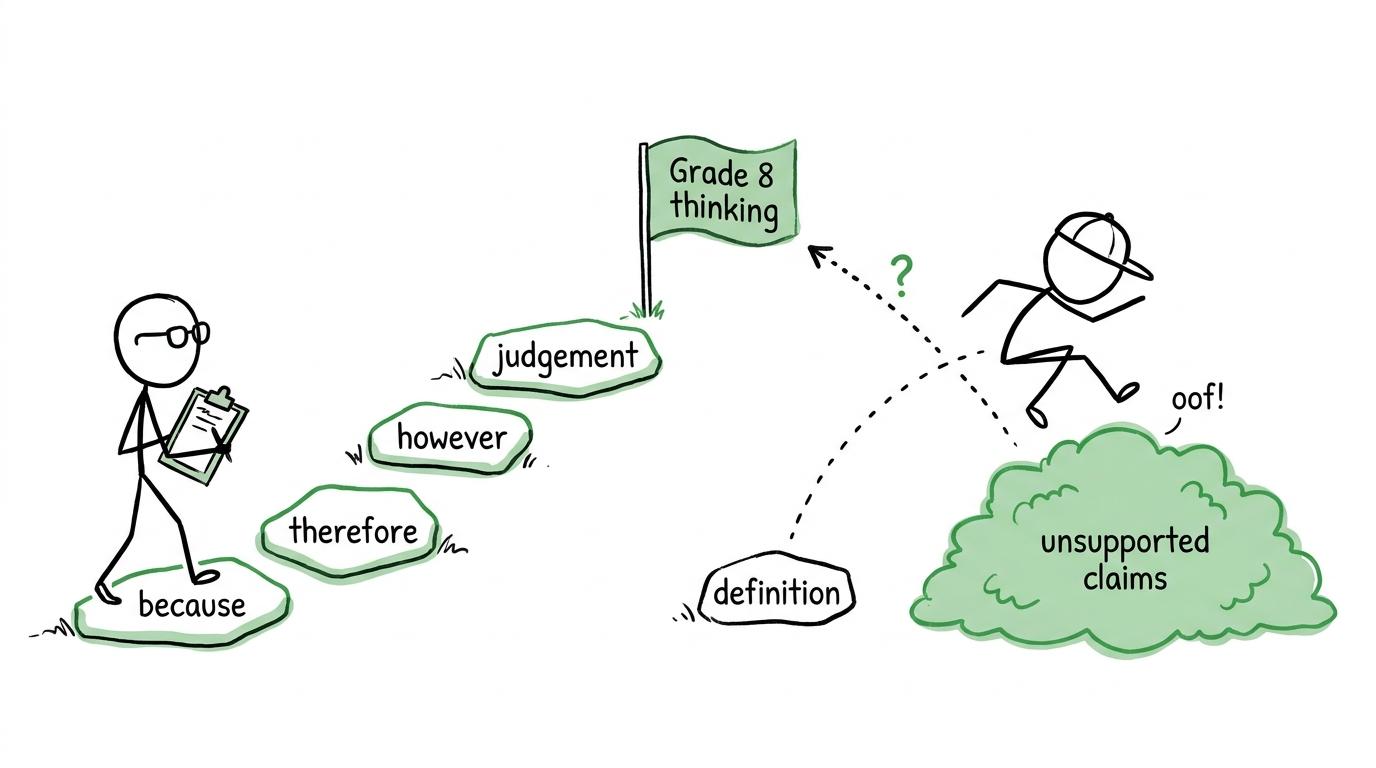 An examiner follows the reasoning steps while a student tries to jump straight to the judgement
Turn maths skills into economic marks
Current AQA and OCR specifications allocate at least 10%10\%10% of the qualification marks to quantitative skills. These may involve percentages, percentage change, averages, costs, revenue, profit, interest, graphs and data interpretation.
Key relationships include:
Percentage change=new value−original valueoriginal value×100%\text{Percentage change}=\frac{\text{new value}-\text{original value}}{\text{original value}}\times 100\%Percentage change=original valuenew value−original value×100% Total revenue=price×quantity\text{Total revenue}=\text{price}\times\text{quantity}Total revenue=price×quantity Profit=total revenue−total cost\text{Profit}=\text{total revenue}-\text{total cost}Profit=total revenue−total cost Average cost=total costquantity produced\text{Average cost}=\frac{\text{total cost}}{\text{quantity produced}}Average cost=quantity producedtotal costThe calculation is only the first layer. A high-quality answer also interprets what the result means for a consumer, producer, worker or government. The AQA quantitative skills guide covers economic calculations and data use, while the OCR calculations revision guide provides board-specific support.
Show the formula, substitution, units and final result. Then perform a sense check. A positive profit requires revenue to exceed cost, and percentage change uses the original value as its denominator.
Use past papers as a feedback system
Past papers are most valuable when they change what you do next. Completing paper after paper without reviewing errors can simply rehearse the same weaknesses.
Use this cycle:
- answer a timed question without notes
- mark it carefully using the official mark scheme
- identify the exact reason for every lost mark
- revise the smallest relevant content gap
- rewrite or reattempt the question
- test the same skill again several days later
MathsGenie's OCR GCSE Economics past papers place papers and mark schemes together, making this process easier to repeat.
Do not memorise one model answer. Mark schemes indicate acceptable content, but extended responses are judged against levels and assessment objectives. Instead, study what the mark scheme rewards: accurate knowledge, contextual application, developed reasoning and justified evaluation.
 A student discovers that the data in an exam extract is evidence rather than decoration
Follow a weekly grade 8 revision routine
A manageable routine is more dependable than occasional heroic sessions.
| Session | Main purpose |
|---|---|
| First session | Retrieve one microeconomic topic and complete focused questions |
| Second session | Retrieve one macroeconomic topic and connect it to policy |
| Third session | Practise calculations, graphs and data interpretation |
| Fourth session | Complete one timed extended-response question |
| Weekend | Complete a paper section, mark it and repair the main weaknesses |
Keep a marks-leak log with four columns: topic, mistake, reason and next action. Classify mistakes honestly. A content gap needs relearning; weak application needs closer use of the extract; an undeveloped chain needs more explanation; a timing problem needs timed practice.
If you are also preparing for GCSE maths, MathsGenie's GCSE predicted papers can strengthen the percentage, graph and data fluency that supports Economics. Predicted papers should complement specification coverage and past papers, never replace them.
Common mistakes that hold students below grade 8
Writing everything known about the topic
Relevance earns marks. Before writing, underline the command word, topic, context and required judgement. An accurate paragraph can still be weak if it answers a different question.
Using context only once
Application should run through the argument. Return to the extract, figures and named stakeholders whenever they strengthen a link.
Producing disconnected chains
Words such as “therefore” cannot repair a missing explanation. State why one step causes the next.
Giving balanced but unsupported conclusions
A conclusion should choose an answer and justify it using the strongest analysis. Explain the condition that could change your judgement.
Ignoring units and diagram labels
Label axes, curves and equilibrium points clearly. In calculations, retain currency, percentage or per-unit labels and avoid premature rounding.
Revising only comfortable topics
Confidence can disguise repetition. Let retrieval tests, marked answers and past papers decide what deserves the next revision session.
Make the next session count
Getting a grade 888 in GCSE Economics is less about discovering a secret technique and more about tightening a small set of habits. Learn the right content. Retrieve it. Apply it. Explain each link. Test the conclusion. Use evidence. Then let marked practice show you where the next improvement lies.
Start with the MathsGenie revision guide for your exam board, complete focused practice questions and move into timed past papers with mark schemes. Use video solutions, mini tests and predicted papers where available to support the wider revision process. One carefully corrected answer is not dramatic, but repeated over time, it is how grade 888 performance is built.











